After decades of staying quiet, I stepped into the streets. What I discovered surprised me: protesting isn’t just a political act—it’s a personal practice that builds resilience, awareness, and a sense of belonging.
Like running, protesting requires practice, discipline, and belief that your effort matters—even when you feel alone.
After joining six protests over the past two months, the experience finally started to feel familiar. I began to understand what it was all about. There’s a reason, a rhythm, and even a reward to protesting that I hadn’t grasped before. Still, something instinctual pushed me into it—more impulse than logic.
Protesting doesn’t come naturally. In everyday life, when things are relatively calm, most of us try not to rock the boat. We avoid confrontation, sidestep discomfort. We’re taught to “suck it up” and “don’t be a complainer.” After all, there’s always someone worse off, right? And then there’s the risk—stirring the pot can bring consequences, especially from those who’d rather you simply “behave.” At my age—77—I could easily ask, who needs the trouble?
But what do you do when logic, reason, and normality seem to vanish? Do you just complain? Do you tune out? Seek comfort from friends? That’s where protesting comes in—not just as a solution, but as a kind of therapy.
Fifty years ago, before fitness was even trendy, I took up running as a personal challenge. Back then, adult recreational running was unusual. But as marathons and Olympic athletes captured public attention, the idea caught on. We began to believe that even the average person could strive for something great—even if the race was personal.
Running took a leap of faith. It demanded hard physical work, but promised positive results—mental clarity, health, confidence. It was lonely at first, with little guidance and few role models. But it became a habit. And eventually, the world caught up. Running went from fringe to mainstream.
Now, since January 20th, I’ve taken up a new “sport”: protesting. Frustrated with the state of the nation and the new administration, I turned to activism not just as civic duty—but for my own mental fitness. And like running, protesting requires practice, resilience, and a belief that effort matters.
First, it takes mental toughness to shake off apathy. You need to believe that one person can make a difference—especially when standing with others. And yes, there’s a kind of performance involved. Maybe you’re just holding a sign in silence. Maybe you’re shouting chants or singing satirical songs about a congressman or the president. It can feel awkward or corny at times. But it can also feel exactly right—like you’re doing what needs to be done. Like you’re part of something larger, and your voice is finally being heard.
There’s power in simply showing up. A sign in hand can be the first step toward change.
So, I’ve come to believe we must train ourselves—just like athletes—to overcome political passivity. With every new day of shock and awe, we grow stronger, more aware, more ready to push back. Protesting may not fix everything, but it sends a clear message: we will not sit quietly and watch democracy fade.
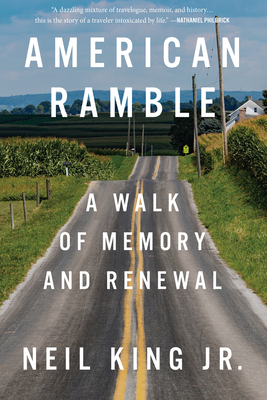
A great book on a 2021 solo walk from Washington DC to NYC. King unearth’s the past with the present in his personal journey.
The following is a review of a 2023 book by Neil King, Jr, about his very personal solo walk from Washington DC to New York City in 2021. My son Justin gifted it to me after hearing Neil discussing it at a local talk. Thanks Justin!
It was a book that I related to very personally. I’ve done many long walks in past years and lately have changed most of my serious personal journeys to long bike rides.
But I have to admit the feel of pushing one’s self, even as I get older, is still alluring to me. And, the absolutely free feeling of being solo on a journey is an experience I will never forget. I love being back home with my family but I also love the wanderlust of being on the road.
-Paul
Neil King Jr. confronts aging, a personal battle with cancer, and the broader struggles of COVID-19 and political upheaval. In the midst of these challenges, he embarks on a long walk as an antidote to depression. This walk becomes a deeply focused endeavor, channeling his energy into researching, planning, and executing a journey through history to better understand the present state of the country.
King’s unique journey is more about the creation and leveraging of a personal challenge than the physical feat of walking 330 miles in 26 days. Though the route may appear to be a ramble (a walk for pleasure, typically without a definite goal), it is anything but aimless. King meticulously plans his route and accommodations, choosing interesting and often off-beat places with unique ties to America’s past. Equipped with a simple backpack, he immerses himself in the journey.
His walk from Washington, D.C., to New York City becomes a tapestry of American history, reminding us of Native Americans, revolutionary patriots, immigrants, slavery, and more recent events like 9/11 and the January 6th insurrection. The country has changed significantly, yet remnants of the past remain, often hidden in plain sight. King’s research brings these historical elements to life, allowing for a deeper understanding of our present.
However, King’s book is more than a historical sketch; it captures moments of interaction with the environment and people, making it special. It’s about contemplating how others live, recognizing our similarities and differences, and discovering more about oneself.
Back in 2010, I had a similar experience as I turned 60. While I did not face a health issue, I sought a deeper reflection on my life’s journey. Inspired by JFK’s fitness challenge (50-Mile Hike), I decided to walk 50 miles in one day, following the East Coast Greenway from Metropark in Edison, NJ, to New York City. This path, then a new concept in “pedestrianism,” connected communities for walkers, runners, and cyclists.
The newspapers picked up the story, and to my surprise, over 50 fellow walkers joined me. This overwhelming experience led to the founding of FreeWalkers, a group dedicated to long-distance walking. Today, http://Freewalkers.org has inspired thousands to experience places differently—city to country, historical to new, monuments to industrial waste, in all types of weather. Meeting fellow walkers and people along the way is as natural as walking itself and is a major reason walking has gained popularity. Some prefer the solitary walk King fondly describes, while others enjoy the group experience.
King encapsulates the essence of his journey: “My walk was, in reality, its own explanation. You embark on a long solitary stroll in part so as not to explain it. You go to cast aside distractions. You go for the fun of it, the promise of pure serendipity, and simply because you can….Possum ergo facio – I can, therefore I will.”
I applaud King for writing a book that describes the fascinating patchwork of people and places awaiting anyone who takes up the challenge of walking more than they think they can. His journey helps us appreciate the world around us, both past and present.
The above review was also published on Goodreads.com here.
Here’s how we became genealogical detectives in Poland as we hunted for clues to our family history.
If the word “Dragnet” means something to you, my guess is you remember Sargent Friday saying “Just the facts, ma’am.” on the old popular TV show. Or the 1960’s comedy movie version of that show with Dan Ackroyd and Tom Hanks. Either way it was about how detectives solved crime (mysteries). It seemed they had odd and funny ways of discovering facts when they interviewed suspects or witnesses.
Dragnet Theme
Now, we were on the ultimate dragnet for any clue to our family history. Facts mattered. Leads needed to be followed. We were on a missing persons investigation in Poland.
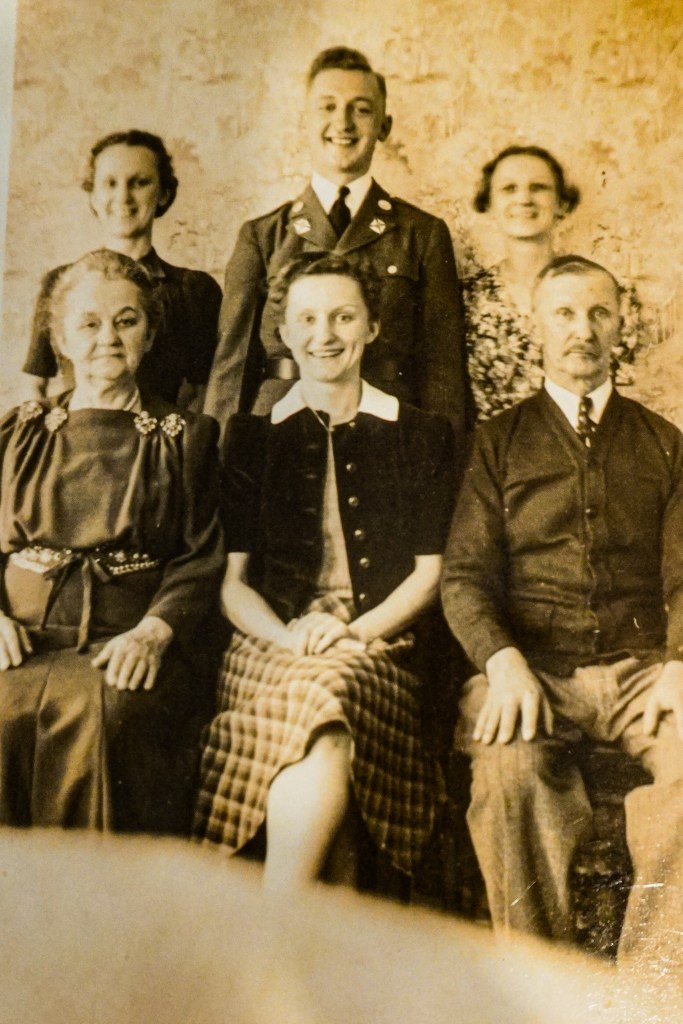
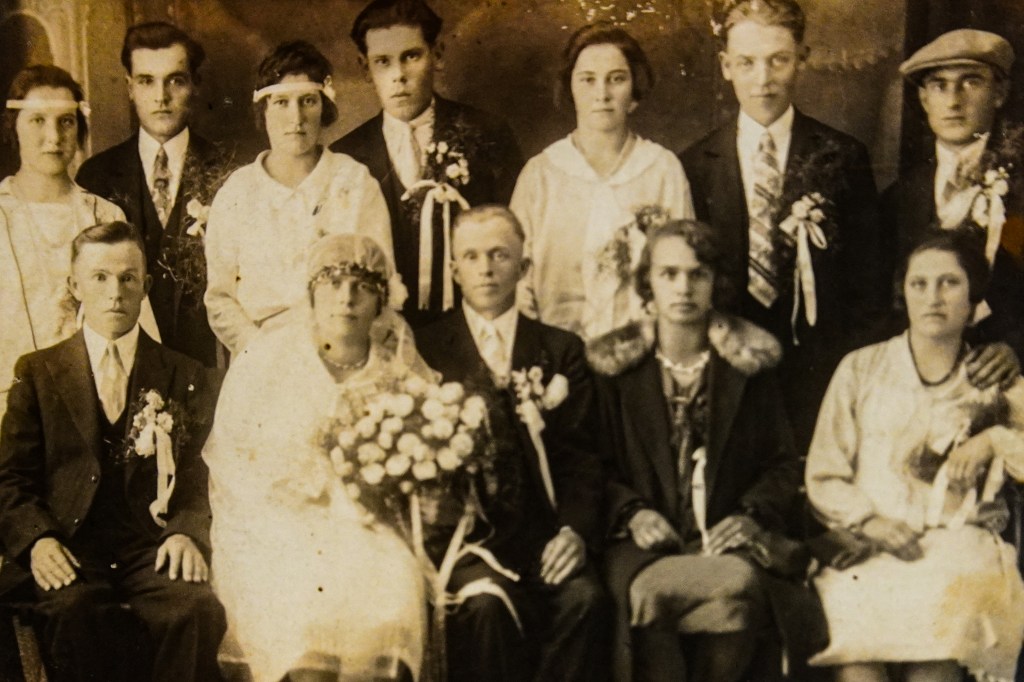
Near the top of my personal mysteries is how we got here. Ultimately, we all come from the same relatives. But the road that was taken by each of our ancestors made us who we are today. Sometimes, it was a voyage to leave their country and family. Other times it was to stay and make the most of the life they had, even if it was harsh at times. Whatever path was taken, family connections remained strong in most situations.
Where This Investigation Begins
About 10 years ago, Krystyna Onacki, a distant cousin from Poland discovered our Kiczek family. A Polish citizen at the time, she met and later married John Onacki a U.S. citizen when he was studying abroad in Poland. They moved to Roselle, N.J., coincidentally, the same town in which I grew up. Our family connection was through her mom who was a descendant of Josef Kiczek, my great grandfather.
Little did I know then that Josef had a second wife after his first passed away which created a second branch of the Kiczek family. Just 10 years ago, I had little knowledge of who my grandfather was, let alone my great grandfather. And, my parents and their siblings had passed away years before so it seemed we had no one left to ask, until Krystyna found us.
Large families were desirable back then to help work the land, provide financial support and to replace those children that would die young. For our side of the Kiczek family, my grandfather would immigrate to the U.S., and have nine children. My father’s siblings included one brother who became a priest and three sisters who would live their lives as cloistered nuns. To most Polish families this might have been the ultimate career choice and source of family pride. It was also seen as a way to increase their blessings by bringing the family closer to the Catholic Church.
Covid Creates a Time Warp
My oldest son, Ethan Kiczek, met the Onacki’s and understood the family connections better than I. Ethan has an engineering degree and has worked in technology his entire career, appreciating the complexity of large scale projects. In 2020, tied down by the pandemic and working remotely, he became absorbed in discovering more details about the family.
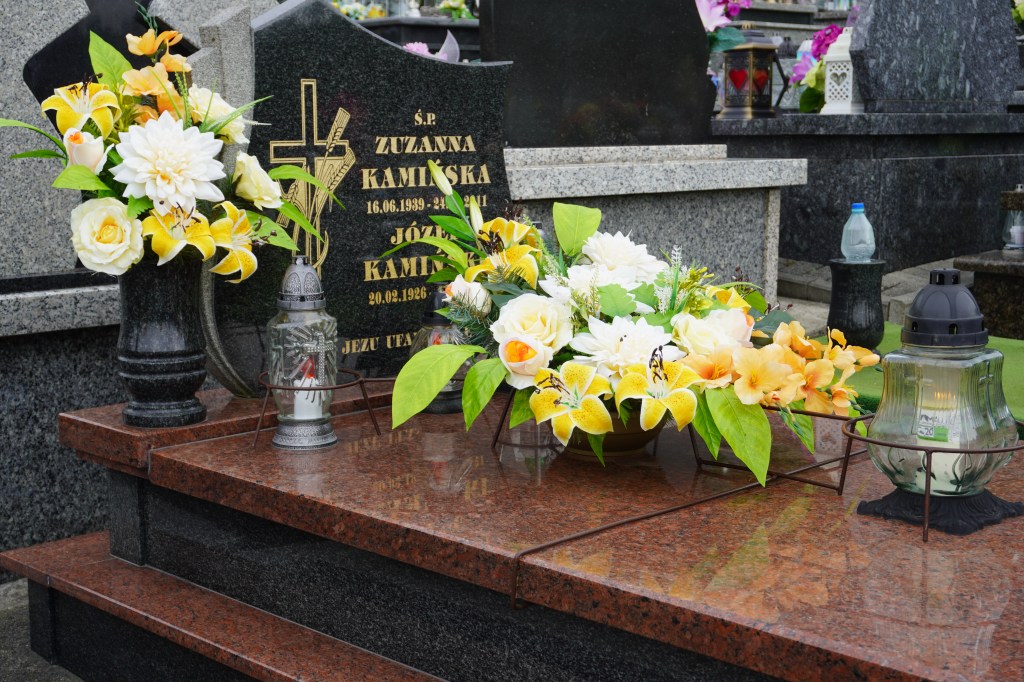
Often a search leads to a clue about another relative or the nature of a relationship. This usually needs to be verified. There’s digital sources, like ancestry.com and there are analog sources, like a town’s records of births, deaths and marriages or even finding tombstones.
While it’s possible that a birth record can appear as a digital image, more often than not it simply needs to be found in a physical registry of births, deaths and marriages. This is especially true for older records. In Poland. registry books are often located in the town where the family lived – or in the registry of the local church where they prayed. All this would take time and concentration, which with Covid, we all had plenty of.
Ethan searched a few databases like the Mormon’s FamilySearch and Facebook’s genealogy groups to discover what sources could help and how to get more information, if the data was not available online. This led to outsourcing a remote genealogical researcher in Poland, Lucjan Cichocki, who could actually go to local Polish towns to search registries to validate and discover family connections. Lucjan became our Sargent Friday. But, that led us to considering getting involved in this Polish dragnet too.
Going Back in Time
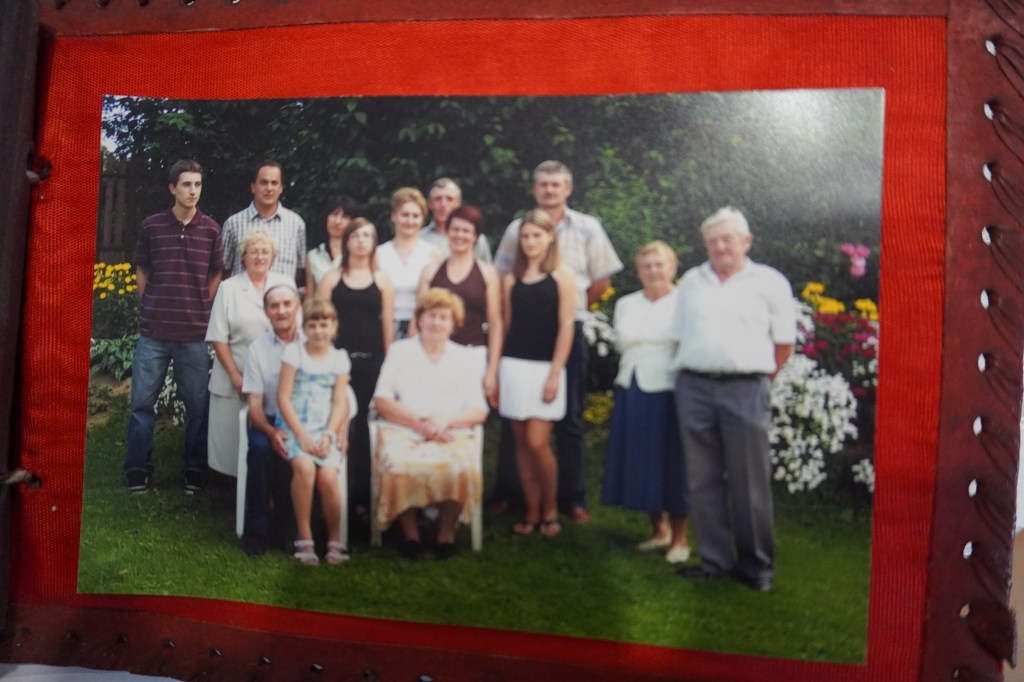
Ethan discovered, with the help of Lucjan, the towns where our family lived and even traced some ancestors to the 1700’s. But to dig deeper, we would need to view the registry records. Those records also state some other related information like the birth date, name of parents, religion and towns they came from. Ethan began to construct a large family tree that opened up our imagination as to who were our ancestors and how we were related.
PK’s Family Ancestors to Investigate
In 2022, we began to plan for a trip to Poland to discover our relatives – assuming we could find them and they would talk to us. But it was then that the Ukrainian-Russian war started. The area where our family was from was only about 50 miles from the Polish-Ukraine border. At that point we had no idea if the war would spill over to Poland. Poland’s borders have been moved often and the area we were planning on visiting was once even considered part of Ukraine. So, we postponed the trip for safety reasons. But the dragnet research continued.
Our Case History
Plans were set in late 2023 to visit the following year all the towns where my family seemed to have originated or once lived. Ethan’s mom, Judy’s (Dolac) mom had a clear connection to a town in the same region too. So, Ethan worked with a special touring company called PolishOrigins and created a custom tour that would take us to most places we had confirmed had a family connection. We hoped to visit those places, hopefully discover more connections and perhaps meet some relatives!
We spent four days investigating our ancestors in Poland, mixed with some interesting sightseeing along the way. Here’s a brief case history of what actually occurred during our investigation part of the trip:
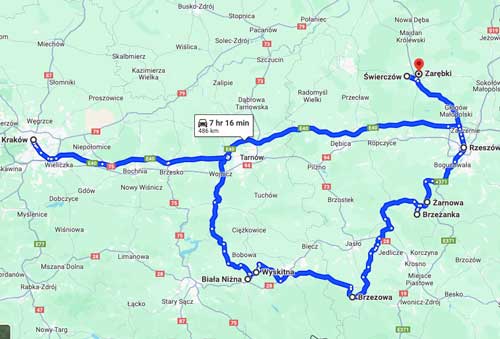
Our Ancestry Tour Route from Rzeszòw to Kraków
Tuesday, June 11, 2024
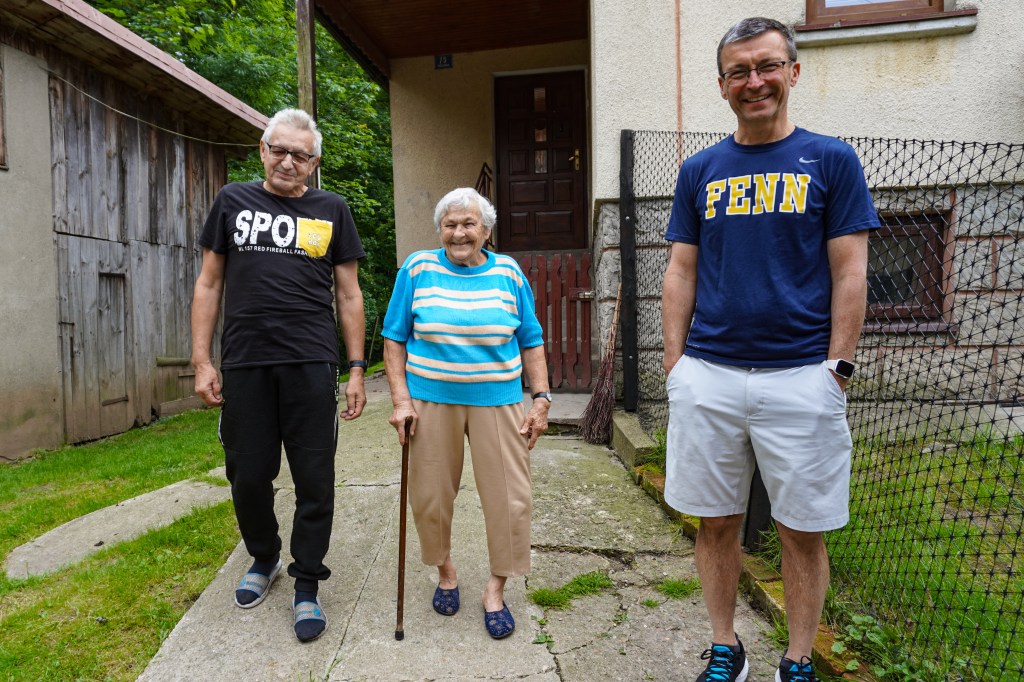
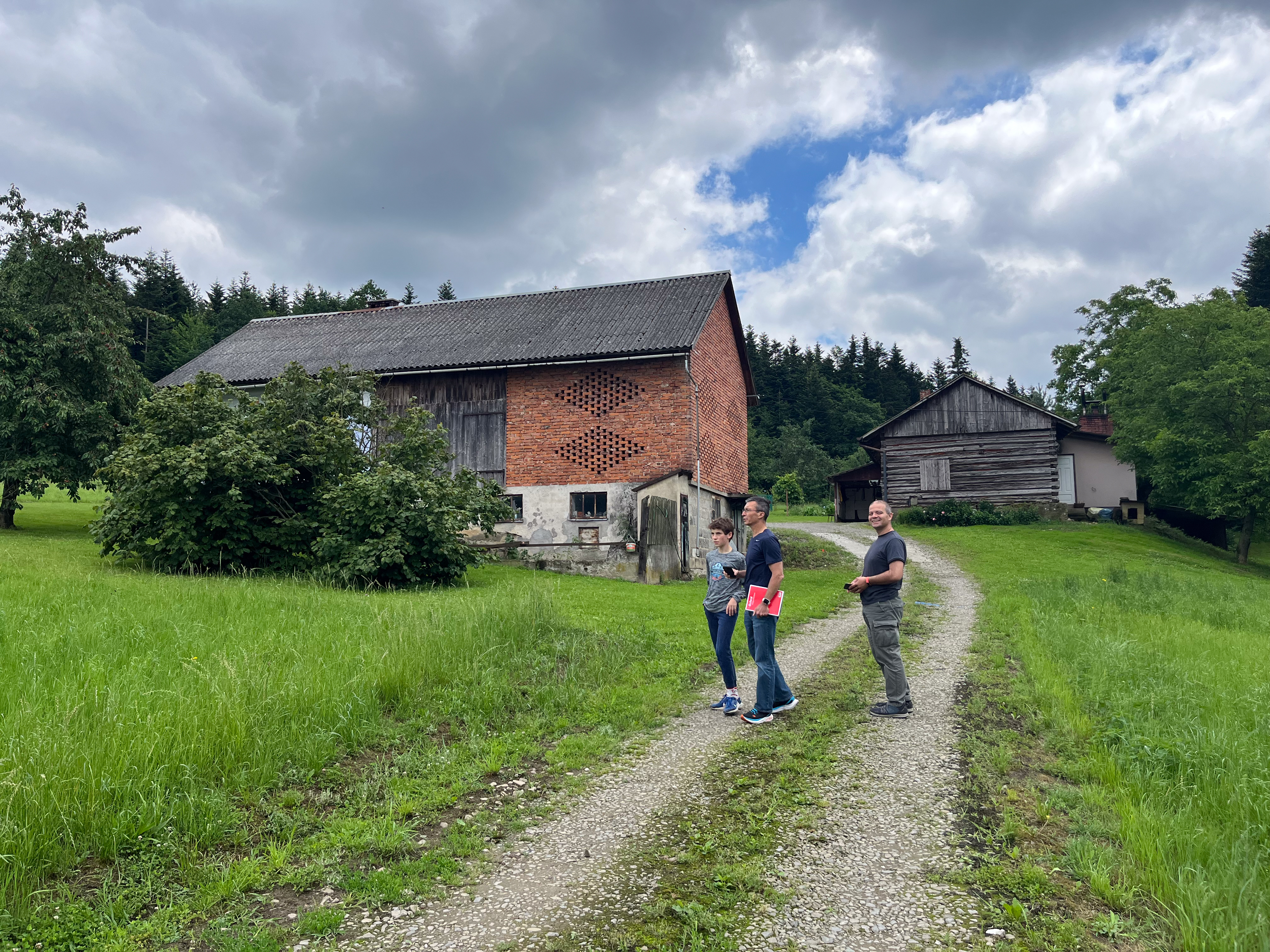
Świerczów – About 20 miles north of Rzeszów, our starting base, we sought family connections to the Stobierki’s (Ethan’s grandmother on his mother’s side). We had an address to go to from previous research. Found a distant cousin Halina Knipa and son Bartek. They share a great great grandfather Michal Stobierski with Ethan. We visited the town hall for records, the old family farm where his grandparents lived and a local cemetery. We exchanged emails for future follow-up. See the earlier post for more details on this visit.
Bartek, Ethan, Ethan Luke, Helina
Wednesday, June 12, 2024 – morning
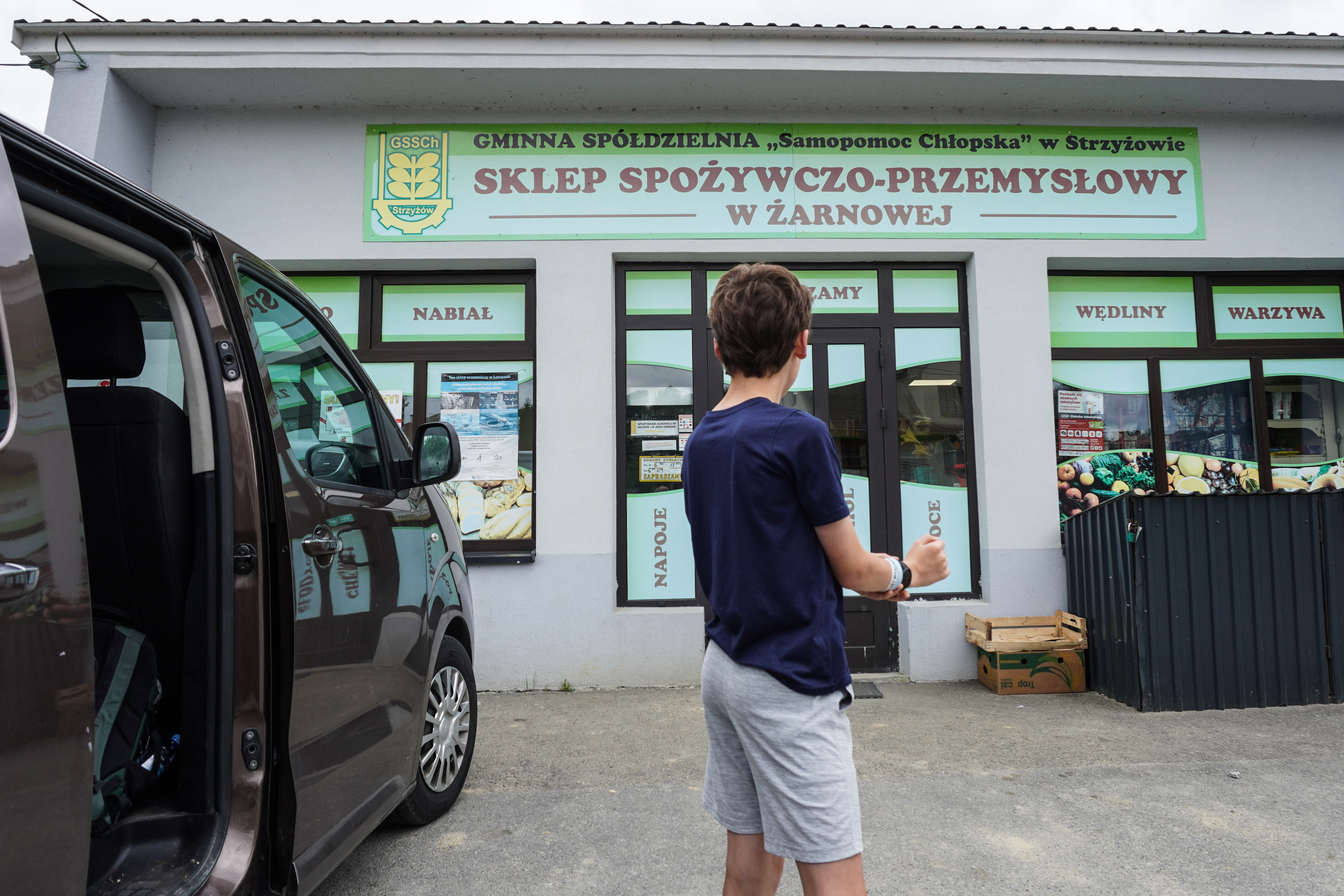
Żarnowa – In search of Sliwinska family (or possibly Sliwinski). Marriage records showed that great grandmother MariannaSliwinska (born 1847) had married Josef Kiczek (born 1827) and was originally from this town, about 20 miles south of Rzeszów. We had a possible address or location but it seemed wrong. We went to the nearby convenience store to ask around if anybody knew a Sliwinska family and followed a lead to an address that might be a descendant. No one was home but a neighbor corroborated that there might be a connection. They called the possible relative and we promised to send a letter explain our relationship. Low odds on connecting here, but maybe they will respond.
Wednesday, June 12, 2024 – afternoon
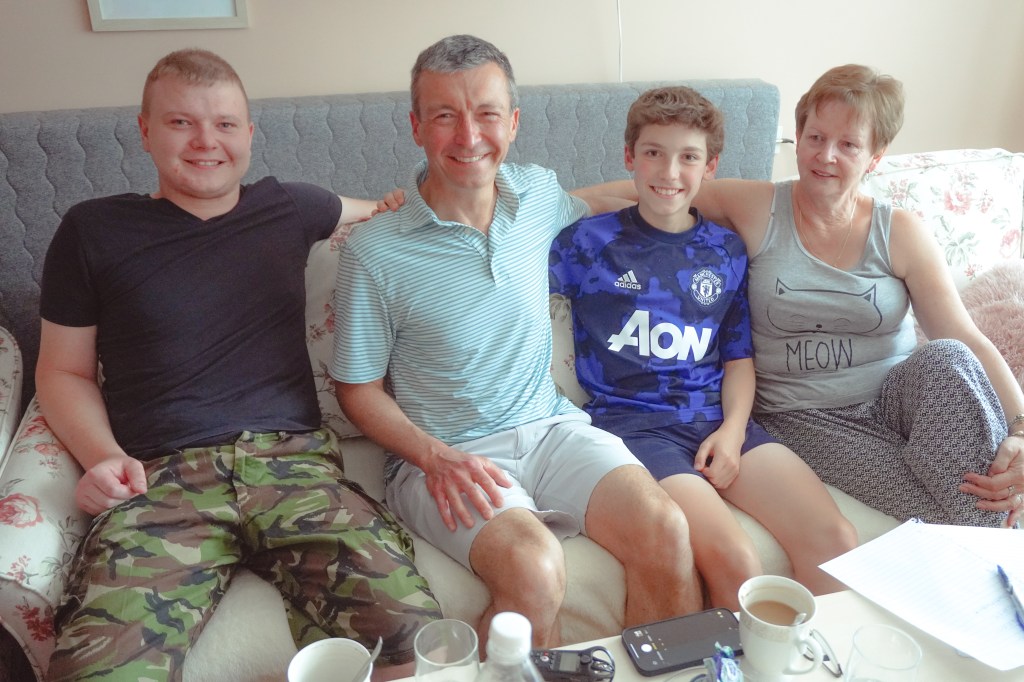
Brzeżanka – a neighboring town to Żarnowa, we had our best clues and even arranged a meeting with Bogumila and Zdzislaw Furtek. Bogumila is a sister of Krystyna Onacki, our cousin who helped start this whole investigation back in the states. This was pay-dirt for us.
We now had a direct connection from the other branch of the Kiczek family. Antoni Kiczek was a half-brother of my great grandfather, Josef Kiczek. His descendants included Bogumila and Krystyna. It seemed Josef married once had eight children and married again having four more. Not so uncommon back then. One of Antoni’s sons was our familiar “Uncle Joe”(Joseph Kiczek) as he became the messenger between the U.S. and Poland Kiczek families. We just never realized what the exact family relationship was.
This was the highlight of our trip from a social and genealogical point of view and the main objective. We met a distant but direct relative, had a warm inviting visit, saw where my great grandfather and some of his descendants lived and tilled the land, even until today. We ate together, exchanged gifts and promised to keep in touch. We had an open ended welcome to come back. More than that, we discovered the land where our ancestors lived and worked was a beautiful peaceful place. See the earlier post for more details on this visit.
Thursday, June 13, 2024 – morning
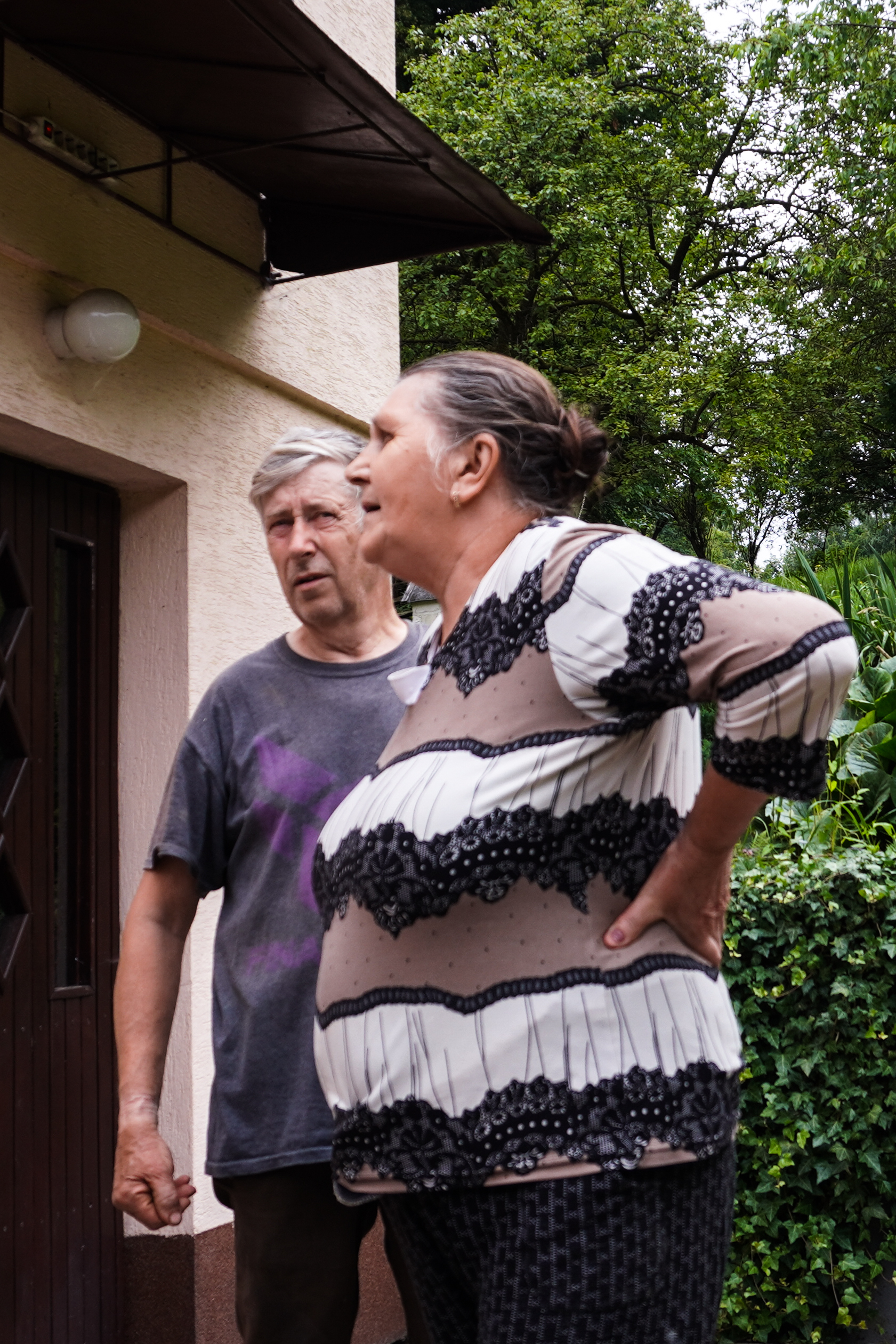
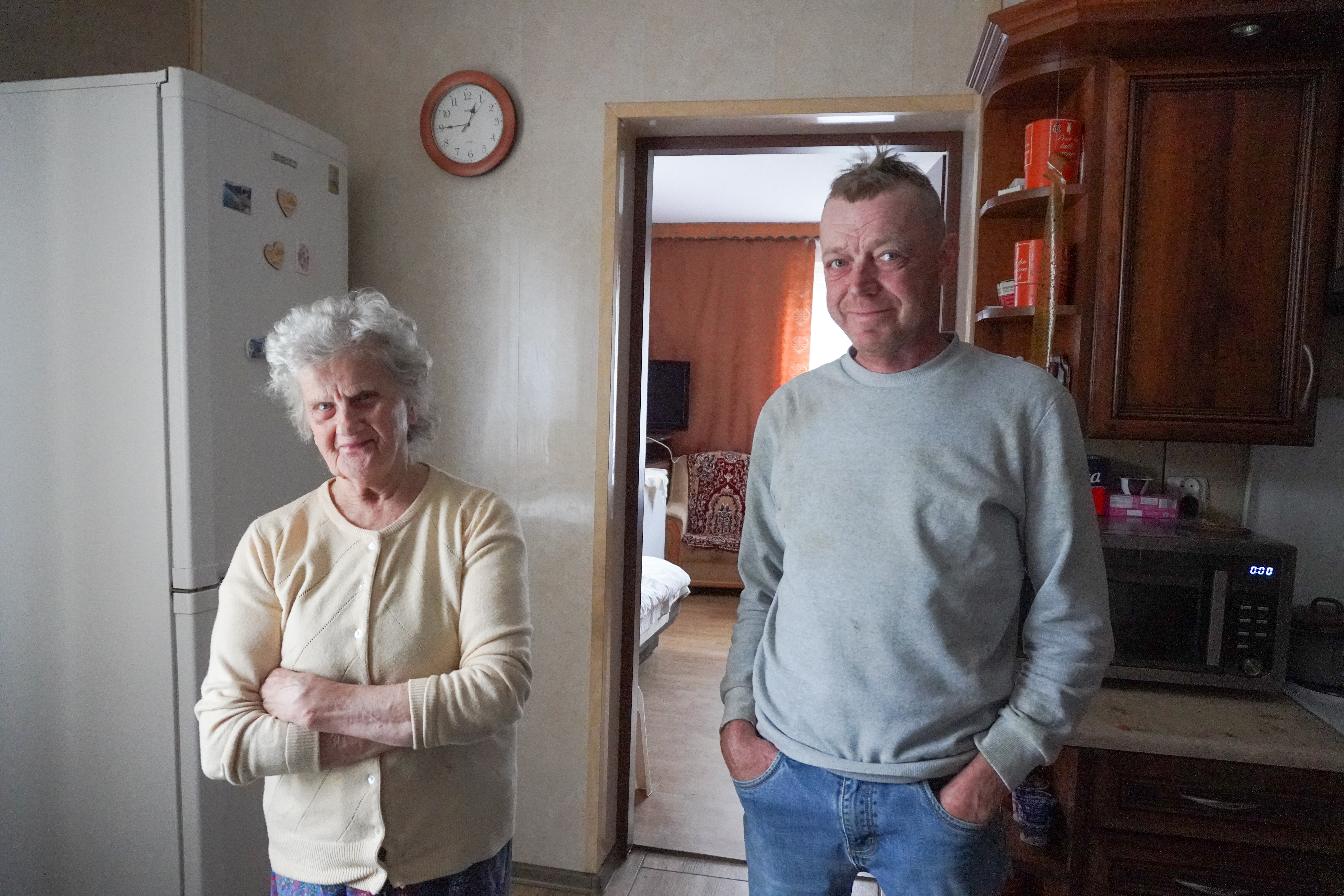
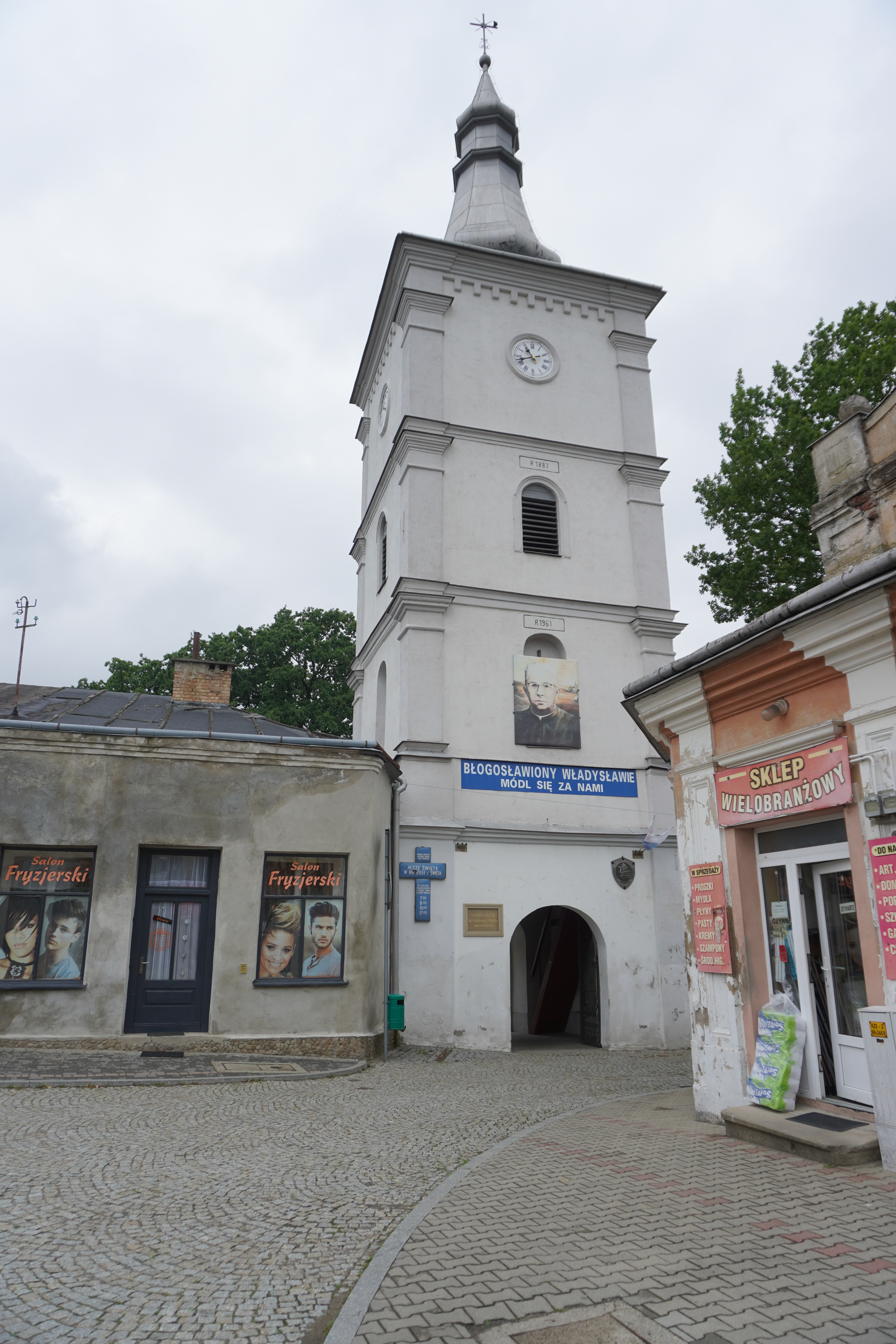
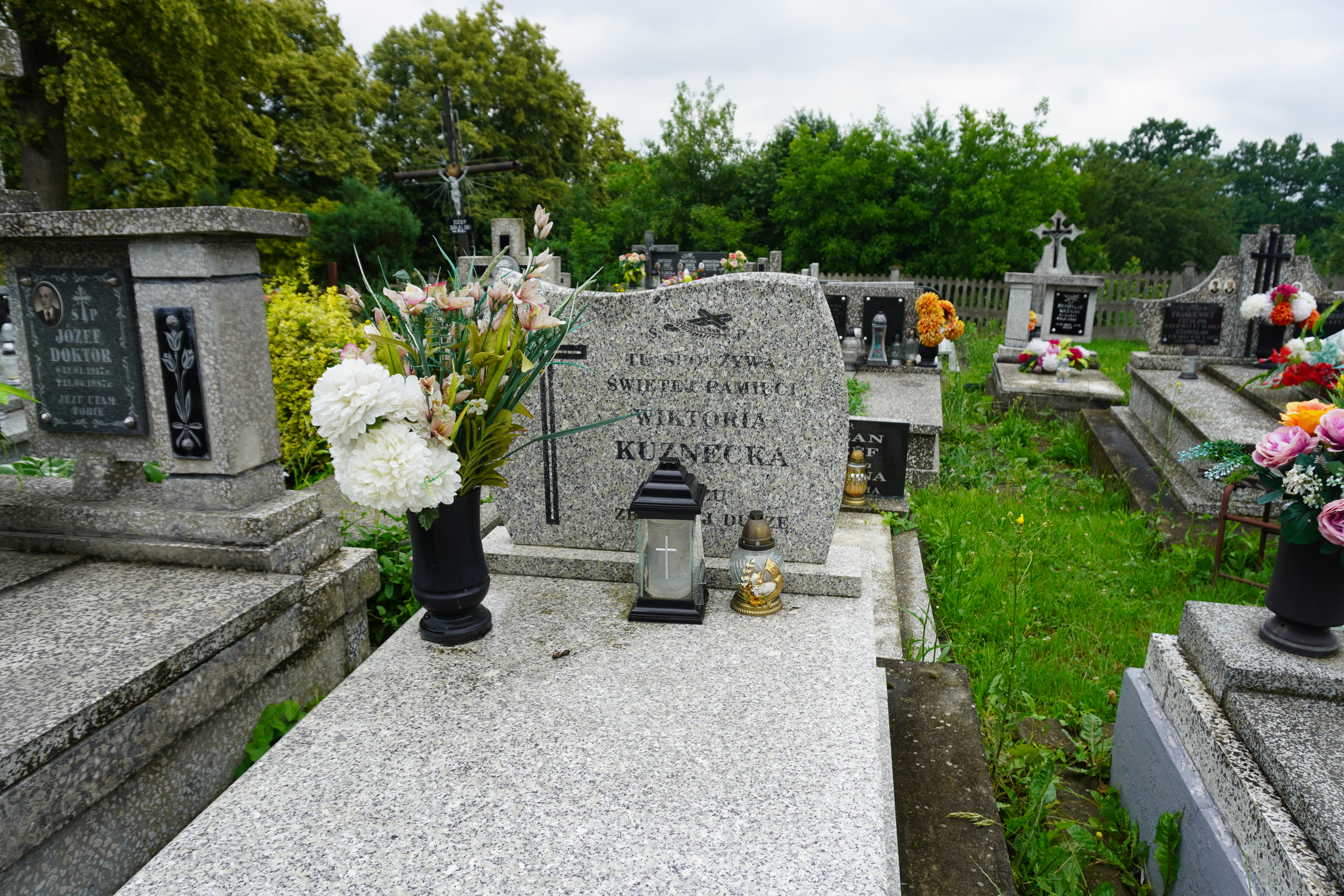
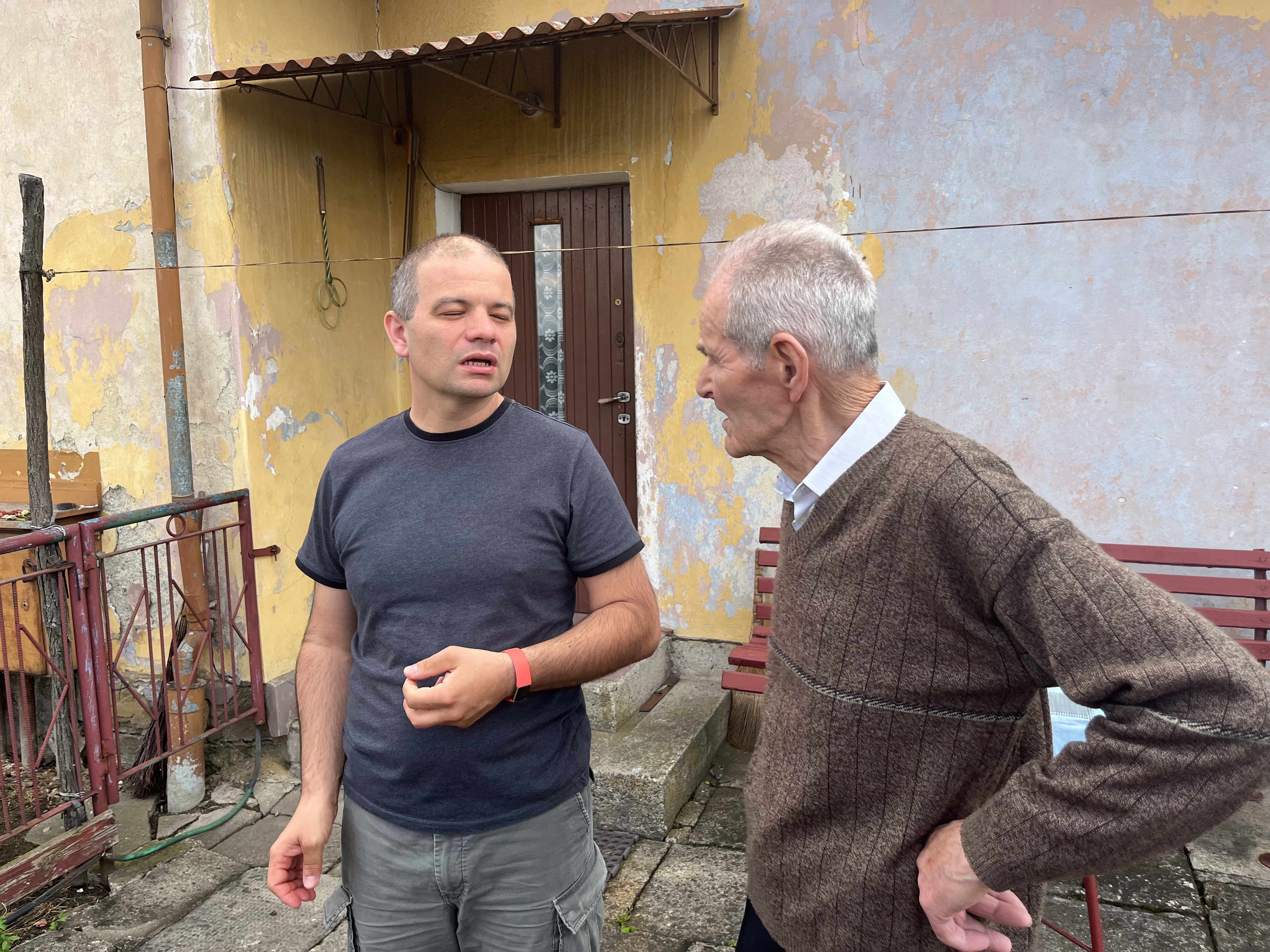
Brzezowa – Our investigation moves on as we travel 30 miles southwest toward the foothills of the Carpathian Mountains and closer to the Slovakian border. There we searched for traces of my paternal grandmother’s (maiden name Katarzyna Kuchnika) family. After visiting the town hall records we found a possible relative’s address. We went to a cemetery and the home of to a a Kuchnika descendant and her son but they did not seem terribly interested in relating anything to us. We made the connection but in this case there wasn’t much interest in continuing communication.
Friday, June 14, 2024 – morning
Grybow/w – We travel west another 10 miles in search of my maternal grandfather’s ( Kmak) family. We started in Grybow, the area where we had a record of his family. We went to the local town hall to explore records. We found a clue that Kmak’s were still in town and a relative might be living nearby. We visited Richard and discovered another lead to a younger generation relative. For our last investigation we went to a local farm and met Kamil Radzik, 28 years old, our youngest relative we met. He offered his email and promised to connect.
Friday, June 14, 2024 – afternoon
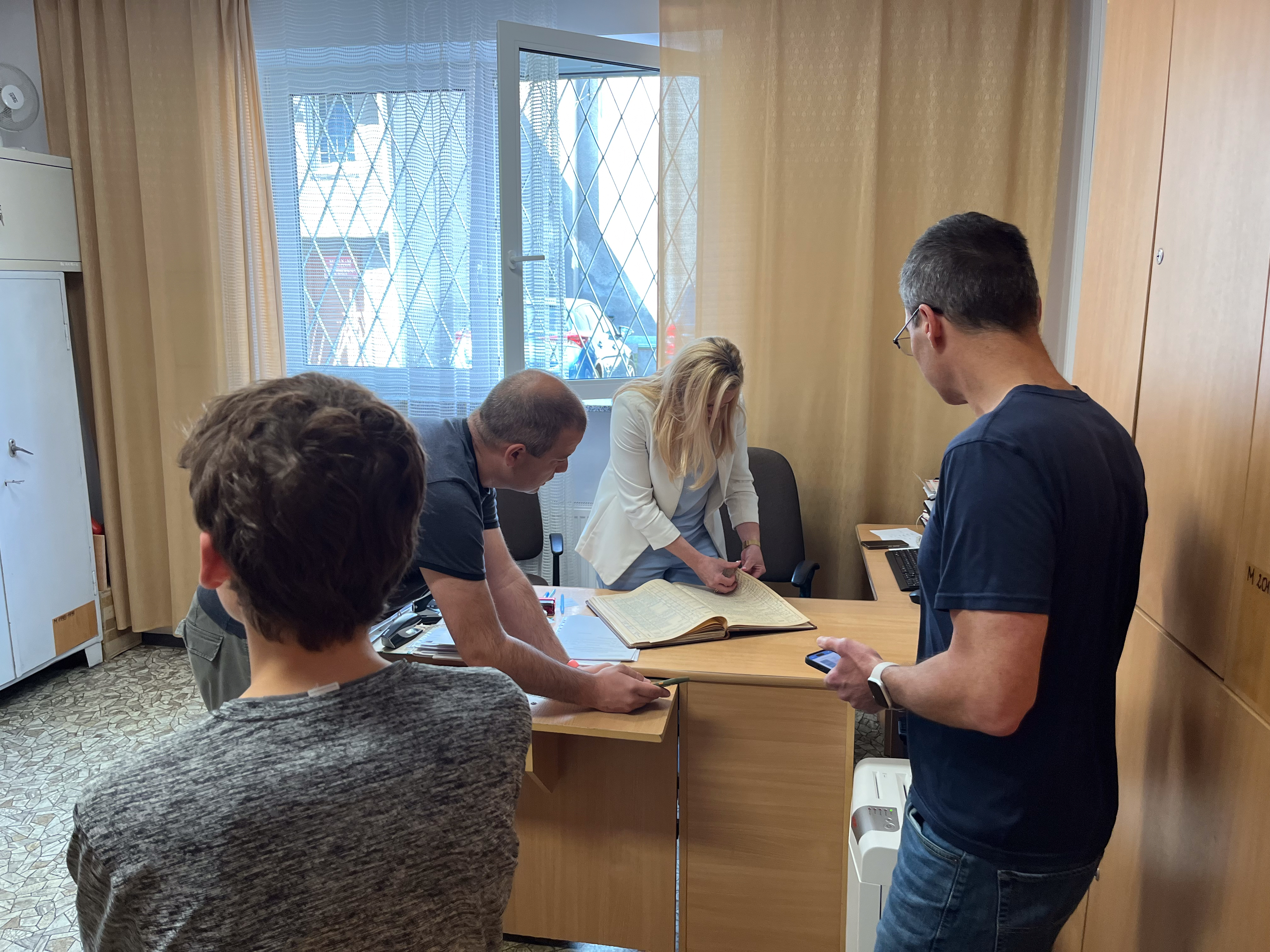
Bobowa – Our last investigation started in the local town hall. Through Lucjan’s charm and two very conscientious staffers we spent over an hour pouring through records to find my maternal grandfather’s family.
Case Closed?
Four days of investigation had ended. With the help of Lucjan as our translator and charmer, we had managed to discover new facts, meet family members and potentially open up further communications. Eventually, Lucjan mentioned that he was interested in police detective work, his skills fit perfectly for that job.
More than that, we had a real feeling of what it was like living in Poland. It is truly a beautiful country, not unlike America. There are small quaint towns, small shops, even American fast food (e.g., McDonald’s) and town halls with vital records. Beyond that there is a huge landscape of open fields and undulating mountains. It changed my perspective about who are ancestors were and where they were from and why many chose not to leave.
I couldn’t stop myself from thinking of one of my favorite Elvis Costello songs that seem to relate to us being amateur detectives, if only for a while and in a friendlier way. The following video has nothing to do with genealogy, but it too is a great mysterious song and video about being a detective….
Who expected Soviet-style bureaucracy at a New Jersey airport? Is this a forewarning of things to come?
Newark Liberty Airport – June 9, 2024
To start our journey, Ethan and Ethan Luke arrived at our house in Morristown in time for lunch and a small family gathering wishing us a bon voyage! A car service picked us up in a stylish big black van which probably made us look like a neighborhood celebrity. It were high-flying until we reached Liberty National airport terminal B at about 6:00 for our 8:10 flight to Poland. Plenty of time, as it should be.
The LOT Airlines receptionist asked if we had any electronics. Duh! Who doesn’t? But what she meant was that ANY electronic device had to be carried onboard and NOT checked in our luggage. Seemed odd to us but we went into the suitcase and transferred our gear, including cameras and computers to our carry on bags. This was a minor inconvenience but we gladly complied. BTW – LOT does not offer onboard wifi.
With boarding passes and luggage checked we proceeded to the TSA screening. Since we were flying Business Class we were able to avoid the “Economy” screening line of about 100 people and were processed quickly…until the woman who looked as stern as a prison guard saw my passport and notice an irregularity. My name on the passport was “Paul Kiczek” but the ticket, which Ethan had bought months ago was issued to “Paul Robert Kiczek”. This was a big red flag and we were pulled out of line. The TSA clerk said she could not let me board unless the ticket read “Paul Kiczek”.
So, we go back to the LOT receptionist and plead with her to change the ticket. She said she could not but could add another line with “Paul Kiczek” showing so that might help. Fortunately, although the screening line was getting long the nasty TSA clerk must have now been on break and we all passed the name test this time. Now all that was left was for our carryon bugs and our bodies to be scanned.
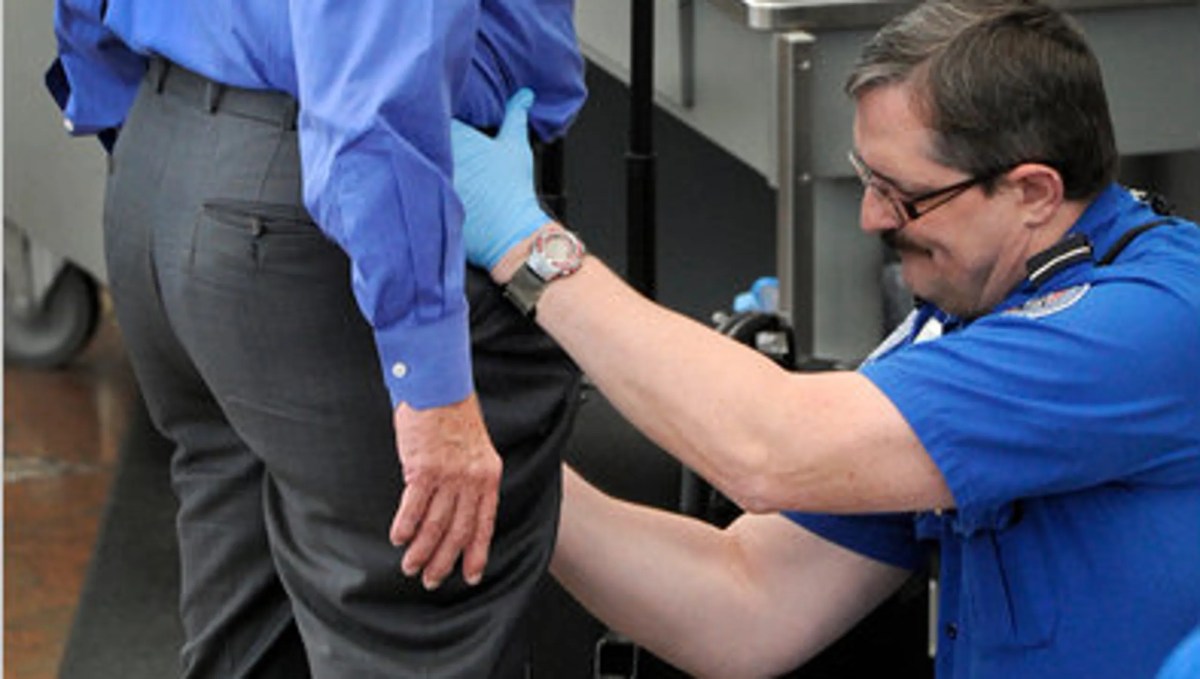
And, of course there was a new problem – my body. The x-ray somehow showed a metallic area at my crotch! Folks, I know of no reason that I could think of for me going “metal”. Naturally I was man-handled with a pat down but not cavity searched by a professional screener as he snapped on his latex gloves and found me to be free of at least dangerous metals. Yikes! It still makes me wonder. Why me?
Finally, post-body search I go to pick up my screened bag and its pulled out of line. Yes, this time it was a rookie mistake on my part. I had taken a can of seltzer with me to drink before we boarded. And, everyone knows that 12 ounces of liquid can be as dangerous as carrying a loaded gun onboard. Tossing out the drink, we were finally ready to board with just 45 minutes before departure.
This was an awkward start. Right now I am flying over the Atlantic and all things seem peaceful again and actually pretty nice in business class with 8 hours to go before landing. Fingers crossed. We will soon be entering an old Soviet-style world which we hope has changed its bureaucracy for the better.
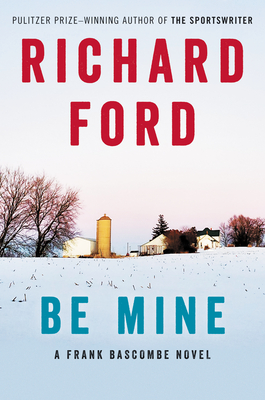
Here’s a review of Richard Ford’s latest novel in the Frank Bascombe series. Frank has his son’s health problem to deal with as well as reconciling his past, present and future as he ages.
The following is my Goodreads review for this new Richard Ford book, one of my favorite authors. Ford’s famous for his character Frank Bascombe, a fictitious character now appearing in a fourth Bascombe novel. He’s full of wisdom and wit and always a pleasure to read. His everyman characters live ordinary, yet unique lives set in places and people you recognize – including many places in New Jersey! This one takes place mostly in a cold mid-west winter under uncomfortable circumstances. Not a joyful read, but always entertaining.
Wisdom is the currency Frank Bascombe has to offer readers who choose to explore the pages of Be Mine, or for that matter any of the other four Bascombe novels on living a life in these times. When I plumb my life (I’m 75) at the age of Frank (He’s 74), I can’t help but think he knows exactly where I am and what I’m thinking and experiencing.
Crafted by an extraordinarily talented writer and storyteller, Ford can make even the drollest facts interesting and draw you into a storyline that might otherwise turn off readers. The art is in the storytelling. His subtle magic will suck you in as you begin to discover a reality and hope that exists at any age.
Here he starts by posing the question, “What exactly is happiness”? Putting the messy details aside, he posits that it may be as simple as the “absence of unhappiness”. Yet how do we become and stay happy? Frank is reminded of this by memories of his mother and a high school reunion which impress upon him the secret of life is just to be happy; as if we could tailor our our actions and our circumstances to make it so.
Frank is in the that retirement stage of life of being partially connected to an old career by shifting into an easy, part time job working for Mike Mahoney, his ex-real estate partner who remains a friend and ally to Frank. Those past tumultuous years (documented so well in all the Frank Bascombe novels) of being a writer, teacher, real estate agent, husband, father, lover and friend have gone by. Life is simpler now with a stressless job, a few trusted friends, a comfortable home and a realization of his successes and failures in his life, family and career. In a word, Frank is “happy”. That’s not in a joyful way but in resignation. The absence of unhappiness gives him no right to complain.
Frank has previously survived a young child dying, a divorce, an estranged daughter, a second wife leaving him and numerous other challenges that life has put in front of him. Yet through all this he has found that life is good and there’s little left to go after. It is a waiting game as to what’s coming up next?
Frank’s immediate dilemma that has shaken his world is the fact that his 47-year old bachelor son, Paul, has been given a terminal diagnosis of fast staging ALS. Paul lives alone but near his dad. His sister can provide limited help remotely. So, Frank decides his life must change as he moves from his comfortable home in New Jersey to Minnesota to assist him. Suddenly, Frank is shaken from his comfortable “happy” life with the idea that he must do something to help Paul.
Knowing Paul’s ildeocycrancies – he has many – Frank offers to take him on a crazy last car trip to visit the Badlands and Mt. Rushmore. It’s a quirky road adventure that fit both their personalities and the bizarre timeline they find themselves in. This is mid-winter, February (around Valentine’s Day) at the Mayo Clinic where Paul is a participant in an advanced ALS research program which only leads to the prognosis that he has little time left.
It’s a story of both father and son estrangement and love for each other. Maybe the biggest gift they can give each other is their remaining time together. Both share a similar sense of humor in their dialog that offers the reader a hundred different funny and entertaining moments they share together, for the last time. Both are self-deprecating. Despite his serious disease Paul insists on calling his ALS condition “Al’s). Paul’s life career goal was to be a ventriloquist which never fully materialized. But his years developing greeting cards for Hallmark shows in his dialog with Frank.
Ford knows how to make the most of words and branding to help bring home the commercial and absurd aspects of our everyday lives. For example, he points out businesses like “Free Will Cleaners, Lint Free or Dye”, “Little Pharma Drugs” and “Vietnamese-American Hospitality”. One of Paul’s favorite t-shirts says “Cornhole IS America”. Many commercial brands from Walmart to Starbucks to Dunkin Donuts are woven into the story which lends to its legitimacy.
The adventure takes him through mid-western America as two keen observers like modern-day Tocqueville’s. Visits to the Comanche Mall, the Northern Lights Octoplex. the Corn Palace, Fawning Buffalo Casino and Mt. Rushmore tell a different story of today’s America. They meet medical staff, protestors, nurses, ex-military, loving couples and ethnic strivers. Just common good folks out in this cold unforgiving land of promise.
On Comanche Mall…
Shopping malls all emit the same climate of endgame up and down their carnivorous expanse. (They were never meant to be places where people belonged.) The mealy light emanates from nowhere. Air is a warm-cool Temperature found only here, and riding it is a cotton candy aroma, like at a state fair. “When you wish upon a Star” sung by a cricket is being piped in on top of everything.”
On Mt. Rushmore…
(Paul’s observation to Frank)– “It’s completely pointless and ridiculous, and It’s great.” His eyes are jittering and gleaming. “There’s not enough in the world that’s intentionally that stupid.” (Frank’s observation)He is smiling beatifically, as if he’s experienced an extraordinary discovery and surprise. A confirmation. I’m merrily happy to believe we see the same thing the same way once – more or less. It is pointless and it is stupid. And if seeing it can’t fix him, it can a little. “We’re bonded,” Paul says slyly still smiling, gazing with complete awareness toward the presidents. I am his favorite turd.
There’s no happy ending to this story as you might expect. Frank appears to have reached a new awareness of his late stage in life and a resignation that he had done all he could. Maybe it’s time to look at things fresh again and renew friendships. With Paul gone, he has eliminated the “unhappiness” of seeing his child pass but re-gained a stable“happiness”. At least for now. With happiness there is hope.
How do you react when you get hit by a stone? Adjust to where you are and move on.
This essay reflects personal thoughts that were written and collected to be passed on later to the family for my Storyworth project - a personal collection of life's memories. Today, is a memorable moment for me reaching age 75 and staring a health issue in the face. It's all part of growing older and being thankful for good health.

"Long may you run...", as Neil Young has often sung.
I’ve been thinking a lot about my health and my age lately. I’ll be 75 tomorrow. Unbelievable! It’s a birthday that all my immediate ancestral family never lived long enough to pass. Dad had the record making it to 74. Mom was 70 when she passed a year after Dad. My three sisters are still in the running with me, being a bit younger. My older brother John, died in 1976 at the young age of 30 in a tragic accident. Now, I’m pondering, ‘What controls the length and quality of life?’ …as if I could control it. You can take your pick: genetics, environment, stress, exercise, relationships, diet and/or just plain luck. Some you are dealt. Some you choose.
I’ve managed to live through it all to retirement, raise a fine family with grandkids to enjoy. I think I figured out what life style works best for me with adequate exercise, a healthy diet, and maintaining relationships. Actually, I don’t usually think consciously about how old I am or how I feel. I’ve been lucky to have no real health issues. That is until recently.
Being Stoned
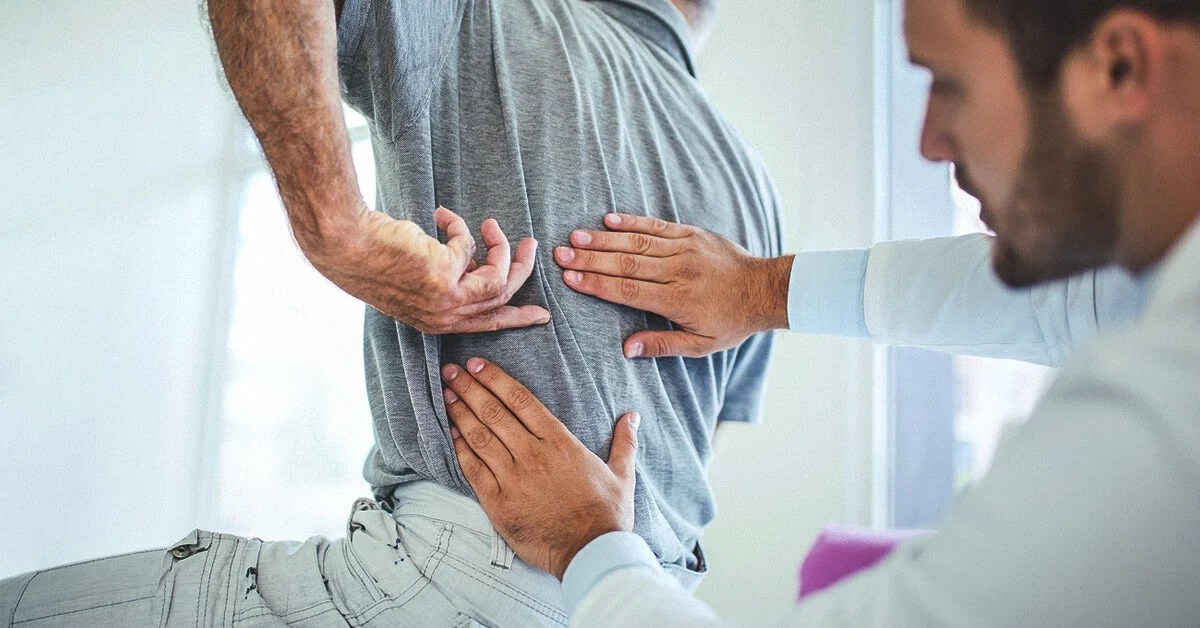
About a week ago, after a Saturday bike ride, I started to feel a mid-left back pain. Shortly after, I started to feel queasy, nauseous and fatigued. I had not done anything out of the ordinary that would have caused a muscle to be strained so I knew it had to be something else. Two days went by and on Monday my back and abdomen pain had increased tremendously. It was time to seek medical help, which I normally avoid like the plague, whenever I can. My suspicion was that it was a kidney stone that was causing the pain.
I remembered years ago, on a tough long-distance walk, I was pretty sure I had passed a kidney stone near the end of that day. My wife, Mary Ann, had a couple similar bouts with stones, as did my father as I recalled. At the time of the walk, I had not properly hydrated and had to deal with an excruciating pain in my lower back. Then miraculously, it stopped an hour or so later once I rested and hydrated myself. I learned that severe dehydration is one way to bring on a kidney stone. I also learned that pain is easy to forget once it has passed. My kidney stone nightmare, which I had buried in my memory, suddenly came to life again.
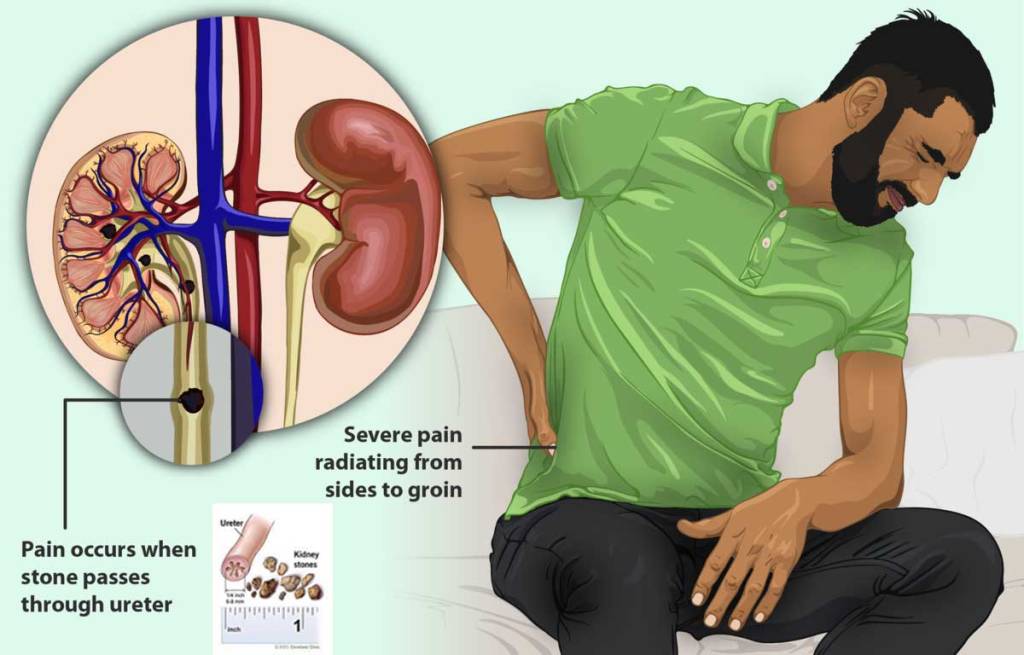
Kidney stone pain is legendary. Some have said it is worse than childbirth, which I would not want to judge, even if I could. The pain usually appears after crystals build up into a stone which moves from the kidney to the ureter tube which carries it to the bladder then beyond. My primary doctor noticed a small amount of blood in my urine on Monday and ordered an ultrasound the next day which confirmed the location of a 3 mm stone, large enough to become an all-encompassing problem for me by Wednesday morning. Then, I had to wrangle an “asap” appointment the with my Urologist for the next day, promising to provide stronger pain medicine and a plan to get my life back. But, I wasn’t sure I could make it another day as the pain worsened.
After realizing I might have to wait another 24 hours for relief, I sat on my front steps hunched over in pain. Then, miraculously the pain stopped! The stone had apparently moved down to a more welcoming spot and was probably expelled soon after, without a proper goodbye. I did not get to see or determine the type of stone. Strange how a tiny stone can alter your life so quickly and make you suddenly appreciate life – with and without pain.
Stone-Cold Facts
As painful and debilitating as kidney stones can be, they are quite common and rarely fatal. More than 1 in 10 people are affected and most often seen in people aged 30 to 60.. Kidney stones are usually troublesome when discovered in the kidneys or in the ureter, the tube that connects the kidneys to your bladder. Stones can be of several types based on which chemical builds up in the kidney, most are calcium oxalate or uric acid stones. Besides the pain, stones can cause a urinary tract infection which can lead to complications.
Adequate hydration, a certain diet and a hereditary disposition may help explain the presence of a stone or chances of an occurrence again. In my case, my conclusion is I have a hereditary situation, a need to hydrate better and because I probably had an incident before and now, there’s a good chance I may have another. That’s not a pleasant thought, but one I can accept and hope to avoid.
My Stepping Stone
I read recently that 20 percent of American adults — some 50 million people — suffer from a form of chronic pain. As I age I see pain present more and more. If not myself, my wife and friends are faced with dealing with painful joints, operations, treatments and disease that we all face at one time or another in our lives. Fortunately, kidney stones don’t last very long. But even a few days in extreme pain is more than one should bear.
For now, I see being pain-free as a gift. When that monster is on your back there is not much you can do or say that draws attention away from the suffering and the empty feeling that there is nothing you can do to stop it. With opioid pain-killers like Fentanyl and Oxycontin all over the news, its hard to avoid the subject of pain and the downside of finding a way to make it stop. In my darkest moment, I prayed for something stronger. It’s not difficult to see how someone would be willing to bend their principles and exchange one form of hell for another under the right circumstances.
Hopefully, I’m done with this stone and ready to move on. The question before me, at age 75, is “How should I change because of it”? The older you get the more advice and requirements you receive. Eat properly, consume less alcoholic drinks, get more sleep, see more doctors, avoid stressful situations and enjoy life when you can.
I would never say the stone was a blessing, but it reminded me to give thanks for what I have and to be vigilant at my ever-ripening age of what will be coming. That’s not to say I’ll change much at this stage, but maybe make a few lifestyle adjustments to keep the rest of this body going for as long as I can. Growing older is all about adapting to change… when you have to.
Serendipity happens when you most need it. A retired New Brunswick couple share their lives with us.
It was hump-day, Wednesday, probably the hardest day of our 125-mile (171 km), week-long, Beyond Borders Walk from Saint John, New Brunswick to St. Stephen, the last Canadian border town near the tip of Maine.
Walking a lonely road
Today, there were 23 miles of walking from St. George to the Chamcook Forest Lodge near St. Andrews. Ken, our fourth team member was out with a back spasm. We started walking country roads which eventually turned into highways. It was not quite like walking an Interstate, but close. By mid-afternoon, the temperature reached the high 80’s, only made hotter by the asphalt, so much so you could feel heat through your shoes. The only relief was an occasional bay breeze near the top of a hill.
This is a relatively undeveloped area of the Provence of New Brunswick just a few miles from the shore. St. George’s lush woods soon gave way to a desolate area with few houses and no commercial business for miles. Even traffic seemed rare. The only thing interesting out here is dead porcupine roadkill.
As the day heated up, I realized I had made a rookie mistake. A long hot day walking requires more than a couple bottles of water, especially when there is no place to refill. About 18 miles (6 hours) into the walk I find myself light-headed and completely empty in every respect. I’m in that state where you watch the heat create mirage waves on the road and begin to wonder “How am I going to make it to the end?”
Miraculously, while heading up a long stretch of highway there appears a sign in the road saying, “Taylor’d Art” an “Open” flag waving underneath. This area was dotted with lakes with a few homes set back. This one though could be seen clearly. Although, we did not come this far to see and appreciate local art, we had no choice and no willpower left to pass this by.
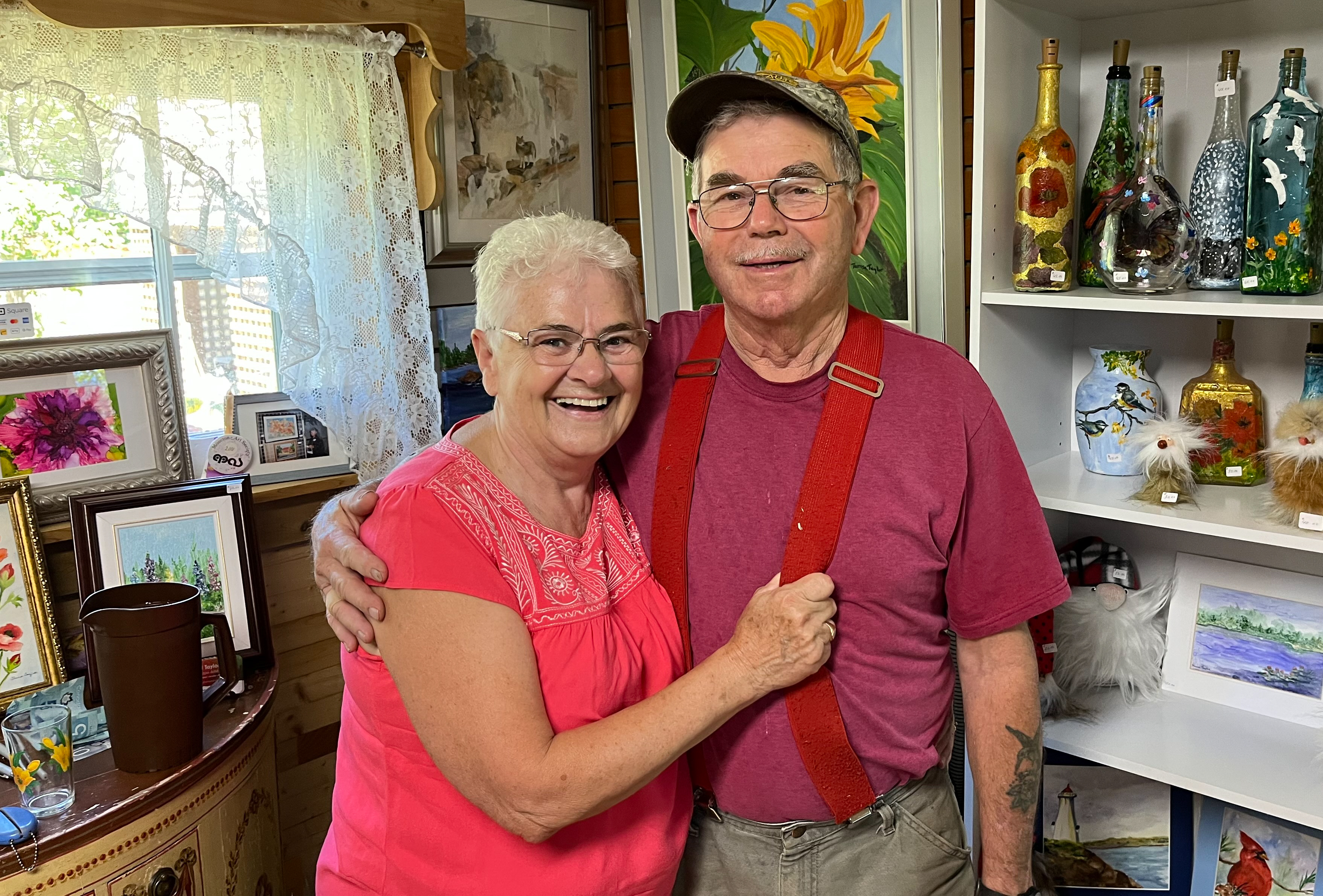
Theresa and Burl Taylor are about as happy couple as I ever met. Married just 52 years ago they were most welcoming to the three of us as we asked (we would have begged) for water. Theresa has maybe 200 natural setting paintings here in a small shed which she had created. She has experimented with various artistic methods from watercolors to oils, flock to canvas and many other methods I had never heard of. Being efficient walkers, we opted to buy a few beautiful refrigerator magnets that pretty much exemplified her work in miniature.
Burl came by with a big pitcher of water and we began talking about life out here as we began to revive. They had moved into a smaller version of this home 50 years ago and discovered this was the place they always wanted to be. Years went by and Burl expanded the house, built a garage, chicken coop, workshop and swimming pool. Much of this prior to his retiring as a forestry engineer. His property and projects look like he put a lot of thought into them.
Theresa is a self-taught artist. As she describes it, one day she just started scribbling and copying things until she began painting a scene, going over and over it until it was right. She presented it to Burl and said this is what she wanted to do and he agreed. Decades later she continues to paint, mainly for the pleasure of it. She painted so much they needed to move some out pieces and Taylor’d Art was born.
They had a son who Theresa mentions often as he developed into an talented artist who’s paintings she still sells. Unfortunately, he passed away a while ago but you can tell he’s very much part of their lives.
There are no other children but a very large extended family. Theresa was one of 21 children! Her mother, whom they speak about with reverence, gave birth to all 21 children individually, no twins or triplets! And, she passed away at the age of 46 due to cancer. Theresa said she spent a great deal of her time with her many siblings and keeps in touch with them often. We are in awe. Can you imagine what a family reunion must look like?
After much water and talk we had to go. Time is very unforgiving when you are walking. I think they enjoyed our company as much as we did their’s. We could have easily stayed for hours learning more about how Theresa and Burl share what they do together – their art, building, hunting, fishing, getting by in the winter and the life between them.
When you are out here you have to be flexible, forgiving, innovative and self-reliant. The Taylor's have figured a way to make the most of their lives and offer an oasis to others.
Just getting started on our walk. Getting adequate sleep in strange places is a must.
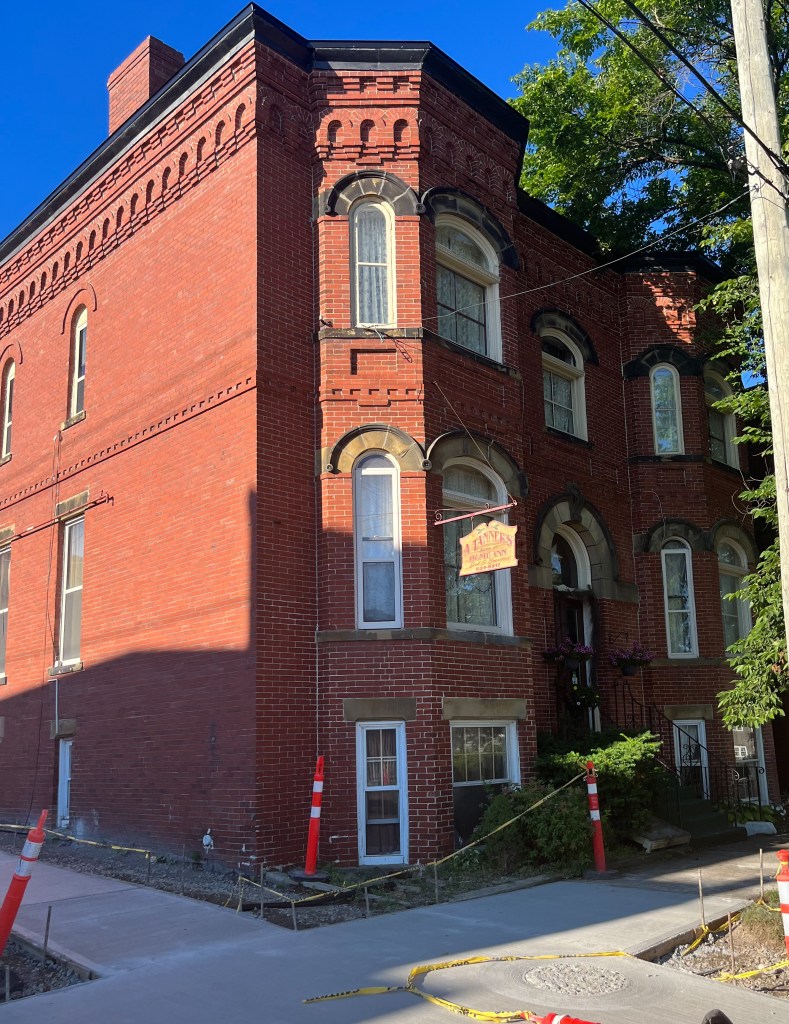
Jul 31 – Day 1 Walking – Sunday was our first full day in Canada. Tom and I stayed Saturday night at “A Tanner’s Home B&B” which was once a curiously old (148 years old) home of a wealthy gentleman who made his fortune in tanning leather goods and real estate. Today, it was an airbnb-like home which had a 1800s historical vibe but updated to accommodate tourists. It’s still a work in progress.
A Tanners Home B&B, Saint John NB
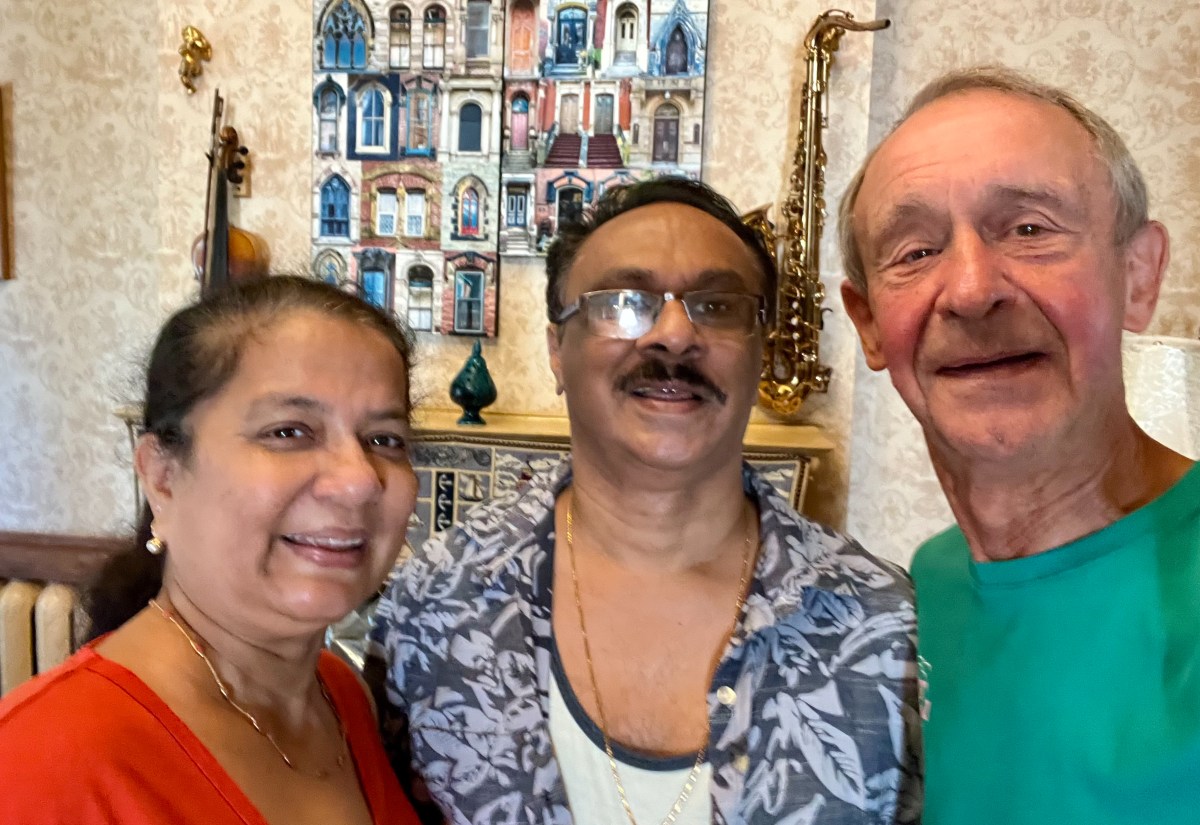
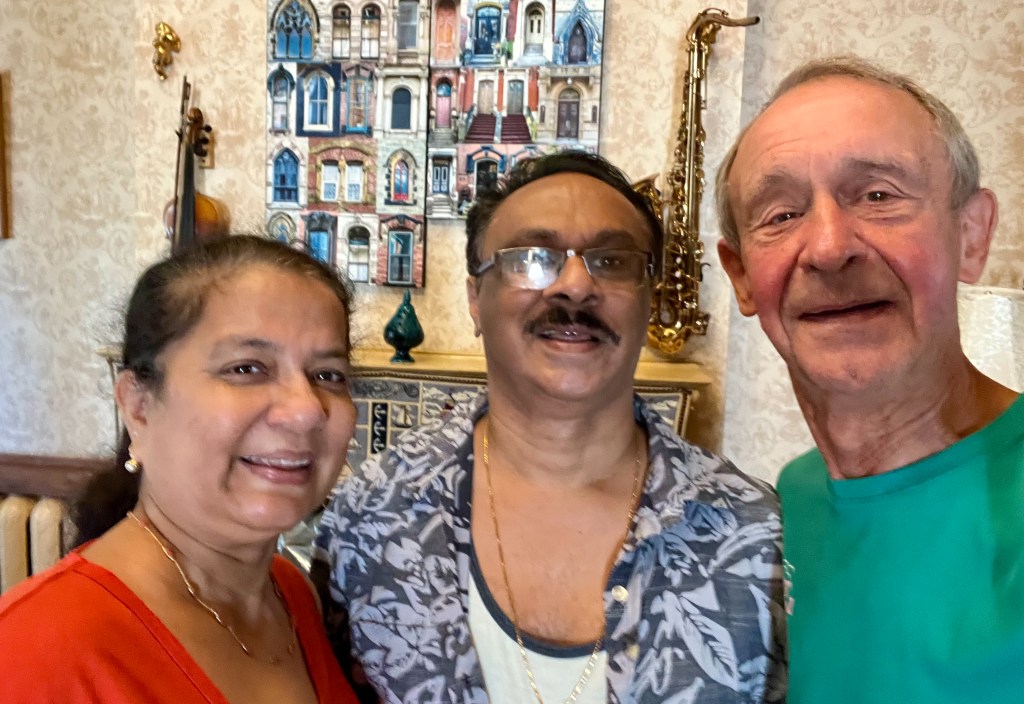
Our hosts, Doreen and Sebastian were proud ex-pat Indians who found their formula for retirement hosting this B&B in the warmer months and flying back to Mumbai the rest of the year. Sebastian, a former sea captain, hates the cold but loves Canada.
Like many parents in search of the best for their family while planning for the next phase of retirement, Canada seemed to fit. There is an active Indian population here in Saint John and a government more inclined to take in immigrants than most. The price you pay is an investment of capital in a legitimate ongoing business to get the benefits of citizenship. This enabled Sebastian to send his kids to Canadian universities where they established residency in Toronto.. They are planning that big wedding for their daughter who had to marry quietly during the pandemic. Hope is that grandchildren will soon be in the picture.
Tom and Loredana – Proud of finishing the half marathon in Saint John
Meanwhile, Tom and Loredana set out on on Sunday to run a half marathon before we started our long Beyond Borders Walk later that day. The “Marathon by the Sea” mostly follows the pedestrian trail along the waterfront and ends around noon. After a shower and change, the four of us begin walking the trail out of Saint John, heading for St. Stephen an almost unimaginable 125 miles away. But today we planned an easy day of only 7 miles to get to our next destination, the Regent Hotel just on the outskirts of Saint John.
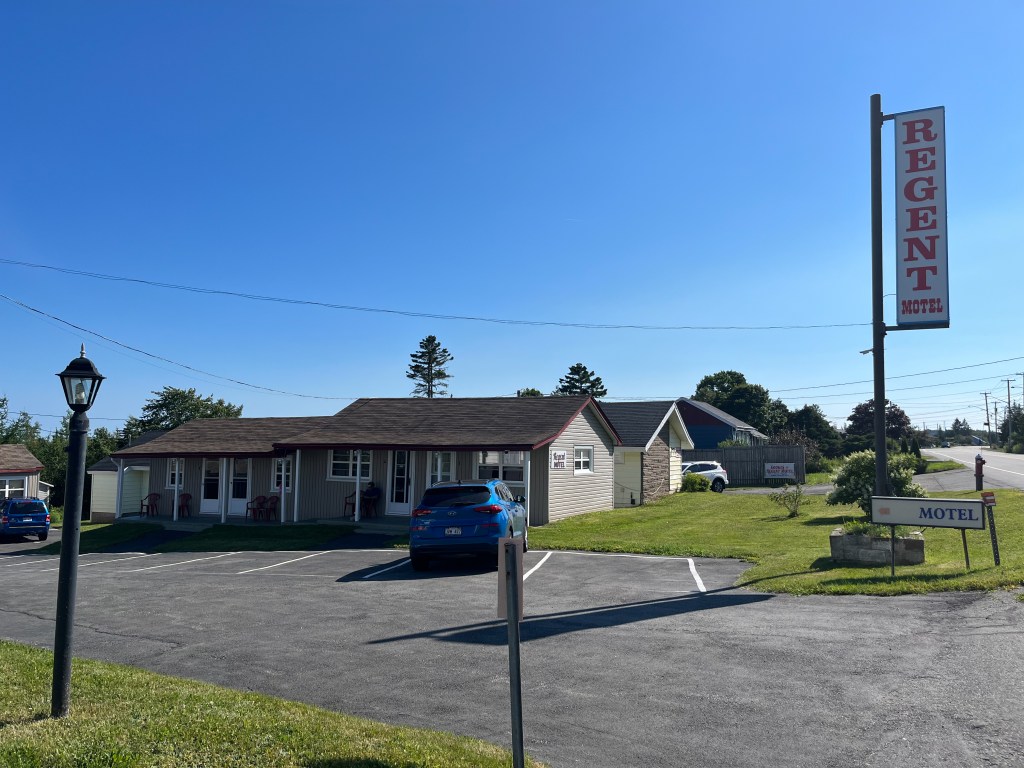
Regent Motel – 2nd night
The Regent was as basic a motel as you could get. But it helped us get a start on the journey. Rooms were dingy but clean. Little tiny soap bars, shampoo in sealed envelopes and no air conditioning. Luckily the single ceiling fan was all we needed. The only problems were no coffee and no place to eat within walking distance. Luckily we found a restaurant that delivered in this remote outskirts of Saint John. With pleasant weather and a single outdoor picnic table the four of us shared a good-enough Chinese dinner.
Its not difficult to find people that want to talk to strangers here at the motel or anywhere in this area. One couple was coming from Manitoba with plans to retire in Nova Scotia. Another guy, with sunburned face and head, struck up a conversation about how he had moved to Alberta only to find his partner had decided she need to be alone. Now he was back to rekindle a relationship with his children and grandkids. Glad to be back “home” he looked forward to seeing his son drive race cars. His sunburned head and face were proof of how he just witnessed a drag car hitting 210 miles per hour. A happy camper glad to be back.
Motels and B&B’s serve a useful purpose in helping us move on. We need sleep to move forward in the morning. But, every host and guest has a story from the past and a story yet to come.
Check out more information and stay up to date on the Beyond Borders Walk here.
Lessons from another pandemic and unpredictable year. Being thankful for the good things that still happen.
A similar story was originally written a year ago as part of my Storyworth writing project. I'm updating it for our unique times in February 2022. These essays reflect personal thoughts that are written and collected to be passed on later to the family. I include this story in this blog to help remember and savor the simple and good things that we were able to enjoy and are often overlooked. As we work our way through another pandemic year in 2022, we are optimistic that the Covid Omicron variant is passing. But we still need to slowly adjust our behavior and come back to a "normal" lifestyle.
The writing challenge was to discuss, “What simple pleasures in life do you enjoy?” This question forced me to think about what I take for granted and yet value, even if they seem like small parts of my life. Unfortunately, you soon realize that many simple pleasures have had to be forgone or change over the last two years. You can find my thoughts on this same question a year ago here. Here’s to recognizing and enjoying them lately and again in the near future.
Hugging the Kiddies: Upgraded 👍
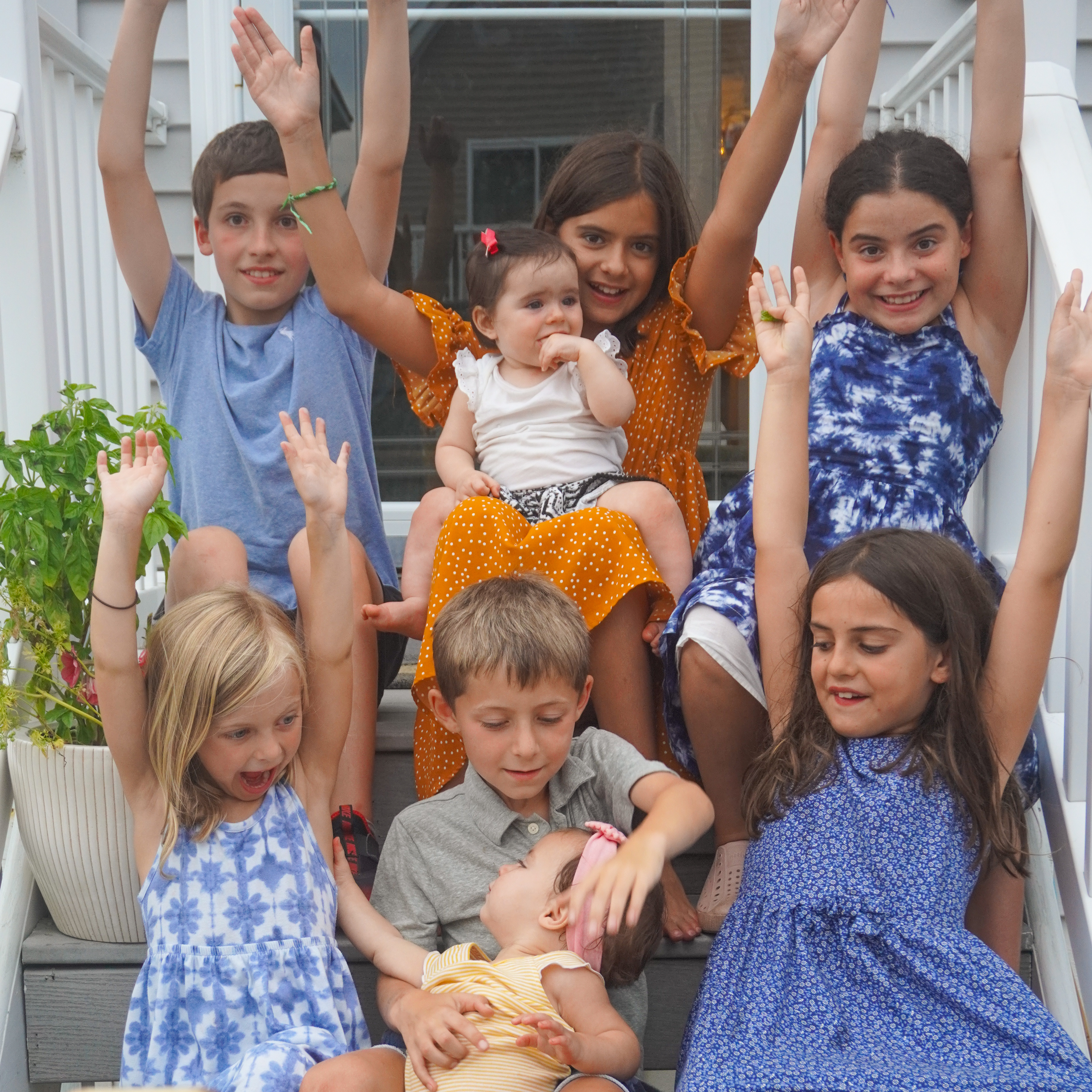
My 8 Grandkids on Vacation at Ortley Beach
Throughout last year we made great progress, or so it seemed, until December 2021 when we had to change our behavior again! Still, there was progress – in spite of contradictory advice, vaccines, sicknesses, trial and error, minor emergencies, masks, and taking reasonable risk. No one in our family got Covid, even though there was plenty of it around us!
What that meant for me was that I gradually got to get back to a normal show of hugs and kisses to all my eight grandkids. Mary Ann and I are still cautious, often seeking news of local covid cases and at-home tests, all of which reduce stress somewhat. Probably the peak of the year was the summer season where we all got together at the Jersey shore, including our two newest members of the family: Maeve and Claire, who reached their first birthday unscathed by pandemic times. Its still not unbridled love and happiness but I’m grateful for what we have.
Live Music: It’s Still Alive 👏
While YouTube did offer some recordings and virtual streaming of performances, it was still nothing like being part of a live audience. Some concerts were held after vaccines became available and they usually required showing proof of vaccination or recent negative testing. Attendance at these concerts was often limited and sometimes attendees were spaced apart. But, it seemed that musicians and venues were ready to make up for lost time.
That summer MaryAnn and I usually played it safe and only occasionally dropped by Ruthie’s in Montclair for some live Blues played outside. There was ample room behind this juke joint and we were feeling good about the possibilities of overcoming Covid by the end of the summer. Here’s one of the very informal, fun and cool presentations of a musician we both like, Dean Shot.
Dean Shot @ Ruthie’s in Montclair
On a whim, my son Ethan who lives in Lexington, MA, suggested I join him and his friend Andy at the Leader Bank Pavilion in Boston for a Wilco concert. Luckily, I was able to book cheap $29 Amtrak tickets from Metropark to South Station (one of the few benefits of this pandemic) and effortlessly traveled to Boston and back home within 24 hours! Besides getting to see him and his family, this was my first live large concert in years with about 3,000 fans in a 5,000 seat open air seasonal arena.
Maybe it was just the freedom to travel or the rarity of such an opportunity but the band and everyone there seemed to really appreciate being part of the event. The following video was a tribute to the Rolling Stones’ Charlie Watts who had just passed away two days before.
Wilco concert in Boston – August 2021
Over the last two years I’ve gained an appreciation of how hard it must be to be an artist, especially in a restricted world. We all need to show those that work for almost nothing these days that their efforts count. I’ve decided to actively click that pervasive “like” button or give a little to my favorite artists, like Sean Tobin, through Patreon and play a small part in helping keep music alive.
Riding a Bike: Born-to-Ride + Gravel 💪
My Gravel BikeGravel RidersBikes at Rest“Born-to-Ride 2021” – 85 Miles of Jersey Shore
I consider myself lucky that I chose cycling as my primary exercise sport, especially as I get older and especially in these times. Besides the obvious cardio workout, it probably is the best sport for a pandemic. Cyclist can chose to ride anywhere a road or path takes you. And, we, who are notorious for gathering in groups, can usually safely exercise together without masks because of the space and moving air between us. The Omicron wave, however, challenged even those assumptions last year. Donning a mask when we end a ride at our favorite coffee stop is not a big ask at all.
Born to Ride
I’ve organized a long distance (85 miles), end-of-season (early October) bike ride for several years called “Born to Ride” which wraps up the regular cycling season. After taking a year off because of Covid, our group managed to get the ride going again. The ride idea started about 10 years ago on a wave of Bruce Springsteen nostalgia. This year we targeted spots along the route from Ortley Beach to Sandy Hook and back that had some connection with Bruce. (BTW – We have no idea whether Bruce rides a bike. It always seemed like he should.) It was the highlight of my cycling activity for the year.
Official Born to Ride 2021 documentary video
discovering gravel
Over the last few years, a new popular trend has developed in cycling called gravel or multi-surface riding. When I had a custom designed Seven Cycles bike built a few years ago for my 1,600 mile Epic Ride, we chose a design that would allow touring and as a “cross” bike, i.e., a sturdier frameset that could ride well on-road and off-road.
Riding gravel usually means choosing a route that is primarily an unpaved dirt or gravel road. Where I live in Morristown almost all roads are paved. However, only 10 or 15 miles away I have discovered extensive areas of dirt roads, usually around farms, estates or wooded trails. Gravel riding is usually slower, bumpier and requires more attention. But the benefit is seeing and being in nature – and maybe best of all; little or no traffic. I hope riding gravel will add to my interest and options for cycling for years to come.
Walking: The Routine Exercise 🚶🏻♂️
Walking seems to be a good compliment to cycling and universally accepted. It’s low impact, anybody can do it and it adds a nice social element. Mary Ann and I have developed a daily routine of a one hour walk, usually in town, but sometimes on a trail. Walking is a great way to just get out of our rut and get back into the world. Interestingly, I notice more cyclists lately are also walking as a low intensity alternative exercise.
My history of leading the FreeWalkers, the long distance organization that I created over 1o years ago, is now a past fond memory. Although I have walked with them and will again in the future, these pandemic times have still limited my involvement which feels appropriate right now.
Sunrises and Sunsets: A Better Show 😎
There must be an explanation for it. Sunsets seemed to have been consistently outstanding this year, in particular this past fall and winter. The cloud formations and low horizon light have been stunning. It’s a welcome consolation for a trying year.
Gardening: Bumper Crop 🍅 🥕 🧑🌾
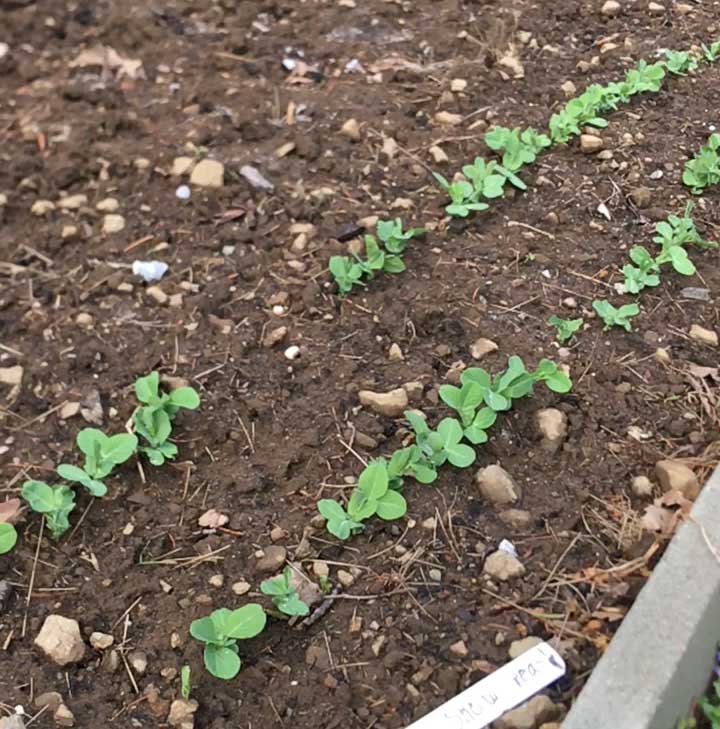
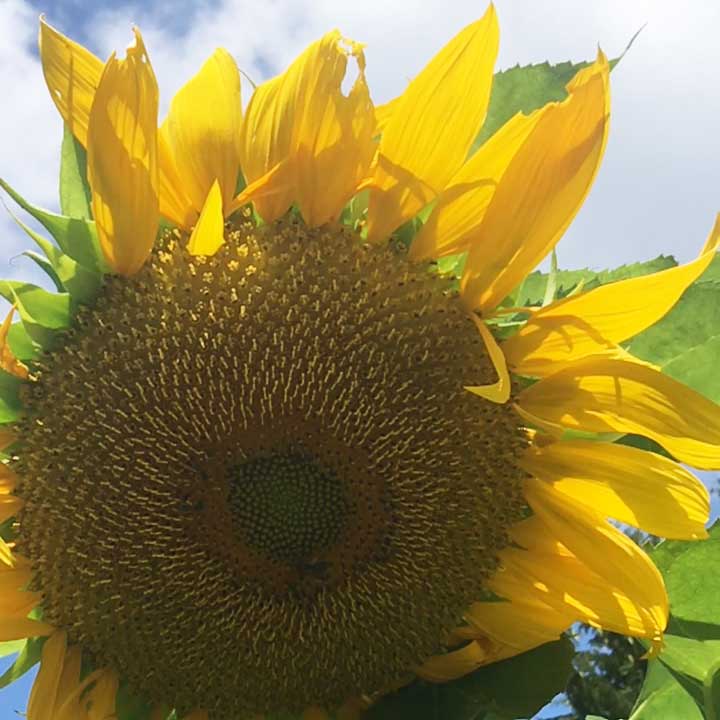
Peas in a RowJack’s Giant Sunflower
My community garden plot grew a bumper crop this past year. Most gardeners would agree that the weather conditions were near perfect. There was sufficient precipitation and seasonal temperatures. Insects seemed controllable. Lots of tomatoes and other vegetables. While cucumbers had a bad year for some reason, my grandson Jack’s sunflower seeds became the tallest plants in the whole garden with giant 18 inch heads!
Dining Out: Fun While it Lasted 🍝🦞🍔🍕
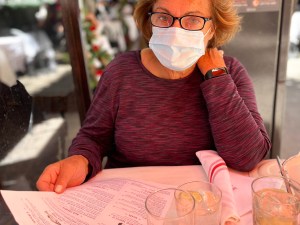
Restricted Outdoor Dining in NYC Pulled Pork in Montclair
Over the past year, we gradually adventured out to restaurants where there was outdoor seating. By the summer, we had a few chosen spots near Morristown and at the shore where we felt comfortable enough to eat outside weather permitting. But by December, that seemed like a dream between the weather and the threat of Omicron, we have not eaten out in several months. We are now plotting our next meal, possibly indoors, as the threat seems to recently be reduced.
Short Hiking Getaways 🚶🏻♂️
Arlo, Charlotte, Justin & Anna @ Round Valley State ParkMe and Mike @ Mt. Greylock Peak
Round Valley Camping
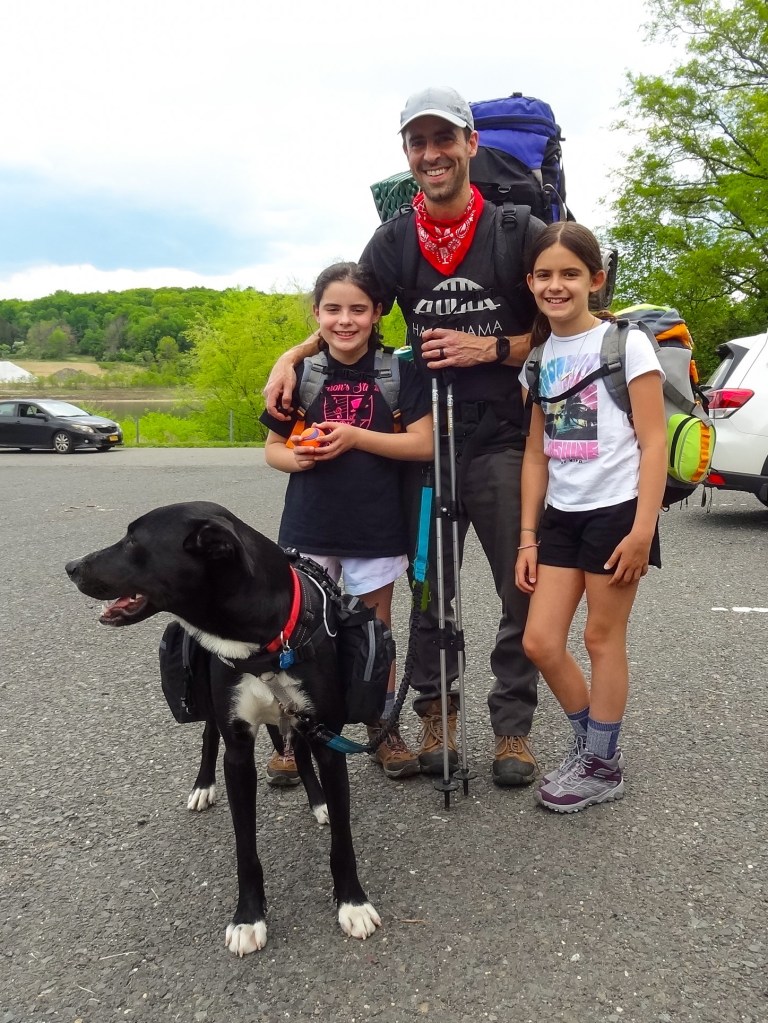
In the spring, son Justin, granddaughters Charlotte and Anna and granddog Arlo hiked five miles with packs for an overnight camping adventure at Round Valley Reservoir. It felt great to do an outdoor adventure again, especially with people you love and admire.
Hiking the Berkshires
In the fall, I managed to get away to Williamstown for a few days, hike Mt. Greylock (highest point in Massachusetts) and see a little bit of the Berkshires with my old friend Mike Kennedy. It was great to just get away, see something new and feel some freedom again.
Playing Handyman: Renovations 🔨🪚🔩🧰
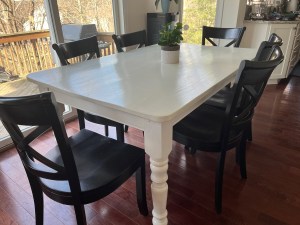
Master Bath VanityKitchen TablePowder Room
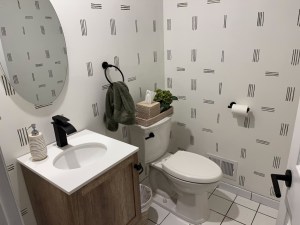
It was well past time to renovate our master bathroom, particularly the formica double vanity. Many years ago when I was younger I enjoyed rebuilding kitchens, baths and other rooms in the house. Watching This Old House was the closest I got to a major construction project in decades. So, retirement offered an opportunity to see if I still remembered skills like plumbing, electricity, carpentry and painting.
Mary Ann found a great deal on a double vanity. After planning this out I got to demolish the current setup, install the vanity and rebuild a set of fixtures. Luckily the rest of the bathroom was fairly modern looking and only required minor improvements. It took a couple months to complete but came with great satisfaction. So much so that I recently switched the vanity in the powder room downstairs and refinished our farmhouse kitchen table. I had forgotten how much satisfaction you can get by doing a project on your own.
And a few other things…
In summary, I have a lot to be thankful for. Here’s a few more to add to the list of what I was able to enjoy this past year….
The benefits of upgrading to a new iPhone 13
The warmth and convenience of converting our wood fireplace to gas
The challenge of finishing jigsaw puzzles
Helping to build and share our ancestry roots with the family
Watching the grandkids enjoy and improve in sports
Reading other people’s life stories (shoutout to Bob, Loredana and Barb!)
Recording the family talent show “Live From Lavalette 2021” (sample below)
I recommend this book to my cycling friends and every father and son that I know. It’s a story of fathers and sons, a cycling adventure and the importance of family and community. Besides that, it’s a fun and fast read!
If life is a journey, then the best moments happen when we have the courage to take a different route. This is a story of a coming of age for three men. The author, Rob, convinces his dad, Stephen, to join him on a discovery bike trip through Italy with the goal of visiting their ancestral village, San Donato. Rob’s grandfather (“Papa”) is seriously ill and is near the end of his life. While Papa was part of a first born generation in the U.S., many of the people that settled in their Brighton neighborhood had come from the same village. Rob concocts the idea of a bike trip to understand Papa’s family background and vicariously provide a trip for Papa before it is too late.
While Rob seems to have a good relationship with dad, it’s obvious that Stephen is not your average father. He’s extremely independent, has obsessive habits and tends to love wild challenges, even at the age of 64. He also manages to commute to work on a “fixie”, which is a sure mark that he is already a badass cyclist. The image we get is of an aged-out hippie that is true to his core of beliefs who is a great father, but is not fully understood by Rob. With Papa slipping away and dad becoming a senior citizen, Rob sees the serendipity of the moment to enlist his father as his companion on a 500 mile trip from Florence to San Donato. As Rob says to Stephen, “We’ll go for Papa.”
While the experiences in the towns along the way are brief and somewhat interesting the real benefit is in overcoming the physical and mental challenges along the way. Once at San Donato, the revealing of the family history and the gracious hospitality there is an unexpected reward. Within a few days in the village, they have a change of perspective and a different appreciation for the importance of history and our ancestry. The village has a surprise story of courage and community during the days of Fascism that brings wonder and pride to both father and son.
I’ve taken a couple long distance bike rides over the past few years. Riding with others can be difficult because of the push and pull of each rider’s skills and conditioning. But, the reward is to discover more about that person, share your own personal story and to motivate each other. There can be no better pairing than father and son to benefit from this opportunity. Any son or father naturally looks back at the mystery of each other and desires at some point to know and understand more – even though that always has its limits. Each fact we discover inevitably reveals something about ourselves too.
The author has a casual style of writing which exposes a mixture of personal feelings and humor which makes for an easy and enjoyable read. The pace of the book and its subject matter is fast and complete as it goes from the start of the idea of the trip to its final conclusion and slightly beyond leaving a very satisfying ending.



























 My Plan C