Watching Ken Burns’ ‘The American Revolution’ brought back memories of my 15-mile historical reenactment walk eight years ago. There’s nothing like being there to appreciate the sacrifices our forefathers made for our country.
It was January 7, 2017, near midnight when we started.
The plan was to walk with a Revolutionary War re-enactment group from Trenton to Princeton to reenact the famous Battle of Princeton. What that actually meant to a crazy group of long distance walkers remained to be seen.
Battle Briefing
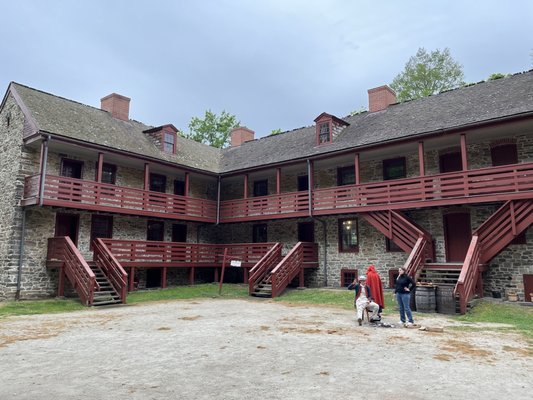
As we approached the Old Barracks of Trenton there was an eerie silence. The old wooden two story building was wrapped in a fort-like fence barely lit by faint street lights in the middle of a post-industrial city. There was no trace of life, let alone preparations for a battle.
Our rag-tag group of six FreeWalkers were here as volunteers to experience what it might have been like to be part of a crucial Revolutionary War battle by following reenactors in an event labeled “To Princeton with Peale!.” To be accurate these were Charles Wilson Peale’s Company of Philadelphia Associators who would march through the night to surprise the British at the Battle of Princeton.
We were experienced long distance walkers but not battle tested, as they were. We were used to marching long distances and even cold temperatures. Our march on Princeton event provided new challenges for both pedestrian civilians and enacting soldiers.
The Battle of Princeton was a crucial event in turning the tide against the British and surprising Cornwallis’s troops. Only days before, Washington had held off the British at Trenton and captured a Hessian garrison after crossing the Delaware.
Now, bolstered by their current successes and desperate for victory, Washington planned a surprise, nightime offensive attack on the British. They needed to somehow quietly march the troops 15 miles around the British flank with a surprise attack on Princeton. Reenactors and observers like us would re-create what it was like to be there and be part of it.
Getting Ready for Battle
The general informs us the troops are still sleeping
Our first problem appeared at the stroke of midnight when we were set to start. We learned the troops were actually still sleeping in the barracks and would start this year at 1:00 a.m.! Where would the Continentals go if they had to wait an hour?“To a pub!” someone replied. As we started walking away, a faint bar light of the Smoke House (aka 1911BBQ) on Front Street appeared. Naturally, we took shelter in preparation of the upcoming battle walk.
At the Smoke House … waiting.
After about an hour at the Smoke House, we were primed for some kind of battle as we spilled out of toward our Continental troops mustering outside the barracks. Orders were given. We were headed to Princeton. Soon we headed down the old streets of Trenton following the troops. There was a positive energy in the air, in spite of the hour, five inches of snow and bitterly cold temperatures.
It’s Time to March
Peale’s Philadelphia Associators at attention and ready to move out
This was our first experience interacting with reenactors. Reenactors take their roles seriously. We managed to chat briefly with couple soldiers but most kept quiet on the march or talked quietly – just as it was ordered by Washington. We learned that historical reenactments are more than just dressing up and marching to this event. There is a sincere attempt to mirror history as best they can.
Quietly marching through the streets of Trenton at 1:30 a.m.
In 1777, history recorded that the temperatures were probably in the 20s and snow had fallen a week before. It had thawed and refroze leaving a crusty snow to walk on. That was an important fact in deciding to attack, as too much mud or deep snow would have made a successful attack impossible. This day we had to face the cold temperature and five fresh inches, enhancing the experience. Our conditions, at least for weather, were worse this year of 2017 than 1777.
We continued past the old colonial homes and townhouses of Trenton into the Chambersburg section. Then continued on a broad Hamilton Avenue into Mercerville, Hamilton and eventually turned on Quaker Bridge Road toward Princeton. This was a roundabout route around Cornwallis’s troops. Now, these are well-travelled commercial roads.
As we walked in the middle of the quiet night in these suburbs the only sign of life was a single Wawa convenience store where we could take shelter for a 15-minute break. The troops were not so lucky. They kept going, presumably because convenience stores are a post-revolution concept.
Our objective was finally reached about 6 a.m. when we approached the Thomas Clarke House on the Princeton Battlefield. This was where the soldiers would come together for the battle reenactment. The only problem with this was that we still had a couple hours before the reenactment began. There was one campfire and one house for all to share and the temperature was said to be in the single digits.
Our history lesson organized by the Princeton Battlefield Society started at 6:45 a.m. It was fascinating and helped put the actual event in perspective. The British Army historian William P. Tatum III, Ph.D. told the story of the battle.
Our History Lesson
We all recognize Washington’s crossing of the Delaware which occurred on December 26, 1776 where he attacked the Hessian troops in the Battle of Trenton. With that success he moved into Trenton and held back the British who attacked him at the Battle of Assunpink Creek on January 2, 1777. Then, in a surprise move, Washington’s troops led by General Mercer continued marching that night toward Princeton to capture the British garrison before heading to Morristown for winter quarters.
Trumbull’s Death of General Mercer
Mercer was mortally wounded. Reinforcements under General Cadwalader turned back after seeing Mercer under fire (Peale’s unit was under Cadwalder). But, eventually Washington sent troops who overcame the British and took over Nassau Hall, a strategic British garrison. The victory helped drive the British out of New Jersey and helped turn the tide of the war. It gave new confidence to the Colonials and helped enlist more soldiers.
On the battlefield where we watched, soldiers fire cannon at costumed British troops on the snow covered fields, amazed at the difficulties of war. Moving heavy cannon in the snow, wadding bullets and gunpowder, meanwhile being shot at in the open. If nothing else this had to be a nerve-wracking experience for both sides. Then, if you consider that most of these men had just been through several major battles in recent days, were lacking sleep and were at the end of their supplies, the effort and outcome seems all the more amazing.
Taking Solace in Victory
The combination of bitter cold, warmth of a fire, shelter in historical homes and the presence of colonial soldiers had created a new, yet old, reality show. After this long 10-hour bitter cold night, learning first-hand about war in the 18th century, and building close bonds with fellow troops – we had enough.
Just as Washington headed to his headquarters in Morristown after the battle, I too headed for my Morristown home.
War is hell, and a tough slog, especially in the winter.
For one sleepless night, we became immersed in history and energized by the spirit of 1776. Huzzah!
As a teenager I witnessed Dylan perform his first electronic set after Newport. Little did I know the music, musicians and fans were to become the stuff of music legend.
Let me be upfront: I was there on August 28, 1965, but I remember little about it. What I do remember is that it was, and still is, the strangest concert I’ve ever attended.
So, I wondered, Is it possible to recall a vague memory that happened 60 years ago and make sense of it today? Could research reconnect sleeping neurons and help me understand what really happened on that one strange night?
Watching A Complete Unknown, the Bob Dylan biopic with a memorable performance by Timothée Chalamet, recently triggered that long dormant memory. The Forest Hills concert was Dylan’s next public appearance after being booed at Newport just a month earlier for daring to plug in and play electric. Up until then, he’d been the lone troubadour: acoustic guitar, harmonica, and words that shook a generation. But the winds of change were already blowing.
For many, Dylan’s transformation felt like betrayal. For me, that night was simply bewildering. I couldn’t make sense of what I saw — but six decades later, I crave to.
The Times They are a-Changin’
We sat in Forest Hills Tennis Stadium in Queens, New York among 15,000 fans filling the horseshoe-shaped arena built for tennis, not rock. Forest Hills was an ideal outdoor venue for a large audience drawn from the New York metropolitan area, including the important Greenwich Village folk scene. Acts like the Beatles, Rolling Stones, and Frank Sinatra had previously played there. In fact, Dylan had played there just a year before, appearing with Joan Baez.
At just 24, Dylan had already become the reluctant “spokesman of a generation.” His lyrics carried rebellion and poetry in equal measure — a mix of Woody Guthrie grit and James Dean defiance. America in 1965 gave him plenty to sing about: war, inequality, and political unrest.
Many think of Dylan as a protest activist. But he was never a joiner — he gave voice to movements without belonging to them. His songs were protest anthems, even when he refused the label “protest singer.”
“I’m not writing for any movement. I just write what I see.”
– Bob Dylan at interview with Studs Turkel (1963)
Yet the times and the sound were changing. Rock music, born in the 1950s, had exploded. By 1965, Dylan sensed it was time to evolve. He began to push both his music and his audience toward a new hybrid of protest and power, folk-rock.
Like a Rolling Stone
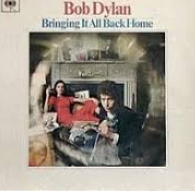
In March of 1965, Dylan released his fifth album Bringing It All Back Home. One side is solo acoustic; the other electric backed by a studio band. The album cover design and music were a clear sign to his fans that he was resetting his style.
Then came the single Like a Rolling Stone (listen) (lyrics) which was recorded in June and released July 20, 1965 before appearing on his next album. This was five days before his notorious appearance at the Newport Folk Festival (July 25, 1965).
The song quickly made the top radio charts even though it had an angry protest message, full use of electronic instruments, and was over six minutes long instead of the industry-standard three minutes. It violated all those norms while creating a popular bridge between folk lyrics and the infectious sound of rock music.
“The first time that I heard Bob Dylan I was in the car with my mother, and we were listening to, I think, maybe WMCA, and on came that snare shot that sounded like somebody kicked open the door to your mind, from ‘Like a Rolling Stone.’ And my mother, who was – she was no stiff with rock and roll, she liked the music, she listened – she sat there for a minute, she looked at me, and she said, ‘That guy can’t sing.’ But I knew she was wrong. I sat there, I didn’t say nothin’, but I knew that I was listening to the toughest voice that I had ever heard.”
– Bruce Springsteen
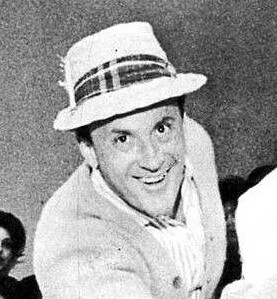
The afternoon before the concert my friend Mike Kennedy called to say he had extra tickets, thanks to his older brother Tom, a Columbia student who was tuned into the changing scene. Mike and I were just 17 years old, Jersey high-schoolers trying to be cool. We’d heard some Dylan, but didn’t yet get Dylan.
We definitely weren’t ready for what we were about to witness.
With No Direction Home
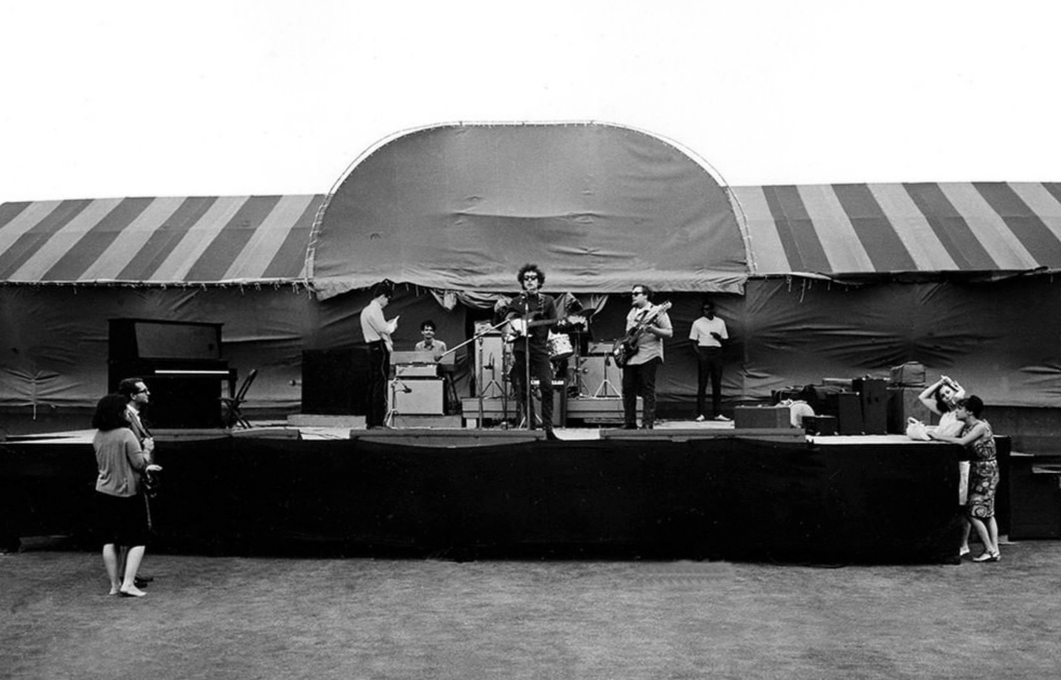
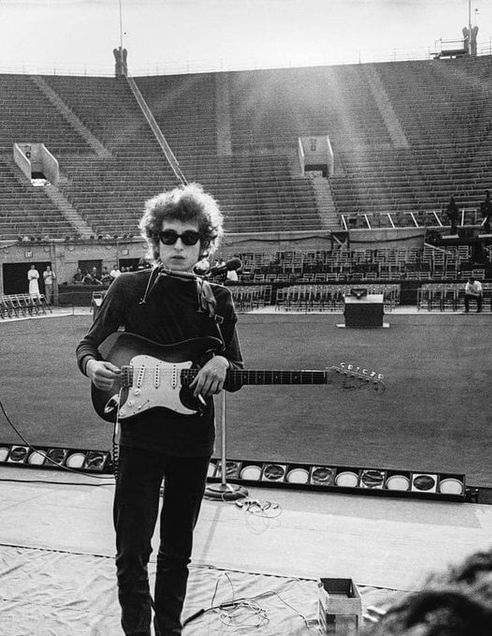
Sound check and rehearsal pre-show at Forest Hills.
Dylan wanted the sound just right after technical problems at Newport. He knew this would be big raucous event and prepared the band or the mayhem that would follow.
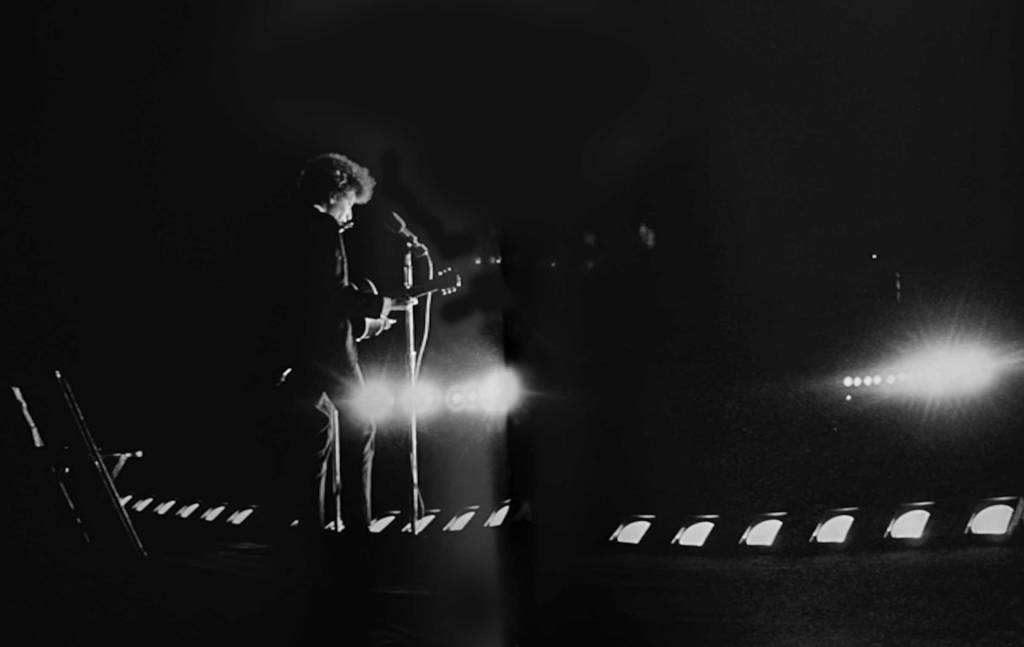
On this unusual windy and cool August night, temperatures dropped from the 80s to the 50s and brought gusty winds. It was an omen of what was to come. We were sitting on bench seats in a steep upper deck of a very dark stadium. Everyone was focused on a single miasma of brilliant light shining on the platform stage where Dylan and his band would perform. You could immediately feel the nervous energy of the buzzing crowd in anticipation of Dylan’s appearance.
Everyone wondered: would Dylan go electric again, like at Newport?
He would — but only halfway. The plan: an acoustic set first; then an electric one.
But the tension was already in the air.
He Really Wasn’t Where Its At
The concert opened oddly with “Murray the K” Kaufman, a popular Top-40 DJ, as emcee. Folk purists booed loudly. To them, Murray symbolized the commercial rock world they despised. It was a taste of things to come.
Click to listen to Murray the K’s intro to the concert
You Say You Never Compromise
The first half of the concert went smoothly. It was the acoustic set which everyone recognized and seemed to enjoy. That is to say Dylan performed solo with guitar and harmonica in his usual style. The 45-minute set including She Belongs to Me, To Ramona, Gates of Eden, Love Minus Zero/No Limit, Desolation Row, It’s All Over Now and closed with Mr. Tambourine Man. This set featured the public debut of the ten-minute long “Desolation Row,” which went over very well with the entire crowd who appreciated its clever caustic lyrics.
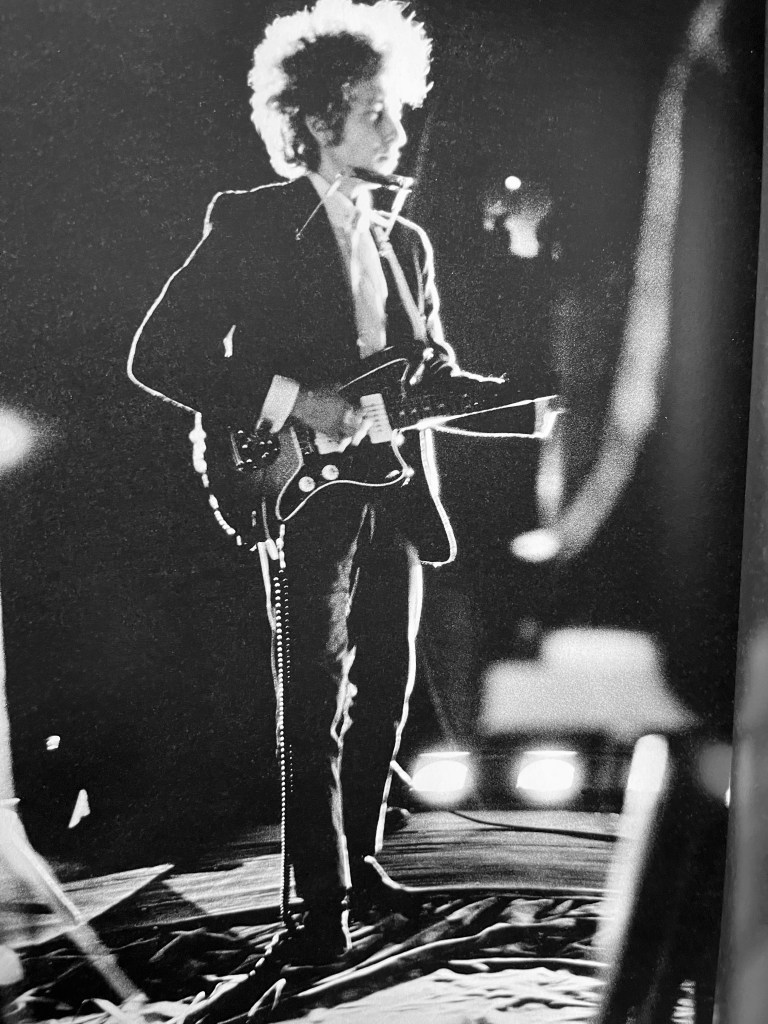
Click here to listen to the full Desolation Row recordingDylan playing solo acoustic guitar. Photo: Daniel Kramer
To Hang On Your Own
After a fifteen-minute break, everyone knew something big was coming. Dylan appeared accompanied by a band of four relatively unknown musicians at the time – Robbie Robertson (guitar), Levon Helm (drums), Al Kooper (organ) and Harvey Brooks (bass). Over the years they would create their own history in the world of rock and roll.
They launched into Tombstone Blues. The stadium erupted — not with joy, but outrage.
Click to listen to the raucous first minute of the electric setDylan’s band at Forest Hills – Photo: Daniel Kramer
“Due to the stage lighting, we couldn’t see the audience – only the deep green lawn in front of us. Since Dylan had gone electric a few weeks earlier at Newport, uncertainty about what would happen here – his first live performance since Newport – was running high. The audience was self-righteously hostile and they didn’t hide it.“
– Harvey Brooks (bass guitarist)
Boos, shouts, insults. “Scumbag!” someone yelled. Dylan shot back, “Aw, come on now.” That was followed by a chorus of “We want Dylan.”
Listen to the negative reactions to the “new” Bob Dylan
Dylan had already anticipated the negative reaction. According to Harvey Brooks Dylan warned the band, “I don’t know what it will be like out there. It’s going to be some kind of carnival, and I want you to all know that up front. So go out there and keep playing no matter how weird it gets!”
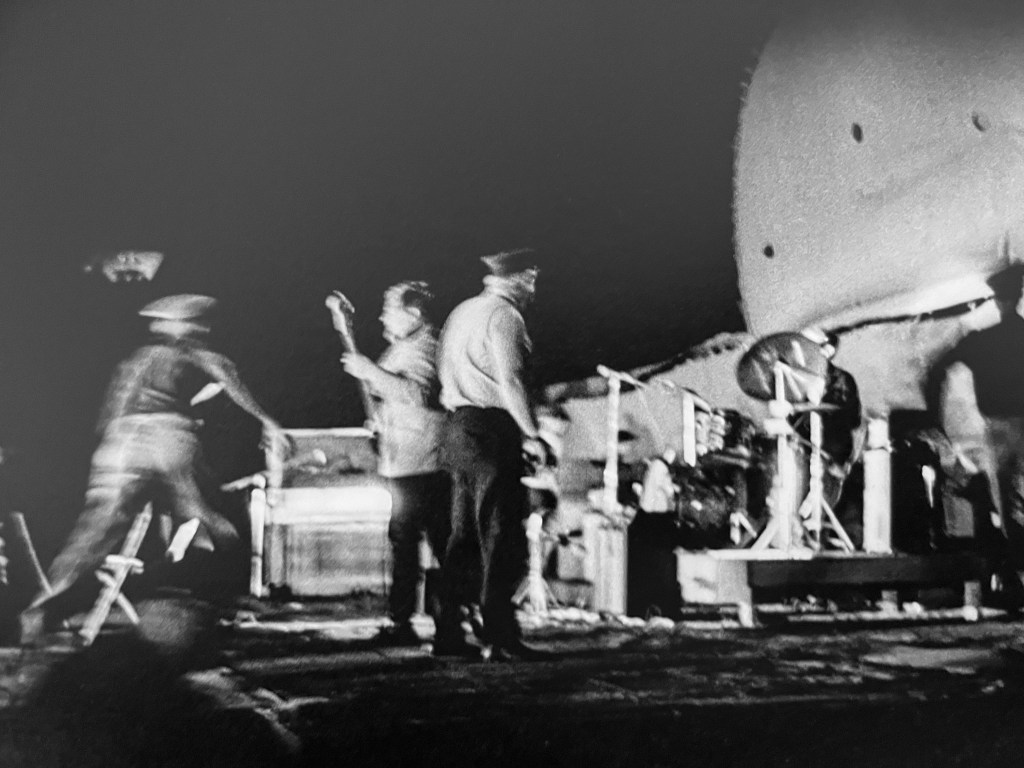
And weird it got. The crowd seemed to quiet a bit after a few songs. But as the set went on the audience grew restless. Half-way through the set, fans ran across the grass toward the stage only to be tackled by security guards. Al Kooper’s organ was knocked over and Levon Helm had to hold off a couple protesters charging his drum set. Objects were thrown at the stage. Still, Bob and the band played on!
Unruly crowd storming the stage – Photo: Daniel Kramer
The electric set included Tombstone Blues, I Don’t Believe You, From A Buick 6, Just Like Tom Thumb’s Blues, Maggie’s Farm, It Ain’t Me Babe, Ballad Of A Thin Man, and Like A Rolling Stone. When he got to Ballad of A Thin Man, Bob played the intro over and over again until the audience quieted down. The concert ended with Like a Rolling Stone and a dozen teens rushing the stage amid the sound of cheers, jeers, and a sing-along! When the song ended Dylan said, “Thank you very much,” and walked off the stage without an encore.
Listen to part of Like a Rolling Stone
The reaction at this concert, and others that followed for over a year, often resembled what started in Newport as a revolt of his fans. That second set clearly split the audience into fans and enemies of the new Dylan.
I didn’t understand the reasoning and hostility but realized that it must have been important enough to have Dylan rebel against his own musical style. I can’t say I enjoyed the concert as much as watching the emotions in the crowd.
“The electric band and the high voltage vocalizing raised the level of Mr. Dylan’s performance from the intimate introspective vein of the first half to a shouting, crackling intensity.“
Robert Shelton, NY Times, August 30, 1965
Dylan had played in a folk style for years, yet he appreciated the new rock sound. In fact, Dylan once said, “I just got tired of playing guitar by myself.” He felt he needed to draw other instruments and musicians into the process.
And Now You’re Gonna Have to Get Used to It
Other singers and rock groups such as the Byrds, Sonny and Cher, Barry McGuire, and the Rolling Stones either copied Dylan or carried their own anti-establishment and free-spirited messages in their songs. Dylan helped move the counter-culture movement that was already reaching a broader popular audience. Pure folk music continued with Pete Seeger, Joan Baez, and groups like Peter, Paul and Mary, and the Mamas and Papas, but would lose much of its momentum to a changing culture and sound. Music became more political, poetic, and electric, mirroring the headlines.
How Does It Feel?
One interesting observation of the concert was that Dylan, while upset at the performance in Newport, was exhilarated by the crowd at Forest Hills. According to band members Kooper and Brooks at a post-concert party, Dylan bounded across the room and hugged both of us. “It was fantastic, a real carnival.” He began to appreciate that fans were reacting to his music. He said to one woman who was said to not have enjoyed the set, “You should have booed me. You should have reacted. That’s what my music is all about.”
“I thought it was great, I really did. If I said anything else I’d be a liar.”
– Bob Dylan on the Forest Hills Concert – Interview by Nora Ephron & Susan Edmiston, summer 1965
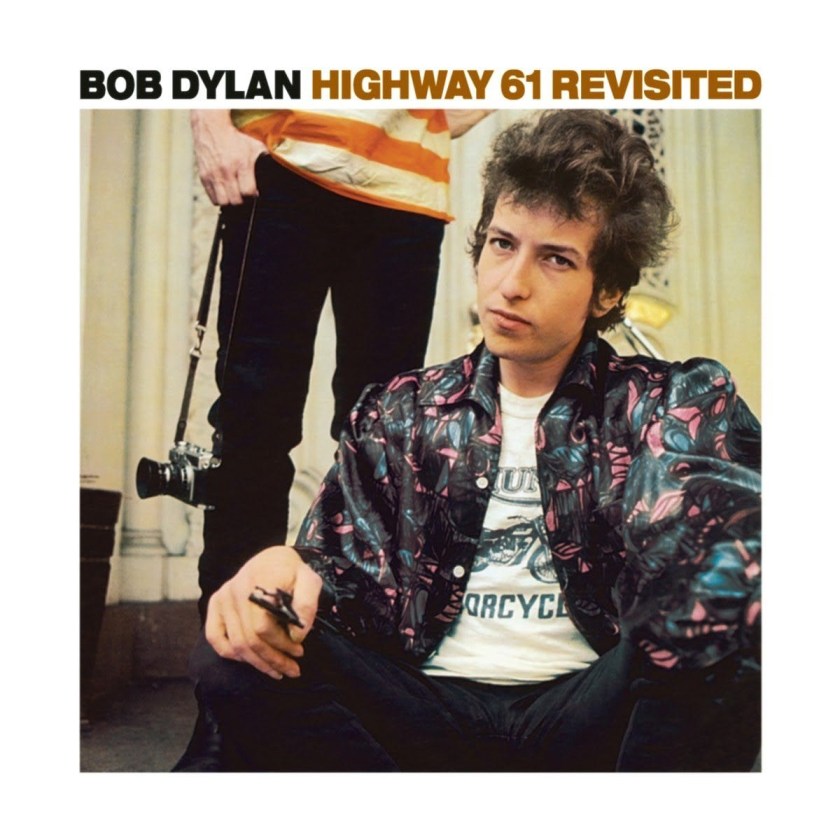
Two days after the Forest Hills concert, Dylan released Highway 61 Revisited, his first full rock album. Its title was a play on U.S. Highway 61, known as the “Blues Highway.” It contained his hit single, Like a Rolling Stone, and was a mixture of songs that tied folk-blues to rock, some of which he introduced at Forest Hills. The album was a success and is considered among the greatest albums of all time.
Dylan went on a worldwide concert tour for the next year with his own band playing a similar format of half folk – half rock format, and fan anger continued. There would be no turning back.
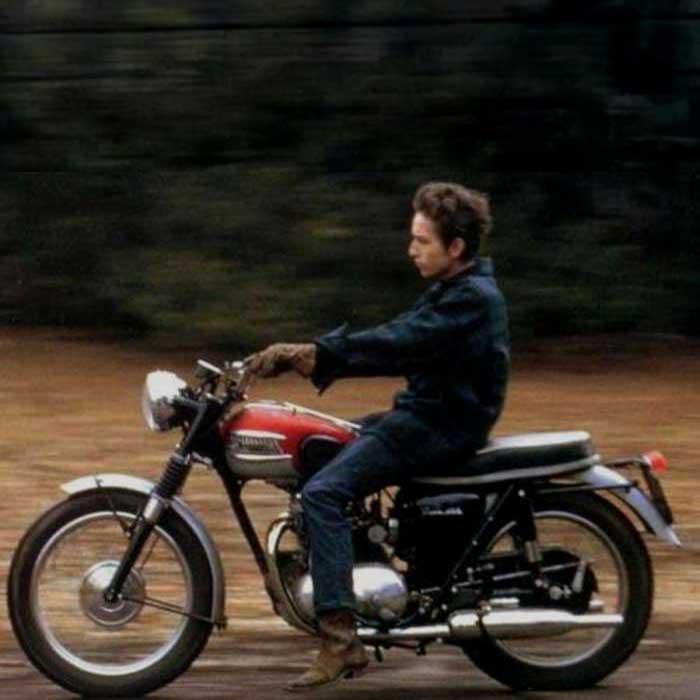
On July 29, 1966 he was seriously hurt in a motorcycle accident near his home in Woodstock, N.Y. Rumors surrounded him. Despite reports that he had serious neck vertebrate injuries, no hospital records were ever discovered. Some speculated that he had enough of the tour and wanted to retreat from the fame. He cancelled all tour dates and retreated out of public attention for the next year.
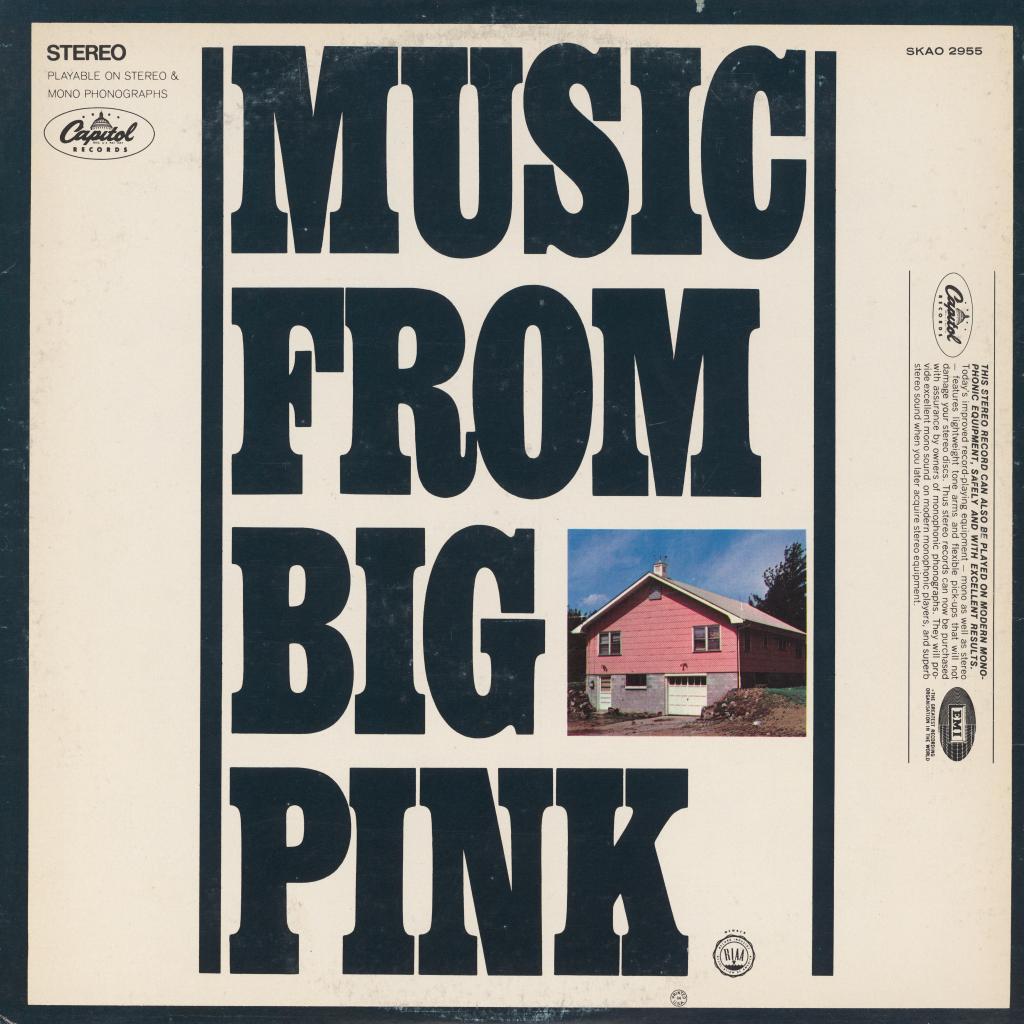
During that year off, he began to collaborate with his bandmates, formerly know as “The Hawks.” Meanwhile, they would release their own famous Music From Big Pinkalbum created at nearby Saugerties. That album would be hailed as a masterpiece and launch their successful career as “The Band.”
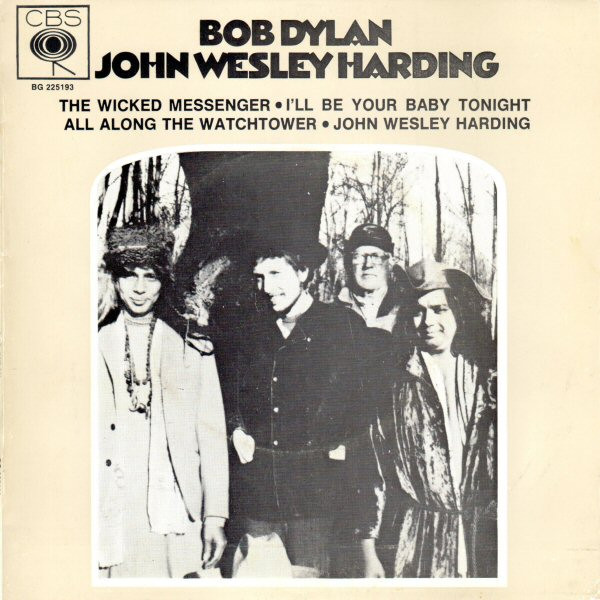
During his recuperation Dylan would work on music that would evolve into his eighth album, John Wesley Harding (December 27, 1967)- which had a distinct country and blues sound and included a new big hit I’ll be Your Baby Tonight. Once again, proving his musical style was always changing.
His style and audience had changed. In fact, throughout his long career to this day, he would constantly change his music, the way it is played, and his interests. Change has always been his one reliable constant.
Afterword
That night in Forest Hills was my first Dylan concert. I’ve seen him a few times since, always curious what he’ll sound like next. My search for reviews and recollections led me into a tangle of lore — Murray the K, Al Kooper, Harvey Brooks, Albert Grossman, Daniel Kramer, Tony Mart, and “The Band.”
No video exists of that concert; only a rough bootleg recording survives. But after revisiting it through memory and research, I realize how lucky I was — to have been there when music, and culture itself, shifted gears.
I may be too old now to recall every detail, but not too old to appreciate it anew.
Long live Dylan — and the memories he still manufactures.
Bonus Tracks
Harvey Brooks Remembers
Harvey Brooks played bass during that electric second set at the Forest Hills. He vividly remembers how strange the night was. Brooks was a renown studio bass player and played on the Highway 61 Revisited and Blonde and Blonde albums. He was asked by Dylan’s manager, Albert Grossman to play on tour for two concerts one at Forest Hills and the other the Hollywood Bowl. He would be replaced by Rick Danko of The Hawks (which would become The Band) for the rest of Dylan’s worldwide tour.
Harvey Brooks (bassist) discusses his memory of playing Dylan’s Forest Hills Concert August. 28, 1965
Al Kooper On His Most Famous Organ Riff
Studio musician Al Kooper played organ at Forest Hills behind Dylan. But the story behind how he got involved is an interesting combination of luck and one brilliant organ riff when recording Like a Rolling Stone . Kooper went on to a successful career as songwriter, record producer, and musician. He played behind many famous musical recordings and founded the group Blood, Sweat and Tears. Kooper was replaced in Dylan’s band after two concerts by Garth Hudson of The Hawks (which would become The Band).
Al Kooper discusses his accidentally famous organ playing on Like a Rolling Stone
Daniel Kramer on Photographing Bob Dylan
On August 27, 1964, the young aspiring photographer Daniel Kramer made a pilgrimage to Woodstock, NY to propose to act as personal photographer for Bob Dylan. Dylan agreed and Kramer went on to produce some of the most iconic and beautiful images of Dylan in his heyday – for exactly one year and a day. Those included album covers, time with friends and concerts such as Forest Hills. Here he shares some of his thoughts on that one-year assignment that brought him fame and added to Dylan’s legend.
Kramer’s opus “Bob Dylan: A Year and a Day” is a great story and source of beautiful images of Dylan in his heyday 1964-1965. This should be on the book shelf of every true Dylan fan. More on Kramer’s work.
Sources
Books
Elijah Wald, Dylan Goes Electric: Newport, Seeger, Dylan and the Night That Split the Sixties. Harper Collins, NY, 2015
Robbie Robertson, Testimony, Penguin Random House, NY, 2016
Levon Helm, This Wheel’s On Fire, William Morrow and Company, NY, 1993
Bob Dylan Press Conference, KQED Studios, San Francisco, CA, December 3rd, 1965 Transcript of a long interview with Dylan during the folk-electric tour with some insight on his music and showing how he always befuddles interviewers. https://dylanstubs.com/extras/1965.pdf
Nora Ephron & Susan Edmiston, Don’t Look Back — Bob Dylan Speaks, New York Herald Tribune Sunday Magazine, New York, June 6, 1965 Transcript of a long interview in the transition period to electric. Famous for Dylan responding to a question if he was a poet, “Oh, I think of myself more as a song and dance man.” https://www.interferenza.net/bcs/interw/65-aug.htm
Thomas Meehan, Public Writer No, 1?, New York Times, December 12, 1965 Meehand discusses the question of Dylan being a true poet for the generation.
Robert Shelton, Dylan Conquers Unruly Audience, New York Times, August 30, 1965 Shelton offers a positive review of the Forest Hills concert in spite of the negative reactions.
Dave Moberg, The Folk and the Rock, Newsweek Magazine, September 20, 1963 Discussion of the new folk-rock movement created by Dylan
Bob Dylan – The Forest Hills Concert (Swingin’ Pig Remaster) [Aug 28, 1965] This is the only audio copy of the original concert. It’s a rough unprofessional recording but covers most of the concert. Click here to listen
Documentaries
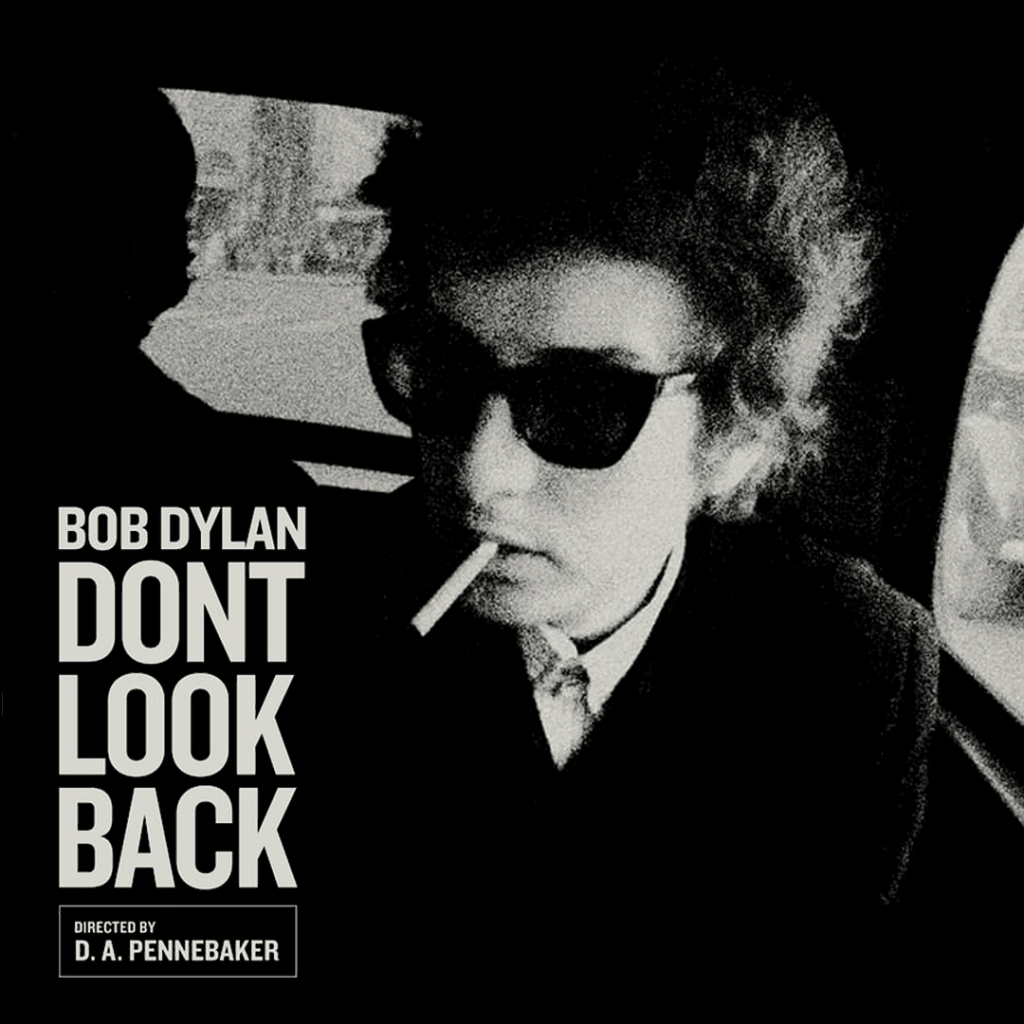
Dont Look Back, 1967 Director: D. A. Pennebaker The definitive Dylan documentary — raw, handheld, and intimate. Dylan’s 1965 U.K tour. Captures him just as he’s leaving folk behind for rock. Led to the behind-the-scenes documentary format in film. Watch options.
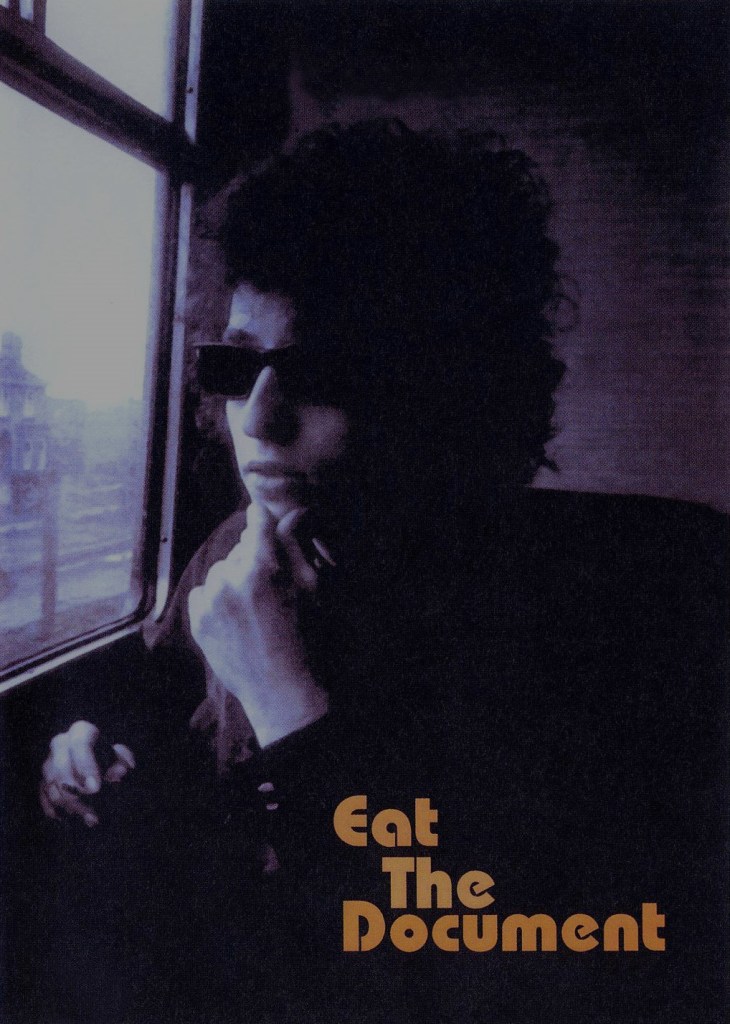
Eat the Document, 1972 Directed by: Bob Dylan & D. A. Pennebaker Dylan’s 1966 European tour with The Hawks (later The Band) This film shows Dylan’s onstage electricity and offstage exhaustion during his chaotic “electric” phase. Watch options.
The Last Waltz, 1978 Director: Martin Scorsese The Band’s final concert and one of rock’s greatest films. Dylan appears near the end — his tribute to having been backed up by these performers on his 1966 tour. Other famous musicians including Neil Young, Joni Mitchell, and Eric Clapton join in. Watch options.
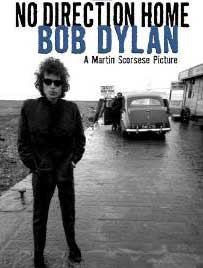
No Direction Home, 2005 Director: Martin Scorsese Film produced with Dylan’s cooperation focusing on Dylan’s early years, 1961–1966. Includes archival footage from Newport Folk Festival and 1966 World Tour showing his evolution from folk hero to rock revolutionary. Watch options.
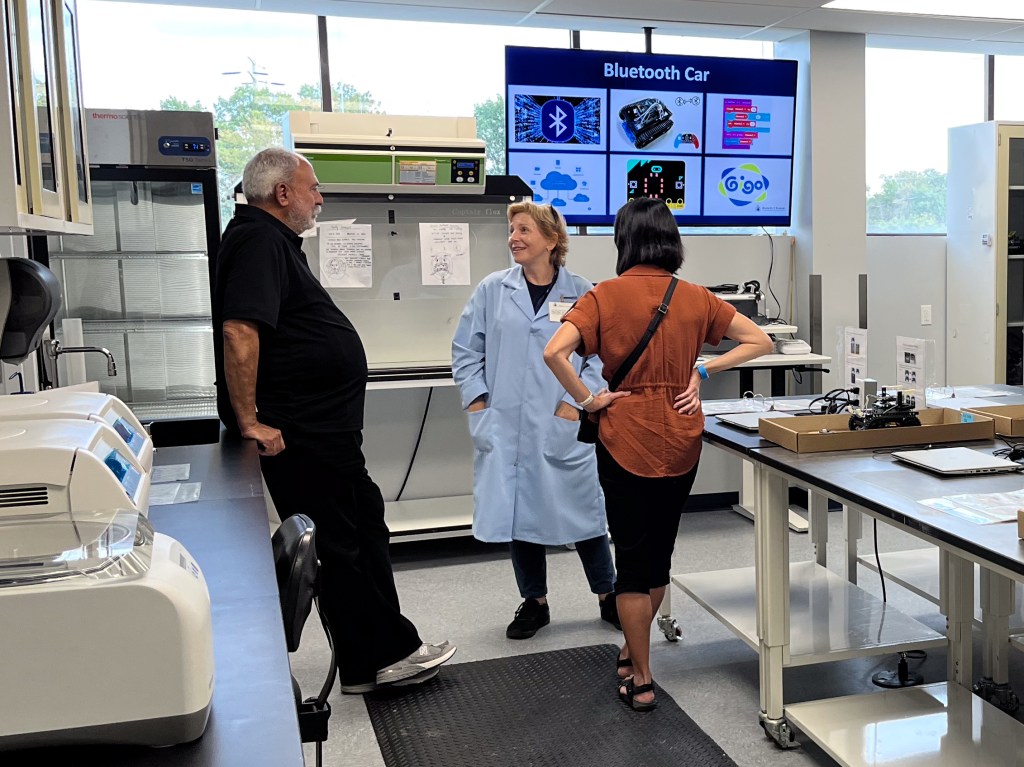
My recent visit to Students 2 Science’s Apollo Technology Center offers hands-on STEM experiences, aiming to inspire underserved New Jersey students. By fostering curiosity and ambition, S2S cultivates future innovators, relying on corporate and individual support for its mission.
I recently had the opportunity to visit a new kind of technology center designed not just to educate, but to inspire students in STEM (Science, Technology, Engineering, and Math) through hands-on experiences. Students 2 Science’s Apollo Technology Center is an ambitious new facility devoted to giving every New Jersey student, especially those from underserved communities, access to real-world science.
Students 2 Science Welcome
As a self-identified techie (at least I used to be), I’ve always been drawn to science, even if math was never my strongest subject. What has always fascinated me is how science and technology can amaze us and improve our lives. That’s probably why my career centered on using technology to solve problems and make things work better.
Today, science faces growing skepticism and misinformation. Healthy questioning is one thing, but the outright rejection of evidence and expertise has become troubling and discouraging for young people who might otherwise pursue careers in the sciences.
My son-in-law, John Dempsey, a trustee of Students 2 Science (S2S), had long spoken highly of the organization and invited me to the opening of their brand-new Apollo Technology Center. I knew little about how science is taught today or what truly motivates students but I was eager to find out.
What I discovered was an impressive nonprofit that has spent years building a professional team of educators, corporate partners, and volunteers dedicated to one mission: making STEM education accessible to all. S2S has already reached nearly 250,000 students across Newark and 25 other New Jersey school districts. The Apollo Center in Whippany, a newly renovated, 20,000-square-foot facility in a once-vacant office building, represents the culmination of those efforts. I wanted to see firsthand how science itself could be re-imagined to inspire the next generation.
During the Open House, visitors could tour the labs and classrooms of this unique facility. I watched demonstrations in ecology, electronics, communications, biology, and medical science. The equipment was modern and professional-grade; the instructors and staff were enthusiastic and eager to share their work.
Two labs especially stood out. The Virtual Lab featured a microscope linked to a digital display, allowing instructors to project real-time images, like a magnified view of bees, to large monitors and even broadcast them live to classrooms across the state via Zoom. Few school districts could replicate this kind of technology and expertise on their own, but through S2S, they can all share in it.
Virtual Lab
The Medical Diagnostics Lab was equally impressive. Designed for high school students, it simulates real-world medical problem-solving. Teams of students are presented with a (hypothetical) patient in crisis and use vital signs and blood test results from actual diagnostic equipment to identify the condition and propose treatment. It’s the kind of immersive, problem-based learning that makes science come alive.
Medical Diagnostic Lab
Experiencing the energy of these labs and meeting the scientists, educators, and volunteers behind them convinced me that Students 2 Science offers something truly special. Programs like this not only teach skills, they spark curiosity, confidence, and ambition. With the growing demand for professionals in science and technology, we need more initiatives like this to cultivate future innovators.
Students 2 Scienceis a nonprofit organization that relies on the generosity of its corporate partners, volunteers, and donors. Companies can contribute equipment, expertise, and mentorship, while individuals can volunteer their time or make donations to support the mission.
If this new “branch” of STEM education is any indication, the future of science in New Jersey and beyond is looking bright and growing.
What was it like to be at the new Shea Stadium on August 15, 1965 to see the Beatles? Proof that serendipity happens every so often.
I’m reposting this 2021 article today (8/15/25) on my experience with the Beatles – being young, naive and lucky; as I would learn as an adult. Today, is the 60th anniversary of that August 15, 1965 concert which would become famous and cherished as marker for this moment in history.
A Washington Post writer, Billy Heller, called me last week to discuss what it was like to be there. I helped fill in some blanks and directed him to my sister Barbara who was there with me, as the best example of what a crazy teenage girl experienced that night. She not only appeared in the lead of the story was interviewed by CBS New York for a small segment recalling that special day for Beatle fans and for Shea stadium.
Unfortunately, the writer neglected the story behind the story, where my friend Mike and I had accidentally found ourselves in the stadium and experienced an other-worldly event that we would only truly appreciate later in life.
Read on if you are curious about our adventure. And do read the full Washington Post article: When the Beatles hit a grand slam in rock-and-roll to get the full idea of what Beatlemania was all about.
Paul Kiczek
This is a TV video screen capture of the August 15, 2025 CBS News segment. Note there is a slight window glare top middle part of screen.
There are not many moments in life where you find yourself witnessing and participating in a significant historical event. You know it even then because there has never been anything like it before. You are gobsmacked with what you see, hear and feel. And, to top it off, all this happens accidentally by a fortunate set of circumstances.
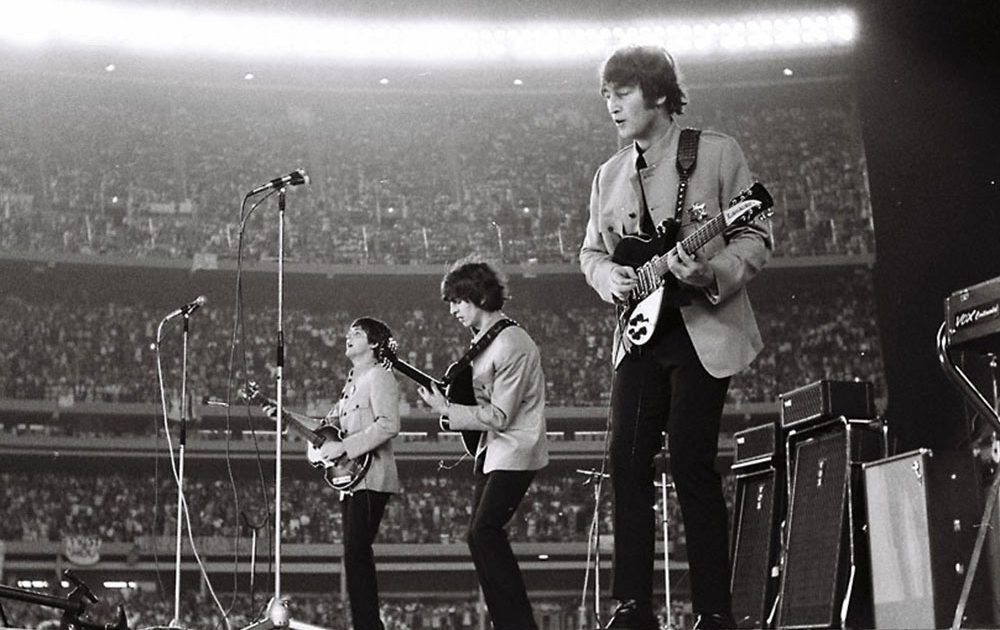
It was on August 15, 1965 that the Beatles were scheduled to play Shea Stadium in Flushing Meadows, New York. My sisters Chris and Barbara and their friend Gail were rabid Beatle fans and they made sure they had their tickets as well as their white go-go boots ready. These were the days when large concerts were rare. This one would be their second tour of the U.S. but the first-ever “stadium concert” and the largest concert crowd (55,600) at any concert at that time.
Strangers in a Strange Land
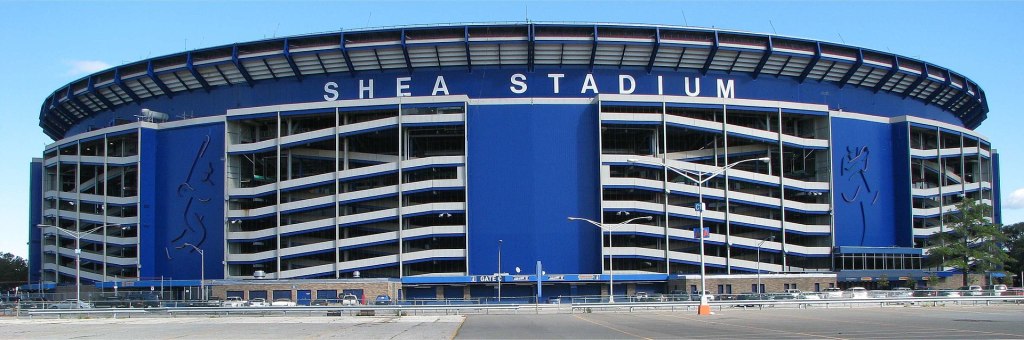
Shea was completed only a year before and as the latest project promoted by Robert Moses, the famed New York City planner, to develop the Queens area. It was located in Flushing Meadows next to the grounds of the World’s Fair of 1964-65 in Corona Park.
Most of us had visited the World’s Fair the year before and marveled at exhibitions. It was a fascinating look at the future and and offered a taste of other countries. I still remember the Lowenbräu beer pavilion where we could drink beer freely, just like being in Bavaria, even though we were underaged and about as naive as we could be about the rest of the world. It seemed like we were moving into the future and becoming part of a bigger world.
1964-65 New York City World’s Fair
Accepting the Mission
In the original plan, my dad was supposed to drive my sisters to and from Shea since they were young teens not old enough to drive. Well, it turned out my buddy Mike Hayser and I were hanging around my house that hazy 80-degree Sunday with nothing particular to do so we volunteered to take them instead. Why my father allowed us to drive I’ll never know but probably the long ride and the need to wait for them were factors. And, it was, after all, the 1960’s and there was a certain freedom and permission that’s hard to reconcile with today’s helicopter parenting.
We didn’t even think about how crazy this could be with thousands of screaming fans. But we sensed that there would be lots of girls and a great adventure awaiting. Little did we know we would be driving directly into history.
At 17 years old I considered my six months of experience enough to tackle the big-game driving in New York City’s traffic and its strange mysterious boroughs. Shea was then a big new and bold stadium. It was built to last for the New York Mets franchise, which started only a few years before. Both the stadium and the team represented new hope for us bitter and abandoned ex-Brooklyn Dodger fans.
1956 Chevrolet Bel Air
The Way to Shea
This was my longest and most challenging drive with my hand-painted blue 56’ Chevy. Living in Roselle, the best way to get to Shea was to take the Goethals Bridge from Elizabeth to Staten Island and drive across the new and mammoth Verrazano-Narrows Bridge (which was another Robert Moses project.). The bridge had just opened in January 1964 and was an instant success allowing traffic to Brooklyn, Queens and Long Island via the Belt and Grand Central Parkways. To us on the Jersey side, these were legendary roads where we were warned daily of horrendous traffic conditions on the radio and assumed only brave and crazy drivers dare go. So, why not try?
Verrazano-Narrows Bridge led to a new world
The only way to get somewhere far away in those days was to rely on old-fashioned, artfully folded paper maps. Every car had dozens of maps in the glove compartment which were free to grab at any gas station. We relied on maps, intuition and signs (if they were still there) to find where we were going. So, we grabbed a map of New York and headed out like modern explorers to find Shea Stadium and experience the wild urban frontier.
Going with the Flow
As we approached Shea the traffic became heavy and led to a stop. A tremendous crowd was moving toward the stadium so we decided to find a parking spot along the road and walk to the stadium, even though our mission was to deliver my sisters and kill some time exploring the area – later to pick them up somehow. My sisters found the gates where ticket holders entered moving rapidly. Mike and I realized at this point that the action was inside the stadium and our best move would be to try and get in.
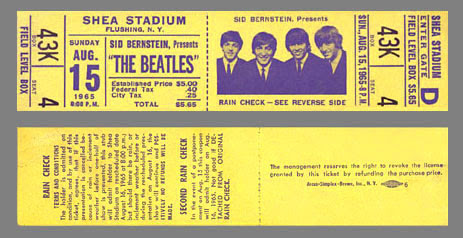
A $5.65 Box Seat Ticket to Ride
We studied the situation and realized that this was a sellout and there no tickets (Box seats cost $5.65 apiece!) to be bought and the security staff seemed only half-interested in checking tickets. So, we approached a guard to tell the story of our good deed of taking my sisters to the concert; only to be left outside waiting. Let’s just say on that day everyone was in a good mood. They turned away as we freely walked into the most important concert of our lives, without a ticket.
The Beatles had only broken into the U.S. market a couple years ago but by now they were known worldwide having created over a half-dozen albums and two films. This was the beginning of their North America tour having just released their album and film “Help!” less than two weeks ago and had appeared on the Ed Sullivan show the night before.
Experiencing Pandemonium
From dugout to stage
Pop concerts were not that common and were not believed to be big revenue generators. All that changed at Shea. The concert at Shea Stadium set a world record for attendance and gross revenue. The Beatles got $160,000 of the $304,000 box office sales and proved that there was money and other benefits in staging large concerts.
Lead off acts included Brenda Holloway, King Curtis, Sounds Incorporated, Killer Joe Piro and The Discothèque Dancers, The Young Rascals and Cannibal & the Headhunters. Hosts included Murray the K and Cousin Brucie Morrow. Television host Ed Sullivan introduced the band when they took the stage: “Now, ladies and gentlemen, honored by their country, decorated by their Queen, and loved here in America, here are The Beatles!”
The concert was ahead of the audio technology at the time and could not properly project the music in the massive stadium. Powerful stage amplifiers couldn’t play louder than the screaming crowd. Even the stadium’s P.A. system, normally used by baseball announcers, was also employed to help project the band’s sound. But, the roar of the crowd could be heard throughout their appearance.
Thousands of fans like these
Once the Beatles started playing, it didn’t matter where your tickets were or if you had one. Everyone spilled into the lower levels and stood for the entire concert in awe of the band and the crowd of frenzied fans. They continued to play 12 songs lasting about an hour. We had traveled two hours, witnessed the largest crowd we had ever seen, managed to crash the gate and listen to some great music. But, nothing compared to the electric reaction of this huge crowd. Girls were out of control and screaming everywhere. I remember getting goosebumps by just witnessing the joy and excitement that was beyond our imagination. It was obvious that Beatles were having as great a time as their audience.
Playing to the ecstatic noisy crowd
After the concert fans stormed the field and we made our way out. I’m still not sure how we found my sisters in that crowd of over 55,000. I don’t remember a thing about the ride home but I’m sure we basked in the good vibes of the event knowing that we were there for a very special event with memories that will last a lifetime.
The Concert at Shea in the Beatles’ Words…
“I think we just went a bit hysterical that night; we couldn’t believe where we were and what was going on, we couldn’t hear a bloody thing and we thought ‘This isn’t very good, but it’s going down great.’ The hysteria started to kick in. That was a great one.”
Paul McCartney, Back To The World tour book
“Once you know you’ve filled a place that size, it’s magic; just walls of people. Half the fun was being involved in this gigantic event ourselves.”
Paul McCartney, The Beatles Bible
“What I remember most about the concert was that we were so far away from the audience. . . And screaming had become the thing to do. . . Everybody screamed. If you look at the footage, you can see how we reacted to the place. It was very big and very strange.”
Ringo Starr, The Beatles Anthology
“At Shea Stadium, I saw the top of the mountain.”
John Lennon, recalling the show in 1970 in a TV interview
Epilogue
It’s interesting to note that at the time of the concert the Watts Los Angeles riots were taking place with the black community angry about the police brutality and civil rights. Meanwhile, President Johnson signed the Voting Act of 1965 that very afternoon establishing new laws that were meant to provide free and fair elections forever.
The mighty Shea was demolished forty seven years later replaced by Citi Field, but the same roads and bridges remain. The Beatles were only in their 20s and at the height of their careers in 1965 but played their last concert together in 1970, just five years later. That last concert and the Beatles legend is still being explored with the release of the new Peter Jackson/Disney+ retrospective on the Beatles last project together, the making of “Get Back.”
History, it seems, is never written in stone and just takes time to understand and appreciate.
The Beatles at Shea Stadium Video
The following video was purchased years ago online and represents a rough cut of the original special recording which appeared on British and American TV as a special. It is approximately 52 minutes long.
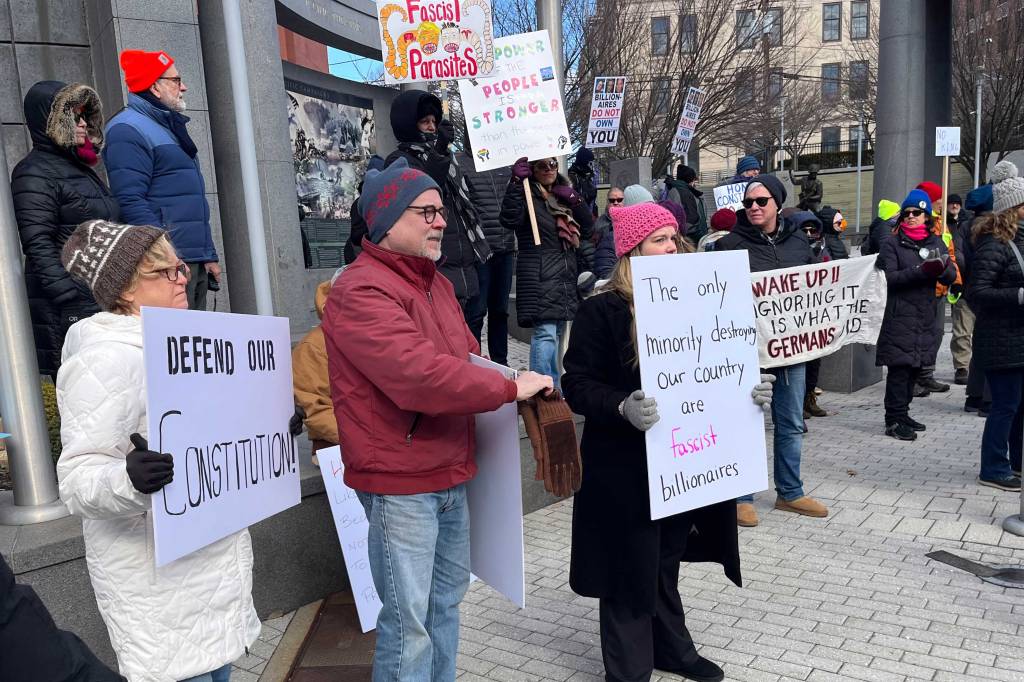
After decades of staying quiet, I stepped into the streets. What I discovered surprised me: protesting isn’t just a political act—it’s a personal practice that builds resilience, awareness, and a sense of belonging.
Like running, protesting requires practice, discipline, and belief that your effort matters—even when you feel alone.
After joining six protests over the past two months, the experience finally started to feel familiar. I began to understand what it was all about. There’s a reason, a rhythm, and even a reward to protesting that I hadn’t grasped before. Still, something instinctual pushed me into it—more impulse than logic.
Protesting doesn’t come naturally. In everyday life, when things are relatively calm, most of us try not to rock the boat. We avoid confrontation, sidestep discomfort. We’re taught to “suck it up” and “don’t be a complainer.” After all, there’s always someone worse off, right? And then there’s the risk—stirring the pot can bring consequences, especially from those who’d rather you simply “behave.” At my age—77—I could easily ask, who needs the trouble?
But what do you do when logic, reason, and normality seem to vanish? Do you just complain? Do you tune out? Seek comfort from friends? That’s where protesting comes in—not just as a solution, but as a kind of therapy.
Fifty years ago, before fitness was even trendy, I took up running as a personal challenge. Back then, adult recreational running was unusual. But as marathons and Olympic athletes captured public attention, the idea caught on. We began to believe that even the average person could strive for something great—even if the race was personal.
Running took a leap of faith. It demanded hard physical work, but promised positive results—mental clarity, health, confidence. It was lonely at first, with little guidance and few role models. But it became a habit. And eventually, the world caught up. Running went from fringe to mainstream.
Now, since January 20th, I’ve taken up a new “sport”: protesting. Frustrated with the state of the nation and the new administration, I turned to activism not just as civic duty—but for my own mental fitness. And like running, protesting requires practice, resilience, and a belief that effort matters.
First, it takes mental toughness to shake off apathy. You need to believe that one person can make a difference—especially when standing with others. And yes, there’s a kind of performance involved. Maybe you’re just holding a sign in silence. Maybe you’re shouting chants or singing satirical songs about a congressman or the president. It can feel awkward or corny at times. But it can also feel exactly right—like you’re doing what needs to be done. Like you’re part of something larger, and your voice is finally being heard.
There’s power in simply showing up. A sign in hand can be the first step toward change.
So, I’ve come to believe we must train ourselves—just like athletes—to overcome political passivity. With every new day of shock and awe, we grow stronger, more aware, more ready to push back. Protesting may not fix everything, but it sends a clear message: we will not sit quietly and watch democracy fade.
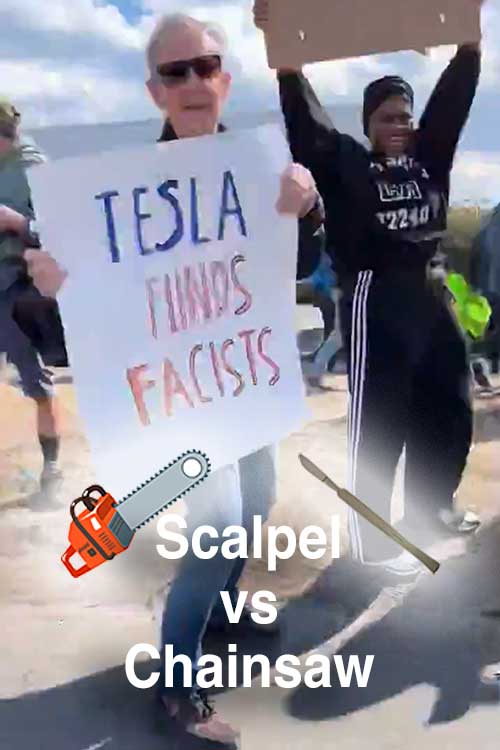
A chainsaw cuts through the trunk but roots remain. Protests are like a thousand surgical cuts, exacting a slow painful death for Tesla.
It was my second protest.
Our target was a newly born corporate giant – Tesla, Inc.
It had the potential to grow into mighty beneficial force only to turn lately into a funding source for a fascist.
Tesla is a corporation led by a charismatic leader who promised a new world of consumer choice with environmental benefits, a cool modern design and a refreshingly new use of energy; only to use his influence and money he earned from his venture to tear down our democracy.
Fortunately, then unfortunately, Tesla grew up to become the step-child of Elon Musk who is a larger-than-life leader responsible for building a good intentioned company; only to become a pawn in his egotistical fantasy and global politics.
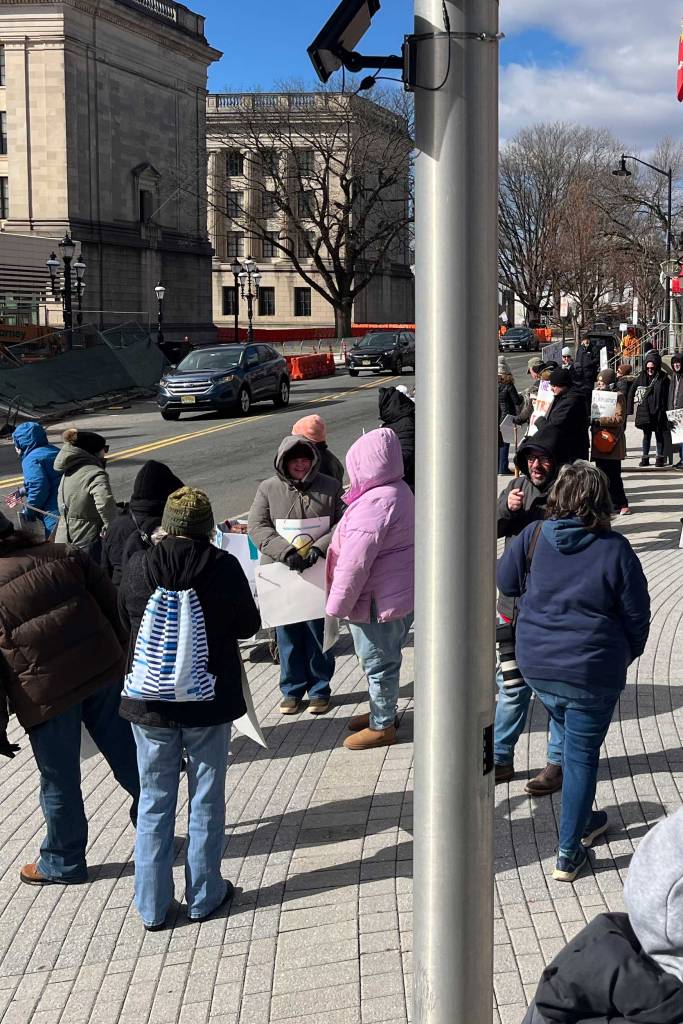
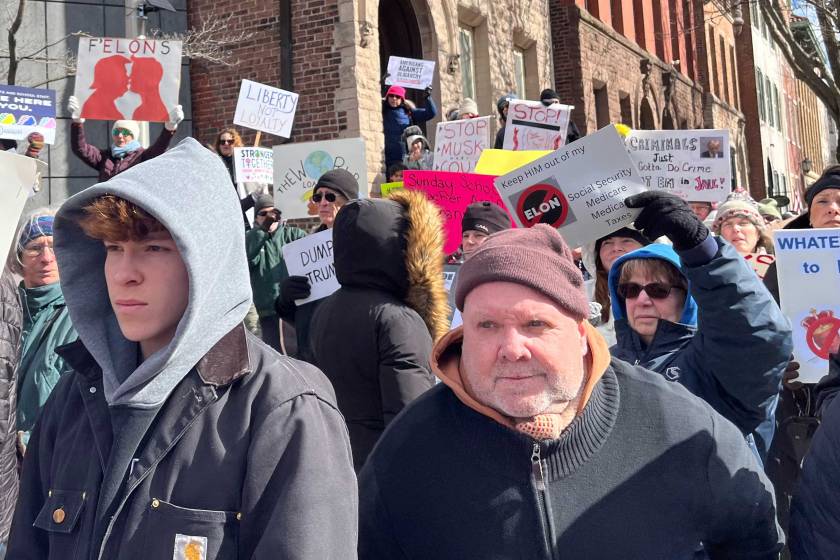
About a week ago, I protested in Trenton at the state capitol building as a general protest of the policies and executive orders of Trump and Musk. I considered that protest a warm-up and learning experience for a rookie. Being a quiet President’s Day in the city, it became apparent that we (about 500) were mostly preaching to the choir. You can’t help but ask yourself at the scene, “Who knows we we are here with our message?” With little traffic and little press coverage, I left there thinking it was worth the effort but it could have been much more. Confessions of a Reluctant Protester.
Paul’s sign for Tesla protest
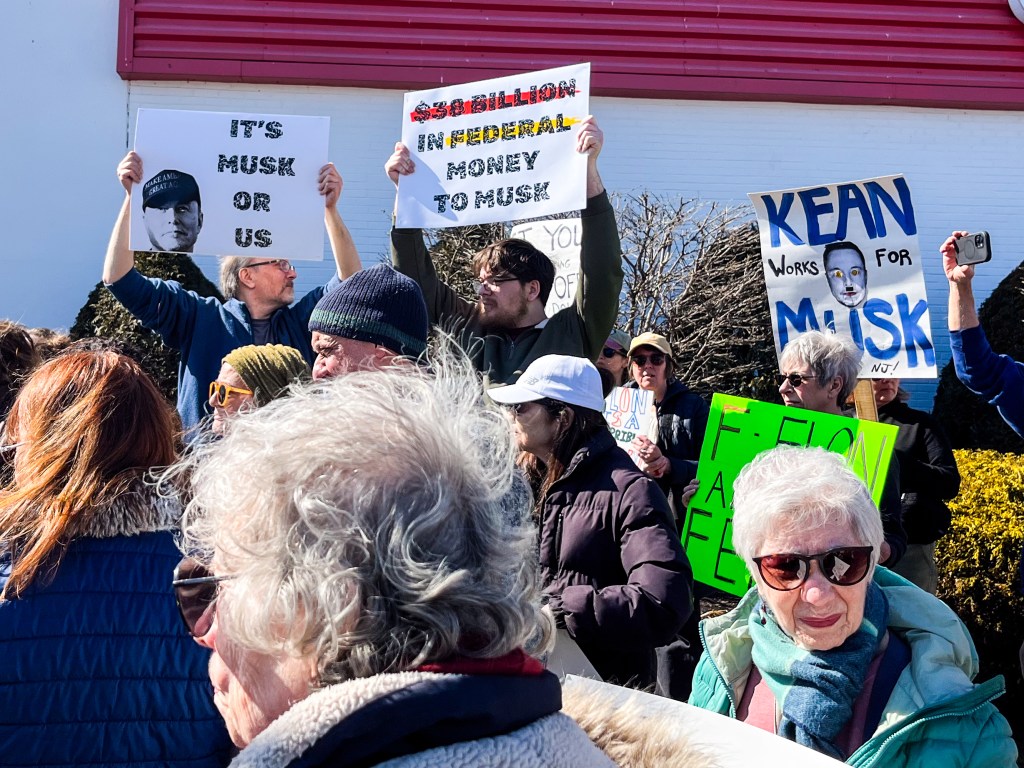
But today, Saturday, March 1, 2025, promised to be a more targeted effort. A Tesla Takedown. We were after Elon Musk’s primary source of wealth and income by loudly demonstrating in front of a Tesla showroom on Route 22, Springfield NJ – a notoriously busy commercial highway. It happens that Tesla vehicles can only be bought online. But, they are typically picked up and serviced at the few regional showrooms. Since, there are no dealerships, any effect that can be made at a showroom is directly on the company and not any independent dealer.
I heard of the hastily planned protest by SOMA Action thru posts on Facebook Group Lean On Us and registered for the event. Our group (estimated at 220) met across the street near a Staples, ready with signs and some general guidelines – Don’t block the showroom, don’t interact if there are counter-protesters and always safety-first. Luckily, there was plenty of parking nearby and a grassy shoulder right in front of the Tesla showroom facing Route 22.
The weather was cold and windy but the traffic was constant and moving slowly as they saw an impressive protesting crowd yelling loudly and waving signs they could not miss. Our enthusiastic group of all ages yelled to chants such as “Hey, hey, ho, ho, Elon Musk has got to go!” As cars were going by at 20 mph, horns were blaring in support. Even more strangely, many passengers (and even some drivers) were video-recording the protest on their smartphones as they passed by. It seemed mostly positive support, in spite of the fact that we were causing a major slowdown!
A steady stream of traffic, including local police and Tesla owners drove by from noon to 1:30. I felt tired yet relieved. We all came away with the feeling that this was an effective protest having been seen and heard by several hundred, if not thousands, in a very short time.
I know if I owned a Tesla, whether or not I believed in what Musk-Trump was doing, I might think hard about conveying a negative feeling. Does the car now represent a political point of view? Has the brand and value of my Tesla been trashed? Being able to generate those feelings is a victory, however small, for democracy by my account.
If Musk-Trump can “chainsaw” government services at the elevated organization level by cutting thousands of jobs at once, maybe enough motivated individuals can surgically cut into organizations like Tesla with a “scalpel” using various forms of protests that destroy the brand and negatively affect sales over time.
Tesla’s role as a pioneer in electric vehicles is over. Today, there are plenty of companies that can offer a better product without the dirty laundry. We can put capitalism to work if we all get out our scalpels and carve Tesla into a pariah. A slow death for Tesla, by a thousand cuts, would be sweet justice and a fitting contrast to a chainsaw massacre.
More Thomas Paine words of wisdom in troubled times….
What can the average person do to fight back? It’s never too early or too late to get involved. Take back our country before it’s too late.
It didn’t have to be this way. I’m a reluctant protester and I’m pissed off.
I have been enjoying an active, yet complacent retirement for the last eight years. At least that was the case until Trump clawed his way back to running our nation. Four days from today I’ll turn 77 years old. I’m at a time in my life where one usually mellows and winds down activities and ambitions. But, if Trump, at 78, can find the energy to ruin a country, then maybe I should at least try to help build it back. But how?
I’m still trying to understand what happened in just a few short weeks. What will happen tomorrow? And, how can anything be the same once the dust settles? I bemoan those who have lost their government jobs and noble ideals that they upheld. Collateral business, friendships and relationships may be permanently frayed. It will take a lot of effort to someday reconstruct a government and a community that are in basic harmony again.
I have to ask myself, “Is it me?” Why do those I care about not seem as troubled about the repercussions of what is happening? The news is filled with so many new catastrophes each day. It’s all shocking and numbing, yet still feels distant right now. Most of us have yet to see the effect these changes will have to employment, health, safety and peace – to name a few likely bad outcomes. And, for what?
Protest – “Not My President”
Last Monday I gathered for a protest at the New Jersey state capitol building in Trenton for a few hours, venting my frustrations and meeting others who had similar feelings. I had gotten a tip from my friend Bob who had posted some of his frustrations with the current state of affairs. He created a private Facebook group Lean On Us which linked to a national public site 50501 which listed a “Not My President Day” event. It seemed like the perfect celebration for this President’s Day. Understand, at this point most of us are just becoming active and have no idea how this works and what to expect.
I got there early and then watched as a handful of us became a large crowd of about 500 or more. Apparently, our small group was just one of many small organic groups of citizens that had become frustrated enough to get out in 20 degree weather with 20 mph winds to protest what Trump-Musk is doing to destroy our government. There were no speakers but plenty of motivated, energetic and loud people with great rebellious signs wanting to take back what we already lost and to stop the bleeding.
Protest Builds
The size of the crowd, chants and the waiving and beeping of cars was the only indication that we are on the right track. There was little press coverage, although similar protests were happening across the country at many state capital buildings.
I would not call protesting fun but it is rewarding. A least it feels like I’m actively doing something. Ultimately, you want your effort to pay off and have some effect, even it’s just to let others know that they are not alone. My dream is that everyone finds a way to express their anger and their will; enough to change what seems to be an inevitable train wreck.
If you feel frustrated too, find a way to get active. It's a new rebellion. Protesting, phone calls, writing letters, talking to others will help you cope as it did for me.
Remember what Thomas Paine wrote in the American Crisis..."These are the times that try men's souls."
The dreams and nightmares of a 14 yr old Auschwitz prisoner is part of what has been haunting me. Ghosts are all around and are trying to warn us.
Visiting Auschwitz was a profoundly emotional, yet strangely analytical experience. Your senses and mind struggle to comprehend the unimaginable atrocities that unfolded there.
Being physically present in such a place heightens your awareness in ways no history lesson ever could. But sometimes, a single image can evoke emotions almost as powerfully.
Since that visit, I’ve often felt haunted by echoes of what I witnessed. Evidence of this haunting continues to surface.
Shortly after our trip to Poland, I watched A Real Pain, a film about two Jewish cousins, David (Jesse Eisenberg) and Benji (Kieran Culkin), on a Polish heritage tour. While the film is mostly a comedy, their visit to the Majdanek concentration camp bore an unsettling resemblance to my own experience.
Not long after, The Zone of Interest was released. The film focuses on Auschwitz commandant Rudolf Höss and his wife Hedwig, who live a comfortable family life just beyond the fence of the concentration camp. In their home, domestic routines play out against the distant backdrop of prison sounds and the ever-present specter of death.
More recently, I read a review of Lily Tuck’s book in the New York Times. The book, inspired by a single photograph of a 14-year-old girl, imagines the life of an inmate before and during the Holocaust. That led to my expanded interest in the holocaust.
Then came Holocaust Remembrance Day, marking the 80th anniversary of Auschwitz’s liberation. Media coverage was filled with stories from the few remaining survivors, all children during that horrific time. Their voices served as reminders that the past still lingers.
Ghosts don’t need to appear physically to haunt us; they are far more subtle. The echoes of the dead surround us if we care to look and listen.
My Goodreads Book Review: The Rest is Memory
It was less than a year ago, on a heritage tour of Poland, that I had an opportunity to visit the Auschwitz-Birkenau Museum. That visit was still fresh in my mind. So, when I learned of Lily Tuck’s new book “The Rest is Memory,” a portrayal of a young prisoner, I immediately dove into the book to see if it could provide a perspective of what it was like as a teenager to experience this manufactured hell.
Visiting Auschwitz is an otherworldly experience. The tour is an extremely efficient, almost military process, led by knowledgeable docents who lead you through various buildings and exhibits. The guide touches on who was imprisoned there, how they were treated and the unfathomable amount of death and destruction that occurred. The fact that over a million prisoners died in this one camp, the great majority between just 1942 and 1944, is hard to comprehend.
There is a special quiet and solemn feeling shared by all throughout the tour. Occasionally, you would hear someone in the tour breakdown in tears. But, most of us were absorbed in trying to comprehend what happened and how we could reconcile that with our understanding of humanity. Our tour guide explained in simple, cold terms the operation of the camp and how a prisoner might live and die here. The grounds and exhibits were obvious evidence of the holocaust.
Seeing prisoner ID portrait photos on a wall was my most vivid memory. They personalized life in a concentration camp. No photo could even begin to tell the story of what a person went through, although they looked like they knew what was ahead. However, there were some survivors, including the camp photographer, Willhelm Brasse, who managed to save 40,000 photos along with his memories.
The Rest is Memory is a story of the star-crossed life of Czeslawa Kowka, a 14-year old female prisoner, who’s camp portrait became an obsession for Tuck as she imagined what it must have been like for her. It is told in a style that recalls my Auschwitz tour guide’s careful, factual and unemotional telling. The language is sparse and almost banal. There’s no need here for elaboration or exaggeration when imagination based on facts is a more powerful agent.
Czeslawa’s personal story is necessarily made up by Tuck. Czeslawa was tattooed as prisoner number 26947 and immediately lost her identity when she arrived in Auschwitz in 1942. There is little trace of her real life, except for a few basic facts like birth date (August 15, 1928), internment date (December 13, 1942) and death (March 12, 1943). Tuck appears to have looked back at her hometown area and constructed a possible tale of a normal life before the Nazi invasion. Its a life of a pre-war ordinary teenager with a romantic interest in Anton, an older guy with a motorcycle. She’s close with her mother Katarzyna, friends, community and church (she is Polish Catholic). Although she has an abusive, distant father, she has an enjoyable life and a promising future, maybe even as a teacher. All this will be violently taken from her within a couple of years.
Tuck seems just as committed to telling the horrific story of how the Polish people were completely controlled and abused. The Nazis declared war on Poland in September 1939 and in twenty-six days gained full control of the entire country. Hitler declared “The destruction of Poland is our primary task.” Germany needed “Lebensraum” (living space) for its survival and expansion. Most of the populations of Central and Eastern Europe would have to be removed permanently through mass deportation, extermination, or enslavement. The country of Poland was to be resettled with Germans.
Czeslawa lived in the small town of Wólka Złojecka outside of the historic eastern city of Zamosc. This area would be among the first to be repopulated in 1941. Over 110,000 would eventually move. She and her mother were forced off their farm with other women and eventually sent to Auschwitz to do forced labor. We learn her father (Pawel), uncle and other farmers in her village are shot and buried in a mass grave. Her would-be boyfriend Anton escapes on his motorcycle only to be beaten, imprisoned and die in Russia. Even though Russia fought Germany, it also had its designs on Polish territory and inflicted its own cruelty on the Poles. There appeared to be no escape for the Poles.
The book alternates timelines: from a broad historical view, to the innocent mind of a young girl before all this happens and then to the mundane sadness of a prisoner of which there is no hope. Although we don’t dwell on the suffering it seems to be everywhere. If you juxtapose that with the privileged life of the SS guards and their Commandant Rudolph Höss, it becomes hard to imagine a crueler place.
Pleasant and unpleasant memories are all that are left for Czeslawa. Occasionally, there are flashes of what might have been. Dreams of food, friends, wizards, dragons and even dogs are all warped by the environment where scarcity is everywhere and hope is nowhere to be found.
The book weighing in at 112 pages is a blessedly short read. My normal reading self would have craved for more details. But, I think in this case, Tuck sets the limit on what we need to know. For me, reading The Rest is Memory was like re-visiting Auschwitz. It is not a pleasant experience but a re-awakening of my senses and imagination. Unfortunately, we see many of the same cruel signs of those times around us today. Its always worth considering what are the limits of humanity and acknowledge that if it happened once, it can happen again.
The above review was published on Goodreads which can be accessed here.
A brief look at three days in the cultural capital of our motherland. It was our reward for a week’s worth of exploring family history in Poland.
Three days were not enough! But we gave it our best shot. There’s plenty to see and do in this old classic European City. It’s probably the best place to truly understand Poland and its rich history.
As we approached Kraków, the highway gave way to a grand boulevard. Stylish pedestrians strolled past modern storefronts housed in historic buildings. After five days as an odd trio of Americans navigating a land both unfamiliar yet strikingly reminiscent of suburban America, we found ourselves in a quintessential European city. Kraków exuded all the charm, energy, and grandeur of the world’s great cities.
Thanks to our guide and translator, Lucjan Cichochi, we had managed to overcome the language barrier during our PolishOrigins tour. As we prepared to part ways with him and venture out on our own, we reflected on how a few key phrases and a friendly attitude could go a long way in bridging communication gaps. Now, it was time for a little indulgence: the ease of English accessibility, the freedom of being a tourist, and the vibrancy of Kraków awaited us.
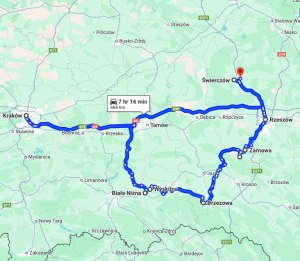
Ethan (my son), Ethan Luke (my grandson), and I had traveled over 200 miles across southeastern Poland by van, tracing our family roots. Over the past week, we experienced moments of wonder and joy as we discovered familial connections, met new relatives, and explored beautiful locales. Even when our leads seemed to run dry, the journey offered insights into Polish life and history, connecting us with our ancestors’ world.
After an enriching week in Poland’s rural heartlands, we turned our attention to Kraków—our final destination. Over the next three days, we planned to immerse ourselves in the city’s rich history and culture, which serve as a proud testament to Poland’s enduring spirit.
Kraków, one of Poland’s oldest and most significant cities, became the country’s capital in 1038. Situated along the Vistula River, it has long been a hub for trade, linking the Baltic and Black Seas. During the Middle Ages, Poland grew into one of Europe’s most influential nations, with shifting borders reflecting its complex history of alliances, invasions, and leadership changes. Though the political capital moved to Warsaw in 1596, Kraków remained the intellectual, cultural, and historical heart of the nation.
Kazimierz: A Neighborhood with a Soul
Friday, June 14, 2024
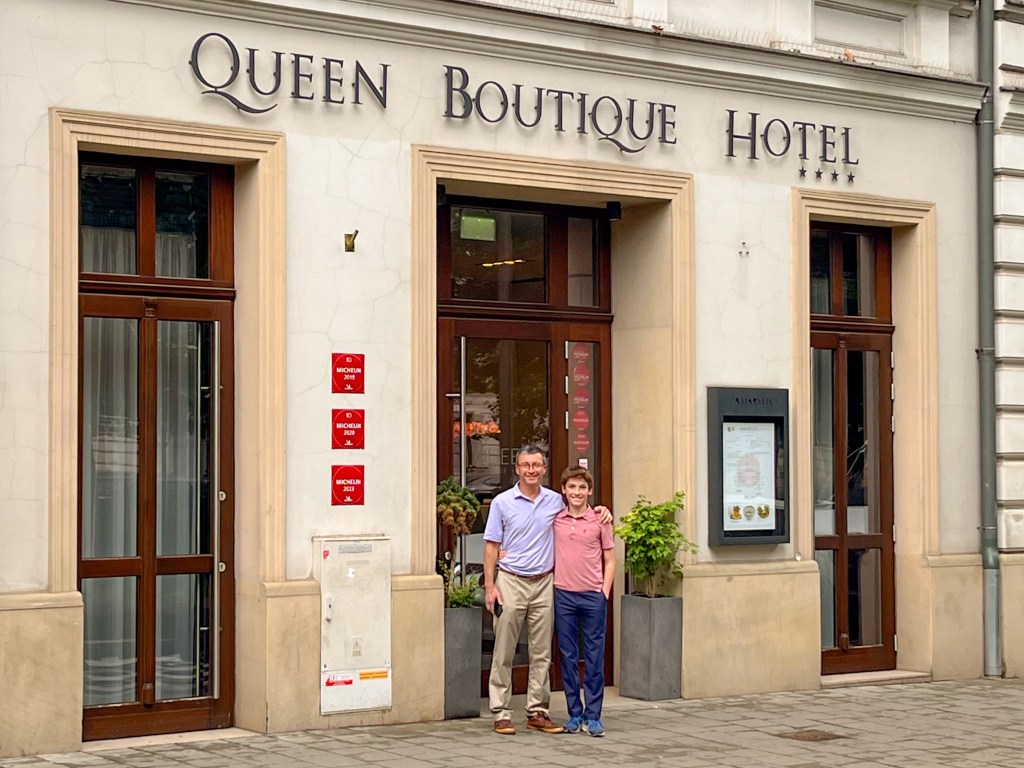
We arrived in the afternoon at the Queen Boutique Hotel, a four-star gem nestled in the heart of Kraków’s Kazimierz district. With spacious rooms priced at a reasonable $130 per night, the hotel’s central location made it an ideal base for exploring nearby landmarks, including Wawel Castle, Old Town, and Podgórze.
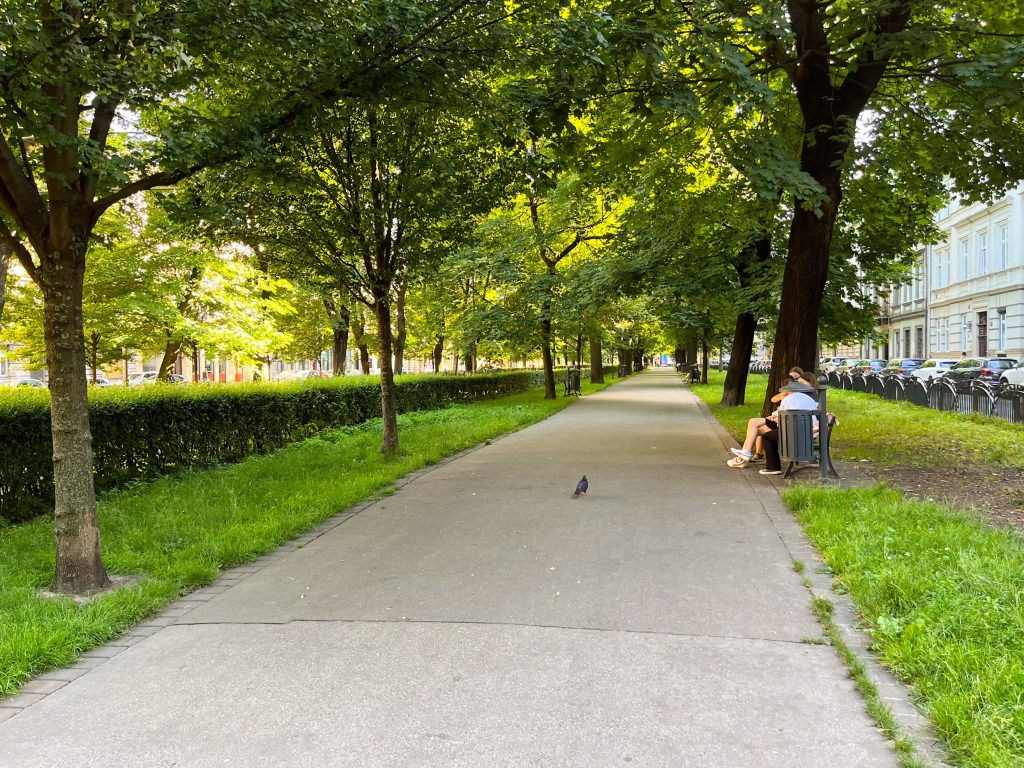
Outside our Hotel in KrakiwStrolling the Dietla
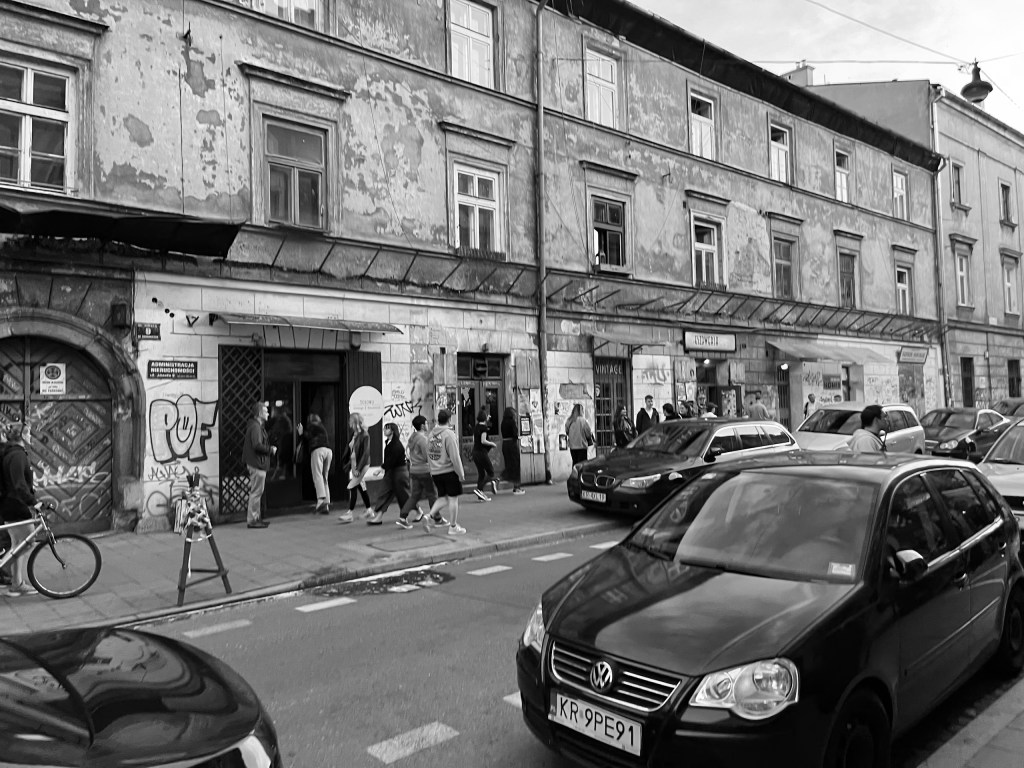
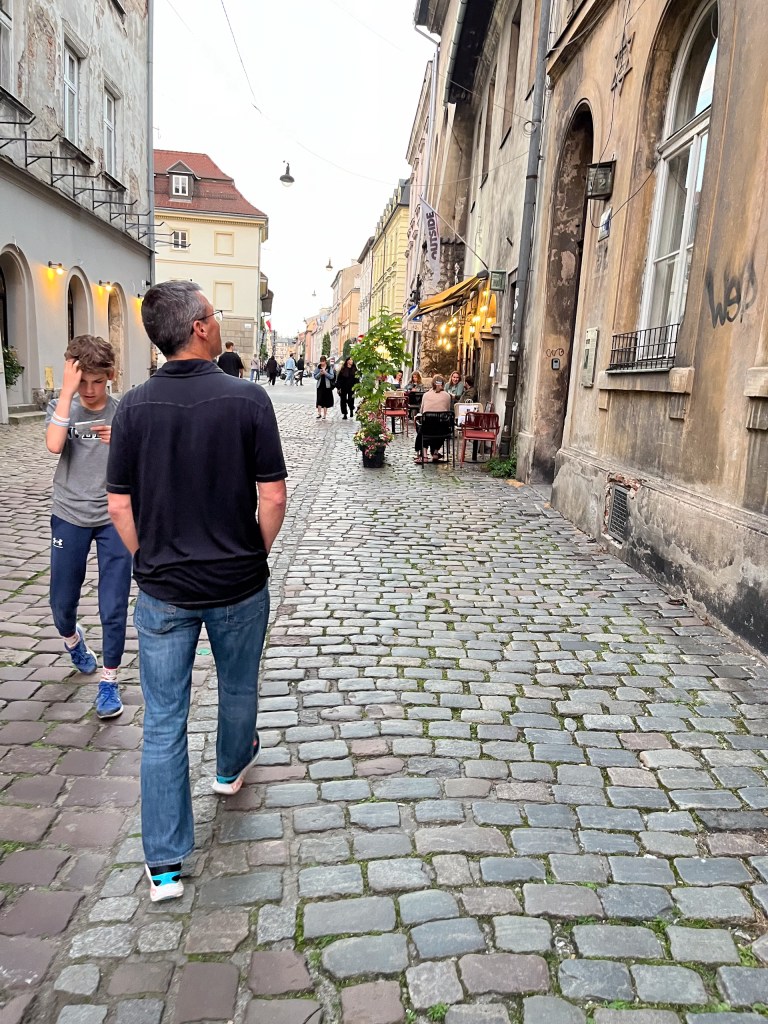
That evening, we ventured out, guided by local restaurant recommendations. Just beyond our hotel, we crossed the leafy Dietla boulevard and entered Kazimierz. The area’s weathered facades, adorned with graffiti and steeped in history, told a story of resilience and rebirth.
A Challenging History
Once an independent town, Kazimierz became a haven for Jewish refugees fleeing persecution. By World War II, it had evolved into Kraków’s Jewish quarter, only to be devastated by the Nazis. During the communist era, Kazimierz remained neglected until the 1990s, when the movie Shindler’s List sparked a cultural revival.
Savoring Flavors and Music
Drawn by lively music, we stumbled upon a cozy plaza surrounded by restaurants. The weather at 7:30 p.m. in mid-June was still bright (darkness around 10:00 p.m.) and comfortable, perfect for eating outside and watching the crowd of visitors. We dined outside at AWIW, a Jewish-Polish café, as we broadened our culinary tastes with a mix of Polish, Jewish, and Middle Eastern dishes, all accompanied by traditional klezmer music.
After dinner we decided to explore more of Kasimierz. While looking rundown and dirty, this was the liveliest and most creative section in town, filled with historical buildings, galleries, and restaurants.
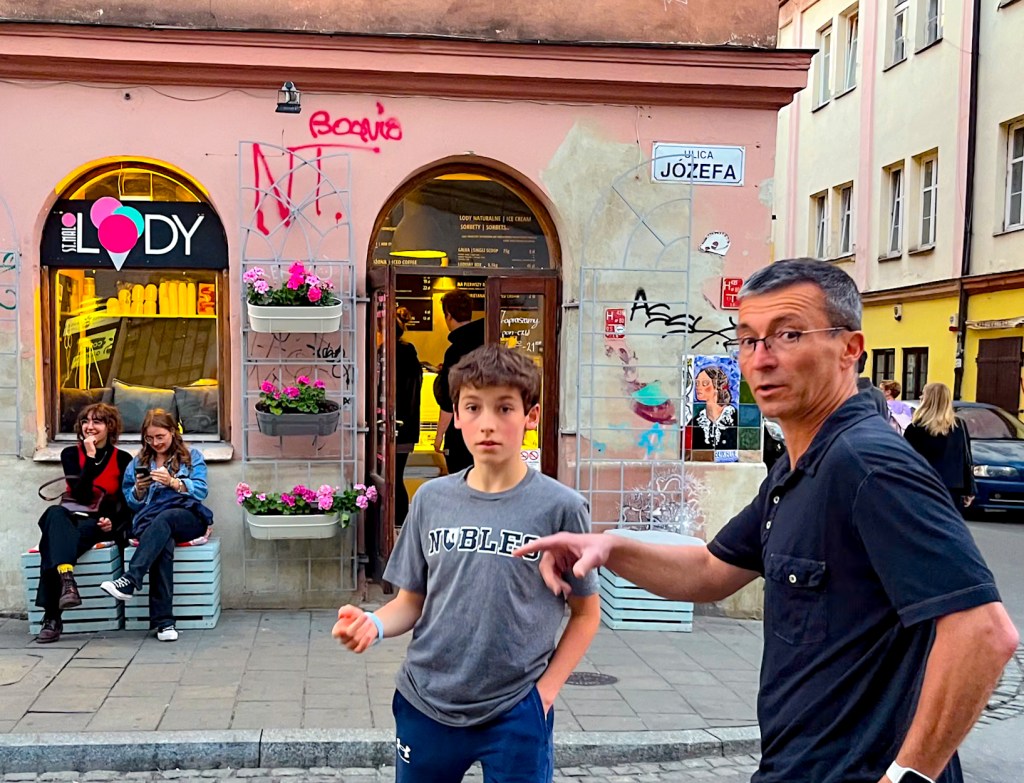
Tonight we set aside our hunt for the past and searched for the best homemade ice cream for dessert. It was not easy. There were too many places to choose from and it seemed we were not the only ones on that mission.
A Day in Polish History
Saturday, June 15, 2024
Wawel Hill
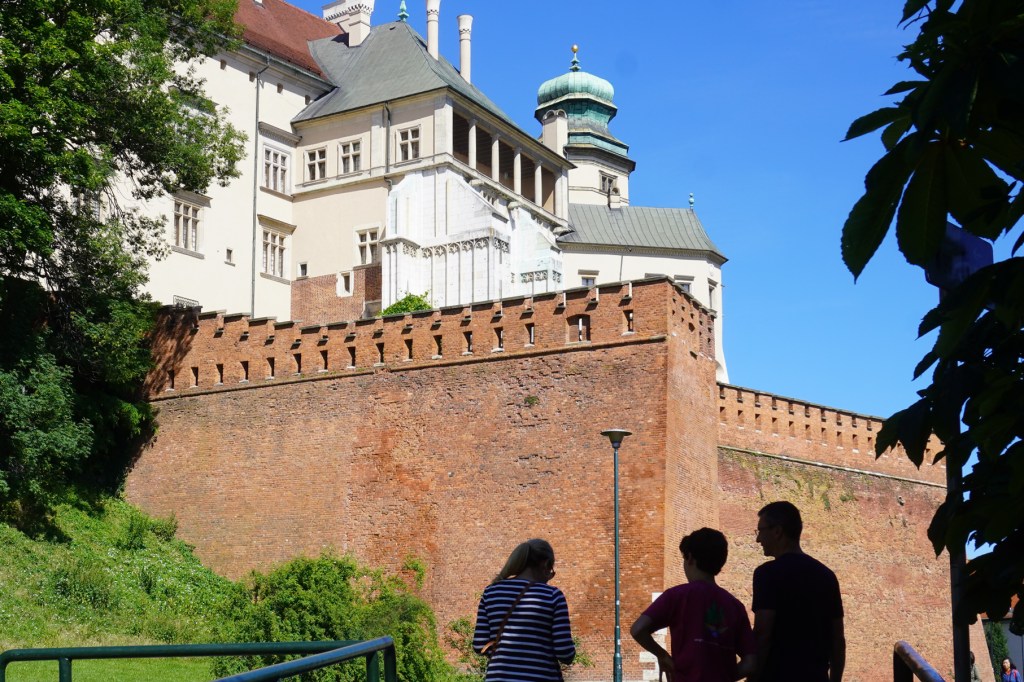
The next morning, we met our guide Johanna and walked to Wawel Hill, home to Kraków’s iconic Wawel Castle. Perched above the Vistula River, the castle complex dates back to the 14th century, though the site has been inhabited since the 4th century.
The Legend of the Wawel Dragon
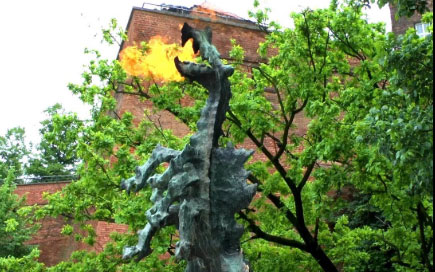
One version of the legend (there are many) of Smok Wawelski, the dragon,claims that this troublesome monster lived in the limestone cave at the base of Wawel Hill and liked to eat maidens. Knights came from all over to slay the dragon but instead were eaten alive. It took a shoemaker to devise a plan to kill the dragon by offering it a sheep with sulfur sewn inside which the dragon ate and then died. For his reward he married the princess. Today, there is a statue of the dragon that occasionally spews fire at the base of Wawel Hill reminding us of the city’s very own famous dragon.
Fire-breathing Krakow Dragon Monument
Wawel Castle
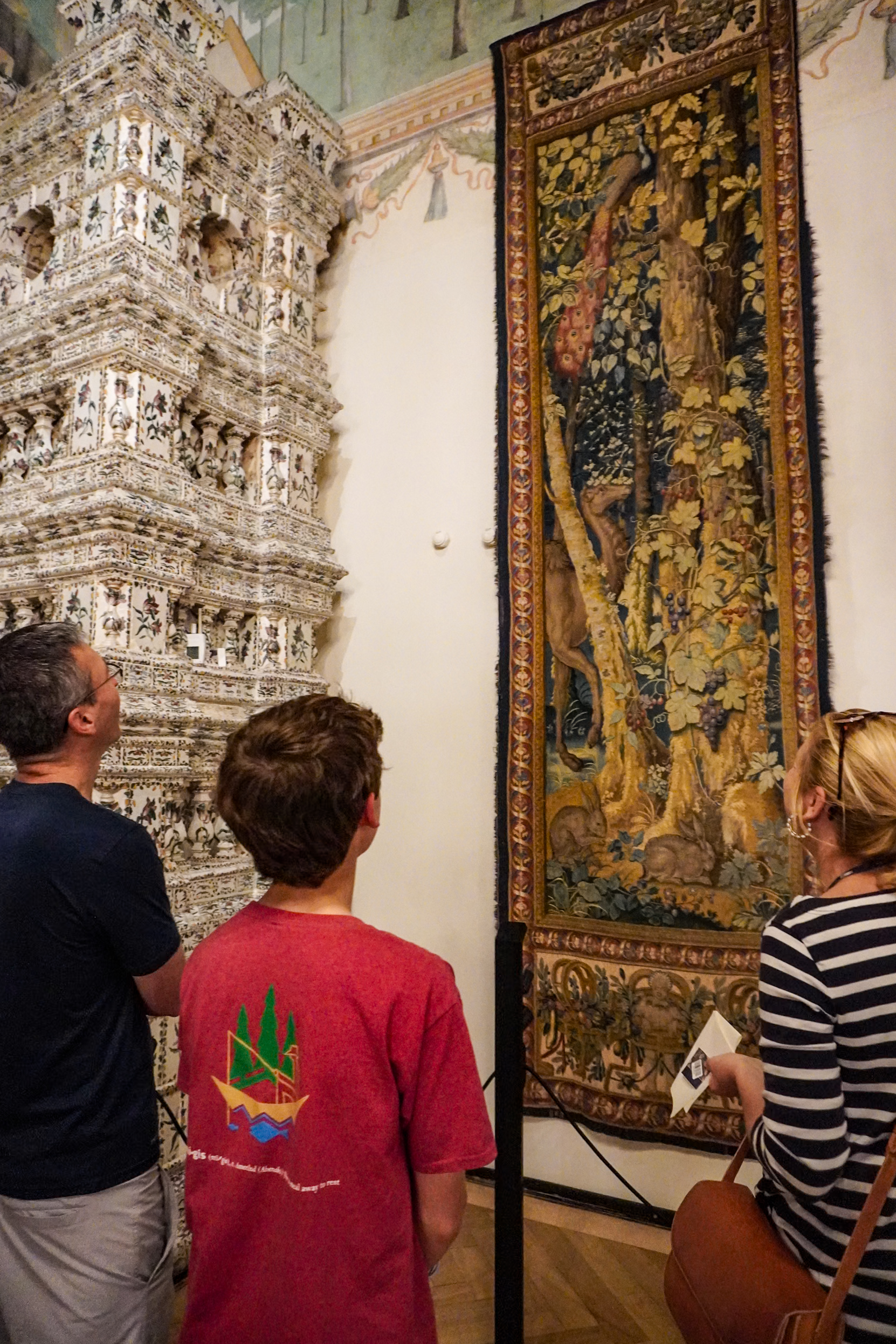
Our tour began with the castle’s Royal Apartments, brimming with centuries-old treasures: ornate armor, tapestries, and murals depicting Poland’s storied past. We also explored an Oriental Art exhibition, featuring intricate artifacts from 17th-century Turkey.
The National Shrine
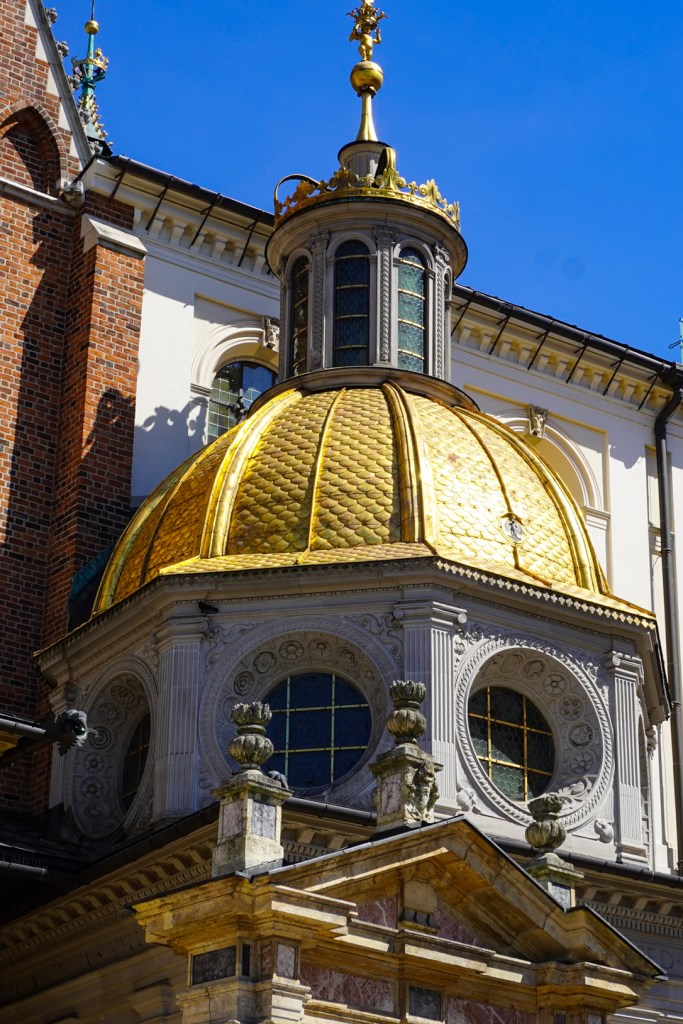
Next up was a visit to Wawel Cathedral is the sacred center of Krakow and possibly the entire country. Sigismund Chapel is notable for its 24kt gold domb. Since the 1300’s kings and other notable Poles have been coronated and buried here. You can see the actual sarcophagi tombs carved with images of the dead. Even the national hero, Tadeusz Kosciusko, who led American troops during the Revolutionary War, is buried here.
For Whom the Bells Toll
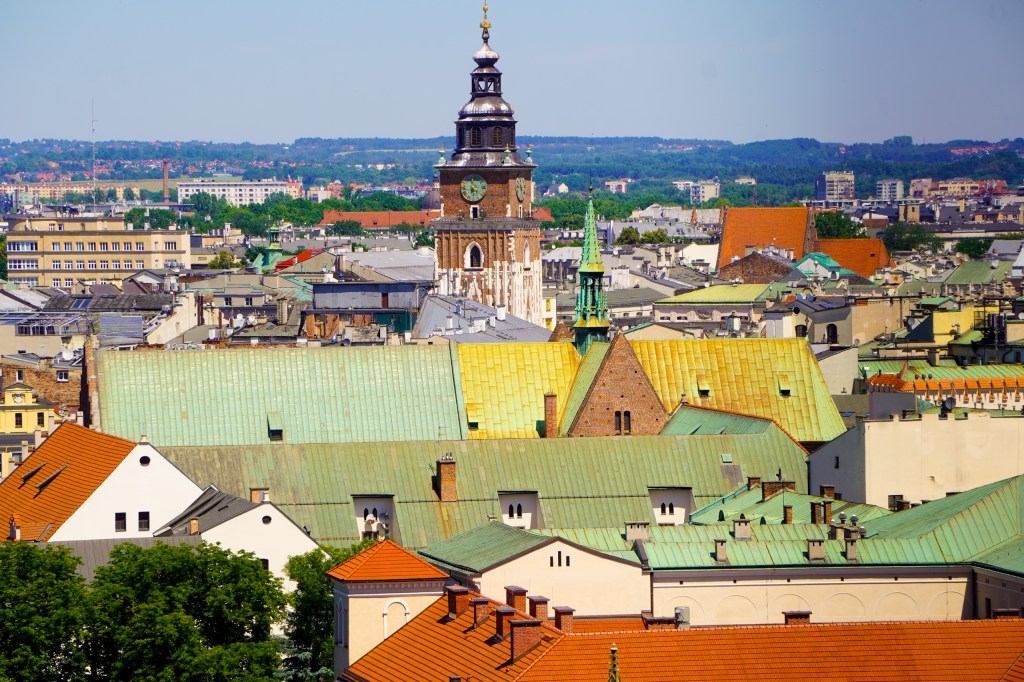
Of special interest, is climbing the 70 tight wooden steps up to the Cathedral bell tower. Here there is a great view of the castle and old town areas. But, our destination was the huge bells above us as we climbed.
View from the Wawel Cathedral Bell Tower
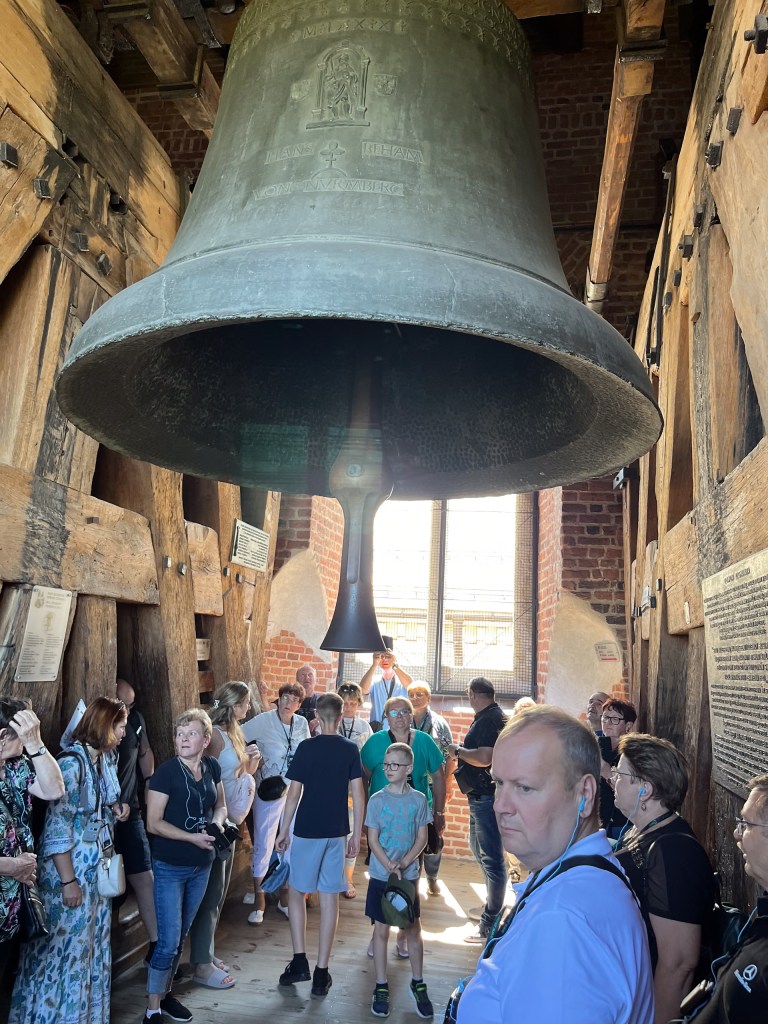
The huge, 12-ton Sigismond Bell (cast in 1520), is said to have a magical sound and is only rung on momentous occasions for Poland, such as national celebrations, major religious holidays, or times of great sorrow.
Sigismond Bell
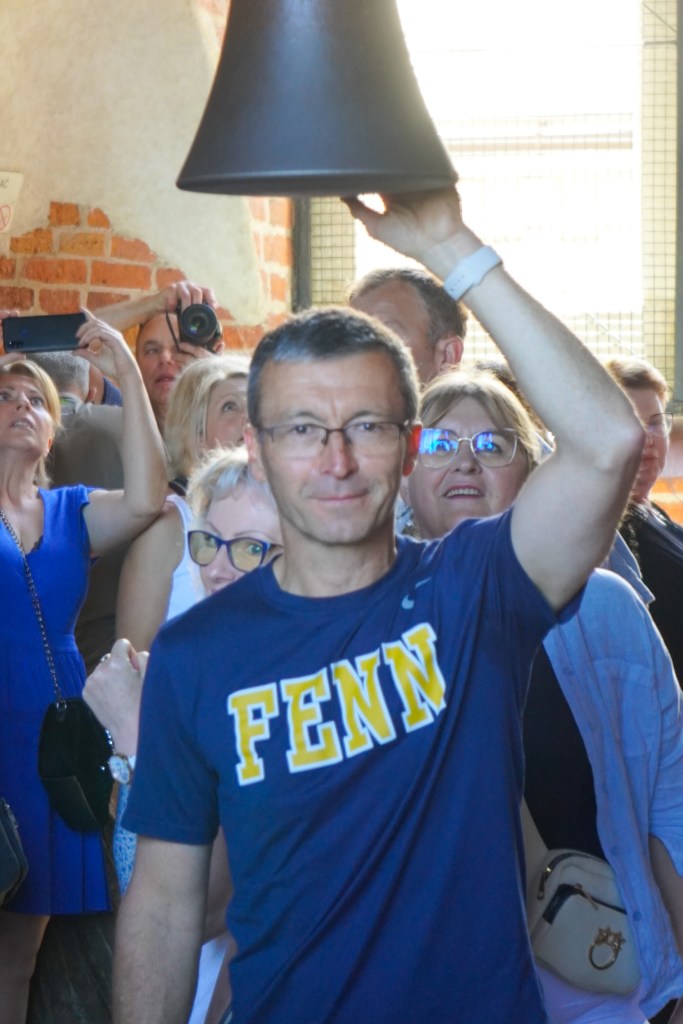
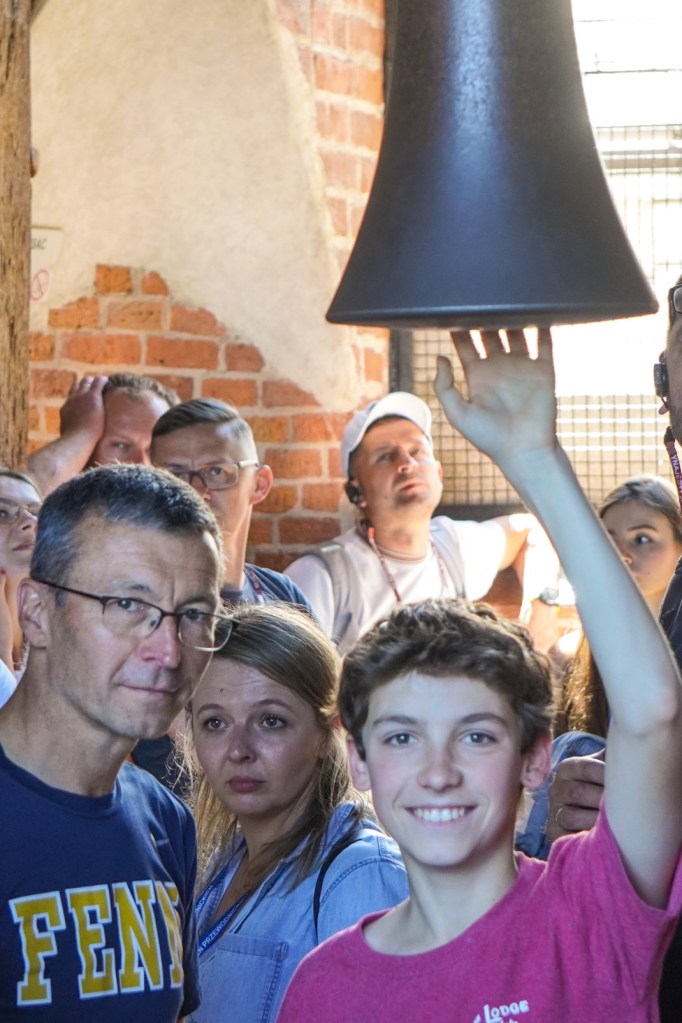
Of lesser importance, in the bell tower, but even more popular, is the Bell of St. John. The bell should be touched with the left hand while making a wish. especially in matters of the heart, such as love and marriage. Each of us touched the bell with our own private wish.
Old Buildings in the Old Town
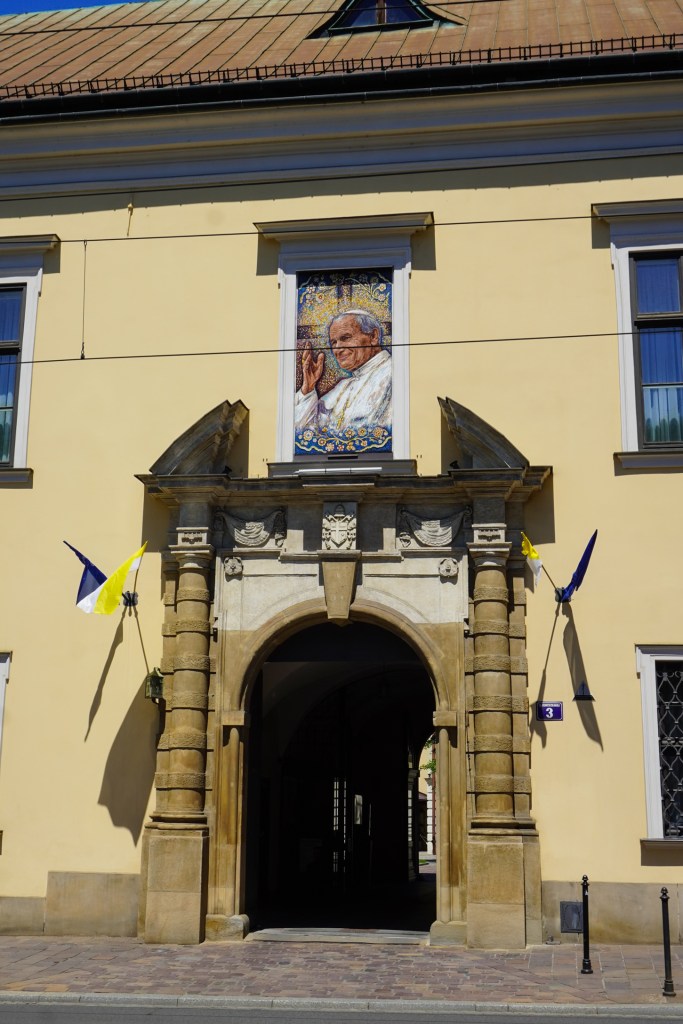
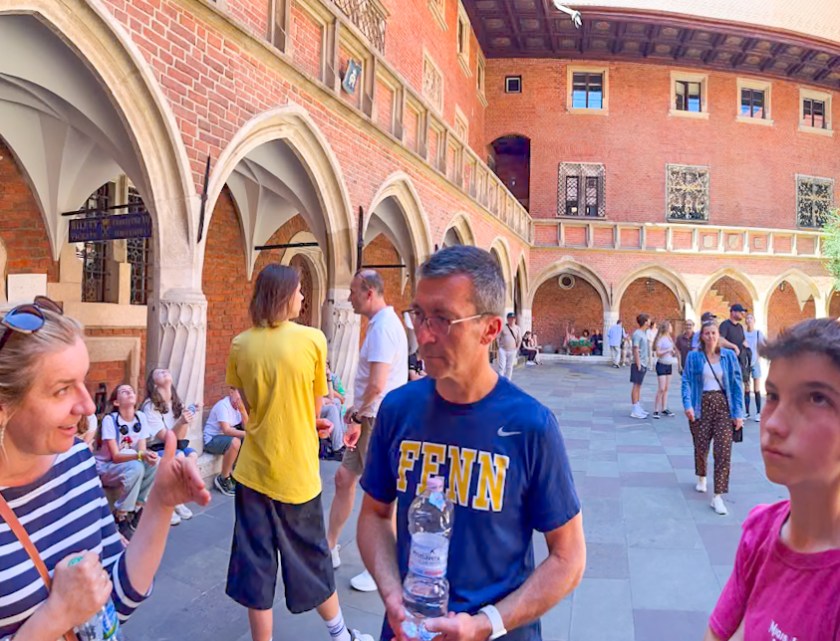
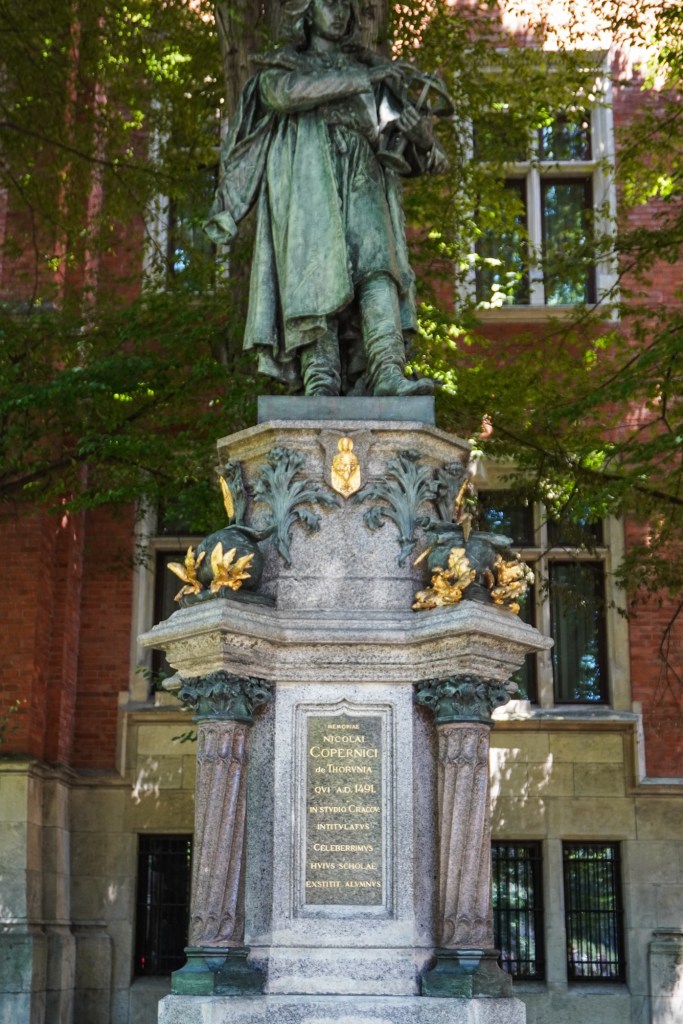
We left the castle area to briefly view a few other historical buildings. The Papel Window in the bishop’s palace where favorite-son Karol Wojtyla (who later became Pope John Paul II) would address his followers, the Church of Saints Peter and Paul and the Jagiellonian University, one of the oldest universities in Europe (1364).
A Gothic Masterpiece
Chief among other nearby historical buildings St. Mary’s Basilica know for its magnificent stained-glass windows and famous altarpiece, a pentaptych by Veit Stoss, is said to be the greatest Gothic work of art in Poland.
Roaming Around
Our three hour tour ended with us heading toward Rynek Glowny (aka Rynek Main Marketplace) for lunch and then a nap back at our hotel, only a few blocks away.
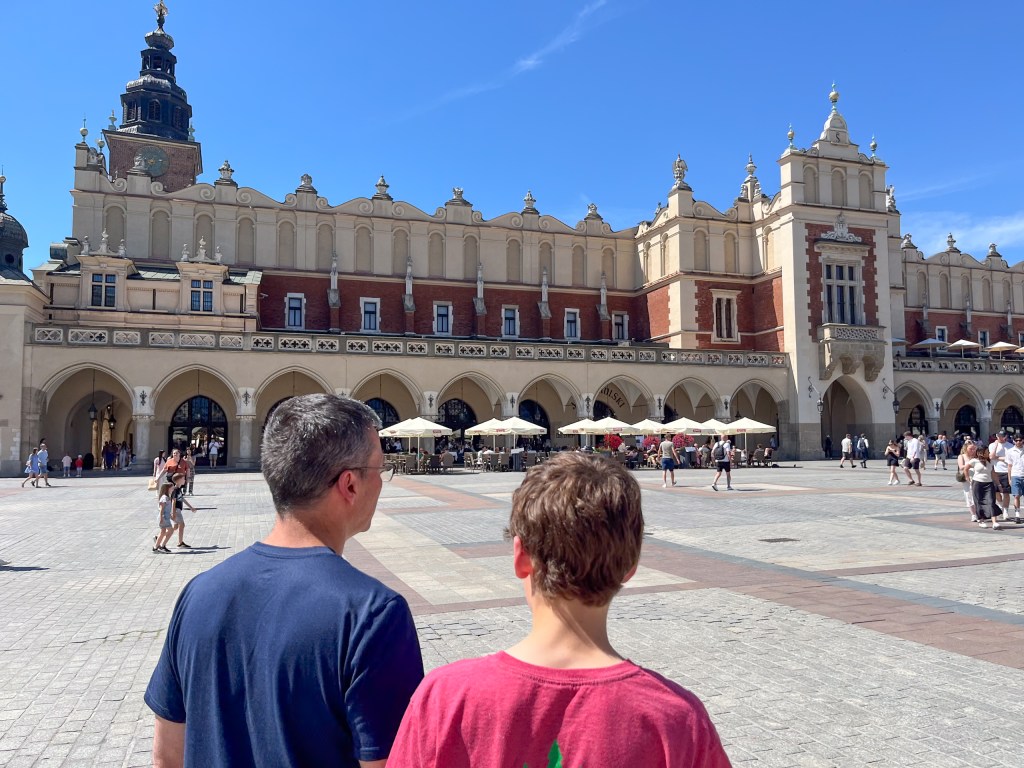
We were surprised by the size of this plaza, said to be the biggest in Europe. In the middle of the plaza, was a large building called Cloth Hall, a very old medieval marketplace where vendors would sell goods, especially clothing. Tip:Here was a great place to buy amber jewelry and Boleslawiec pottery, specialties of this area. We found just what we needed to bring home at a reasonable price solving our souvenir anxiety quickly.
Streets of Old TownCloth Hall
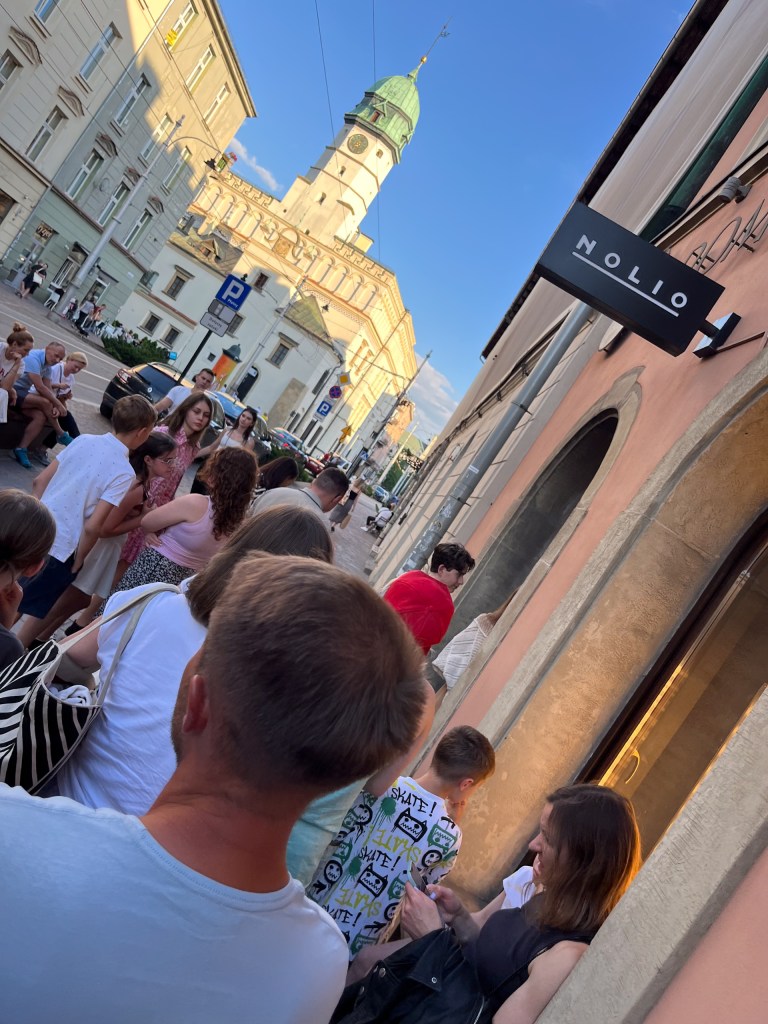
That evening we explored more of the Kazimierz and Old Town sections. We followed the crowds and found maybe the best Italian/pizza restaurant in town, Nolio’s. It was a very lively night with people of all ages, appreciating the good vibes and weather.
A Day of Reflection
Sunday, June 16, 2024
Auschwitz-Birkenau
Our final day in Kraków took a somber turn with a visit to Auschwitz-Birkenau. Located a short drive from the city, the concentration camp stands as a harrowing reminder of humanity’s capacity for cruelty. Touring the grounds was a powerful, emotional experience, leaving us with a renewed commitment to remembering and learning from history.
Auschwitz Entry Gate – (translation) “Work Will Set You Free”
Returning to Kraków that evening, we marked Father’s Day with a celebratory dinner at Kogel Mogul, a Michelin-star restaurant specializing in gourmet Polish cuisine. The meal, a gift from Ethan’s wife Amanda, was the perfect way to cap off our journey.
A Michelin-star restaurant in Old Town called Kogel Mogul had been recommended to me by a friend. They specialized in gourmet Polish food. Both the food and service was outstanding and prices were reasonable for that level of quality. We would recommend it to anyone looking for a special dinner in Krakow.
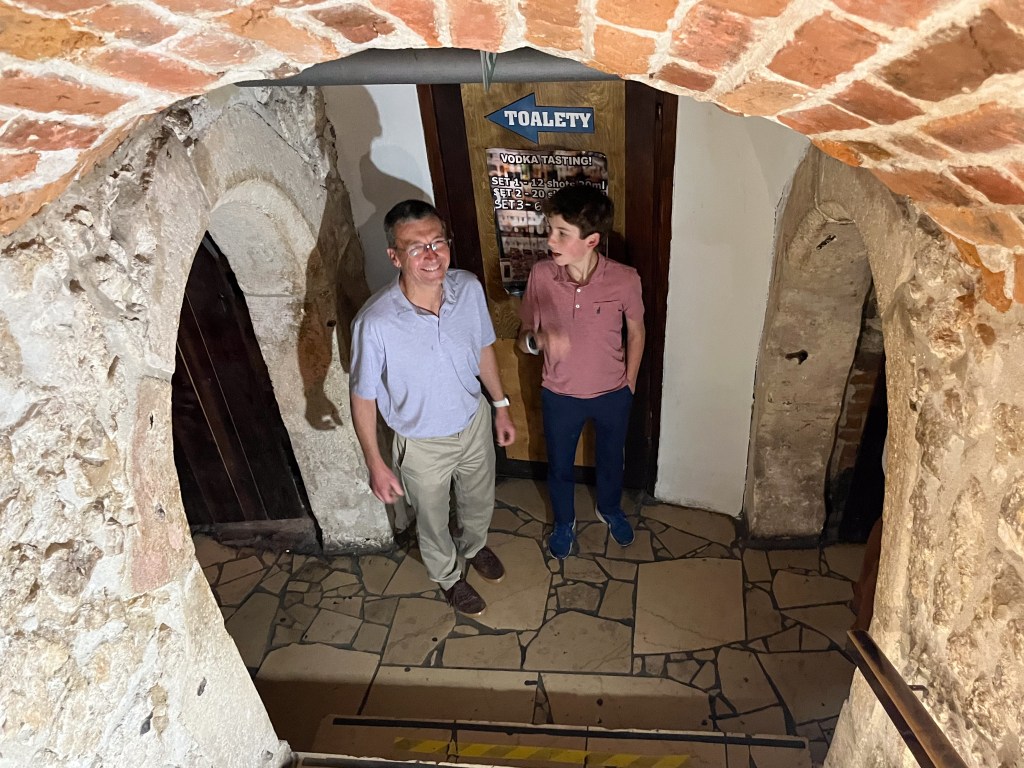
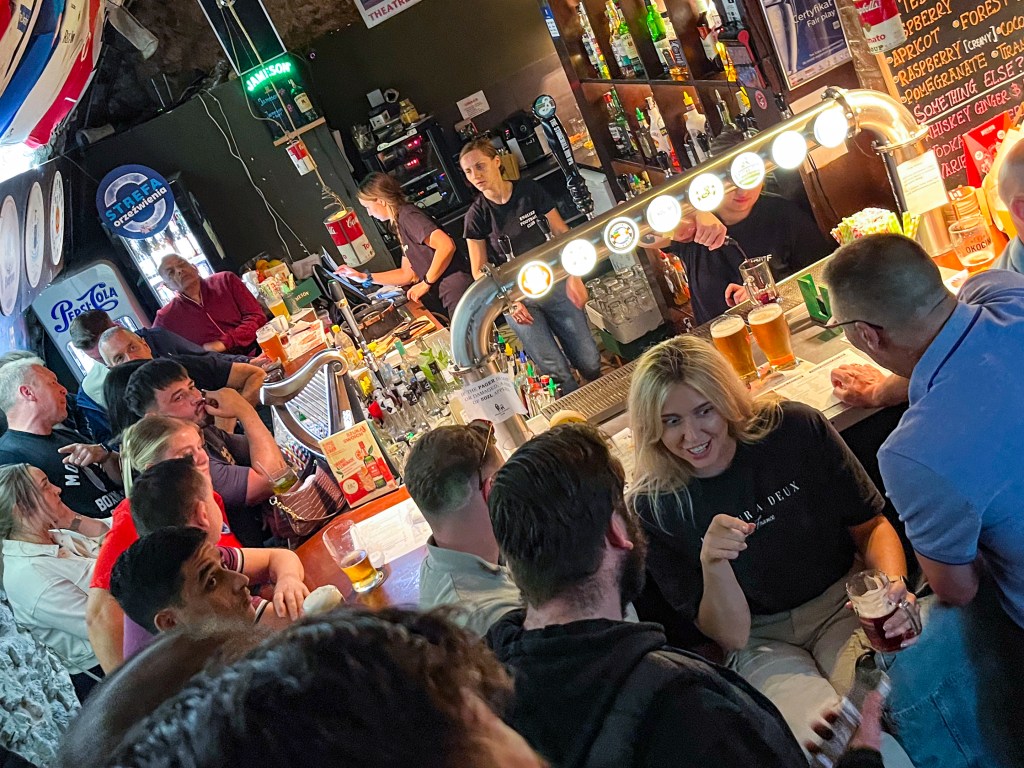
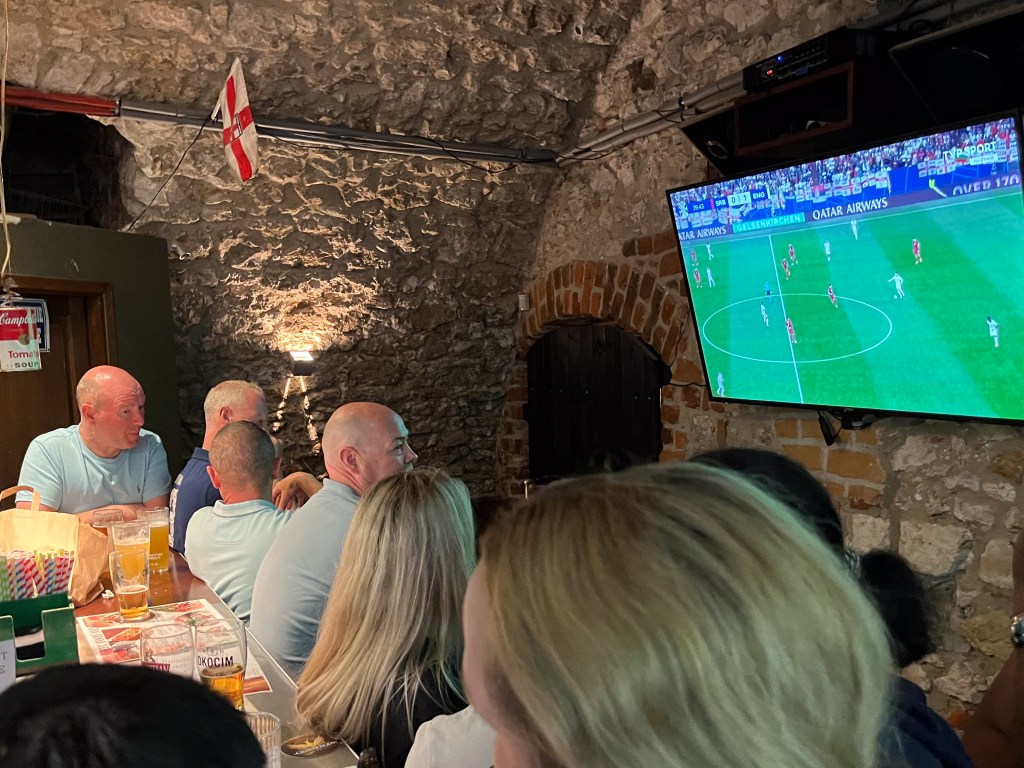
Leaving the restaurant after a leisurely meal we walked around the old town which was still lively but less crowded. We followed a stream of people heading to what looked like a cellar bar with called the “English Football Club”. Seemed a bit out of place here in Poland but especially relevant because the Euro 2024 Tournament was underway, as my young grandson Ethan Luke (15 years old and a BIG “soccer” fan) reminded us.
We ended up in a jam-packed bar of what we presume were mostly British ex-pats cheering on the England against Serbia. Wow! For a few moments we were transported to a different part of Europe with all the spirit and camaraderie we seek in our travels. The crowd was so tight that we could not even buy a drink, which would have been nice but not necessary to enjoy the fun.
We continued exploring the Old Town section for a while that last night while father and son duked it out on where to go next. Next, would be back to the hotel for some sleep after a long day.
Final Thoughts
Kraków captivated us with its unique blend of history, culture, and modernity. Its welcoming atmosphere, vibrant neighborhoods, and proud heritage left an indelible impression. While we regretted not having time to explore every corner, we left with a deep appreciation for the city and its people—and a resolve to return.
As a Polish American, this journey was more than a vacation; it was a homecoming.
Eating our way through eight days of genealogical touring in southeastern Poland. Searching for relatives brings back old memories of a different kind.
I didn’t go on my recent trip to Poland for the food, although I probably should have given it more consideration. Our mission was to discover family ties, but we soon realized that food is a major link to our past and remains a proud tradition for all Poles.
I’m a child of second-generation Polish parents who turn out to be from families that once lived in roughly the same southeastern region of Poland, about an hour’s drive from the Ukrainian border. While my father and mother were both born in the U.S., their parents came from Poland around the turn of the century. My parents never had the opportunity to visit the old country.
My mom learned to cook from her mom, our “babci” (grandmother in Polish). That’s how most Polish dishes were passed down in the family, a tradition likely still true for many immigrant families. While Polish dishes were not regularly scheduled unless it was a holiday, we probably ate Polish food at least once every week or two. Those hearty dishes were different from what our friends and neighbors ate. Little did we know that we would come to miss that food and wonder what else we were missing from our heritage.
For the last 45 years, I’ve been lucky enough to be married to a notable Italian chef, Mary Ann, who reigns over our kitchen. Mary Ann learned most of her important cooking skills from her “nonna” (grandmother in Italian), and so it goes. I would never argue which country’s cuisine is best, but occasionally she will cook something Polish, like kielbasa or pierogies. It’s been decades since my mom passed, but recently I got to go full “Polish” again during my visit to our country of origin.
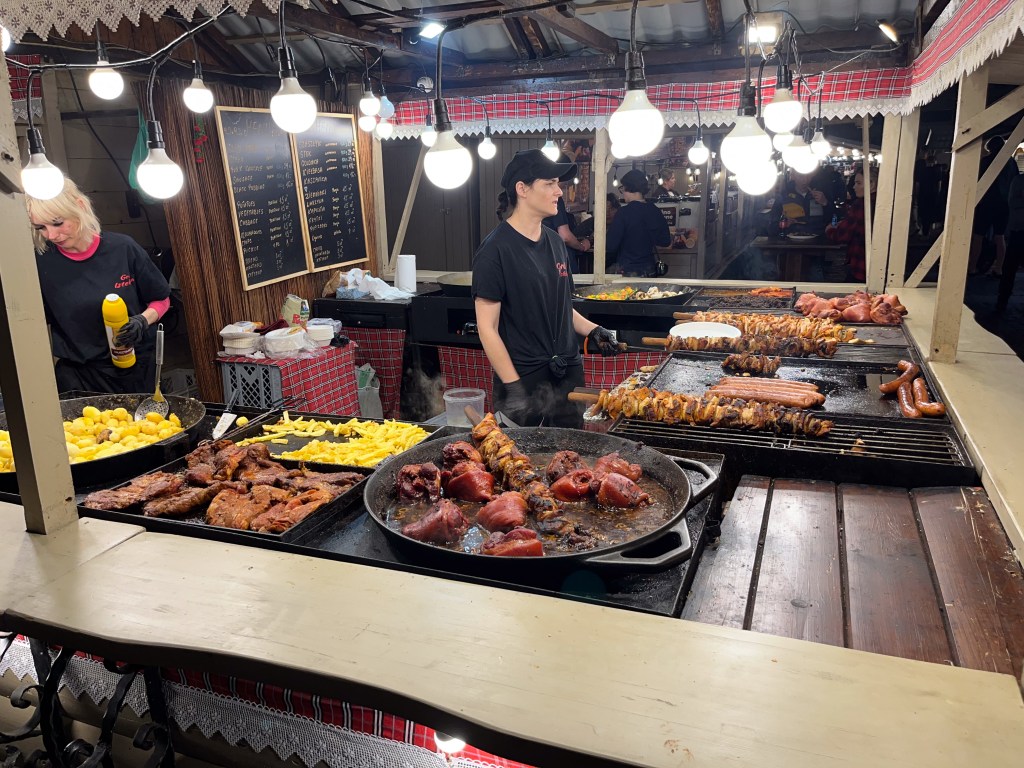
During our week-long stay, except for an afternoon dinner at our relatives’ home, we ate fast food for lunch and full dinners in the evenings. Polish food options were everywhere, but there were also American and international cuisine choices. Payment and tipping were similar to anywhere in Europe today—quick and painless using a credit card or smartphone. Most credit card companies automatically convert the currency at a favorable rate. Tipping is minimal; 10% is advised for exceptional service but not necessary. Being American, we tipped more.
Poland uses the zloty for its currency, not the Euro. The good news is that the zloty is trading at about $0.25 to the $1 (U.S.). Even more importantly, everything seemed cheaper, and food seemed half the cost in Poland compared to the U.S.
A Traveler’s Breakfast
If you have traveled to Europe, you know breakfast offerings are similar in places you stay and are usually free at your hotel. The hospitality in Poland is no different. Hotels offer a full-choice free breakfast buffet with pastries, fruit, meats, yogurt, eggs, etc., along with juice, tea, and coffee. Coffee, of course, is mostly served in smaller, fancier ways like espresso or cappuccino. A large cup of “American” coffee is almost unheard of, except where Starbucks has landed in the bigger cities. All of our hotels seemed to use the same self-serve, high-end coffee machine that offered a choice of any type as long as it fit into an 8-ounce cup or smaller. Coffee limitations aside, breakfast buffets are a great standard solution to start your day. It’s even possible to grab some breakfast items “to go” and save them for lunch on the road or later as a snack.
Eating on the Road
Since we were traveling on the road most of the days during the week, we would find a place to eat a sandwich, slice of pizza, dish of pierogies, or better yet, look for a McDonald’s (young Ethan Luke’s preference). It’s commonly believed that McDonald’s food tastes better here because they use local sourcing for burgers, chicken, and dairy products.
Inside McDonald’s in Poland
These are ultra-modern McDonald’s with the familiar menu kiosk (English translations available), but with small differences in the style of burgers, chicken, and wraps with special sauces. Probably the most popular (the one our 14-year-old Ethan Luke preferred) was the WieśMac or Country Mac, a variation of the Big Mac but with a mustard-horseradish sauce—only available in Poland.
At least the vegetarian wrap and Polish sausage sandwich seemed different. Of course, as in the states, you can order online, use a credit card, or pay by phone app. No need for cash. That was true almost everywhere we went.
Playing the Food Guessing Game
My teenage grandson was incredibly patient over the five days and 300 miles of travel. But he gradually became obsessed with Polish products on sale at local convenience stores like chips, candy, and drinks. It became a game to seek out different products, sometimes using Google Translate to figure out what the product was. Some were variations of familiar products or branded with popular Euro stars, like Lionel Messi. Others were just something we had never seen before, like different flavors of chips or thick nectar fruit drinks.
How to Manage a Food Allergy
Ethan Luke has a nut allergy, so he has to be careful what he eats. Ethan had a very useful card with him that explained the allergy condition and foods he must avoid, including those that might have been in contact with nuts. It was in English on one side and Polish on the other.
So, he would present the card as he ordered. It seemed to work well. (Purchase online at Equal Eats) And, we enjoyed seeing him navigate what to order with the waitresses! Everywhere we went, the wait staff seemed eager to accommodate Ethan Luke and point out dishes that would be off-limits.
What’s for Dinner?
Dinnertime was where we got to really enjoy the cuisine of Poland. Our dinners were mostly at our hotels, which were all excellent. Most restaurants served traditional Polish and other international dishes. Ethan and I were looking forward to tasting and remembering old family dishes. For young Ethan Luke, this was an adventure in travel, language, and eating something new. He settled mostly on pierogies for dinner and became our pierogi expert by the end of the week.
Pierogi is King
Pierogies are considered a staple in Poland and can be found almost everywhere. Pierogies are stuffed dumplings usually filled with either meat or vegetables in a buttery garlic and onion sauce, served with sour cream on the side. Absolutely delicious in any flavor.
However, there were many more variations in almost every restaurant. In addition to the standards—cheese, meat, mushroom, potato, and sauerkraut—we tried pierogies filled with veal, buckwheat, and strawberries. With such choices available and a lighter texture than ravioli, they are considered the most popular national dish. But it seemed like every place we went had its own favorite way of offering pierogis!
Playing the Oldies but Goodies
I hadn’t been thinking much about old Polish dishes I hadn’t tried in years until they started appearing on the menu. Fried breaded pork chops were a personal past favorite that I got to enjoy our first night at the Grand Hotel restaurant in Rzeszów. Memories of potato pancakes (placki) with sour cream came back as I ordered them for dinner at the Bartna Chata Restaurant at the bee farm Sądecki Bartnik. We were “buzzing” about the place for days.
I’m pretty sure it was because there was so much else to try, and kielbasa is so well known, that we never ordered it during our entire stay. The one dish I sought out but was not on the menu when I wanted it was gołąbki, cabbage rolls stuffed with a mixture of rice and beef and served in a thin tomato sauce. It’s a common dish, less likely to be seen on a fancy menu. I still have fond memories of helping my mom make those by rolling together the chopped beef, rice, egg, breadcrumbs, and onions into those cooked leaves of cabbage. We would grab small chunks of the filling and eat the filling raw!
Different Eating Habits
Speaking of eating raw meat, all the dinner restaurants we ate at offered steak tartare as an appetizer. Ethan and I ordered it several times and thought the taste was amazing. I’m not sure what the current food handling laws are in Poland, but the food is not highly industrialized and considered safe even raw. I’m pretty sure this is a “rare” dish in the U.S., in a different way.
Another country favorite is soup as an appetizer. My impression was that most restaurants expected you to order an appetizer, and there was always a variety of soups to choose from. Żurek, a sour rye soup, is often seen on the menu. Probably the most popular is borscht (aka barszcz), a clear beet soup with a sour finish from added lemon and/or vinegar with Polish mushrooms. I wish I had tried it, but it seemed there was always something else to try instead. I went for the cream of asparagus soup our first night, and it was outrageously good.
Chicken Salad
Of course, our visit would not have been complete without sampling the wide variety of international food in Krakow. We got to try Jewish and Middle Eastern dishes and one of the best pizzas I ever had in Kazimierz, the old Jewish section of town, where practically every type of food could be found.
Memorable Polish Dining
Dinner @ Kogel Mogel in Krakow
For our last night out, we ate at Kogel Mogel, a Michelin-starred restaurant in the old section of Kraków. Amanda, Ethan’s wife, treated us (remotely) to a Father’s Day dinner for the three of us at one of the best restaurants in town. I had the roasted duck, the house specialty, which was amazing, as were all the other dishes we tasted there.
No doubt, the highlight of our culinary experience was to take place mid-week at our cousin’s home. We got to enjoy a surprise homemade afternoon dinner at the home of Bogumilia and Zdzislaw Furtek in Brzezanka. Bogumilia is a sister of cousin Krystyna Onacki, who had helped plan the visit to the place where our related family was born.
We had a chicken consume soup followed by a roast pork dinner with mushroom gravy, dill potatoes, and fresh salad – all sourced directly from their farm.
Memories for Dessert
It’s funny how food often so basic that we take it for granted. What helped make this trip so special is that it brought back a flood of fond memories while opening up a new horizon of taste to explore. We did not get to try many of my old favorites and some new ones like the street food of Krakow and the famous filled Paczki donut.
Food may not be the top reason to come back but it will be another major reason to revisit the friendly people and delicious cuisine of Poland.
Our family of three generations of Polish-Americans tour Auschwitz-Birkenau in search of its history and cautionary message. Can anything so brutal ever happen again?
We decided to add a visit to the Memorial and Museum Auschwitz-Birkenau as a final point of interest on our genealogical trip to Poland. It was about an hour and a half cab ride north of Krakow. As you can imagine, touring a concentration camp is not a pleasant task, but it was an important one for a trip themed around life and death.
All of our sources suggested purchasing tour tickets well in advance, as it is an “important” tourist destination. Much of the concentration camp area is free and open to the public. However, the museum offers reasonably priced small group tours in various languages, including English. The professional guide leads about 30 ticket holders throughout Auschwitz and the neighboring Birkenau camp, providing the necessary historical background in a roughly 90-minute tour.
There were busloads of visitors this Sunday (June 16) starting at the new visitors’ center, which seemed well-equipped and organized to handle large daily crowds in the thousands. The visitors’ center, a year-old, mostly concrete structure, is sparsely designed but well-thought-out as a waiting area to keep visitors moving. There seemed to be a bit of irony as we followed our somber guide, almost blindly, in military order to Auschwitz and then by bus to Birkenau. The place naturally has that kind of aura.
We visited a handful of the many buildings in a progression that seemed to heighten the senses to the scale of this horrific place. We started with an understanding of the scale of this project, which began in 1939 when the Nazis annexed the town of Oswiecim to create an industrial base with a work camp at Auschwitz, a former WWI Polish barracks. The success in exploiting and then murdering prisoners led to a huge expansion at nearby Birkenau and other smaller camps in the area. The camps held over 1.5 million prisoners, 1.1 million of whom were murdered. In just a few years, the Nazis had learned how to efficiently kill and plunder Jews (largest number by far), Poles, Russians, Gypsies, and others from all over Europe.
The tour, buildings, and grounds are preserved much as they would have been back then. Auschwitz does not look particularly threatening from the outside of the buildings until you learn what happened on the inside. The museum tour continues quickly through several buildings, each with a specific focus such as medical experimentation, extermination, proof of crime, interrogation, punishment, and cremation.
All this is explained and examined through the many glass-enclosed statements and artifacts. Surprisingly, the photos on display do not show the ravaged bodies of the starved and tortured, but rather pensive and scared individuals waiting for the worst to come. This is not a multimedia experience. We see and hear only the story, but by being in the actual place, we can more easily imagine what happened. Imagination here can be more powerful than simulation.
The final third of the tour was a short bus trip to Birkenau after touring Auschwitz. I was surprised by the larger scale of the Birkenau camp. Its 365 acres are wide open except for a dozen or so buildings and the ever-present electrified barbed wire fence. There is a dominant headquarters building and guardhouse with train tracks running right through it. The tracks and train end about a half-mile into the camp, where thousands of prisoners would end their final journey.
Auschwitz remains important as a reminder to all of us of man’s ability to do wrong, especially to each other. One can only imagine how anyone could be so cruel, although there is plenty of reason today to think that it could happen again. On the other hand, we know that people can change too. Germany and Japan today are positive examples. It’s worth a visit to Auschwitz at least once in your life to give that some serious consideration.
For this particular visit I chose to create one slide show video with pics we took while on the tour with the theme from Shindler’s List playing in the backgroud. While we were all lost for words, the pictures are memorable and speak much louder than words.
Slideshow Video of Photos taken at Tour of Auschwitz-Birkenau
Here’s how we became genealogical detectives in Poland as we hunted for clues to our family history.
If the word “Dragnet” means something to you, my guess is you remember Sargent Friday saying “Just the facts, ma’am.” on the old popular TV show. Or the 1960’s comedy movie version of that show with Dan Ackroyd and Tom Hanks. Either way it was about how detectives solved crime (mysteries). It seemed they had odd and funny ways of discovering facts when they interviewed suspects or witnesses.
Dragnet Theme
Now, we were on the ultimate dragnet for any clue to our family history. Facts mattered. Leads needed to be followed. We were on a missing persons investigation in Poland.
Near the top of my personal mysteries is how we got here. Ultimately, we all come from the same relatives. But the road that was taken by each of our ancestors made us who we are today. Sometimes, it was a voyage to leave their country and family. Other times it was to stay and make the most of the life they had, even if it was harsh at times. Whatever path was taken, family connections remained strong in most situations.
Where This Investigation Begins
About 10 years ago, Krystyna Onacki, a distant cousin from Poland discovered our Kiczek family. A Polish citizen at the time, she met and later married John Onacki a U.S. citizen when he was studying abroad in Poland. They moved to Roselle, N.J., coincidentally, the same town in which I grew up. Our family connection was through her mom who was a descendant of Josef Kiczek, my great grandfather.
Little did I know then that Josef had a second wife after his first passed away which created a second branch of the Kiczek family. Just 10 years ago, I had little knowledge of who my grandfather was, let alone my great grandfather. And, my parents and their siblings had passed away years before so it seemed we had no one left to ask, until Krystyna found us.
Large families were desirable back then to help work the land, provide financial support and to replace those children that would die young. For our side of the Kiczek family, my grandfather would immigrate to the U.S., and have nine children. My father’s siblings included one brother who became a priest and three sisters who would live their lives as cloistered nuns. To most Polish families this might have been the ultimate career choice and source of family pride. It was also seen as a way to increase their blessings by bringing the family closer to the Catholic Church.
Covid Creates a Time Warp
My oldest son, Ethan Kiczek, met the Onacki’s and understood the family connections better than I. Ethan has an engineering degree and has worked in technology his entire career, appreciating the complexity of large scale projects. In 2020, tied down by the pandemic and working remotely, he became absorbed in discovering more details about the family.
Often a search leads to a clue about another relative or the nature of a relationship. This usually needs to be verified. There’s digital sources, like ancestry.com and there are analog sources, like a town’s records of births, deaths and marriages or even finding tombstones.
While it’s possible that a birth record can appear as a digital image, more often than not it simply needs to be found in a physical registry of births, deaths and marriages. This is especially true for older records. In Poland. registry books are often located in the town where the family lived – or in the registry of the local church where they prayed. All this would take time and concentration, which with Covid, we all had plenty of.
Ethan searched a few databases like the Mormon’s FamilySearch and Facebook’s genealogy groups to discover what sources could help and how to get more information, if the data was not available online. This led to outsourcing a remote genealogical researcher in Poland, Lucjan Cichocki, who could actually go to local Polish towns to search registries to validate and discover family connections. Lucjan became our Sargent Friday. But, that led us to considering getting involved in this Polish dragnet too.
Going Back in Time
Ethan discovered, with the help of Lucjan, the towns where our family lived and even traced some ancestors to the 1700’s. But to dig deeper, we would need to view the registry records. Those records also state some other related information like the birth date, name of parents, religion and towns they came from. Ethan began to construct a large family tree that opened up our imagination as to who were our ancestors and how we were related.
PK’s Family Ancestors to Investigate
In 2022, we began to plan for a trip to Poland to discover our relatives – assuming we could find them and they would talk to us. But it was then that the Ukrainian-Russian war started. The area where our family was from was only about 50 miles from the Polish-Ukraine border. At that point we had no idea if the war would spill over to Poland. Poland’s borders have been moved often and the area we were planning on visiting was once even considered part of Ukraine. So, we postponed the trip for safety reasons. But the dragnet research continued.
Our Case History
Plans were set in late 2023 to visit the following year all the towns where my family seemed to have originated or once lived. Ethan’s mom, Judy’s (Dolac) mom had a clear connection to a town in the same region too. So, Ethan worked with a special touring company called PolishOrigins and created a custom tour that would take us to most places we had confirmed had a family connection. We hoped to visit those places, hopefully discover more connections and perhaps meet some relatives!
We spent four days investigating our ancestors in Poland, mixed with some interesting sightseeing along the way. Here’s a brief case history of what actually occurred during our investigation part of the trip:
Our Ancestry Tour Route from Rzeszòw to Kraków
Tuesday, June 11, 2024
Świerczów – About 20 miles north of Rzeszów, our starting base, we sought family connections to the Stobierki’s (Ethan’s grandmother on his mother’s side). We had an address to go to from previous research. Found a distant cousin Halina Knipa and son Bartek. They share a great great grandfather Michal Stobierski with Ethan. We visited the town hall for records, the old family farm where his grandparents lived and a local cemetery. We exchanged emails for future follow-up. See the earlier post for more details on this visit.
Bartek, Ethan, Ethan Luke, Helina
Wednesday, June 12, 2024 – morning
Żarnowa – In search of Sliwinska family (or possibly Sliwinski). Marriage records showed that great grandmother MariannaSliwinska (born 1847) had married Josef Kiczek (born 1827) and was originally from this town, about 20 miles south of Rzeszów. We had a possible address or location but it seemed wrong. We went to the nearby convenience store to ask around if anybody knew a Sliwinska family and followed a lead to an address that might be a descendant. No one was home but a neighbor corroborated that there might be a connection. They called the possible relative and we promised to send a letter explain our relationship. Low odds on connecting here, but maybe they will respond.
Wednesday, June 12, 2024 – afternoon
Brzeżanka – a neighboring town to Żarnowa, we had our best clues and even arranged a meeting with Bogumila and Zdzislaw Furtek. Bogumila is a sister of Krystyna Onacki, our cousin who helped start this whole investigation back in the states. This was pay-dirt for us.
We now had a direct connection from the other branch of the Kiczek family. Antoni Kiczek was a half-brother of my great grandfather, Josef Kiczek. His descendants included Bogumila and Krystyna. It seemed Josef married once had eight children and married again having four more. Not so uncommon back then. One of Antoni’s sons was our familiar “Uncle Joe”(Joseph Kiczek) as he became the messenger between the U.S. and Poland Kiczek families. We just never realized what the exact family relationship was.
This was the highlight of our trip from a social and genealogical point of view and the main objective. We met a distant but direct relative, had a warm inviting visit, saw where my great grandfather and some of his descendants lived and tilled the land, even until today. We ate together, exchanged gifts and promised to keep in touch. We had an open ended welcome to come back. More than that, we discovered the land where our ancestors lived and worked was a beautiful peaceful place. See the earlier post for more details on this visit.
Thursday, June 13, 2024 – morning
Brzezowa – Our investigation moves on as we travel 30 miles southwest toward the foothills of the Carpathian Mountains and closer to the Slovakian border. There we searched for traces of my paternal grandmother’s (maiden name Katarzyna Kuchnika) family. After visiting the town hall records we found a possible relative’s address. We went to a cemetery and the home of to a a Kuchnika descendant and her son but they did not seem terribly interested in relating anything to us. We made the connection but in this case there wasn’t much interest in continuing communication.
Friday, June 14, 2024 – morning
Grybow/w – We travel west another 10 miles in search of my maternal grandfather’s ( Kmak) family. We started in Grybow, the area where we had a record of his family. We went to the local town hall to explore records. We found a clue that Kmak’s were still in town and a relative might be living nearby. We visited Richard and discovered another lead to a younger generation relative. For our last investigation we went to a local farm and met Kamil Radzik, 28 years old, our youngest relative we met. He offered his email and promised to connect.
Friday, June 14, 2024 – afternoon
Bobowa – Our last investigation started in the local town hall. Through Lucjan’s charm and two very conscientious staffers we spent over an hour pouring through records to find my maternal grandfather’s family.
Case Closed?
Four days of investigation had ended. With the help of Lucjan as our translator and charmer, we had managed to discover new facts, meet family members and potentially open up further communications. Eventually, Lucjan mentioned that he was interested in police detective work, his skills fit perfectly for that job.
More than that, we had a real feeling of what it was like living in Poland. It is truly a beautiful country, not unlike America. There are small quaint towns, small shops, even American fast food (e.g., McDonald’s) and town halls with vital records. Beyond that there is a huge landscape of open fields and undulating mountains. It changed my perspective about who are ancestors were and where they were from and why many chose not to leave.
I couldn’t stop myself from thinking of one of my favorite Elvis Costello songs that seem to relate to us being amateur detectives, if only for a while and in a friendlier way. The following video has nothing to do with genealogy, but it too is a great mysterious song and video about being a detective….
A recap of two days of gumshoe detective work, unique sites and the Polish countryside.
I expected this would happen.
There’s too much going on to keep all the interesting stories coming. Everything is going according to plan. In fact, much better than we imagined. More details to come about the last few days in future postings .
Yesterday we were spent a beautiful day touring Krakow. Today, we are heading to Auschwitiz so we expect the mood to change but feel excited about the new experience.
I should add that coincidentally it’s Father’s Day! I’m feeling something special about that on this trip.
As a quick update on some past days …
Last I left the notes on this trip, we were heading into heading to our hotel Polanca Palace in Krosno on Wednesday night. It was a beautiful restored mansion with a great restaurant.
Pałac Polanka Hotel
Thursday – June 13
The next day (Thursday), we drove southwest another 40 or so miles to Brzezowa. Here we were on a hunt for traces of my grandmother’s family on my father’s side. Joseph Peter Kiczek had married Katarzyna Kuchnicka who records had shown were from this village town.
The hills became broader and steeper as we neared the Tatra Mountains range bordering Poland and Slovakia. We did not have much to go on but a record that she was from this town in either her immigration papers or marriage certificate.
Our translator and guide’s, strategy was to visit the town hall records and see if they had either direct records for Katarzyna father or some other clue that could tie in the family. Basic detective work. This led us to several municipal records stops and a possible cemetery where others in the family had been buried. It was gumshoe work with small gains in our research. We found a woman who had Kuchnika roots but perhaps from another branch of the family. Name on gravestones and other records could not directly tie those past lives with our family.
Possible Kuchnicka family but not verifiedSimilar Kuchnicka names on gravestones
In nearby Binarowa, we visited the very unusual wooden church of Michael the Archangel, This church built in the early 1500’s is listed on UNESCO’s historical sites list. It’s one of several very old country wooden churches with unique wooden carvings and invaluable art located in a small country town. Many were destroyed by either the Nazis or Communists. There’s lot’s of pics to come on this.
At day’s end, in Stróże we we located Sadecki Bartnik, our most unique place to stay. It would be hard to categorize this place except to say it was a honey farm, and nature camp, a resort dedicated to nature and beekeeping. Sounds odd I know, but a beautiful resort with some interesting twists to buzz about later.
Entrance to the bee farm campWe stayed at the “Babci Marysi” cabin
Friday – June 14
Our last day of family research. Records we had showed that my grandmother on my mother’s side, Anna Semla Kmak, had come from Wyskitna or Biala Nizna area not too far from Stróże. Again, we went to the municipal records offices and found a trace of the family which we followed with some success and met a few interesting characters along the way. It was an interesting day to end our research. We added more mystery finding and meeting a connection to the family.
A Very Dilligent Records KeeperVery likely Kmak relativeNew generation Kmak relativeSweeping hilly countryside
Now, we were headed to Kraków about 40 miles awayas fast as we could go so Lucjan could return his van and catch his train back to Rzeszów and we could check in our hotel in Krakow for a 3-night stay.
And, what a beautiful city Kraków is! We learned that there was plenty to experience in this very old city. It’s unique in history, culture, education and now, maybe, a model for a melting pot for today’s immigrant refugees. We may be seeing both the past and the future here.
Day two on the road looking for relatives and we uncover some of the mysteries of the family.
It’s day two of actual relative hunting. Our first objective was to find a Slawinska family relative which was the maiden name of my paternal grandmother, Marianna Kiczek. We knew she was born in 1847 in Poland through a marriage record which showed she was from a small village area called Źaranowa, about 40 miles south of Rzeszów, where we had stayed the last two days. The terrain became more hilly and rural the further we traveled.
Convenience Store Clues
We did not have a specific address so our guide Lucjan suggested we stop and ask at a convenience store if anyone knew of a Slawinska family. To him this was a logical professional move. To us it was more like following a detective trying to track a criminal.
While the store clerk was not able to help, we stumbled upon a nice looking, fit older woman outside the rough-looking store who said she knew of a family that might have had a family connection with the Slawinska’s and could be related. We volunteered to drive her to her home a couple miles away. Like amateur detectives ourselves, we deduced this was how she kept in shape, walking up and down these hills these steep hills would be tough for any of us.
Super walking ladyNeighbors of Slawinska’s
No one seemed to be home at the possible family house but a next-door neighbor took our email address and promised to pass on our interest. We had made a loose connection but could not be sure if our detective work would pay off. Now, we began to realize this could be a slow process and may turn up as a dead end. On the other hand, luck might be on our side and practically everyone we met seemed eager to help.
There’s Gold in These Hills
Our second goal for the day was actually a planned visit to Bogumila and Zdzislaw Furtek. Bogumila is the sister of Krystyna Onacki, my distant cousin who had discovered our family connection many years ago. We share the same great grandfather but have different great grandmothers.
Josef Kiczek married Zofia Kielar and had three children before she passed away, one of which was Zusanna. Zuzanna married Victor Kaminska and had three children of her own, among them was Bogumila and Krystyna. Josef remarried Marianna Slawinska after Zofia’s death and had three more children, one of which was Joseph Kiczek, my paternal grandfather. Whew!
Krystyna and her husband John Onacki currently live in Roselle, NJ and are extremely warm people that embrace our shared Kiczek family connection. We have kept in touch over the years but this trip was an ideal way to share in our family heritage since much of her family still either lived in Poland or maintained connections there. This was a perfect time to actually meet and understand more about our family. And, Bogumila was the perfect personal connection to make it happen. While Krystyna could not join us physically she set up our meeting with Bogumila at her home in Breźanka just a few miles away from Źaranowa.
You could see both a physical and personal connection between the sisters. While Krystyna is younger they both have a warm beauty and personality. Bogumila and her husband, Zdzislaw, invited us into her home in the dining room and immediately talked about the family with Lucjan acting as our translator.
It seemed awkward at first but we quickly grew accustomed to the dialog. Next, she brought out several photo albums with old and new family pictures. I, in turn, had brought some of our old and new family pictures to share. We laughed when we realized that we both actually had a few of the same photos.
Bogumila and Zdzislaw’s Home
Bogumila planned lunch with us and a visit to the land and house where our common great grandfather Josef had lived. There was a new owner now and the place had been renovated many times over the years. An older woman and her nephew lived there now. Her husband had passed away and her nephew had come to take care of her. They graciously invited us in for coffee and cake as we spoke about old times there. You can’t seem to escape hospitality here!
We eventually returned to Bogumila’s home where a full lunch of Polish food including soup, salad, roast pork and dessert awaited us. After lunch we took a walk around her property, a large tract of land which they continue to farm part-time.The house and farm are situation on beautiful rolling countryside hills broken occasionally by patches of forest. It reminded me of those alive hills in the Sound of Music.
Late in the afternoon we exchanged gifts and goodbyes. But that was not before calling Krystyna in Roselle and telling her all about our adventure. Finally, we agreed to go with Bogumila and Zdzislaw to visit the local church and cemetery to see the graves of many in the family.
The Legend of Uncle Joe
My father had a close cousin Joe who was always a mystery to me growing up. He was the physical connection to the old country, living in Bayonne and working for a school for the deaf in New York City. He was a sharp dresser and a very buttoned-up character who had a worldly view traveling frequently between the U.S. and Poland and having us help our distant family in Poland in many ways. Joe also was responsible for helping to build the neighborhood church, earning him such respect that he still seeems to have earned sainthood here in the town of Breźanka.
The church that Joe Helped BuildUncle Joe
Cemetary Life
The Poles have a special reverence for the dead and for past generations which we seem to have lost here in the U.S. It’s the final evidence of lives lived and gone. And, maybe reminding us that we’ll all be gone too someday. Nothing lasts forever but memories can linger for generations.
Our first day of relatives hunting began today. A combination of detective work and history.
It was Tuesday and our first day of relative hunting. Our guide Lucjan Cichochi arrived at our hotel in Rzeszów, Poland to take us to our first destination for the week. One big advantage we had was a personable tour guide who spoke both English and Polish was a professional genealogist who Ethan had consulted with on our family history. So, he already had some familiarity with our case(s).
What’s in a Name?
Ethan’s mom Judy’s mom was Helen Dolac (maiden name Stobierski). Her family was known to come from an area about 40 miles north of Rzeszów in the town of Świerczów. We had an address for a Stobierski and approached a woman living there who said no one with that name lived there and there were many families with that name. She suggested trying another address down the road where Halina lived who might be from that family.
It was in a multi-family apartment building which seemed might be daunting for a stranger to ring a doorbell. Lucjan, however, never let that stop him from asking around. Through a neighboring park attendant, he called Halina Knipa (formerly Stobierski ) and asked if we could meet to discuss her family for the benefit of three strangers from the U.S. seeking family history.
Naturally, it seemed, she let us in her modest apartment and treated us to coffee and cake while he began asking questions to see if she was indeed connected to the Stobierski family who immigrated to the states. She spoke only Polish but her 28-year old son Bartek, spoke some English and joined us as we looked through old photos. Ethan and Lucjan agreed that there probably was a connection to the the U.S. Stabierski’s through a great grandfather. She even agreed to take us to the town hall records building to verify his birth record to see if he was a brother of Tomas Stobierski, Ethan’s great grandfather.
Halina and Bartok then took us to the house where she and the Stobierski family once lived which is now vacant along with many others in the area. Once mainly a farming community, commerce had settled in and the family moved on. With no one interested in a house in need of repair, a barn and acres of farming land, Helena’s sisters now owned the land and its future was uncertain. It seemed likely the family home would be sold off someday. We agreed to exchange emails and make a connection
The land in this area is mostly flat and fertile. It’s fairly busy with traffic although the population is not dense and there seems to be an oversupply of land with little influence from big agricultural companies. It seems like a place where time has stood still, at least for now.
Visiting the Ethnographic Park
After a quick lunch we headed to the Ethnographic Park in Kolbuszowa a few miles away. The term “Ethnographic Park” is probably a more globally acceptable term for a recreation of a past time and culture. Williamsburg in the U.S. is considered as such. There are many such places in Europe reflecting past history and how people lived in those times.
The southeastern part of Poland was mostly an agricultural area and the common village people who worked the land and raised farm animals, mostly for the benefit of wealthy landowner aristocracy. The park is an assembly of about 60 buildings in an area resembling what a Polish village might look like several hundred years ago.
All buildings in this living exhibit were historically accurate and selected from the nearby areas then reassembled to create this reconstructed new village, including peasant houses, barns, shrines, schoolhouse, silos and manor house.
Ironically, our guide Sabina was married into the Stobierski family but we quickly realized that there was no direct connection to our’s. She became our private guide walking us through the village and explaining the history of the early settlers in this part of Poland. It was a great way to appreciate the past and think about how are history was both the same and different.
The Ethnographic park continues to expand and is a very popular destination for visitors from Poland and beyond. For a relatively new and small area of Poland, they are now attracting up to 50,000 visitors a year. Probably most important to many visiting these days is that a popular Netflix streaming comedy series (in Poland only?) called “1670” was shot here for its first season and a second season is in the works. We’ll be looking for it on Netflix when we get back to the states. I guess you could say it’s a virtual recreation of past, not unlike what we are trying to do.
We visit a charming Polish city before we embark on our hereditary journey.
June 10, 2024 Rzeszów, Poland
Our 8-hour LOT Polish Airlines flight from Newark Liberty flew into Rzeszów at 11:00 a.m. The two Ethan’s managed to catch a few hours sleep in our deluxe Business Class seats. In spite of my recent habit of catching daily naps (goes with the age) I could not sleep. Worse was the lack of WiFi and decent entertainment. Maybe it was the stress of the last couple days and the anticipation of what lie ahead that kept me up in spite of the excellent service and onboard meals.
We landed on time but had to wait for a back up driver to take us to our hotel in Rzeszów (pronounced shesh ov) about 10 miles away. Rzeszów is a regional capital of southeastern Poland bordering Ukraine. Much of our week would be close to an hour away from Ukraine. In fact, Ethan noticed when landing that we had passed several Patriot-type missile launchers along the way and we continued to see the subtle presence of military personnel. Poland is not currently threatened but their is a whiff of anxiety in the air and a common hatred of Russians.
We were staying 2 nights in the boutique Grand Hotel in the heart of the old part of the city. While we had no real preconceptions of Rzeszów, we also knew it was not one of the big cities but had some interesting history going back centuries and future promise. Its an interesting blend of “Old European”, Soviet-styled cement buildings and monuments and brand new office buildings and even a shopping mall that resembled those in New York and New Jersey. In fact many of the stores were very familiar, including H&M, McDonalds’s and Starbucks. We loved the cobble stone streets and open piazza similar to Italy and Spain, with outdoor restaurants and cafes. To me its a modest city with lots of potential.
The Grand Hotel was pretty grand in its open court setting and service, although rooms were not particularly great or big, they had plenty of amenities like a spa area with exercise room, pool, hot tub and sauna which seemed were ours alone. In fact the hotel looked less than half full, although we could not figure if that was a seasonal thing. Even the outdoor cafes seemed relatively empty for this time of year. Maybe we were on the early side of the summer season.
After going out for a burger lunch at one of the local cafes we headed back to the room for a “power nap” to try and get our bodies used to the 6-hour shift in timezone. The afternoon consisted of walking around, visiting churches, a big shopping mall and killing a couple hours at the spa/gym. A nice dinner followed at our hotel where we began to try the excellent local Polish cuisine, much of it brought back old memories of my Mom’s cooking as I grew up.
The more time we spent in Poland the more felt disappointed in myself for not studying the language more as Ethan and Ethan Luke were able to enthusiastically converse much more with the natives. They even had fun and enjoyed trying their new skills, even if they had a limited vocabulary. I think I am a hopeless case with a mental block. Languages were never my strong suit and Polish is a particularly hard language to learn.
Tomorrow (Tuesday) is a day in Zarębki and Šwierczów about an hour north of Rzeszów. This is ou first stop on exploring for relatives. This first stop involves my son Ethan’s mom, Judy’s family, in particular Judy’s mother’s side of the family. We have a few clues, birth records and an address to visit. With our trusty genealogist, Lujan, we hope to learn more. It seems a long shot but anything can happen.
Who expected Soviet-style bureaucracy at a New Jersey airport? Is this a forewarning of things to come?
Newark Liberty Airport – June 9, 2024
To start our journey, Ethan and Ethan Luke arrived at our house in Morristown in time for lunch and a small family gathering wishing us a bon voyage! A car service picked us up in a stylish big black van which probably made us look like a neighborhood celebrity. It were high-flying until we reached Liberty National airport terminal B at about 6:00 for our 8:10 flight to Poland. Plenty of time, as it should be.
The LOT Airlines receptionist asked if we had any electronics. Duh! Who doesn’t? But what she meant was that ANY electronic device had to be carried onboard and NOT checked in our luggage. Seemed odd to us but we went into the suitcase and transferred our gear, including cameras and computers to our carry on bags. This was a minor inconvenience but we gladly complied. BTW – LOT does not offer onboard wifi.
With boarding passes and luggage checked we proceeded to the TSA screening. Since we were flying Business Class we were able to avoid the “Economy” screening line of about 100 people and were processed quickly…until the woman who looked as stern as a prison guard saw my passport and notice an irregularity. My name on the passport was “Paul Kiczek” but the ticket, which Ethan had bought months ago was issued to “Paul Robert Kiczek”. This was a big red flag and we were pulled out of line. The TSA clerk said she could not let me board unless the ticket read “Paul Kiczek”.
So, we go back to the LOT receptionist and plead with her to change the ticket. She said she could not but could add another line with “Paul Kiczek” showing so that might help. Fortunately, although the screening line was getting long the nasty TSA clerk must have now been on break and we all passed the name test this time. Now all that was left was for our carryon bugs and our bodies to be scanned.
And, of course there was a new problem – my body. The x-ray somehow showed a metallic area at my crotch! Folks, I know of no reason that I could think of for me going “metal”. Naturally I was man-handled with a pat down but not cavity searched by a professional screener as he snapped on his latex gloves and found me to be free of at least dangerous metals. Yikes! It still makes me wonder. Why me?
Finally, post-body search I go to pick up my screened bag and its pulled out of line. Yes, this time it was a rookie mistake on my part. I had taken a can of seltzer with me to drink before we boarded. And, everyone knows that 12 ounces of liquid can be as dangerous as carrying a loaded gun onboard. Tossing out the drink, we were finally ready to board with just 45 minutes before departure.
This was an awkward start. Right now I am flying over the Atlantic and all things seem peaceful again and actually pretty nice in business class with 8 hours to go before landing. Fingers crossed. We will soon be entering an old Soviet-style world which we hope has changed its bureaucracy for the better.
Who are we and how did we get here? Difficult questions but learning about our Polish heritage might shed some light.
I’ve been itching for a challenge in these post-pandemic years, even as I get older. Something to match my curiosity and level of difficulty that makes the effort worthwhile. It was time for something intellectually and socially challenging rather than physical.
What is it about understanding your ancestry that makes it so compelling and frustrating? We learn little bits of obscure information as we grow up that become fragments of a bigger story as we get older. Just when you begin to appreciate the complexity of the world and your broader family picture, its easy to give up on trying to understand the mystery of it all. So, to my amazement, my interest in learning more about who I am and where I’m from came from my son Ethan (53 years young).
Ethan is a supreme techie and a naturally curious guy that got absorbed with the challenge of creating a family tree five or so years ago. He hunted for evidence of relatives such as ship manifests, photos, birth and death certificates. He joined Ancestry and explored other websites for information. For our Kiczek family (my father and mother’s side), the task was somewhat easy as we seemed to have settled in the southeastern section of Poland near Ukraine and Slovakia. Ethan’s mom’s family (Judy’s family) was also Polish so a there was a common history, even if those ancestors were from different towns, they were still from the same section of the country. My grandparents and Judy’s were first generation immigrants having been born in Poland around the turn of the century and having migrated to the U.S.
Coincidentally, we were fortunate to have met a distant cousin Krystyna Onacki, living in Roselle, NJ who was from Poland and helped us create the beginnings of the family tree. That meeting also gave us a renewed interest in learning more about life and history in Poland. Poland is now seen as a productive and progressive country. While it has had its recent share of right wing nationalists, it seems to have found away to move forward and become an independent country. Unique in its history, politics and pull of the Catholic religion its now become a destination for vacationers.
A few months ago Ethan proposed we take a trip to Poland and visit the places of our ancestry. He contacted a Polish genealogist, who helped tie up some loose ends in our family history. We geographically located the towns of our grandparents. Ethan’s son, Ethan Luke Pearson (14 years old), expressed an interest in joining our journey. I’m not at all sure other 14-yr olds would feel the same! But now we had three generations to explore a completely foreign country which binds us together. We fly out to Poland tomorrow, June 9th and expect to return in 10 days on June 17th with a circular itinerary that takes us around the southeastern region including Krakow and a tour of Auschwitz.
Of course there is the possibility that this will be a bust and boring – exploring too many small countryside villages, graveyards and churches. But it’s the mystery of it all, our planned visit to at least one relative and the likelihood that we’ll learn more about how alike and yet different we are that excites us. It should be fun and educational and a great way to connect generations.
Turn, Turn, Turn
For some reason, this upcoming experience made me think of the Byrds song “Turn, Turn, Turn” (aka Ecclesiastes 3:1-8 from the Bible). Always worth some contemplation… especially in a country such as Poland.
There is a time for everything, and a season for every activity under the heavens: a time to be born and a time to die, a time to plant and a time to uproot, a time to kill and a time to heal, a time to tear down and a time to build, a time to weep and a time to laugh, a time to mourn and a time to dance, a time to scatter stones and a time to gather them, a time to embrace and a time to refrain from embracing, a time to search and a time to give up, a time to keep and a time to throw away, a time to tear and a time to mend, a time to be silent and a time to speak, a time to love and a time to hate, a time for war and a time for peace.
Update 6/9/24
We will soon be off flying from Newark to Rzeszów, Poland non-stop. We will have the benefit of using a custom genealogical tour by PolishOrigins Tours. In fact, it’s a good thing that we have a personal guide, Lucjan Cichocki, with us for the 10 days. He speaks both languages fluently which will definitely come in handy.
Has your musical tastes changed over the years? Mine has been a slow transition that has only broadened my interest. Maybe Beyonce is trying to tell us something?
I’m adding this preface to my original post from March 2024 triggered by a Raul Malo concert at a small theatre in Newton, NJ. I recently learned that Raul had passed away last Monday, December 8, 2025, at age 60 after fighting a two-year battle with cancer. He was a unique talent that bridged musical genres. I’m thankful that I had the chance to attend one of his unforgettable performances. Here’s what Raul said of his medical challenge:
“In these past months, I’ve had to fight battles I’ve never imagined,” his note concluded. “But on the hardest of days, music remained my companion. Your letters, your stories of how a song helped you through loss, heartbreak, joy, those became our songs. You all carried me more than you know… Thank you for giving my voice a place to live, even when my body cannot be the one delivering it.”
Little did I realize that Beyoncé and I may have something in common. Beyoncé has just released her genre-bending album “Cowboy Carter.” It features collaborations with Country music legends like Dolly Parton and Willie Nelson. It’s her latest evolution. And, it seems my musical tastes have changed too. Sad to say it has nothing to do with her, although we may be on the same track.
Cover of Beyoncé’s “Cowboy Carter” Album
Maybe it’s a product of getting older, or a mash of all the music I’ve come to like over the years. While I always have preferred rock or folk, I think my ear is bending a bit more toward progressive country, American Songbook classics and even the right Latin beat.
A few days ago, Mary Ann and I caught a famed singer, songwriter and musician at the Newton Theatre. Lately, I’ve been playing Raul Malo and his Grammy Award-winning band the Mavericks on my Spotify lists and noticed that we both were listening to the same music. Just a week ago Mary Ann found Raul had a one-night gig in NJ which gave us a rare opportunity to watch and listen to him perform.
You may remember the Mavericks for a few past popular hits but they have a strong following with a sound that always has been hard to categorize. Terms used start with progressive country, rockabilly, Tex-Mex, Americana, Cuban ballads, jazz and blues but Malo’s preferences are even broader than that. Raul Malo is the an American born singer with Cuban ancestry who has has a reputation as one of the most beautiful full baritone voices in music today. He also is a guitar virtuoso and plays numerous instruments. He’s that famous singer you probably never heard of.
Currently he is on a solo tour away from the Mavericks at smaller venues like the Newton Theatre which suits his talents perfectly.
The Newton Theatre
The town of Newton is about a 45-minute drive from Morristown and in a remote part of Northwest NJ. It’s the kind of place that’s easy to forget. Once a bustling town a century ago, it conjures up a nostalgic vision of an old western town which now seems charming with old storefronts and quiet narrow streets. And, it has restored its 1926 605-seat theater into an intimate performance space and occasional movie theater again with the help of SkyPAC, the local arts supporting organization. Maybe, this was the perfect place for tonight’s music.
It was a dark, wet and dreary Wednesday night so we hesitated for a moment before we decided to make the long schlep, having already purchased the tickets. The show started with the soothing sound of Seth Walker, a former Mavericks musician, playing upbeat and easy original tunes with a sound similar to Jack Johnson. It was a nice intro to what was to come.
The house was full of excited fans waiting as Raul came out around 8:30. Mary Ann and I looked around to judge the audience as we (seniors) often do these days. It was mostly gray-haired, pony-tailed or long-haired adults. For a typical “Country” concert it might be easy to conclude which way politically the audience leaned but we guessed this could be a rare situation with equal sides and in no mood to bicker. Raul is an actively progressive guy but never mixes politics with his gigs.
He dressed plain and casual on a spare stage with one stool and a single snare drum set, it seemed almost too little to deliver what was expected. This crowd called out to hear their favorites. But he just said, “Look there’s no play list, you may not hear songs you expect. I’m just going to play what I feel like tonight.” Luckily, we were all okay with that.
He started out with two ballads so Cuban that you felt transported to a cigar-smoked cafe in Havana. Then he changed to old classic songs of love and longing from Elvis to Sinatra to Nelson to Orbison. He mixed his material carefully in the playlist. His musical knowledge and taste is only matched by his perfect guitar playing and vocals.
Dino and Raul Malo (photo by Jack Casey/What’sUp Newp)
Dino, his eldest son, joined him half-way through the set picking up the pace by playing smooth percussion. Together they performed maybe the best song all night, Neil Young’s “Harvest Moon.” Raul closed with what he noted was one of his top three songs of all time – Hoagy Carmichael’s “Stardust” which was in a category of its own. This may have been one of the most “intimate” sounding concerts I have ever attended.
Maybe music genres are blurring, are just too numerous to appreciate or you just outgrow them. Today, I’m looking for a performer to deliver the right mix. Perfect sounding music that speaks of everyday life, love and longing. Music that I can relate to at this time of my life. “Country” or some other category? No category seems right for my evolved musical taste. Has your musical tastes changed over the years too?
Here’s a taste of Raul Malo and his band The Mavericks:
Raul Malo, The Mavericks – Havana’s Midnight (Official Video)
Here’s one of my favorite cover songs sung by Raul Malo:
On August 18, 2021 all rides and adventures stopped for Iohan Gueorguiev. But his legend and spirit lives on in his videos and our fond memory of him.
Listen to this story on Spotify including Iohan discussing his thoughts and goals.
While browsing the New York Times’ website in August of 2021 I came across a link to an article that immediately caught my attention. The link read, “Iohan Gueorguiev, ‘Bike Wanderer’ of the Wilderness, Dies at 33.” It was probably the combination of his odd name, his given title and the fact that he lived a short life that drove me to find out more.
In his short life, and in particular his last seven years, he rode over 60,000 miles, rode in 19 countries, climbed mountains, paddled rivers and experienced all sorts of discomfort, pain and pleasure along the way. Fortunately for us, he documented much of his accomplishments in a collection of over 70 YouTube videos which have had over 7 million views. His “See the World” YouTube channel was basically the travelogue of his adventures. Iohan was chasing a dream of biking from Canada’s Arctic Circle to the tip of Argentina. He almost made it.
Iohan’s YouTube Channel “See the World”
Iohan was not unique in the adventure sport of bikepacking. But through his videos you would find that there was no one quite like him. He consistently held a positive and humble attitude as he would bravely move forward through snow, ice, wind, rain, heat, rough terrain and the highest mountains. His videos are evidence that he saw himself not as a super hero, but as a witness to a world we never see. Through him, we could vicariously conquer the harshest conditions, see the beauty on those backroads and meet the real local people (and animals) along the way.
During his last two years, Covid restrictions and logistics got in the way. But, at the end, it was the physical condition of obstructive sleep apnea which led to insomnia and then depression causing him to give up his dream and his life. His abrupt final end seemed like the ultimate paradox to a life that always found a way to overcome all obstacles.
Riding Into the Rabbit Hole
With my own experience cycling and touring on a bike, I was especially intrigued about his crazy adventures and the effect he had on others. I began pouring over one video to the next for months until I had followed his seven- year journey . From the beginning, he chose not to be the ultra-prepared, technical sportsman but to rely on on basic knowledge, a positive attitude, his intuition, friendly spirit and his ability to improvise in a McGiver-ish way. He became the “everyman adventurer” I so admired.
With no detailed plan he set out to experience the world, not to conquer it. Each trip over the years he would gain knowledge of bikes, tires, roads, weather, sponsors, photography, travel, native languages and native people. Starting with a basic GoPro camera and simple mountain bike in the Yukon he films the icy frontier and finishes his travelogue on a fat bike taking stunning drone videos of the high mountain desert of Patagonia and some of the highest peaks in the world.
The videos are not about him but about what he sees. Iohan shot and edited all the video while laying down a beautiful sound-track for each of them. They are a pleasure to watch, listen to and dream about.
The popularity of his videos and comments about his death seemed outsized for what he accomplished. Many, including me, felt like we had met him, or at least understood him. His many experiences with people and animals, especially dogs, are in those videos as evidence of a kind and caring person you could not help but admire.
The Butterfly Effect
There is a popular notion in chaos theory that some very small action can cause something great to happen called the “butterfly effect.” A story often told is that the flapping of a butterfly’s wings may eventually cause a change in the weather. I would like to think that Iohan is that butterfly for thousands of us.
His many followers vicariously lived an adventure by meeting him or experiencing his videos. I know that the hours of video I watched changed my impression of bike touring, the natural world beyond and the people we never get to meet, but wish we could – from the top of North America to bottom of South America.
I have no doubt that some of Iohan’s fans will embark on similar journeys, share friendships with others and take joy in the natural world around us because of Iohan and the work and experiences he left behind. The fluttering I hear is the sound of a bike pedal.
Lessons from another pandemic and unpredictable year. Being thankful for the good things that still happen.
A similar story was originally written a year ago as part of my Storyworth writing project. I'm updating it for our unique times in February 2022. These essays reflect personal thoughts that are written and collected to be passed on later to the family. I include this story in this blog to help remember and savor the simple and good things that we were able to enjoy and are often overlooked. As we work our way through another pandemic year in 2022, we are optimistic that the Covid Omicron variant is passing. But we still need to slowly adjust our behavior and come back to a "normal" lifestyle.
The writing challenge was to discuss, “What simple pleasures in life do you enjoy?” This question forced me to think about what I take for granted and yet value, even if they seem like small parts of my life. Unfortunately, you soon realize that many simple pleasures have had to be forgone or change over the last two years. You can find my thoughts on this same question a year ago here. Here’s to recognizing and enjoying them lately and again in the near future.
Hugging the Kiddies: Upgraded 👍
My 8 Grandkids on Vacation at Ortley Beach
Throughout last year we made great progress, or so it seemed, until December 2021 when we had to change our behavior again! Still, there was progress – in spite of contradictory advice, vaccines, sicknesses, trial and error, minor emergencies, masks, and taking reasonable risk. No one in our family got Covid, even though there was plenty of it around us!
What that meant for me was that I gradually got to get back to a normal show of hugs and kisses to all my eight grandkids. Mary Ann and I are still cautious, often seeking news of local covid cases and at-home tests, all of which reduce stress somewhat. Probably the peak of the year was the summer season where we all got together at the Jersey shore, including our two newest members of the family: Maeve and Claire, who reached their first birthday unscathed by pandemic times. Its still not unbridled love and happiness but I’m grateful for what we have.
Live Music: It’s Still Alive 👏
While YouTube did offer some recordings and virtual streaming of performances, it was still nothing like being part of a live audience. Some concerts were held after vaccines became available and they usually required showing proof of vaccination or recent negative testing. Attendance at these concerts was often limited and sometimes attendees were spaced apart. But, it seemed that musicians and venues were ready to make up for lost time.
That summer MaryAnn and I usually played it safe and only occasionally dropped by Ruthie’s in Montclair for some live Blues played outside. There was ample room behind this juke joint and we were feeling good about the possibilities of overcoming Covid by the end of the summer. Here’s one of the very informal, fun and cool presentations of a musician we both like, Dean Shot.
Dean Shot @ Ruthie’s in Montclair
On a whim, my son Ethan who lives in Lexington, MA, suggested I join him and his friend Andy at the Leader Bank Pavilion in Boston for a Wilco concert. Luckily, I was able to book cheap $29 Amtrak tickets from Metropark to South Station (one of the few benefits of this pandemic) and effortlessly traveled to Boston and back home within 24 hours! Besides getting to see him and his family, this was my first live large concert in years with about 3,000 fans in a 5,000 seat open air seasonal arena.
Maybe it was just the freedom to travel or the rarity of such an opportunity but the band and everyone there seemed to really appreciate being part of the event. The following video was a tribute to the Rolling Stones’ Charlie Watts who had just passed away two days before.
Wilco concert in Boston – August 2021
Over the last two years I’ve gained an appreciation of how hard it must be to be an artist, especially in a restricted world. We all need to show those that work for almost nothing these days that their efforts count. I’ve decided to actively click that pervasive “like” button or give a little to my favorite artists, like Sean Tobin, through Patreon and play a small part in helping keep music alive.
Riding a Bike: Born-to-Ride + Gravel 💪
My Gravel BikeGravel RidersBikes at Rest“Born-to-Ride 2021” – 85 Miles of Jersey Shore
I consider myself lucky that I chose cycling as my primary exercise sport, especially as I get older and especially in these times. Besides the obvious cardio workout, it probably is the best sport for a pandemic. Cyclist can chose to ride anywhere a road or path takes you. And, we, who are notorious for gathering in groups, can usually safely exercise together without masks because of the space and moving air between us. The Omicron wave, however, challenged even those assumptions last year. Donning a mask when we end a ride at our favorite coffee stop is not a big ask at all.
Born to Ride
I’ve organized a long distance (85 miles), end-of-season (early October) bike ride for several years called “Born to Ride” which wraps up the regular cycling season. After taking a year off because of Covid, our group managed to get the ride going again. The ride idea started about 10 years ago on a wave of Bruce Springsteen nostalgia. This year we targeted spots along the route from Ortley Beach to Sandy Hook and back that had some connection with Bruce. (BTW – We have no idea whether Bruce rides a bike. It always seemed like he should.) It was the highlight of my cycling activity for the year.
Official Born to Ride 2021 documentary video
discovering gravel
Over the last few years, a new popular trend has developed in cycling called gravel or multi-surface riding. When I had a custom designed Seven Cycles bike built a few years ago for my 1,600 mile Epic Ride, we chose a design that would allow touring and as a “cross” bike, i.e., a sturdier frameset that could ride well on-road and off-road.
Riding gravel usually means choosing a route that is primarily an unpaved dirt or gravel road. Where I live in Morristown almost all roads are paved. However, only 10 or 15 miles away I have discovered extensive areas of dirt roads, usually around farms, estates or wooded trails. Gravel riding is usually slower, bumpier and requires more attention. But the benefit is seeing and being in nature – and maybe best of all; little or no traffic. I hope riding gravel will add to my interest and options for cycling for years to come.
Walking: The Routine Exercise 🚶🏻♂️
Walking seems to be a good compliment to cycling and universally accepted. It’s low impact, anybody can do it and it adds a nice social element. Mary Ann and I have developed a daily routine of a one hour walk, usually in town, but sometimes on a trail. Walking is a great way to just get out of our rut and get back into the world. Interestingly, I notice more cyclists lately are also walking as a low intensity alternative exercise.
My history of leading the FreeWalkers, the long distance organization that I created over 1o years ago, is now a past fond memory. Although I have walked with them and will again in the future, these pandemic times have still limited my involvement which feels appropriate right now.
Sunrises and Sunsets: A Better Show 😎
There must be an explanation for it. Sunsets seemed to have been consistently outstanding this year, in particular this past fall and winter. The cloud formations and low horizon light have been stunning. It’s a welcome consolation for a trying year.
Gardening: Bumper Crop 🍅 🥕 🧑🌾
Peas in a RowJack’s Giant Sunflower
My community garden plot grew a bumper crop this past year. Most gardeners would agree that the weather conditions were near perfect. There was sufficient precipitation and seasonal temperatures. Insects seemed controllable. Lots of tomatoes and other vegetables. While cucumbers had a bad year for some reason, my grandson Jack’s sunflower seeds became the tallest plants in the whole garden with giant 18 inch heads!
Dining Out: Fun While it Lasted 🍝🦞🍔🍕
Restricted Outdoor Dining in NYC Pulled Pork in Montclair
Over the past year, we gradually adventured out to restaurants where there was outdoor seating. By the summer, we had a few chosen spots near Morristown and at the shore where we felt comfortable enough to eat outside weather permitting. But by December, that seemed like a dream between the weather and the threat of Omicron, we have not eaten out in several months. We are now plotting our next meal, possibly indoors, as the threat seems to recently be reduced.
Short Hiking Getaways 🚶🏻♂️
Arlo, Charlotte, Justin & Anna @ Round Valley State ParkMe and Mike @ Mt. Greylock Peak
Round Valley Camping
In the spring, son Justin, granddaughters Charlotte and Anna and granddog Arlo hiked five miles with packs for an overnight camping adventure at Round Valley Reservoir. It felt great to do an outdoor adventure again, especially with people you love and admire.
Hiking the Berkshires
In the fall, I managed to get away to Williamstown for a few days, hike Mt. Greylock (highest point in Massachusetts) and see a little bit of the Berkshires with my old friend Mike Kennedy. It was great to just get away, see something new and feel some freedom again.
Playing Handyman: Renovations 🔨🪚🔩🧰
Master Bath VanityKitchen TablePowder Room
It was well past time to renovate our master bathroom, particularly the formica double vanity. Many years ago when I was younger I enjoyed rebuilding kitchens, baths and other rooms in the house. Watching This Old House was the closest I got to a major construction project in decades. So, retirement offered an opportunity to see if I still remembered skills like plumbing, electricity, carpentry and painting.
Mary Ann found a great deal on a double vanity. After planning this out I got to demolish the current setup, install the vanity and rebuild a set of fixtures. Luckily the rest of the bathroom was fairly modern looking and only required minor improvements. It took a couple months to complete but came with great satisfaction. So much so that I recently switched the vanity in the powder room downstairs and refinished our farmhouse kitchen table. I had forgotten how much satisfaction you can get by doing a project on your own.
And a few other things…
In summary, I have a lot to be thankful for. Here’s a few more to add to the list of what I was able to enjoy this past year….
The benefits of upgrading to a new iPhone 13
The warmth and convenience of converting our wood fireplace to gas
The challenge of finishing jigsaw puzzles
Helping to build and share our ancestry roots with the family
Watching the grandkids enjoy and improve in sports
Reading other people’s life stories (shoutout to Bob, Loredana and Barb!)
Recording the family talent show “Live From Lavalette 2021” (sample below)
Here’s some memories of Christmas when I was a kid. Originally written for my Storyworth project in January 2020.
This recollection of Christmas as a child was written a year ago as part of my Storyworth writing project. These are essays reflecting personal thoughts that are written and collected to be passed on later to the family. I believe we all have fond memories at this time of the year.
I include this story in this blog to help remember and savor those simple and good times as a child, especially as we work our way to the end of another tough year in 2021. Many traditions will be paused or changed due to Covid this year. I trust children will still see the best in this holiday season and remember it fondly anyway, even if it's not all it could be.
Christmastime brings back old memories more than any other time of the year. Regardless of how old you are (I’m 72 as I write this), or where you were that Christmas, there’s always a warm memory of giving and sharing with others. It’s a time of mystery, music and carrying forth customs from long ago. Even corny decorations, questionable food choices and extreme commercialization can’t get in the way of enjoying the spirit of the season, especially as a child.
For as long as I can remember, Christmas has been a personal family tradition that we gratefully accept, look forward to and even add to as the years go on. Some Christmas traditions fade over time. And, rightly so. This year we have been forced to change or eliminate many routines that might be called traditions. Hopefully, good old traditions will make it back in future years. Or, we move on with new traditions, still keeping fragments of memories of what used to be.
Here’s some of my memories of Christmas before I turned into a teenager and became a product of the 1960’s. By then I think we had our mind on other things but we always looked forward to coming home for Christmas.
Christmas Presents at Christmas
Some of my oldest memories as a kid were of toys and presents of the day. Boys wanted guns and outfits like those worn in westerns or the military. We wanted to look like Davy Crockett or The Lone Ranger. We took our play seriously with cool toys and games that were interactive. At the time, Monopoly, Electric Football and Rock ‘Em Sock ‘Em Robots were popular. Girls wished for dolls that shed tears like Tiny Tears or talked like Chatty Cathy by pulling on a string or those that looked like a teenage Barbie.
Wanna-be Cowboys in the mid 1950’s – Me, John, Cousin Bernadette and sister Chris
My brother John (two years older) and I had hobbies that kept us busy over many years; collecting stamps, coins, trading cards and building our HO train set in the basement. Stamp collecting, filling coin books and collecting baseball cards were ongoing, year-round projects. While that miniature HO town spent much of the year in storage. It came to life in glorious detail, like a lot of things do, each Christmas season.
When I was very young, we rode trains, buses or walked more than we used cars. Most major highways had yet to be built. My father and mother moved to Roselle from Jersey City when I was just a few years old but still connected to family using the Jersey Central Railroad. They did not even have a drivers license or car for several years.
It was easy to see how you could build a miniature imaginative city around a HO train line including a smoking engine, switch tracks, an elevated trestle, street lights, miniature farms, factories and parks. We plowed back the money we made on our newspaper routes into our growing town, which became really special at Christmas.
Typical wishlist presents in the 1950’s – 1960’s
Hobby stores were fairly common businesses in those days and a great place for gifts. There were Revell plastic model kits that taught you the parts of a 32’ Duce Coup, a B-52 bomber or even the parts of a body like “The Visible Man” (or Visible Woman). You could even get creative by customizing your “Hot Rod” car with paint, decals and optional parts like fender skirts and a continental kit.
As we got older there were more challenging kits to build working models like airplanes, boats and cars. Companies like Heathkit and Radio Shack encouraged building real electronic devices that worked, like transistor radios and TVs. Model kits helped us understand a complicated world but one where you could still take something apart – to learn how it works – or to fix it.
Commercializing Christmas
Christmas represented a once-a-year chance to earn some real cash for a pre-teen with a newspaper route. It instilled in me a love of being an entrepreneur and learning customer service and how to interact with adults. You would be extra careful each year at this time to deliver your papers on time and at the doorstep. Of course, you would sneak a Christmas card into the newspaper a couple weeks before to butter up your clients. In those days, you went door-to-door each month collecting, hopefully receiving a special season tip or gift from many of your customers. This bonus money would help fund our ongoing interests in trains, stamps, trading cards, coins and sports equipment.
As I got a bit older, I added to my resume selling Christmas trees. Our Stewart’s Root Beer drive-in, a couple blocks away, sold trees during the holiday and I quickly learned that there were big tips to be had for a kid with a little hustle.
Decking the Halls
A string of lights, a big illuminated Santa face on the front door and plastic statues of carolers decorated the outside of our house at 626 East 2nd Ave. The Christmas tree took up a third of the living room with its soft glowing screw-in light bulbs, shining glass ornaments and silver tinsel or garland. Of course, there was the nativity scene with plaster-cast characters of wisemen, shepherds and the holy family, which always seemed to need some glue repair from the previous year’s wear.
Holiday Music in the Air
At least as important as the tree was the Sylvania TV to see the holiday specials and the sounds of our our Zenith stereo set with its radio, record player with odd-looking cone speakers.
These were the early days of 33 1⁄3 rpm LP vinyl record albums. Ordinary people obsessed over “stereo” and “high fidelity” and improving sound quality with the right “diamond” needle that played in the record grooves. We bought our “stereo” at a local radio/TV store to provide the best holiday music. And, in our family it was watching Christmas specials or playing albums of Perry Como, Frank Sinatra, Mitch Miller, and of course, Lawrence Welk.
My father, an amateur harmonica player (learned in the Army), believed in the beauty of music and wouldn’t mind singing along if the occasion called for it. The popular musical instrument to learn at the time, especially if you were Polish, was the accordian.
One year the family broke down and bought a Yamaha organ which my youngest sister Carolyn (11 years younger than me) took lessons. My other sisters, Christine and Barbara and even Mom and Dad took some free lessons but did not get far. John and I were not motivated enough to learn any instrument. In time, the musical fad faded and I think we passed the organ to an aspiring neighbor, which probably became a tradition. I’m still wondering how it fit in that small living room.
Christmas Mass
John (altar boy) Me (choir boy)
Christmas Mass was always a center of time during the holiday. I remember in grade school being in the special Christmas choir dressed in a red cassock, starched collar and a big bow. Our parish, St. Joseph’s, took this seriously. It was probably a Latin mass at that time. Also, an altar boy, you had to know the Latin responses during the Mass, but we had no idea what they translated to. We typically went to either the special Christmas Eve mass with the singing or midnight Mass which was “Standing Room Only”.
A Polish Christmas Eve
My Parents: Stella and John Kiczek
Since my Mom (Stella) and Dad (John, Sr.) had very ethnic and religious childhoods growing up in Jersey City, there was a strong desire to carry on some of the sacred Polish traditions at Christmas. My Dad was the youngest of 9 children. My Mom was an only child. Dad’s closest siblings were aunt (Polish: “Cioci”) Frances and aunt Josephine who lived next door to us in Roselle.
A new look at our old family house.
His oldest brother, Father Al, a well-respected priest and pastor at St. Casmir’s and Sacred Heart in Newark, his cousin Joe and his sister Mary “May” Slawinski with her family might visit and we usually made the long journey out to Jersey City to visit them after Christmas.
As kids, holiday old country traditions were almost dreaded. It was hard to be on your best behavior with the company of strange food, a strange language being spoken and relatives that seemed to come from a different world. Jersey City was rough, noisy and crowded. We wondered why everyone lived there in small apartments when they could move out to the suburbs. Little did I know then that my son Justin and daughter Alison would gladly choose to settle there once they started their careers.
My uncle Stan (Slawinski, Sr., husband of May) was a jolly old, stout guy. He set a light hearted-tone for their family and our gatherings. He had a distinctive mustache, much like Charlie Chaplin. I do remember vaguely (spoiler alert) that he showed up at our place on at least one Christmas Eve dressed perfectly as the real Santa Claus. Can you imagine that!
Uncle Stan (aka Santa) with sister Carolyn (1962)
For our family there was probably no tradition more memorable than the Christmas Eve celebration otherwise known as Wigilia. With aunts Frances and Josephine next door in Roselle, we ate this sacred meal either at home or at their place. Cousin Joe or Father Al might drop by. This is a time where it is traditional to get together and invite others for a polish meal with 12 meatless dishes (12 signifying the 12 apostles). It’s also a tradition to set an extra empty plate for anyone who might drop by representing a true Christmas spirit.
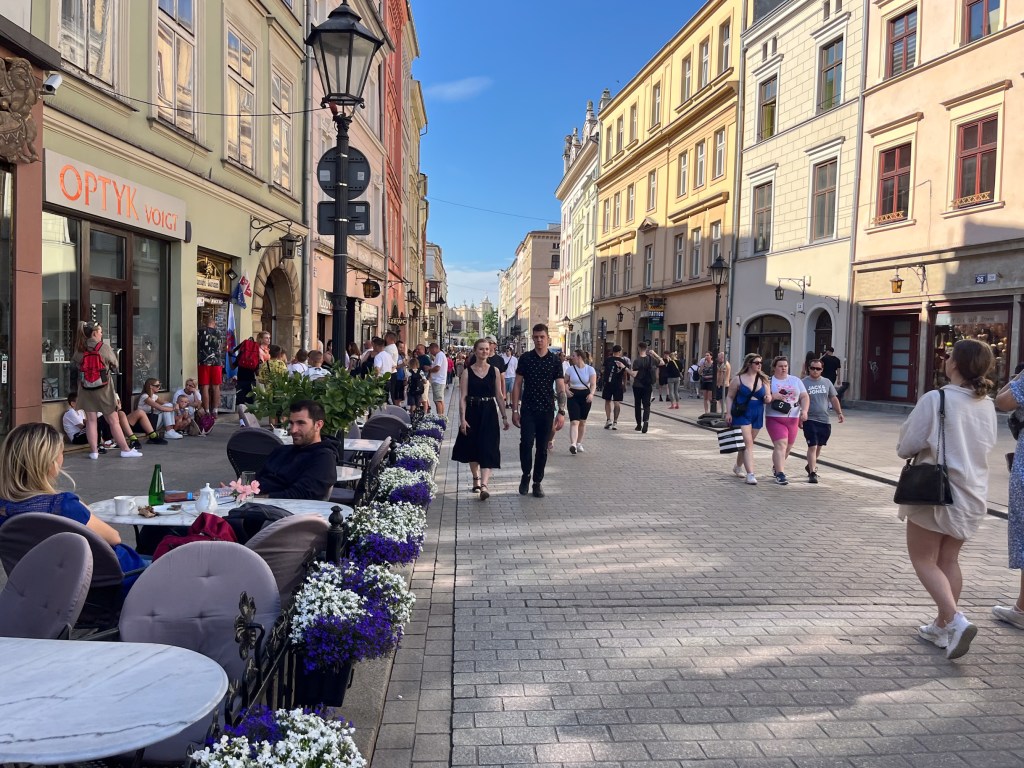
But the first thing that night was to say a family prayer and share opłatek, the Christmas communion wafer. The custom is to take a larger piece and allow each person to break off a piece of yours and eat it, while you do the same to theirs. This commemorates the Last Supper and is a nice social way to wish everyone individually a Merry Christmas.
The meal began late because, as I learned recently, it was customary to start when “the first star can be seen” commemorating the Star of Bethlehem. The two most prominent dishes were a beet borscht soup and fish. Mushroom dishes (Poles are big on mushrooms) were many and varied. First, was the deep red beet soup served with potato dumplings then fried fish, then a mushroom dish. Pickled herring was also an option as it was seen as a sign of good luck for the new year.
Needless to say once the borscht and fish came out, all the kids would bolt away from the table or eat little, until better choices arrived like pierogis and/or potato pancakes (placki). Our favorite polish foods like kielbasa or gołąbki, stuffed cabbage, could not be served, at least not today. We were fasting from meat. Somewhere between dishes we were probably singing or at least listening to Polish and English Christmas songs.
My fondest food memory of the season was probably the buttery kolaczki cookies for dessert made by my Aunt Frances with raspberry, apricot, poppy and prune filling. With 12 dishes to get through, conversation and some drinking it was a sit-down party lasted late into the night as we were sent to bed with beautiful visions of Santa on his sleigh and nightmares of borscht and fish in our heads.
Tradition Continues at Christmas
Old rituals that have stayed the same or maybe improved over time are especially significant to me as I get older. As kids, I’d like to think we behaved a little bit better during the season and learned the valuable lessons of giving and receiving . All this we experienced through the same legends of a jolly old man and a baby being born and through the lens of our own family customs. Tradition helps make the magic.
We might not have understood these mysteries, but we instinctively respected the forces around us and solemnness of the season. Christmastime is still the best of times which we continue to cherish and hope to pass on to other generations.
Living through a year of self-inflicted quarantine has been tough. Then, I remembered we had it rough before and made it thru.
This post is a story I wrote for my Storyworth project. It represents an installment of a personal compilation of stories I hope to complete this year. While the Covid pandemic has delayed long bike trips, I guess I have no excuse to stop writing.
How quickly we forget.
Its been a year living through the Covid-19 pandemic. Our lives have been altered to avoid contracting the disease and to protect others from its spread. Basically, we have led a life that was 90% isolated except for a few selected safe relationships and occasional adventurous activities outside of our homes. Someday soon I hope we can look back on this with some nostalgia. But, not right now.
Ironically, I just came across a note I wrote in 2012 during the last crisis we faced. I’m not even sure why I wrote the note or if I ever published it or showed it to anyone, but it struck me as oddly meaningful today.
At that time, thank God, we did not have our Ortley Beach home when Hurricane Sandy hit. Still, after our Morristown home power lines went out and we tried living in a cold, dark house for days we decided to seek shelter. Ours was by no means the worse thing that happened at that time so we steeled ourselves and made the best of it.
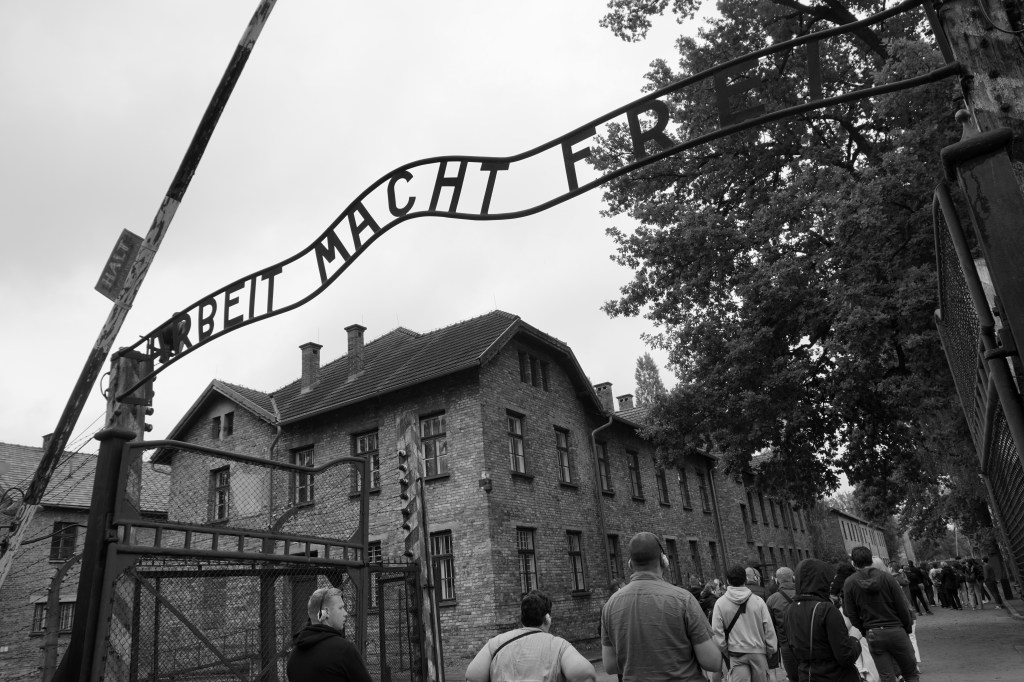
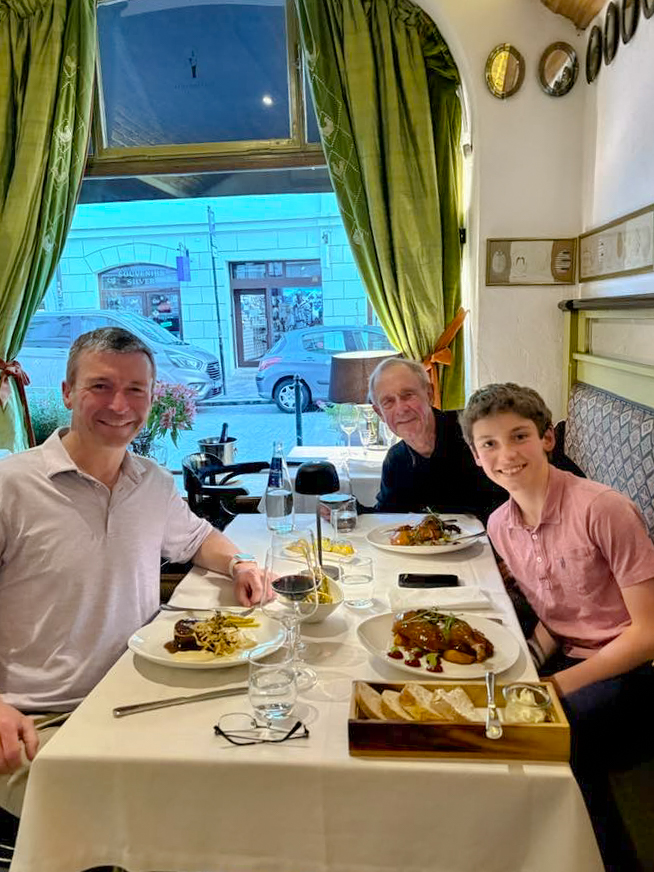
Mary Ann’s mom Caroline, in her mid 80’s at the time and who has since passed, was living alone and independently in her home in Lake Parsippany. She welcomed company and we needed a lifeline.
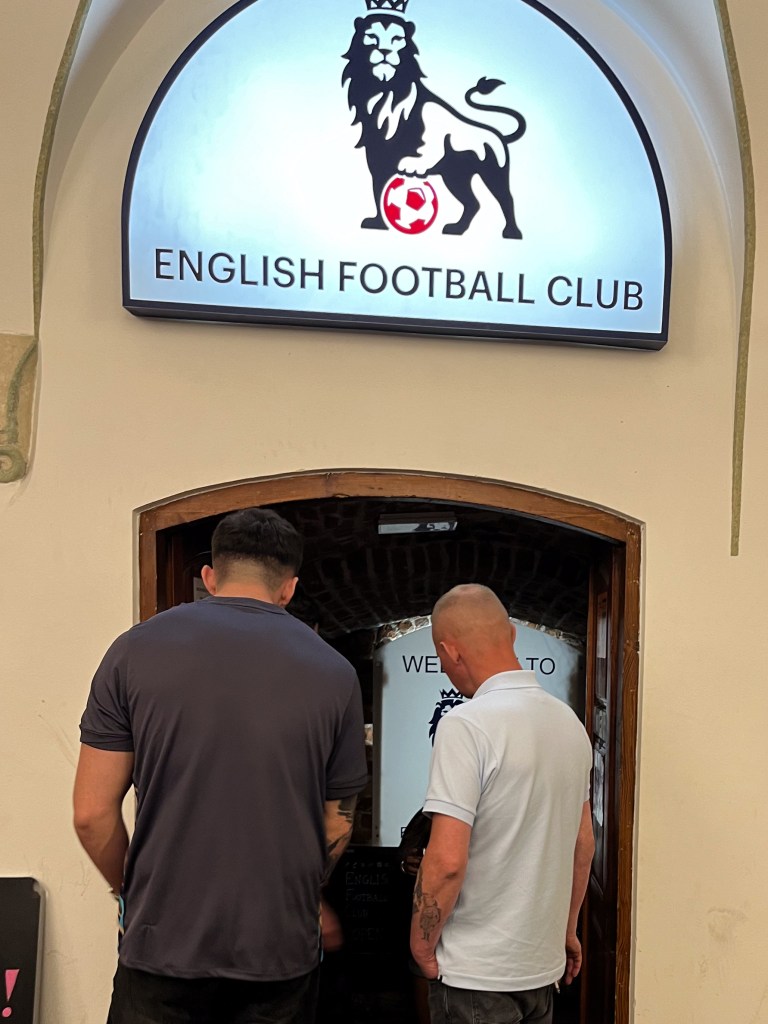
As I remember it, it was a great relief to be in a warm home where mom appreciated the company and we sure appreciated the roof over our heads. This would do until the chaos passed and we could return to normal. It was not a perfect situation but we were all in this together.
Here’s the note I wrote around mid November 2012 as our power was about to be restored after 12 days or so in my mother-in-law’s home:
It made me think that in any catastrophe there are those that suffer much worse than I. Also, overcoming the challenge can lead to good outcomes. Who knew that someday we would all look back on those days when being together in any form would be better than being alone?
My career in the news business was on a roll until I outgrew it. But there were valuable life lessons and skills learned. Where have all the paperboys gone?
This post is a story I wrote for my Storyworth project. It represents an installment of a personal compilation of stories I hope to complete this year. While the Covid pandemic has delayed long bike trips, I guess I have no excuse to stop writing.
Sometime around 1960 I began my career in business. I was gladly working as a 12-year old paperboy (carrier) for the Newark Star-Ledger. This was my first job and real-life classroom on how to make money and work for a boss. My boss, the local circulation manager, was Mr. Danz, who was like a coach for a team of child laborers. Along with baby-sitting, acting and family farming, having a paper route has been one of a very few regular jobs that the Federal Government exempts from the child labor laws.
This was the heyday of print journalism. All families relied on the newspaper as the single most informative and trustworthy source of information. Television and radio, of course, were also important. But, newspapers delivered a long, dependable and regular flow of detailed national, regional and local news that you could choose to read when you wanted. Newspaper outlets were like nodes on the information network of the day. It seemed like delivering the news on my bike was a pretty important job as well as profitable and fun.
Getting Hired
Back then, most families would either buy the paper at a local corner store or subscribe to “home delivery”. In the 1950’s and 1960’s it seemed pre-teen and early teenage boys would deliver most newspapers including morning and afternoon papers. Newspapers advertised for “carriers” as a way to earn some money and be independent. Parents agreed and encouraged their kids to take on a paper route.
A paper route taught a young kid lessons in responsibility, accounting, customer service, sales and marketing. Best of all, most of time you were independent and on your own as long as you lived up to the responsibilities .
Learning Customer Service
Every day a bundle of 50 Star-Ledger newspapers were dropped at the curb in front of my house in the middle of the night or very early morning, with a thud. With newspapers to deliver in the morning before school, I would get up early at 6:00 a.m., break open the bundle and start folding or rubber banding each newspaper. There was an art to a simple fold when the weather was good and the paper was of a reasonable size. There was a feel and smell to the damp news that was evident by the newsprint left on your hands.
If the weather was bad, we wrapped the paper in wax paper (the use of plastics bags came years later). For Sunday, early sections had to be assembled with the latest news that arrived early Sunday morning. Sunday papers were usually an inch or more thick so they required special attention and more delivery time.
Developing Job Skills
The key to a successful paperboy route was preparation and developing a good toss. Because newspapers were so popular your route would usually be in your neighborhood or close by with maybe 33%-50% of the houses as your customers. It was my responsibility to get up early enough to deliver the newspaper before everyone was out the door. Come rain or come shine. No one wanted a late newspaper, one that landed too far away from the front door, or one that was wet. Failure to deliver under these standards could affect tips or worse yet – a complaint to the my boss, the circulation manager.
The “toss” was a zen-like skill that could be honed to perfection. It required executing the principles of balance, aerodynamics, centrifugal force, wind adjustments and deadly aim. While riding and steering the bike with one hand, you would grab a single newspaper and perform a toss across your body, thus causing a backhand spin so that the paper would float to the stairs near the front door. If done properly it was a thing of beauty and a gratifying experience.
Driving the Delivery Vehicle
Most of the time my black Columbia cruiser bike with fenders and a big basket was all I needed. As soon as all papers were bound or folded I’d load up the bike and head out to work.
Bad or cold weather could be an obstacle and often would require my father to drive me around in the two-tone 55’ Ford before he went to work.
You had to get to know your customers and often their particular service requests, like where to deliver the paper and which customer got the paper on certain days, like weekdays or Sundays.
Collecting for the Boss
Near the end of the week was collection day. I’m pretty sure I collected every every couple weeks or maybe monthly. But it was by personal visit to each customer. I would carry around a large ring binder with one card for each customer. I would punch a hole for the weeks paid by that customer as I collected the cash.
On Saturday afternoon, Mr Danz would come by to pick up the payments I collected along with discussing problem customers, any complaints that might have come to him and any new contests I could win for getting new subscribers to sign up.
I was paid only on the number of customers I had and collected. Hey, looking back at this now, it seems like a whole lot like a junior bookie operation – working for the Star-Ledger gang. I remember Mr. Danz as being a nice guy but there was a certain amount of intimidation as a kid answering to an adult of authority.
Getting Paid
In the newspaper delivery business, it was customary to give tips but papers were not expensive. As I remember it, we earned about $20 to $30 per week between a fee per paper delivered and tips. You would lay out your customer cards and count you money less your tips in front of Mr. Danz and officially get paid. It was enough to be proud and make a small profit after considering expenses. You also learned that no one delivering newspapers was going to make a fortune. But you did learn some business skills, a few life lessons and a way to buy a few things on your own or learn how to save money.
Witnessing the Extinction
There has been cultural changes over the years. What used to be an admirable job for young kid began to be seen as potentially dangerous. Children’s freedom became even more restricted. Perhaps, more was given to them rather than requiring them to earn it. In any case, it would be rare to see a child delivering newspapers these days. Selling cookies or popcorn is the extent of our early real-life work experiences that we permit today.
But, beyond the cultural change the Internet has been the major disrupter of paper-based news. Today most news publishing companies rely on subscription service websites and online advertising. The change in the public’s choice of media has caused print ad spending to move to online advertising and news resources given to online stories. Meanwhile, the world of home delivery has changed too. We are consuming less print media and have less of a need for an actual newspaper to be delivered.
The Star Ledger in 1960 cost just $.10 per daily and $.25 per Sunday edition at the newsstand – and that did not change until 1980! In 1960 the typical delivery customer was paying something like $1 to $2 per week. Today, the newsstand cost is $3.00 per daily and $5.00 per Sunday with much less content. The paper is now owned by Advance Local Media LLC which promotes NJ.com as its digital partner preferring to promote a paper and virtual “home delivery” subscription of around $500 per year.
That’s a lot of money for the news to be delivered to you. If you chose to receive a physical newspaper, chances are it would be delivered by a man, or woman, throwing a paper out a car window randomly in the wee hours and whom you would never expect to meet. While there are plenty of reasons, including environmental ones, that make the old model unworkable today, there are also plenty of reasons that we should have thought more about what we lost in automating our news.
Today’s mishmash of online neighborhoods and social networks fracture the delivery of local and regional news. We now have to find where the news is and choose only the news we want. And, our sources are no longer unbiased or represent a higher ideal of truth. Are we getting more information delivered to us or are we less informed than we were 60 years ago?
And so it goes…
My career in the news business lasted a few years but helped me build an interest in business and an entrepreneurial spirit which lasts until today. Today, it seems the only news job a young adult can participate in is creating content for YouTube. That may seem strange but it’s where the eyeballs, fun and excitement are these days. As we move beyond the printing press, let us remember those heady days when newspapers were the boss!
“Were it left to me to decide if we should have a government without newspapers, or newspapers without a government, I should not hesitate a moment to prefer the latter.”
As teens, we were looking for thrills and adventure. We found it along Route 22 and the Watchung mountains. Then, I found there was more to the story.
Get Your Kicks on Route 22
Maybe it was the radical change in the landscape with an abrupt rise of 500 feet that led to its reputation of mystery. Stories would be told of interesting places to visit in the mountains out west along the infamous Route 22. This road was our version of “Route 66”, a highway leading east to west across New Jersey to Pennsylvania and beyond. This was a time before the Interstate Highway system would speed travelers across the state by adding Routes 80 and 78, but bypass many local towns and areas of interest.
Before the age of shopping malls, Route 22 was a destination for shopping and entertainment. For the emerging automobile generation, there were large “discount stores” like Two Guys and E. J. Korvettes you could drive to and avoid the inconvenience of going into the city.
Route 22 had restaurants, gas stations, small and large businesses all along the road from Hillside to Somerville. There was even a night club turned into a clothing store built like a “Flagship.” . Back then, diners, drive-in theaters, bowling lanes, golf ranges and even an amusement park caused lots of driver distractions. Its unique commercial island between east and west traffic allowed right and left lane access adding to the driving danger that was Route 22. For us, the stories of accidents and fatalities on Route 22 only added to its challenging allure.
Bumps in the Road
One memorable destination worthy of a car trip out west was a road known as “13 Bumps.” To get there required about a 10 mile trip on Route 22 to the town of Scotch Plains, at the base of the Watchung Mountains. 13 Bumps was actually another name for Johnston Drive, a narrow two-lane road that paralleled Route 22 for a couple miles but rose several hundred feet above along the mountain ridge. A ride on Johnston Drive offered two unique benefits; a spectacular southern view of the suburban towns below and a place to experience a unique joy ride over 13 large bumps to the bottom.
As a teenager, with a car, a place to park with a view meant a high potential “make out” area for a date. Johnston Drive was a sparsely residential road then with houses built into the cliff and a few turnouts that could provide short-term parking with a view. With no authorized spot to linger and no shoulder, it would not be long before a cop would chase us away. That was probably a good thing. It was not uncommon for guys and girls to meet at Jahn’s in Union and adventure together on Route 22 to 13 Bumps, especially on a moonlit night ripe for the promise of adventure.
Of course, the proof of the quality of any ride was how much you would feel that tickle in your stomach as your organs try to defy gravity. Then, again and again, seconds apart. After each bump the custom was to count out loud the number of the bump until you reached “13” near the bottom of the road. 13 Bumps was our version of a DIY amusement ride which we usually repeated several times on any given night.
Falling into the Rabbit Hole
When I started thinking about 13 Bumps as a story, I decided to look online to see if others in the mid-1960’s had the same memories and experiences. But, what I found was that and more. It seems that Johnston Drive originated back in the mid 1800’s and legend has it that it used to be a unique carriage road that was always associated with mystery.
In 1845 a man by the name of David Felt built a small utopian industrial village in the Watchung’s called “Feltville” to support his printing business. To his disciplined and religious community he was known as “King David”. Feltville grew to over 175 residents in the first five years. Then, legend has it that in the next two years 11 children were captured from the town, mutilated, and died near the outskirts of the village.
As deaths appeared, most of the town believed the attacks to be animal related but the killings never stopped. Families began to turn on one other. They then blamed the murders on devils and demons. But, eventually, they blamed a family of 13 sisters who had lost both their parents at a young age. Because this mysterious family did not seem to be affected by the killings, their farm prospered and there were “13” sisters. the town claimed that they were “witches” who sacrificed the children to pagan gods for the good of their crops.
After a long trial the entire family of sisters were found guilty as witches and were hanged. As a reminder of the crimes. the bodies were buried along a local road creating 13 bumps which is now known as Johnston Drive. A rumor followed that before their death, the sisters put a curse on Feltville that would doom the village. However, no record of this murder spree is in the historical record, but remains an urban legend.
Feltville Becomes a Ghost Town
Update on the Witches of Watchung
First, let me tell you that the 13 Bumps are no longer there! I recently took a ride on Johnston Drive and there’s good news and bad. The good news is that it’s still a nice country road with magnificent houses and a great view. The bad news is that while the road is not perfectly smooth, you would not know that the bumps ever existed.
The municipalities of Scotch Plains and Watchung realized that the road was a problem over the years and attempted to flatten and repave the road multiple times. Locals claim even so, the bumps continued to mysteriously re-appear over the years. The last paving was over ten years ago. Maybe they got the paving right this time. Or, are they destined to come back? It’s possible I suppose that the curse has been finally lifted. Or, Maybe this urban legend is just an old version of “Fake News.”
I recommend this book to my cycling friends and every father and son that I know. It’s a story of fathers and sons, a cycling adventure and the importance of family and community. Besides that, it’s a fun and fast read!
If life is a journey, then the best moments happen when we have the courage to take a different route. This is a story of a coming of age for three men. The author, Rob, convinces his dad, Stephen, to join him on a discovery bike trip through Italy with the goal of visiting their ancestral village, San Donato. Rob’s grandfather (“Papa”) is seriously ill and is near the end of his life. While Papa was part of a first born generation in the U.S., many of the people that settled in their Brighton neighborhood had come from the same village. Rob concocts the idea of a bike trip to understand Papa’s family background and vicariously provide a trip for Papa before it is too late.
While Rob seems to have a good relationship with dad, it’s obvious that Stephen is not your average father. He’s extremely independent, has obsessive habits and tends to love wild challenges, even at the age of 64. He also manages to commute to work on a “fixie”, which is a sure mark that he is already a badass cyclist. The image we get is of an aged-out hippie that is true to his core of beliefs who is a great father, but is not fully understood by Rob. With Papa slipping away and dad becoming a senior citizen, Rob sees the serendipity of the moment to enlist his father as his companion on a 500 mile trip from Florence to San Donato. As Rob says to Stephen, “We’ll go for Papa.”
While the experiences in the towns along the way are brief and somewhat interesting the real benefit is in overcoming the physical and mental challenges along the way. Once at San Donato, the revealing of the family history and the gracious hospitality there is an unexpected reward. Within a few days in the village, they have a change of perspective and a different appreciation for the importance of history and our ancestry. The village has a surprise story of courage and community during the days of Fascism that brings wonder and pride to both father and son.
I’ve taken a couple long distance bike rides over the past few years. Riding with others can be difficult because of the push and pull of each rider’s skills and conditioning. But, the reward is to discover more about that person, share your own personal story and to motivate each other. There can be no better pairing than father and son to benefit from this opportunity. Any son or father naturally looks back at the mystery of each other and desires at some point to know and understand more – even though that always has its limits. Each fact we discover inevitably reveals something about ourselves too.
The author has a casual style of writing which exposes a mixture of personal feelings and humor which makes for an easy and enjoyable read. The pace of the book and its subject matter is fast and complete as it goes from the start of the idea of the trip to its final conclusion and slightly beyond leaving a very satisfying ending.
The New York Times noted Barbara Hillary passed away recently at age 88. This incredible person was the first black woman to reach the North and South Poles – and doing so while in her mid-70’s! These two feats and many others were accomplished in spite of her having breast cancer in her 20s and lung cancer in her 60s. Eventually, her adventures and travels led to becoming a motivational speaker and lecturer on climate change.
As a nurse in her mid 50’s her life took a different course as she took on these personal challenges which seemed to motivate her and bring such joy.
How I fell into a rabbit hole and ended up in the mid-1960’s
On the 10th day of my New England Reunion Bike Tour, I was waiting out the rain in Lee, Massachusetts. I set out for my last meal in town before I was to leave the next morning. This area is known for its history and its embrace of mystery and new-age trends. Here’s what happens when my course collides with local forces.
The Salmon Run Fish House. It sounded out of place here in Western Massachusetts. Sometimes all you want, and really need, is something good to eat and the Yelp reviews were good. But, there was more than food to be found here. It was a rabbit hole of sorts taking me on a journey back to a different time.
Being a Bar Fly
I was kind of stuck in Lee, MA on that rainy evening so I did not mind settling into a comfortable place for a couple hours. The Salmon Run Fish House restaurant was an old, narrow, dated place with paneled walls, maybe a dozen booths and a small bar. The waitress strongly suggested I might want to take a seat at the bar since booths were reserved and they would be occupied soon (Got it! I’m sure they did not want one person in a booth). Or, maybe it was just fate to sit at the bar that night.
A couple sat at the bar near me and we began a conversation about local craft beers. I recommended the beer I was drinking called Two Roads: Road 2 Ruin. It’s a mighty good double IPA brewed in Stratford CT. Their marketing tag “The Road Less Traveled” seemed like the perfect motto for my adventure.
My new bar new friend, Bill Russell, was a pleasant, seasoned guy, 73 years old with an attractive wife. Although they now live in Lenox, he likes to come to this place for the food and atmosphere. He’s retired now but has a couple of unique interests and a memorable past.
My new found legendary friend, Bill Russell was part of the mid-1960’s scene in Stockbridge.
Where it All Began
Bill used to live in nearby Stockbridge, a fairly famous artsy destination in the Berkshires. At least one reason for its recognition is that it was the scene for Arlo Guthrie‘s famous song and story telling adventure called Alice’s Restaurant(actually titled Alice’s Restaurant Massacree).
It turns out there once was a restaurant called The Back Room owned by Alice Brock and her husband Ray Brock in Stockbridge. The 18-minute song and 111-minute movie made from it are largely based on actual events outside of the restaurant and Bill Russell was part of that whole scene.
Bill grew up in Delaware but was sent by his parents as a teenager to the Stockbridge School in 1964 because of behavioral issues. It was a coincidence of time and place that Alice and Ray re-located to the the area from New York City. She became the school librarian and Ray taught shop at the school. Ray was an eclectic charismatic character who was an architect and talented woodworker. He quickly became an outspoken leader of an anti-establishment community which drew students from the school, including Bill and Arlo Guthrie. This was a turbulent time of radical social change, drugs and the Vietnam War.
Cooking Up Alice’s Restaurant
The story of “Alice’s Restaurant” is about a memorable Thanksgiving dinner in 1965 when Alice and Ray invited everyone they knew to a big feast in their newly bought deconsecrated church in Great Barrington which they converted to a commune-like place for young students and bohemian friends to meet, to discuss ideas and to party.
Arlo and friend Richard Robbins decided to help clean up after the Thanksgiving meal and headed to the town dump after dinner to cart off garbage. But the dump was closed. They unloaded the garbage where they should not have and are eventually caught and fined in an overly dramatic police arrest. Later the next year, Arlo was called up for his Vietnam-era draft physical in New York City. Much to his surprise he was re-classified. He had dodged the draft – not because of behavioral or physical issues – but because he had been arrested for littering!
Ironically, Arlo’s dad, famed folksinger Woody Guthrie, was on his deathbed at the time suffering from Huntington’s Disease, a rare genetic disease that Arlo inherited but was fortunate not to suffer from.
A Legend is Born
Bill was one among the dozens that attended that fateful 1965 Thanksgiving Dinner. Alice opened a real restaurant in Stockbridge afterwards which was a brief success before she became fed up with the business and with Ray. They split up a couple years later. Arlo Guthrie wrote Alice’s Restaurant as more a storytelling than a song. But it was to become a perfect humorous symbol of the times.
Album cover of 1969 recording of Alice’s Restaurant.
A movie deal followed the song’s success. It was not one of famed director Arthur Penn‘s greatest films. The movie was shot in the Stockbridge area and expanded the story with added fiction but it could not save it from a poor script and mediocre acting. Many of the original friends of Alice and Ray got walk-on parts, including Bill Russell.
Bill Russell ended up living in a room near the restaurant in Stockbridge and got to know Alice well. He learned the craft of woodworking and ended up moving to New York City where he bought a shop at a time and place when it was affordable. He lived there for 25 years but eventually came back to Stockbridge. He continues to live off the income from properties including his NYC building which once was his workshop.
When Bill and I parted company that night he told me he would be heading to Provincetown on Thanksgiving Day, as he has for many years. Alice Brock is still carrying on their tradition by hosting a dinner for her close friends, including Bill.
Down the Rabbit Hole
Bill was like the Mad Hatter in Alice In Wonderland. He showed me the rabbit hole and I could not help but go in.
I learned Alice opened and closed several restaurants, wrote a few cookbooks and a biography called “My Life As a Restaurant“. Still, she’s always had a love/hate relationship with running a restaurant. She preferred a creative free-form style of cooking. Here’s an audio recipe for Salt and Pepper Soup recorded at NPR.
NPR This I Believe – Alice Brock on her philosophy of life and cooking.
Today, Alice Brock (alicebrock.com) lives in Provincetown, MA and sells beach stones (painted stones meant to be hidden in strategic places) and other personal artwork through her website. Her former husband, Ray Brock, passed away in 1979. The deconsecrated church in Great Barrington was bought by Arlo Guthrie and is now the Guthrie Center at Old Trinity Church. where people people of all religions are welcome, musical events still occur and a large, open Thanksgiving dinner is served each year.
After googling the incident, characters and times, I viewed the movie Alice’s Restaurant on a library DVD. It brought back old memories including the strange times we lived through in the 60’s, including my own draft physical in Newark, New Jersey about that same year.
Its fair to say that listening to this song has become an American tradition for many of us – linked with Thanksgiving, story-telling humor, questioning authority and an ability to laugh at the absurdities of life. To me it’s become as timeless and strange as Alice in Wonderland.
For all those who sweat over the details… Here’s how this bike tour was done. Each time I learn a little more.
This post will answer some questions on how I ride these bike tours. It is a fresh update to my previous posts for my Epic Bike Tour. That tour I rode my bike from Key West to Morristown (home). Here, I’ll discuss the differences in this recent New England tour I called the Reunion Tour from Burlington VT to Morristown NJ, 18 months later.
In last year’s posts of “How the Sausage is made”…#1, #2 – I discussed the following relating to my east coast bike tour:
my bike setup
how I navigate
where I spend money
how I eat.
I applied what learned in April 2018 to this trip and avoided some of the pitfalls. Here’s some of the differences and what I discovered along the way.
The Bike
My bike (named “Silver”) is a custom-built model called an Expat S, titanium gravel/touring bike by Seven Cycles. It is an 11-speed using Sram Force 22 components with gearing of 50/34 front and a 28/14 rear. For more tech details click here. It weighed in at 22 lbs with Portland Design Works aluminum fenders, and Iberia rear rack system and bags. I used 2 panniers, commuter bag and top tube bag. All total about 40 extra pounds to carry in bags. I decided early-on that I would not camp this trip so I did not take as much gear as I did on the Epic Tour.
All other components were the same from last year except I replaced the cassette and chain and switched to a tubeless tire setup. The Seven had come with the lastest Mavic UST tubeless rims. After testing tubeless road tires and reading reviews, I decided to take a risk and go the with SchawalbeMarathon Supreme 700 X 35ctubeless tires for a smoother, safer and more reliable ride. They worked perfectly this time inflated to about 60 psi.
I realized on this trip the importance of disk brakes for this kind of riding. With the extra weight going down monster hills, the bike was easy to control, even in wet weather.
Comparing Tours (East Coast vs. New England)
The goal of this trip was to ride about 525 miles through the mountains of New England within a two-week timeframe while visiting a few friends along the way. That’s much less mileage than the 1,600 flat miles for the U.S. east coast tour in 2018.
As I did in the Epic Tour, I wanted to do this by transporting my bike to the farthest point of the route and then find an interesting way back home by bike. Amtrak provided a convenient way to port the bike to Burlington without breaking it down.
I still averaged the same amount of mileage each day (roughly 65 miles each day) but each day presented a climbing challenge (averaging over 3,000 feet of climbing per day). The trip was tougher on a day-to-day basis but at least as enjoyable, due to beautiful fall scenery and visits with friends.
I’ve learned quickly that whether you are a person who likes routines or not, it is essential to bike touring. Doing otherwise causes wasted time, confusion and lost items behind. Here’s some of my standard routines:
My Daily Start Up Routine
Wake up – between 5:00 and 6:00 a.m. depending on what day’s challenge is ahead. Normal bathroom routine. Includes applying lotions (sunscreen (at times), chamois creme, glide, etc.), take routine vitamin supplements.
Suit up – with usually base layer top, jersey, shorts, leg warmers, socks, gloves, arm warmers, helmet and wind vest. For this NE trip, at times I needed to wear a light winter jacket, shoe covers and long finger gloves for the cold days in early October. One morning started at 29 degrees! I also wore a chest heart rate monitor to monitor physical effort for the day. I purposely wear colors that stand out to be seen for safety for this type of riding.
Routine bike check – tires, screws tightened, rear light on and bike computer. I’ll use a front flashing light and extra rear lights if visibility is poor.
Check top bar bag – make sure I have flat kit, air inflators, anti-theft lock and chain.
Pack 3 Bags Pannier #1 – Casual clothes – 2 t-shirts, underwear, button-down shirt, running shorts, jeans, socks, sandals, light fleece. Toiletries. Portable computer. (total less than 15 lbs.) Pannier #2 – Cycling clothes – 2 jerseys, 2 shorts, 2 socks, extra gloves, arm warmers, leg warmers, cap, warm riding jacket (doubles as casual jacket), shoe covers. Rain gear – pants, water-resistant jacket, helmet cover, water repellent shoe covers. (less than 15 lbs.) Commuter Bag – hard shell bottom with compartments that locks on top of the rear bike rack. Great for everything else and to take into town to carry food back to where I’m staying. Includes everything I might need along the way. Energy food, camera and equipment, misc. electronics (chargers, cables, etc.), papers, bungie cords, wallet/money/ID.
Install bags on bike – panniers on the sides and commuter bag on top.
My Eating Routine
Huge breakfast was a treat in Woodstock VT.
Pre-Ride – eat something light like cereal, bagel, donut and coffee. Coffee is my most important item at this point. If nothing available at start I would search out a place to get something.
Breakfast – optional depending on what I’ve eaten earlier or the length of the ride. I have dabbled in bigger breakfasts and then skip lunch.
Lunch – optional. If it looks like a long hard day, I’ll go for a lunch. A Foot-long Subway Veggie Delight is my preference.
Late Afternoon Snack – I like to stop for Gatorade and some chips or pretzels or nuts. Something salty.
Dinner -For this trip, I either ate with friends or went out to a local inexpensive place that looked interesting based on suggestions from my hosts, people I met or something suggested on Google. Because of the area’s reputation for fine craft beers, I made a point of sampling some fine beers along the way.
General Schedule
Wake up 5:30 a.m.
Breakfast 9:00 a.m.
Lunch 11:30 a.m.
Snack stop 1:00 p.m.
Arrive at lodging 2:00 p.m.
Shower / change 3:00 p.m.
Ride or walk the area 4:00 p.m.
Dinner 6:00 p.m.
Blog / email / phone calls 8:00 p.m.
Lights out 10:00 p.m.
Lodging
I’ve learned to make the most of Airbnb.com locations for great places to stay at reasonable prices. You can also usually book within a short time frame if you are traveling off-season. For this trip, I used a combination of staying 5 nights with friends and 7 nights at airbnb’s.
One of my main concerns was the weather forecast. While I was prepared to ride in the rain, I was able to plan to avoid a full day of rain near the end of the trip. Sitting out a day of rain means that your schedule would need to be reset for an extra day and can throw off all your plans and reservations. That’s why except for the first week, I delayed reserving the mid-part of the trip until a few days before that day so I could be relatively sure I would be riding that day. I have also found that with a day of riding and being alone, I enjoyed the company of others and the opportunity to learn more about the area from the airbnb hosts.
One of the nicest airbnb’s was in Bennington VT in the main house on a tree farm.
Here’s the rundown on my stays. The locations are first based on finding an area near my route and about 50 to 70 miles from my previous stay, The most important factors are 1) how close is the place to my route 2) How expensive – with all other fees included 3) What ratings the host had from previous guests. Here’s where I stayed and the total cost of the stay (1-person):
Sep 28 – Burlington, VT = $81.77
Sep 29 – Burlington, VT = $81.77
Sep 30 – Mike Kennedy’s – Barnet, VT
Oct 1 – Mike Kennedy’s – Barnet, VT
Oct 2 – Mike Kennedy’s – Barnet, VT
Oct 3 – Hanover, NH = $73.84
Oct 4 – West Rutland, VT = $60.95
Oct 5 – Bennington, VT – $67.48
Oct 6 – Lee, MA = $60.53
Oct 7 – Lee, MA = $45.00
Oct 8 – Mike Hayser – Sherman, CT
Oct 9 – Tom Siccardi – Chester, NY
TOTAL = 12 nights, 7 @ airbnb lodging = $471.34
Riding the Roads
Riding on the Ashuwillticook Rail Trail in Adams MA
Probably the most asked about question is what roads I took. As I have mentioned, I tend to use Google Maps / Bicycle routes from one place to another. But Google provides no information on what the roads will be like. Here in Vermont and other places along the way, I was often taken off state roads and guided toward well-meaning country roads. I can only guess that there is some algorithm that decides what might be best for an average cyclist to see and experience. My priorities were 1) to get to the next location as efficiently and safe as possible 2) to see some of the local areas I was traveling through. Google and I were not always on the same wavelength.
My first day on the bike from Burlington, the western part of the state to the eastern part in Barnet, was the hardest day (see more here on that here). With a variety of roads from nicely paved highways with adequate shoulders to busy highways with rumble strips and speeding cars and trucks. This type of trip is not for anyone that panics in traffic. Or, sometimes dirt and gravel roads led to trails more for suited mountain bike. Luckily, the bike and tires were strong enough to take a beating and still roll well on paved roads.
There were rail trails and pure dirt double-track trails in the woods where I would see no one for hours. Many times I was not sure where the road was taking me. I guess that’s part of the excitement of the journey. Eventually, you have to come out somewhere where you can re-calibrate.
One of the rougher roads to roll through. Nice change of scenery but slowed me down. Thanks Google!
For this journey, I relied on Google maps with earphones to tell me when to turn. I normally never ride with earphones. My son Ethan’s friend did provide a route that I did use to get from Burlington to Barnet which did help for that segment. I did not search out other posted cycling maps since I could not know what maps might be best for my objectives. Researching this, especially if I had to change plans along the way would be inefficient.
Electrical power to keep my cell phone and bike computer going was critical. I relied on two back-up sources and every day had to go to back up power shortly after lunchtime. One backup source was a solar cell on the rear of my bike. On that first long day of riding I ran completely out of all power, in the dark, but I was right in front of my friend’s house. Whew! That was close.
There were only three places where I had to actually walk my bike up the hill either because of the steep elevation and/or conditions of the road or the fatigue I was experiencing. While I was avoiding the steepest areas, I think my body adjusted to carrying the extra weight and pacing myself with the hills. It was a personally satisfying achievement and proved that I was capable of doing more than I thought.
What you are about to read may or may not be fiction. I say this so I am not implicated in the crime I may or may not have committed. My intentions were honorable AND I needed content for this blog.This is about a brave new world we’ll all soon be facing.
It didn’t have to be this way. I could have rolled through Lee, Massachusetts just like I’ve done before on my bike through dozens of towns on my way back home from Vermont on my Reunion Tour. But, curiosity got the best of me. I chose to break the law. Luckily, I did not get caught this time. Here’s my warning to all of you who pass this way again.
I had booked an Airbnb stay in Lee(a Berkshire, new-age kind of town) on fairly busy Housatonic Street. My M.O. for a typical day of tour riding is to get to where I’ll be staying by 3:00 p.m. then take a ride or walk around to see what might be interesting in the area and where I might eat later on. Lee seemed rainy, quiet and pretty unassuming.
Public water fountain with image of Chief Konkapot the Mohegan chief who sold much of Berkshire county to colonial settlers in 1722. (His name today seems oddly ironic!)
As I did reconnaissance on the main commercial street leading into town, I noticed an odd-looking, newly renovated commercial building. Despite being set back a bit, there were plenty of signs welcoming you to turn into Canna Provisions. But, why? My usual connection to the word “Provisions” is for food. About a dozen people were lined up at the time apparently waiting to get in. How good could the food be?
Synapses in my brain must have been exploding when I saw a subtle logo on a sign and made the connection. We were in Massachusetts and pot was now legal here as of last summer. Is this a store that sells to the public? If so, is this what an official dispensary looks like.
Curiosity got the best of me as I turned my bike around and coasted toward the entrance. The building looked almost antiseptic except for covered windows, a disabled ramp, steel door entrance and line of people waiting to get in. Then, there was that minder with clipboard and walkie-talkie-like phone that convinced me that I was approaching a strange new world. That steel door was a portal into a world I knew nothing about.
Entering a Brave New World
Marijuana is now legal in Massachusetts if you are over 21. You can possess up to 1 oz on you and up to 10 oz in your home. You can grow up to 6 plants in your home per adult.
The greeter at the entrance was an average, middle age woman who was happy to answer my questions and encouraged me to come in and view what they were selling. I decided to chain-up my bike and take a look at how marijuana is sold and what kind of people are now buying this stuff. Trust me, my intentions were naive and innocent.
My first surprise is the amount of security needed to get into this dispensary store. After presenting my drivers license to the woman I needed to wait on line outside the store. I noticed this was an odd group from young to old, equal number of men and women, sick-looking to healthy. If marijuana is known as a palliative for pain and source of pleasure, it was a small but representative group.
Once I reached the head of the line the door was opened and I entered a small holding area with another secure locked door. I was told to present my driver’s license again to someone behind a bullet-proof window. I’m pretty sure that a full criminal check of my background was made. A few minutes later the inside door was opened and I met my attractive young female sales representative who would explain the cannabis products and the “Menu.” It was too late to turn back. Nor, did I want to.
A variety of products were on attractive display shelves. There were at least a dozen or so people near the sales area and five cash registers. They are prepared for crowds. It was a relief to know that there was more options available than buying a joint. But the number of choices was confounding – flower, pre-roll, tinctures, concentrates, topicals, and edibles.
This is all compounded by the the quantity and potency of marijuana (THC – illegal in most states) and hemp-related products (CBD – legal and becoming common). I had to learn a new vocabulary if I was to buy something here.
Canna Provisions current menu.
Making the Sale
I convinced myself that up until now I was just here to observe this new business and social phenomenon as a researcher. Now, my sales rep was asking me what I would like to purchase. Two thoughts immediately came to mind. My wife Mary Ann has been suffering with sciatica lately and might benefit from a topical. I also needed to buy a gift for Mike Hayser, one of my reunion friends who I would be visiting the next day in Connecticut. Mike had an affinity to smoking a joint now and then over the years and I was pretty sure he would appreciate any product that Canna offered.
Mary Ann gets the Nordic Goddess ointment. Mike gets the fruit gummies.
Payment could only be made by cash or debit card. Because marijuana is still listed as a federal drug, I was told that credit transactions are subject to government scrutiny, so not an option. Lastly, I asked the question about traveling with the products. There’s no problem with possession in Massachusetts and a few other states where it was legal, but the rep said, “If you told me you were going to Connecticut or New York with the product, I would not be able to sell it to you.” Needless to say, I said nothing.
Crossing the Border
I quickly considered that the $100 I had just spent on drugs might get me into a whole other world of trouble caused by the one I just exited. I buried the loot in the bottom of one of my panniers the next day and set off to cross the New York border and later the borders of Connecticut and soon New Jersey. No one was there to nab me at any state border.Laws on this subject are destined for the ashtray of history.
Whether legalization and dispensaries will be successful is an unanswered question. To me, the dispensary is similar to a state-run liquor store. Lots of regulations might change over time or remain the same as we live out legalization. Can the government really control the marijuana genie once it’s out of the bottle?
Back to Reality
As for my post purchase thinking on this, Mary Ann’s Nordic Goddess ointment has not seemed to do much and a better choice for Mike might have been a joint. Although, he says he can buy it cheaper through his own source! As for me, I probably should have bought a joint for me just to add to the interest of this story, but I did not. Maybe next time I pass this way, or go through Massachusetts.It’s a brave new world out there once you cross the border.
A great concert for the ages. Neil Young at the Ryman Auditorium.
We’re taking a slight “detour” here from my Reunion Tour bike trip blogging to comment on and recommend a movie that brought home some of my personal feelings as of late. It’s one of the best concert movies I have ever seen.
Striking Gold
Occasionally, out of the blue, something appears as a selection on one of my 60+ streaming TV channels that really, really is worth watching. That happened last night when I selected from Kanopy the 2006 Neil Young: Heart of Gold documentary directed by Jonathan Demme. Its themes, music and point in Neil’s life tie right into my 13-day, 500+mile bike tour I completed last week. The message sent to me was clear – others pass this way too.
This is the thoughtful and everyman Neil Young performing songs for the first time from his Prairie Wind album which was critically acclaimed and nominated for 2 Grammys. It was a different turn toward an Americana sound somewhat like country, bluegrass and folk ballads. It reminded me of the music I heard in Vermont that just tell simple stories well. I loved the album at the time but had totally forgotten about it. This is the same Neil Young who once sang, “It’s better to burn out than fade away.”
You’re Never too Young
Young wrote most of the songs after his father’s death a few months before. At the time, he was diagnosed with a treatable brain aneurysm. Yet, he opened a tour of the album at the famed 2,600-seat Ryman Auditoriumin Nashville, the shrine and home of the original Grand Ole Opry. At the time he was all too aware of the fragility of life.
The songs are about growing up in Alberta, his father, his daughter, his god, and even his guitar. It’s a beautiful positive ode to the basic important things in life. While I’m not a country music fan, the emotional connection that a good country song brings is in this music, in spades.
Young is reverent to all the places, old times and everyone he has known. The heartfelt lyrics and sound are true and played to perfection with great musicians, including Emmy Lou Harris and with artistic and minimalist filming. Neil never looked more like the musical genius he is than in this work.
If you’ve read other posts on my blog myplanc.blog, you know its about getting older and in appreciating and discovering joy in everyday things. This documentary did just that for me and helped me bask a bit longer in the good vibes I got from visiting some old friends – and having the unforgettable opportunity to reminisce about good old times.
One of These Days – one of my favorite songs on Prairie Wind in harmony with my Reunion Tour.
Some memories of people are etched in our minds. Some of places. And, some memories have both.
It was a rainy day, exactly as forecast. I enjoyed sleeping late that morning at my airbnb in Lee, Massachusetts. I had decided that after 10 days on the road and only 3 more to go to complete my Reunion Tour, it would be wise to avoid riding my bike through the light, steady rain.
25 Housatonic Street is conveniently located near the town center and is large enough for to host at least a few guests in some old period rooms as well as accommodate the owner’s family and grandkids on an occasional visit. Definitely not a motel. It was, as they claimed in the airbnb listing, “Comfortable Living in 1870’s House”.
Trivets from the three states that meant the most to me appeared on the table. A good sign, indeed.
I was sitting alone in a shared guest area that offered coffee, food, and information. There were obviously lots of memories made and shared in this home. The creaky floors and the numerous tsotchkes here seemed to prove that beyond a doubt. But people make memories and I was fortunate to meet a few.
This house keeps lots of memories frozen in time.
New-Age Kathy
I had met Kathy yesterday when I arrived. She was also a guest for the upcoming week, here for the Women’s Week program at Kripalu in nearby Stockbridge. It is the largest yoga retreat in North America. Her upbeat conversation reflected my understanding that this area of the Berkshires is known for its new-age thinking. She had come to gain a new enlightenment, become an instructor and to meet up with other yoga friends. Later, she said the program was everything she expected and more.
Biker Debbie
Later that day I met Dave and Debbie, who were my thoughtful and friendly hosts. Debbie was probably near my age and had been a competitive cyclist who also organized mountain biking races in the Kingdom Trails Burke Mountain area for several years – where I had visited a few days ago. It was obvious she had lots of old memories of those past glory days. Now, she and her husband still ride on tamer local trails and enjoyed walking. Funny, how easily it can be to relate to memories from people we might not have otherwise met.
Nurse Elizabeth
Sharing coffee and stories with Elizabeth, an inspiration of hard work and persistence.
But, that rainy morning I also met Elizabeth who was a regular boarder here and not your usual airbnb guest. After a friendly greeting I noticed she had a slight European accent. She began to explain she actually lived here 3 days a week to accommodate her job as an emergency room registered nurse in a Pittsfield hospital. Obviously, being an EMT nurse requires a certain type of individual.
You probably know that nurses are in high demand these days but their salaries do not necessarily reflect that. Apparently, Massachusetts hospitals pay much better than upstate New York. Elizabeth’s home is about 25 miles west of Albany so rather than travel 80 miles each way for 3 days, she stays here. This way she can have 4 days off to take care of her home and farm animals.
It turns out Elizabeth was born in Poland in an area known as Galacia that is the same area where my ancestors are from. Yet, her family began their American odyssey first in Bayonne, New Jersey, as many Poles did over the last century. Her family was able to begin immigration in the 1940’s after the war when sympathetic Polish troops allowed Poles to cross the border into Austria despite a Russian blockade. Later, the border closed and the family was denied entry until Glasnost occurred in Russia.
As was the custom of the time and place in Poland, Elizabeth married a neighbor in what might be called a pre-arranged marriage which she fought. Eventually, Elizabeth immigrated and worked through marital difficulties, earned here RN degree and raised three daughters (all now in their 20’s) that are doing very well, including one who is a pre-med student. Her’s is a story of a successful persistent immigrant and of one woman’s strength. I could not help but feel her story is not over yet and wondered what memories were ahead for her.
Lasting Memories
Nearly a week after my stay in Lee, I found myself on a weekend away in the Hamptons with my wife, kids, their spouses and the grandkids. It was to celebrate my wife Mary Ann’s 70th birthday. Yes, we were making our own memories too. Accidentally, a moment came a few days ago that brought a flood of memories back from that day in Lee, MA.
The Memory Motel still creates memories-Montauk Bar/Motel made famous by the Rolling Stones
In 1975 Mick Jagger was escaping a busy schedule of North American shows and a productive period of new music. Mick and Kieth Richards escaped to Andy Warhol‘s Montauk vacation home for a break. During that stay, Mick had a fling with a strong-willed woman. They would later name her as Hannah in a song he and Kieth wrote called the Memory Motel. (lyrics here) Some consider it one of their longest anb best ballads.
It’s speculation that the basis of the song then was Carly Simon, who Mick had a relationship with (Of course, it’s no secret that Carly got back at Mick with her hit single “You’re So Vane“). But the famous photographer Annie Leibovitz was also know as Hannah. So, let’s just say Memory Motel it was about remarkable women.
As we traveled through Montauk, we passed the actual Memory Motel. I did a double-take remembering the name but not realizing its history at the time. Apparently, there’s still a dive bar and beat up motel that lives on as a monument to memories past and those that can still be created.
Just like my stay at 25 Housatonic, some memories are just burned-in and will never leave. Rightly so. Chief among them are hard-headed women that make a difference and special places that we never forget.
There’s a world-class playground for mountain bikers here in the Northeast Kingdom. I gotta come back.
I have long thought myself a “roadie” cyclist – meaning my preferred biking is on paved roads with plenty of room to speed and go for miles. Lately, I’m not so sure. It may be a combination of age and looking for new challenges that has got me thinking and behaving differently.
This Reunion Tour I just finished yesterday was a pure solo touring adventure that challenged my endurance, planning, reacting and social skills. It forced me out of my comfort zone for 13 days. And, I totally enjoyed the experience even if it was difficult many times.
On the second day of my visit with my old friend Mike Kennedy in Barnet, VT, he took me to a special area about 25 miles away near the Canadian border that he said was know as a mecca for mountain biking. By far, more people mountain bike in Vermont than road bike.
Burke Mountain is a well know professional skiing area in the winter and is home to Burke Mountain Academy where the best young skiers, like new super star Mikaela Shiffrin, have gone to school while training.
Even with its history and cred as a skiing area its perhaps better know as an elaborate playground for mountain bikers called the Kingdom Trails, a non-profit group that manages the trails. They say that almost every day in the summer and on weekends before the snow comes, thousands come here to ride the trails.
Info center for Kingdom Trails
We went into the information building at the base of Burke and got the basic idea of how this works. You can ride the 60 miles of trail for $15 per day or $75 membership per year. There’s trails of every skill level and the grounds are beautiful. The concept they perfected is to build trails using easements from nearby land owners. So the place is sprawling and everyone is happy.
Panoramic view from lodge at Burke Mountain
Mike and I visited a special bike shop that gets 5 stars from everyone called Village Sports Shop. It’s dedicated to mountain biking and provides a great variety of bikes. It has the greatest panoramic view of the area and is right on the trail. You can rent daily from $40 to $100, from a basic hardtail to a double suspension, carbon fiber, disk brake model. Besides the convenience and great staff there’s a full coffee/kambutcha/beer/wine and food bar right in the store and is probably the most popular place to start and end your ride.
Great choice of rentals at reasonable fees
Darcy & Cheryl talking biking
We walked around the area then settled in for a craft brew. We talked with some new friends about biking the trails, jobs in Vermont and local music. I started thinking how great it would be to come back here another time with a group of friends and shred some dirt, enjoy the many local brews and the friendly vibes of Vermont. I’m not a skier these days but I think I could easily be a happy mountain biker in Vermont.
It’s time to get back to work. Here’s what it’s like to ride the roads of Vermont.
Let me switch back to riding this time. On Thursday, Oct 3rd I needed to leave Barnet VT and work my way down to NJ. The next stage of the tour looked to be easier as it followed the Connecticut River which divides VT from NH. My only problem was starting. The following is a description of the next two days riding to Hanover and the Rutland area. I was soon to find out there is no easy days on this tour.
It’s worthy to note that there is a great variety of roads here for cyclists:
Highways (hopefully with some shoulder)
State roads (e.g., Route 5 or 7)
Local roads (paved streets)
Dirt roads (unpaved roads)
Rough roads (rutted, stone and dirt)
Bike trails (cleared and sometimes paved roads for bike and pedestrians)
Mountain Bike Trails (rough dirt trails, rutted, stones, turns, etc.)
While I rely on Google Maps (chosing “bicycle” as my means of transport), you can never be sure what kind of blend of roads it will create as a route. There often is a variety of roads and trails. Dirt roads are slower to travel, are bumpier and are usually more remote. However, they can be more peaceful and relaxing away from traffic. Note: As a rule I don’t use earphones while riding but they are almost necessary if you follow a route on Google Maps.
Starting out I could see the route while at Mike’s house via an Internet conection, but I could not follow the route when moving because I lost cell service. Long story short, I eventually managed to pick up Google again which suggested a more bike-friendly route. I complied. I should have known better.
The first ten miles took me in a dirt-road circle back to where I started. I had lost at least an hour of precious time. I quickly decided to chuck Google Maps and just follow Route 5 to Hanover NH, where I had planned my next airbnb stay.
Hey, didn’t you pass this way before?
While the rest of the trip was long (56 miles – over 5 hours), peaceful (low traffic), but remote miles, Hanover NH is diiferent. Its the home of Darmouth University and is somewhat lively, especially from where I had been.
The Little Buzz, a cute little coffee shop in Bradford along the way. I needed that.
Dartmouth is an Ivy League school but the town is not as vibrant commercially as Harvard or even Princeton. I had to search around to find even decent pizza and a beer. But I salavged the night with maybe the best gellato I’ve ever had.
While I thought about touring the campus I quickly lost interest. Mary Ann, Justin and I had toured it years ago when he was interested in Dartmouth. But sometimes things just work out differently – and maybe for the better.
I’m the “old man” on campus at Dartmouth quad.
I started out the next day toward West Rutland,VT which is near some big skiing areas like Killington and Okemo. Thinking about that I knew it would be a rough ride wth increasing altitude. Also Mike had mentioned that there are far fewer roads going across the state than north and south. There are chunks of mountain ranges that are just harder to cross.
How beautiful is this? Non-stop scenery. In this case, on a far away country road.
In this mid-state area, route 4 is the heaviest commercial highway from east to west. So, I opted for a more local route which turned out harder and steeper to climb. The ride was beautiful and scenic for much of it.
Quechee DamStunning sights on what was to turn out my sunniest day.
However, I had to ride about 25 miles on route 130, a newer state road built for trucks and high speed cars certanly not pedestrians and cyclists. I needed nerves of steel and legs like pistons on this autobahn. Then, I could see that the last 15 miles or so were not near highways. That could be good news or could be bad. It turned out both.
My “nerves of steel” challenge. When you’ve got nothing, you’ve got nothing left to lose.
First, my exit off of Rt 130 was into a dirt road where even cars were not permitted. Then, there were a series of complicated turns down paved roads. This went back and forth for miles. Finally, I was within 10 miles. The roads were no longer numbered but named (was not sure that was good or bad). West Rutland was farm country and roads are of various conditions.
Near the end was Walker Mountain Road and it seemed paved. I should have known by the name that I had a challenge ahead and I was already pooped. This baby went up, turned and went up again and again until there had to be a 20% grade near the top. I gave up and walked the bike the last several hundred feet. Even that was hard!
Finally, I rolled down Walker Mountain and shortly came to my airbnb. It was the late afternoon around 4:00. I had just ridden 67 miles in about 8 hours. I eaten a hugh breakfast but no lunch so I quickly unpacked and rode another couple miles into the only commercial intersection around and stocked up on food and drink at the local gas station/convenience store.
It was a tough day but not unlike others when you are doing road work on this tour.
I spent two totally enjoyable days with my friend Mike Kennedy and his wife Kristen in Barnet VT, which is in the Harvey Lake area – in the northeast section of Vermont also known as The Northeast Kingdom. Here’s some of the highlights of my first day visiting this special place.
The beauty of having a friend in a far-away place is that you have a built-in desire (maybe a need) to get there someday. I often thought that a visit to see my old high school friend Mike Kennedy might not happen. Afterall, Vermont is an out-of-the-way place. Its on the way to nowhere. Whereas New Jersey always seems to be in the middle of everywhere. Mike had visited my area several times in the past few years.
With the dual personal opportunities of retirement and long distance bike riding, the idea of me visiting Mike seemed to make a lot of sense. And, if not now while I still am healthy and have the time, then when?
Welcome to Vermont
Mike and Kristen are very kind and open people who easily welcomed me to their home. It was an open-ended plan to just crash there for two days. I arrived the evening of October 1 in pretty bad shape from my long 96-mile ride from Burlington across the state and was looking forward to some recovery and company. My objective was to get to know the area and how life was in the part of the country.
Me with Kristen, MIke and Quokka (aka beloved dog)
Building Takes Craft and Sweat
First, a little background on his place. I believe it was about 15 years ago while living in the area, they bought the property with the idea of building a house. To most people, that would mean getting contractors to do the whole thing. But up here it’s often considering first what can be done on your own.
They decided to clear the land, set up temporary shelter and built a house that would surpass most contractors. This house is tightly insulated, has double-thick walls and has a floor heating system, all of which Mike either designed, contracted or installed himself. More work, pain and inconvenience than anyone could imagine. But it’s their effort and sacrifice that made it happen.
Off to the Lake
Mike amd I started my first day there kayaking on Harvey Lake, which is only a few hundred feet from his house. It’s a beautiful vacation area for many who have large lakefront homes. But the area is remote enough that you still cannot get a cell signal.
Today it seemed nearly deserted. We rowed around the lake and looked for loons who spend a great deal of their time under water catching fish and occasionally popping up, honking or flying away. One of Harvey Lake’s claim to fame is it is where Jaques Cousteau made his first dive in deep water that inspired his career.
Harvey Lake – deep and almost famous
Land of The Rich & Famous
After lunch, Mike and I took a ride to the Mount Washington Hotel in nearby New Hampshire to visit this grand hotel and admire the views.
The Mt. Washington Hotel is consider one of “grand hotels” of the area harkening back to the guilded age where the monied class would spend summers with nature and the priveledged. It is also famed for the Bretton Woods meeting that started the InternationaI Monetary Fund (IMF). It is a unique historical site that seems beautiful but out of place in such a raw environent.
Mike has had a fairly regular gig a few times a year playing his Americana music and storytelling there. It would seem a bit offbeat for this kind of place, but this too is a strange blend of basic Vermont living combined with an upper class lifestyle. This day the top of Mt. Washington (supposedly once marked as having the highest speed wind on the planet) was covered with clouds. Still the White Mountains were beyond impressive.
Tonight’s Show
Going back to Mike’s place in Barnet we bought some prepared food and planned to spend the night catching up and listening to music.
Mike is a born performer with a love of all sorts of music but particularly a folkish blend of old folk ballads, bluegrass, countryish songs with lyrics that tell a story. I’d say somewhere between Woodie Gutherie and Wilco.
Mike dubbed the music he favors as “Americana”. Sometimes it’s music with a message and sometimes music with strange old instruments. He talks of legendary local musicians, special venues and times of simply great music. And, I’ve found that same love and respect of music wherever I have gone in Vermont. Maybe its a holdover from those old hippie days that the rest of us have forgotten.
After a few outstanding local craft beers and a lot of singing we called it a night. Tomorrow was another day in the Kingdom.
For me, Vermont holds on to the past but cares about the future. My stay in Vermont reminded me of what’s important. There’s beauty in this struggle with nature.
How does someone you know change over 50 years? Especially if he was a hippie!
I recently spent 2 days with my friend Mike Kennedy and his wife Kristen in Barnet, VT. Here is one of a couple of memories to share before I move on to my bike ride.
Many years ago, in a different time and place, there once was a guy who I would consider among my closest friends who decided he had had enough of the bullshit of Viet Nam, politics, religion, etc. Back then in 1970 or so you had a new choice of protesting and dropping out or going mainstream. Much of it was based on the draft and extreme politics and social norms of day. Most of us were not motivated or had the courage enough to do something about it. But Mike Kennedy was.
Mike at the guitar playing Americana music. Equally talented on the concertina (squeeze box) and musical saw.
While we had graduated Roselle Catholic High School in 1966 together, he had chosen to go to Wilkes College in PA. The rest of his close friends took various college paths. While we were told college was important, we mostly went to local colleges to stay out of the draft and maybe find a direction for a career.
Mike rebelled with his new college friends. This led him to “Tune-in, turn-on and drop-out”. Or, as we would say “He freaked out!” Most of us lost touch with him and his life was directed more on a set of principles than reality. He hoped to find – or create – the ideal lifestyle in Vermont. And, he was not alone. Like it or not, it was a noble goal at the time.
Some statistics have shown that Vermont was poorly populated at that time with less than a million people when an influx of 70,000 in one year was to come with similar motivations. Imagine this as a 1970’s version of a migrant invasion. It was to change Vermont forever.
Despite the harsh environment of Vermont, Mike strugggled, worked, got married, had a family (wife and 2 sons), continued his personal interest as a musician and evenually became a person familiar to us again. But, with a Vermont flavor. Vermonters are tough, versitile, independent, empathetic, socially conscious and caring individuals that have a problem with authority. It looks like Mike found exactly the place where he belongs.
Mike Kennedy’s beautiful house he built in Barnet / Harvey Lake VT
Over the years, Mike lived in a treehouse, ran a local movie theater, built houses, performed as a musician and story teller, learned carpentry, built his own house and gravitated toward a career in planned housing and environmental engineering. He helped build a regional housing project for seniors still in use today in this remote area of Vermont. What I leaned is that today Mike is not unlike you and me. We have just been in two different orbits that have finally met. Maybe because time is the great equalizer
It seems we both have similar life experiences and wishes for today and the future. We might have been on different planets for a while but we all have landed in the same place. I learned that Vermont is both about living a dream and facing a harsh reality. We still dream of what could be and share the principles of the past.
My 96-mile bike journey West to East across Vermont.
After a day of rest in Burlington it was time to tackle what I planned to be the hardest part of this trip – riding across Vermont from west to east near New Hampshire. The train I took from NYC yesterday got me as far north as I needed but now I had to go west to get to Mike Kennedy‘s home in Barnet aka Harvey Lake area. This is just minutes from the NH border and the White Mountains.
Pain or Gain?
As you might know, I’ve been relying on Google Maps / cycling option to help figure out the best route. Mostly. it works but I’ve had lots of problems in their choice of routes too. Everyone I spoke to suggested staying off the main commercial highways like Rt 2 if possible. Google had a 75-route suggestion but a good part highway.
For this trip my son Ethan’s friend Arthur, who live in the Montpelier region, had a recommended alternative 93-mile route which involved more local roads, “dirt” roads, and trails. The problem was what exactly is the condition of those roads and the volume of traffic? There’s a trade-off here in terms of safety vs. extra time needed on dirt or gravel sections. Also, this was a matter 25% more altitude to climb on a bike carrying my extra 40 lbs of baggage.
Anyway, doing a quick analysis I went for the alternate longer route knowing that probably my biggest personal challenge would be how long it would take, how steep the climbs were and if I would have enough daylight and power to keep my bike computer and cell phone going.
On the Road Again
I started out of Burlngton following the pre-set route that appears on my Garmin 1000. It’s a great resource that tells you when to turn but it has problems sometimes with precision and accuracy. It uses GPS so all I had to do was keep it going. No worry about cell signals. As a backup I still had my Google maps which relies on cell if I needed it. The challenge was to keep power going and use backup when needed.
The route started in the reverse order of last night as I headed back to the train station I left last night and then continued northeast. The first 30 miles or so was on typical state roads through small towns like Jericho and Underhill following state highway route 15 a fairly busy road. The payoff was there was lots of beautiful siights along the way in this early Fall.
The Grass is Greener in Vermont
A few hours into the ride I noticed a strange looking farm with plants that grew about 3 feet high into narrow thick bushes lined up almost like tomato plants. Then, I started to smell a vaguely familiar odor and did a double-take of the plants while riding. Two men were placing a black plastic trash bag over one plant. Riding a little close to the edge of the farm I suddenly saw the spiky long narrow leaves. Could this be marijuana? I thought possibly since this was Vermont after all.
I later found out that the latest business craze here was to legally grow hemp which is a close cousin. Hemp has many uses but currently its primary draw is for CBD, which alledgedly has a milder affect and claims to have many benefits. You can only imagine where this might go in the future. The times, they are a changin.
Hemp farm called Valley Dream Farm in Pleasant Valley
All Roads Lead Somewhere
Anyway, up until about a 1/3 rd of the way, it was all asphalt roads. Then, the directions took me to a network of trails. Trails and roads here in Vermont can mean many things. One of the first trails I took was called the “Lendway Trail” which was a straight dirt and gravel shot across numerous farms and fields. Other trails switched to hard packed dirt roads which were almost as good as asphalt but a bit bumpier.
The trails were a great relief from the boredom and danger of riding the roads. Most of the trails were based on old rail lines that no longer existed. One called the Lemoille Trail was probably 20+ miles, some parts currently broken but will evenually be a great long alternate route across a good part of the state.
Captain we’re losing power!
The last third of the ride was dicey. I rode pieces of trails, picked up long dirt roads and sometimes followed the highway, getting slightly lost many times. Around 5 p.m. I started to realize that I was both running out of time and power – and I was already on backup. Luckily, I had a solar panel I could use to continue to power either my bike computer (with directions where I was going) or my cell phone, but not both. On top of that my bike lights were discharged having been used all day. But, I had one extra tailight that I was able to use.
As the sun was going down around, I literally was at low power mode on my iPhone, my bike computer shut down and I had nothing else left but to take a best guess on some roads. Google Maps then says the most beautful words I have heard in a long time, “You have arrived”. I found Mike’s house just in time.
The first and probably the hardest part of this trip was over. It turned out to be over 96 miles and about 11 hours of riding with only a few brief stops. I felt like I was now beginning to appreciate the beauty and vastness of this state. I’d like to say it’s all downhill from here, but we are in Vermont.
My cool clear day started with a ride for coffee. Sounds easy. But, these days not so much. Google maps seems to specialize in coffee shops and cafes where you can get coffee from every country, free-trade, etc. only problems is deciding which method of brewing or flavor nuances. Ugh! Let’s not blame Burlington for that. Luckily I stumbled upon Meyers Bagels.
If you were permitted to call a bagel artesian, this would be the one. They were planted behind an industrial area by the lake and displayed how bagels are made with a 100-lb dough ball being kneaded, a open-fire wood-burning oven, and hundreds of crusty bagels with a surface I last saw on an artesian pizza. It was a good start with a cup of French Roast and a bagel with a shmear. Hard to compare to a good New York bagel. But maybe that was the point. Things are different here in Vermont.
The obvious signs around here point to the Burlington Bikeway. It’s and impressive 20-mile or so 10-ft wide paved trail that is known and beloved. Perhaps because it hugs the coastline of Lake Champlain and is widely used. It was perfect for this high-50s kind of day.
Tonight I found myself at a good place for great beer and some interesting food – American Flatbread. I would say mainly it was a brew pub but with some interesting pizza and an average Burlington crowd and a waiting line
If you are like me, I’m a bit torn about sitting at a bar with almost a need to talk to the next someone who sits down. In my situation, that may be a good thing.
Eventually, a guy sits down and orders and we get talking. Interestingly, my new bar mate is Mike Sheridan who is from Ridgewood, NJ helping his son who is a good long distance runner and senior, tour UVM. He’s going through that old familiar college tour routine. It brought back so many memories. In fact, Mike’s son was also interested in Loyola Baltimore which my daughter had loved and attended – its a very small world, indeed.
Mike has another younger son and daughter and is anticipating the same thing for them. I guess I talked too much about those years and what’s ahead after that. Those 4 go so quick. What do you do as a parent to help make this kind of decision? And, how important is the result in the years ahead? These are unanswerable questions but I have no doubt that he’s doing at least as well as I did during those challenging times. All will work out well.
To put in a plug for my new-found bar buddy, Mike… He is the Executive Producer of a new series on murder mysteries called “The Truth About Murder” coming up on the ID Channel in October. Check it out. I know I will be.
Of course, you can’t leave Burlington without a visit to Ben & Jerry’s. A pretty unassuming place with still the best ice cream and the only ice cream place I know with an acutal VW buggy bus in its store. Peace!
Starting a new biking adventure by riding the Vermonter to Burlington.
Greetings fellow virtual travelers. It’s been a while since I posted to this blog but if you are interested in my latest retirement biking journey – The Reunion Tour – Vermont & New England back to NJ read along. I’ll be attempting to post daily my 10 days of stays and cycling adventure (or whatever comes along). This is the first post of the journey. More background on the trip.
I discovered traveling long distances by train can be a great advantage. Yes, it generally takes longer than flying and you will experience numerous inconveniences due to a lack of consideration for bicycles. But once you are onboard the seats are more comfortable, the ride smooth and relaxing, free WiFi and at least for my Amtrak train today – The Vermonter – a simple bike rack storage so you can transport the bike without breaking it apart, as you would need to do for a flight. And, with my current sub-theme of ecology let’s give it up for trains which consume a whole lot less carbon than the other alternatives. All good reasons to promote train transportation, in my mind.
But, the most convincing argument for a train ride is that a one-way train ticket is a whole lot cheaper at $58 for me, plus $20 for “Silver” my bike. That’s cheaper and easier than flying (need to dis-assemble/re-assemble, pack/unpack), driving there (need to return with the car too) or shipping the bike to a shop and having it re-assembled there.
Planning the trip to Burlington, VT where I’ll get off was a bit of a challenge. The Vermonter originates at Penn Station NY. So, I needed a way to get me and my bike to NYC to catch the train. I could have literally rode from my house to the Morristown NJ Transit station then to NYC except for the fact that on weekends, bikes need to arrive at Penn NY before 10:00 or they are not permitted! That would have meant leaving very early. Instead Mary Ann drove me at 9:00 a.m. to Newark Penn where I planned on catching the PATH train to Penn NY. My bike weighs about 24 lbs. My panniers and rear bag add about 40 extra unsteady lbs. making it unwieldy.
My first problem was getting my bike and 3 bags up an escalator since the Newark Penn elevator was not working! I saw a bike messenger just taking the escalator up so I followed. Bam! The bike was highly uncooperative and flipped backwards throwing the bags off it. But just then a woman appears watching this and says “I’ll get you up to the platform.” What! She advises taking the 3 bags up while she watches the bike, then walking the bike up the stairs where she instructs me on where to pick up the next PATH train. Beautiful. She was sent from heaven, I’m sure.
The PATH train continues to Journal Square where I transfer to another train. By now, its around 10 am and trains are getting crowded with me and my bike taking up too much room. We finally make it to 33rd St. Now its a matter of finding elevators you never knew about to take you up to the street then back down to Penn Station. After waiting about ½ hour the Vermonter appears on the board. This is the only train to Burlington. Each day it leaves at 11:30 a.m. and arrives 9 hours later 7 miles outside of Burlington in Essex Junction, VT.
Another elevator ride down is requried to the track #8. Then, finally, the conductor needed to figure out what car had the rack where I could put my bike. The Vermonter only allows 3 bikes at a time on the whole train.
NY Penn Station waiting room.
I’m in Springfield MA as I write this with another 4 hours to go. Then, I need to reset the bike and make my way to my airbnb stay for 2 nights. Looking forward to getting there and concluding today in one piece. All Aboard?
Afterword
Well Amtrak did its best to live up to its reputation and came in 3o minutes late. We departed the train at about 8:50 and the rest was up to Google Maps. I’m a seasoned enough rider to take on a challenge riding in the dark but it was relatively easy to follow the online guidance direct to my stay 7 miles away.
And, a good stay it was at an airbnb at 32 Spruce St. A few convenient blocks from the city activity and close to the lake but far enough to be very calm and peaceful. Starved, I headed out to a corner “Gastro Pub” to get a couple beers and a burger. All was right with the world again.
Local IPA craft brew to bring me back to life.The neighborhood “Gastro Pub”. A converted candy store with a relaxed feel and plenty of choices of beer and burgers.
A great book on a 2021 solo walk from Washington DC to NYC. King unearth’s the past with the present in his personal journey.
The following is a review of a 2023 book by Neil King, Jr, about his very personal solo walk from Washington DC to New York City in 2021. My son Justin gifted it to me after hearing Neil discussing it at a local talk. Thanks Justin!
It was a book that I related to very personally. I’ve done many long walks in past years and lately have changed most of my serious personal journeys to long bike rides.
But I have to admit the feel of pushing one’s self, even as I get older, is still alluring to me. And, the absolutely free feeling of being solo on a journey is an experience I will never forget. I love being back home with my family but I also love the wanderlust of being on the road.
-Paul
Neil King Jr. confronts aging, a personal battle with cancer, and the broader struggles of COVID-19 and political upheaval. In the midst of these challenges, he embarks on a long walk as an antidote to depression. This walk becomes a deeply focused endeavor, channeling his energy into researching, planning, and executing a journey through history to better understand the present state of the country.
King’s unique journey is more about the creation and leveraging of a personal challenge than the physical feat of walking 330 miles in 26 days. Though the route may appear to be a ramble (a walk for pleasure, typically without a definite goal), it is anything but aimless. King meticulously plans his route and accommodations, choosing interesting and often off-beat places with unique ties to America’s past. Equipped with a simple backpack, he immerses himself in the journey.
His walk from Washington, D.C., to New York City becomes a tapestry of American history, reminding us of Native Americans, revolutionary patriots, immigrants, slavery, and more recent events like 9/11 and the January 6th insurrection. The country has changed significantly, yet remnants of the past remain, often hidden in plain sight. King’s research brings these historical elements to life, allowing for a deeper understanding of our present.
However, King’s book is more than a historical sketch; it captures moments of interaction with the environment and people, making it special. It’s about contemplating how others live, recognizing our similarities and differences, and discovering more about oneself.
Back in 2010, I had a similar experience as I turned 60. While I did not face a health issue, I sought a deeper reflection on my life’s journey. Inspired by JFK’s fitness challenge (50-Mile Hike), I decided to walk 50 miles in one day, following the East Coast Greenway from Metropark in Edison, NJ, to New York City. This path, then a new concept in “pedestrianism,” connected communities for walkers, runners, and cyclists.
The newspapers picked up the story, and to my surprise, over 50 fellow walkers joined me. This overwhelming experience led to the founding of FreeWalkers, a group dedicated to long-distance walking. Today, http://Freewalkers.org has inspired thousands to experience places differently—city to country, historical to new, monuments to industrial waste, in all types of weather. Meeting fellow walkers and people along the way is as natural as walking itself and is a major reason walking has gained popularity. Some prefer the solitary walk King fondly describes, while others enjoy the group experience.
King encapsulates the essence of his journey: “My walk was, in reality, its own explanation. You embark on a long solitary stroll in part so as not to explain it. You go to cast aside distractions. You go for the fun of it, the promise of pure serendipity, and simply because you can….Possum ergo facio – I can, therefore I will.”
I applaud King for writing a book that describes the fascinating patchwork of people and places awaiting anyone who takes up the challenge of walking more than they think they can. His journey helps us appreciate the world around us, both past and present.
The above review was also published on Goodreads.com here.