Avid cyclist and walker. Interested in writing about life's observations, retirement, pushing yourself in your later years and living a healthy lifestyle.
Watching Ken Burns’ ‘The American Revolution’ brought back memories of my 15-mile historical reenactment walk eight years ago. There’s nothing like being there to appreciate the sacrifices our forefathers made for our country.
It was January 7, 2017, near midnight when we started.
The plan was to walk with a Revolutionary War re-enactment group from Trenton to Princeton to reenact the famous Battle of Princeton. What that actually meant to a crazy group of long distance walkers remained to be seen.
Battle Briefing
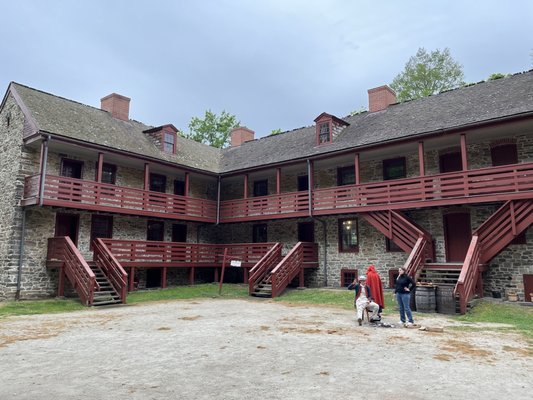
As we approached the Old Barracks of Trenton there was an eerie silence. The old wooden two story building was wrapped in a fort-like fence barely lit by faint street lights in the middle of a post-industrial city. There was no trace of life, let alone preparations for a battle.
Our rag-tag group of six FreeWalkers were here as volunteers to experience what it might have been like to be part of a crucial Revolutionary War battle by following reenactors in an event labeled “To Princeton with Peale!.” To be accurate these were Charles Wilson Peale’s Company of Philadelphia Associators who would march through the night to surprise the British at the Battle of Princeton.
We were experienced long distance walkers but not battle tested, as they were. We were used to marching long distances and even cold temperatures. Our march on Princeton event provided new challenges for both pedestrian civilians and enacting soldiers.
The Battle of Princeton was a crucial event in turning the tide against the British and surprising Cornwallis’s troops. Only days before, Washington had held off the British at Trenton and captured a Hessian garrison after crossing the Delaware.
Now, bolstered by their current successes and desperate for victory, Washington planned a surprise, nightime offensive attack on the British. They needed to somehow quietly march the troops 15 miles around the British flank with a surprise attack on Princeton. Reenactors and observers like us would re-create what it was like to be there and be part of it.
Getting Ready for Battle
The general informs us the troops are still sleeping
Our first problem appeared at the stroke of midnight when we were set to start. We learned the troops were actually still sleeping in the barracks and would start this year at 1:00 a.m.! Where would the Continentals go if they had to wait an hour?“To a pub!” someone replied. As we started walking away, a faint bar light of the Smoke House (aka 1911BBQ) on Front Street appeared. Naturally, we took shelter in preparation of the upcoming battle walk.
At the Smoke House … waiting.
After about an hour at the Smoke House, we were primed for some kind of battle as we spilled out of toward our Continental troops mustering outside the barracks. Orders were given. We were headed to Princeton. Soon we headed down the old streets of Trenton following the troops. There was a positive energy in the air, in spite of the hour, five inches of snow and bitterly cold temperatures.
It’s Time to March
Peale’s Philadelphia Associators at attention and ready to move out
This was our first experience interacting with reenactors. Reenactors take their roles seriously. We managed to chat briefly with couple soldiers but most kept quiet on the march or talked quietly – just as it was ordered by Washington. We learned that historical reenactments are more than just dressing up and marching to this event. There is a sincere attempt to mirror history as best they can.
Quietly marching through the streets of Trenton at 1:30 a.m.
In 1777, history recorded that the temperatures were probably in the 20s and snow had fallen a week before. It had thawed and refroze leaving a crusty snow to walk on. That was an important fact in deciding to attack, as too much mud or deep snow would have made a successful attack impossible. This day we had to face the cold temperature and five fresh inches, enhancing the experience. Our conditions, at least for weather, were worse this year of 2017 than 1777.
We continued past the old colonial homes and townhouses of Trenton into the Chambersburg section. Then continued on a broad Hamilton Avenue into Mercerville, Hamilton and eventually turned on Quaker Bridge Road toward Princeton. This was a roundabout route around Cornwallis’s troops. Now, these are well-travelled commercial roads.
As we walked in the middle of the quiet night in these suburbs the only sign of life was a single Wawa convenience store where we could take shelter for a 15-minute break. The troops were not so lucky. They kept going, presumably because convenience stores are a post-revolution concept.
Our objective was finally reached about 6 a.m. when we approached the Thomas Clarke House on the Princeton Battlefield. This was where the soldiers would come together for the battle reenactment. The only problem with this was that we still had a couple hours before the reenactment began. There was one campfire and one house for all to share and the temperature was said to be in the single digits.
Our history lesson organized by the Princeton Battlefield Society started at 6:45 a.m. It was fascinating and helped put the actual event in perspective. The British Army historian William P. Tatum III, Ph.D. told the story of the battle.
Our History Lesson
We all recognize Washington’s crossing of the Delaware which occurred on December 26, 1776 where he attacked the Hessian troops in the Battle of Trenton. With that success he moved into Trenton and held back the British who attacked him at the Battle of Assunpink Creek on January 2, 1777. Then, in a surprise move, Washington’s troops led by General Mercer continued marching that night toward Princeton to capture the British garrison before heading to Morristown for winter quarters.
Trumbull’s Death of General Mercer
Mercer was mortally wounded. Reinforcements under General Cadwalader turned back after seeing Mercer under fire (Peale’s unit was under Cadwalder). But, eventually Washington sent troops who overcame the British and took over Nassau Hall, a strategic British garrison. The victory helped drive the British out of New Jersey and helped turn the tide of the war. It gave new confidence to the Colonials and helped enlist more soldiers.
On the battlefield where we watched, soldiers fire cannon at costumed British troops on the snow covered fields, amazed at the difficulties of war. Moving heavy cannon in the snow, wadding bullets and gunpowder, meanwhile being shot at in the open. If nothing else this had to be a nerve-wracking experience for both sides. Then, if you consider that most of these men had just been through several major battles in recent days, were lacking sleep and were at the end of their supplies, the effort and outcome seems all the more amazing.
Taking Solace in Victory
The combination of bitter cold, warmth of a fire, shelter in historical homes and the presence of colonial soldiers had created a new, yet old, reality show. After this long 10-hour bitter cold night, learning first-hand about war in the 18th century, and building close bonds with fellow troops – we had enough.
Just as Washington headed to his headquarters in Morristown after the battle, I too headed for my Morristown home.
War is hell, and a tough slog, especially in the winter.
For one sleepless night, we became immersed in history and energized by the spirit of 1776. Huzzah!
As a teenager I witnessed Dylan perform his first electronic set after Newport. Little did I know the music, musicians and fans were to become the stuff of music legend.
Let me be upfront: I was there on August 28, 1965, but I remember little about it. What I do remember is that it was, and still is, the strangest concert I’ve ever attended.
So, I wondered, Is it possible to recall a vague memory that happened 60 years ago and make sense of it today? Could research reconnect sleeping neurons and help me understand what really happened on that one strange night?
Watching A Complete Unknown, the Bob Dylan biopic with a memorable performance by Timothée Chalamet, recently triggered that long dormant memory. The Forest Hills concert was Dylan’s next public appearance after being booed at Newport just a month earlier for daring to plug in and play electric. Up until then, he’d been the lone troubadour: acoustic guitar, harmonica, and words that shook a generation. But the winds of change were already blowing.
For many, Dylan’s transformation felt like betrayal. For me, that night was simply bewildering. I couldn’t make sense of what I saw — but six decades later, I crave to.
The Times They are a-Changin’
We sat in Forest Hills Tennis Stadium in Queens, New York among 15,000 fans filling the horseshoe-shaped arena built for tennis, not rock. Forest Hills was an ideal outdoor venue for a large audience drawn from the New York metropolitan area, including the important Greenwich Village folk scene. Acts like the Beatles, Rolling Stones, and Frank Sinatra had previously played there. In fact, Dylan had played there just a year before, appearing with Joan Baez.
At just 24, Dylan had already become the reluctant “spokesman of a generation.” His lyrics carried rebellion and poetry in equal measure — a mix of Woody Guthrie grit and James Dean defiance. America in 1965 gave him plenty to sing about: war, inequality, and political unrest.
Many think of Dylan as a protest activist. But he was never a joiner — he gave voice to movements without belonging to them. His songs were protest anthems, even when he refused the label “protest singer.”
“I’m not writing for any movement. I just write what I see.”
– Bob Dylan at interview with Studs Turkel (1963)
Yet the times and the sound were changing. Rock music, born in the 1950s, had exploded. By 1965, Dylan sensed it was time to evolve. He began to push both his music and his audience toward a new hybrid of protest and power, folk-rock.
Like a Rolling Stone
In March of 1965, Dylan released his fifth album Bringing It All Back Home. One side is solo acoustic; the other electric backed by a studio band. The album cover design and music were a clear sign to his fans that he was resetting his style.
Then came the single Like a Rolling Stone (listen) (lyrics) which was recorded in June and released July 20, 1965 before appearing on his next album. This was five days before his notorious appearance at the Newport Folk Festival (July 25, 1965).
The song quickly made the top radio charts even though it had an angry protest message, full use of electronic instruments, and was over six minutes long instead of the industry-standard three minutes. It violated all those norms while creating a popular bridge between folk lyrics and the infectious sound of rock music.
“The first time that I heard Bob Dylan I was in the car with my mother, and we were listening to, I think, maybe WMCA, and on came that snare shot that sounded like somebody kicked open the door to your mind, from ‘Like a Rolling Stone.’ And my mother, who was – she was no stiff with rock and roll, she liked the music, she listened – she sat there for a minute, she looked at me, and she said, ‘That guy can’t sing.’ But I knew she was wrong. I sat there, I didn’t say nothin’, but I knew that I was listening to the toughest voice that I had ever heard.”
– Bruce Springsteen
The afternoon before the concert my friend Mike Kennedy called to say he had extra tickets, thanks to his older brother Tom, a Columbia student who was tuned into the changing scene. Mike and I were just 17 years old, Jersey high-schoolers trying to be cool. We’d heard some Dylan, but didn’t yet get Dylan.
We definitely weren’t ready for what we were about to witness.
With No Direction Home
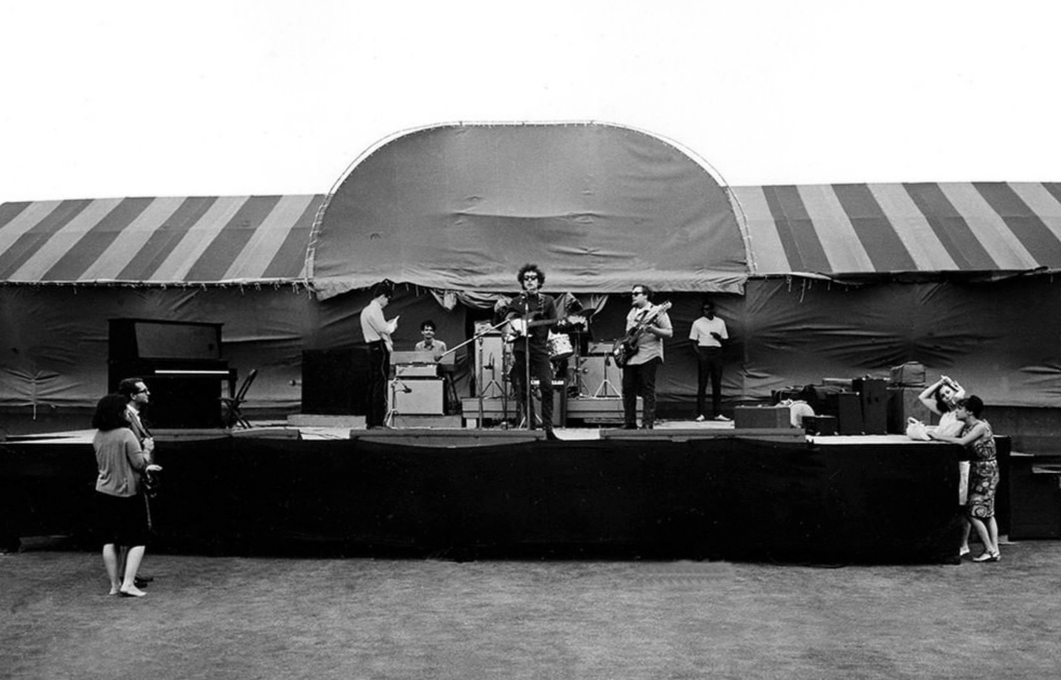
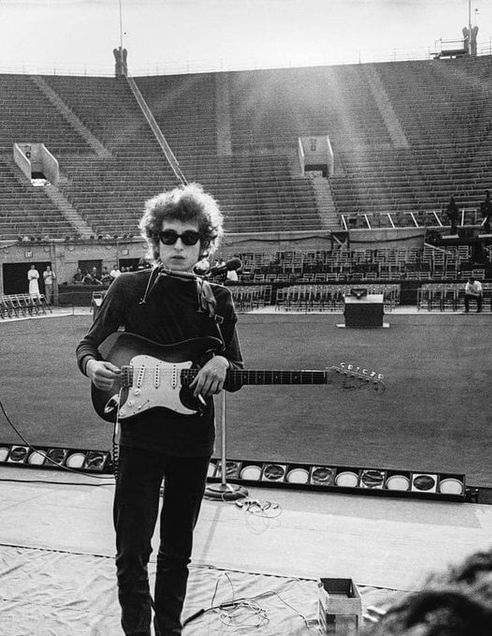
Sound check and rehearsal pre-show at Forest Hills.
Dylan wanted the sound just right after technical problems at Newport. He knew this would be big raucous event and prepared the band or the mayhem that would follow.
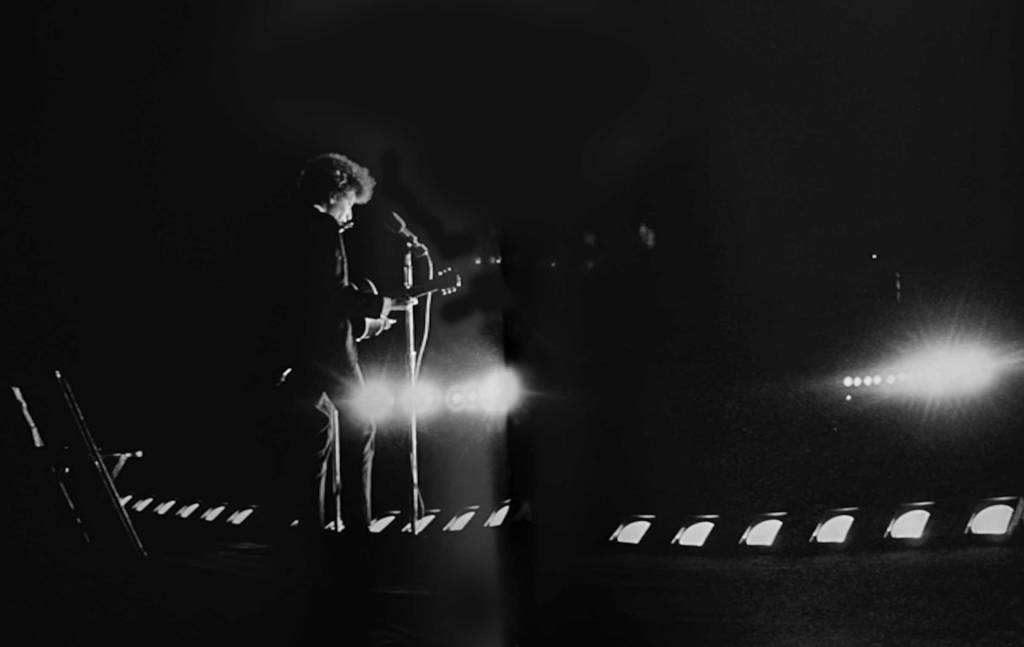
On this unusual windy and cool August night, temperatures dropped from the 80s to the 50s and brought gusty winds. It was an omen of what was to come. We were sitting on bench seats in a steep upper deck of a very dark stadium. Everyone was focused on a single miasma of brilliant light shining on the platform stage where Dylan and his band would perform. You could immediately feel the nervous energy of the buzzing crowd in anticipation of Dylan’s appearance.
Everyone wondered: would Dylan go electric again, like at Newport?
He would — but only halfway. The plan: an acoustic set first; then an electric one.
But the tension was already in the air.
He Really Wasn’t Where Its At
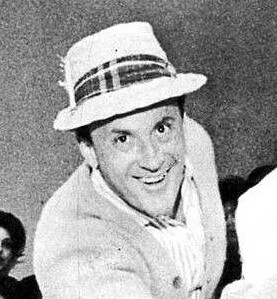
The concert opened oddly with “Murray the K” Kaufman, a popular Top-40 DJ, as emcee. Folk purists booed loudly. To them, Murray symbolized the commercial rock world they despised. It was a taste of things to come.
Click to listen to Murray the K’s intro to the concert
You Say You Never Compromise
The first half of the concert went smoothly. It was the acoustic set which everyone recognized and seemed to enjoy. That is to say Dylan performed solo with guitar and harmonica in his usual style. The 45-minute set including She Belongs to Me, To Ramona, Gates of Eden, Love Minus Zero/No Limit, Desolation Row, It’s All Over Now and closed with Mr. Tambourine Man. This set featured the public debut of the ten-minute long “Desolation Row,” which went over very well with the entire crowd who appreciated its clever caustic lyrics.
Click here to listen to the full Desolation Row recordingDylan playing solo acoustic guitar. Photo: Daniel Kramer
To Hang On Your Own
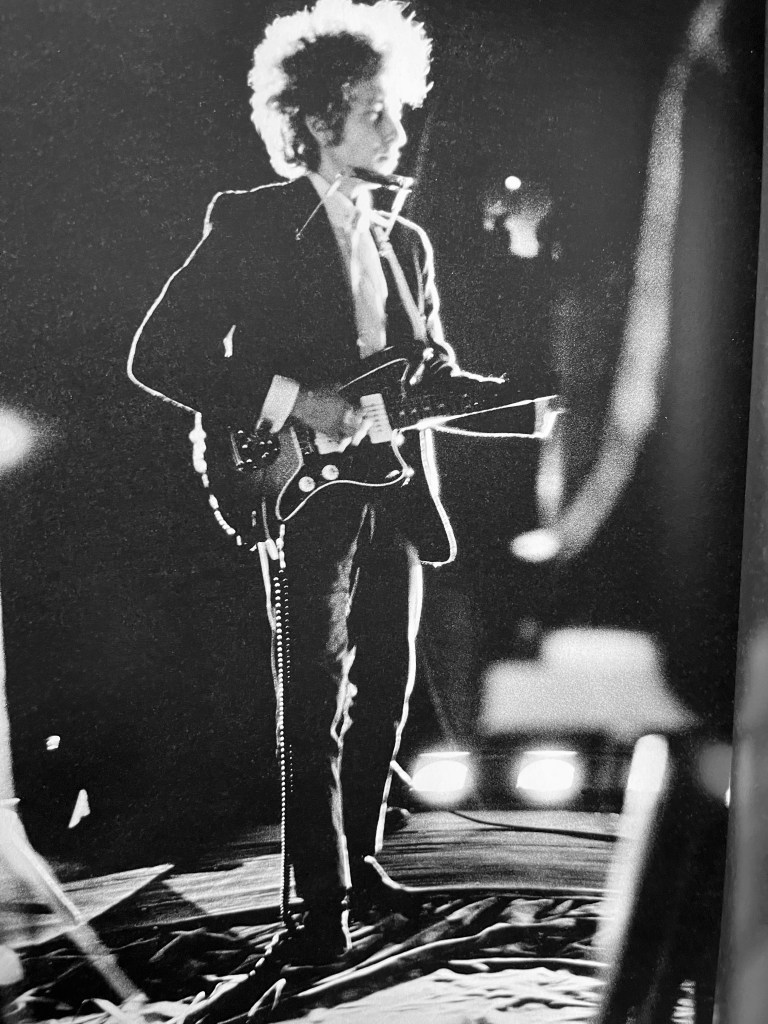
After a fifteen-minute break, everyone knew something big was coming. Dylan appeared accompanied by a band of four relatively unknown musicians at the time – Robbie Robertson (guitar), Levon Helm (drums), Al Kooper (organ) and Harvey Brooks (bass). Over the years they would create their own history in the world of rock and roll.
They launched into Tombstone Blues. The stadium erupted — not with joy, but outrage.
Click to listen to the raucous first minute of the electric setDylan’s band at Forest Hills – Photo: Daniel Kramer
“Due to the stage lighting, we couldn’t see the audience – only the deep green lawn in front of us. Since Dylan had gone electric a few weeks earlier at Newport, uncertainty about what would happen here – his first live performance since Newport – was running high. The audience was self-righteously hostile and they didn’t hide it.“
– Harvey Brooks (bass guitarist)
Boos, shouts, insults. “Scumbag!” someone yelled. Dylan shot back, “Aw, come on now.” That was followed by a chorus of “We want Dylan.”
Listen to the negative reactions to the “new” Bob Dylan
Dylan had already anticipated the negative reaction. According to Harvey Brooks Dylan warned the band, “I don’t know what it will be like out there. It’s going to be some kind of carnival, and I want you to all know that up front. So go out there and keep playing no matter how weird it gets!”
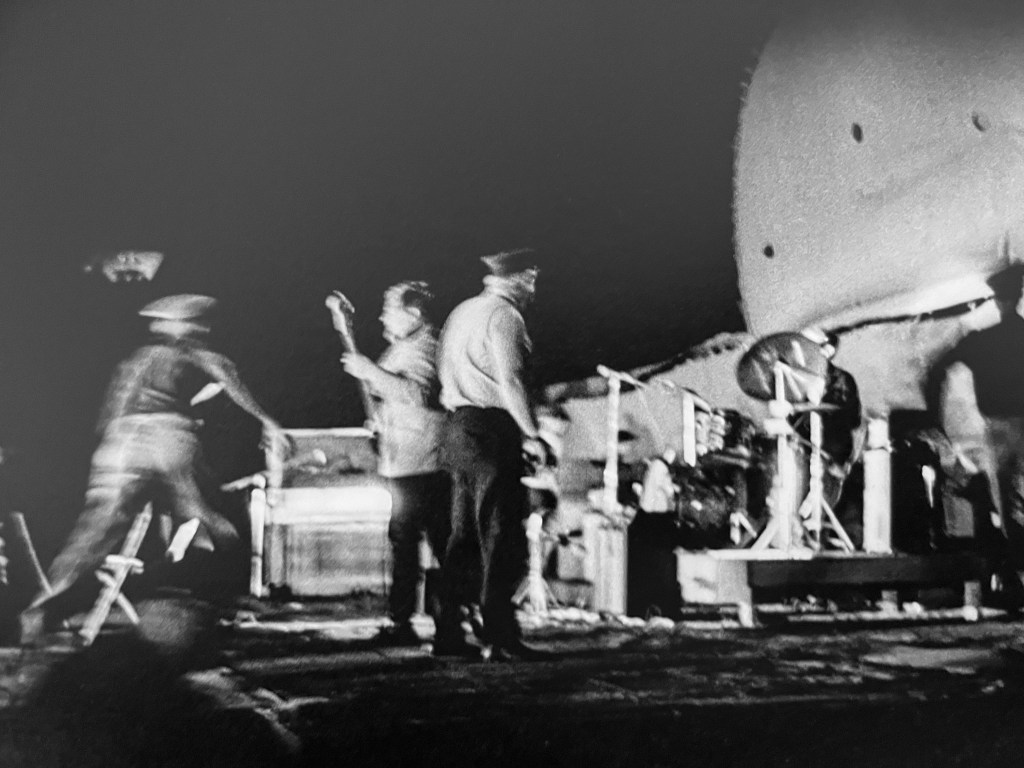
And weird it got. The crowd seemed to quiet a bit after a few songs. But as the set went on the audience grew restless. Half-way through the set, fans ran across the grass toward the stage only to be tackled by security guards. Al Kooper’s organ was knocked over and Levon Helm had to hold off a couple protesters charging his drum set. Objects were thrown at the stage. Still, Bob and the band played on!
Unruly crowd storming the stage – Photo: Daniel Kramer
The electric set included Tombstone Blues, I Don’t Believe You, From A Buick 6, Just Like Tom Thumb’s Blues, Maggie’s Farm, It Ain’t Me Babe, Ballad Of A Thin Man, and Like A Rolling Stone. When he got to Ballad of A Thin Man, Bob played the intro over and over again until the audience quieted down. The concert ended with Like a Rolling Stone and a dozen teens rushing the stage amid the sound of cheers, jeers, and a sing-along! When the song ended Dylan said, “Thank you very much,” and walked off the stage without an encore.
Listen to part of Like a Rolling Stone
The reaction at this concert, and others that followed for over a year, often resembled what started in Newport as a revolt of his fans. That second set clearly split the audience into fans and enemies of the new Dylan.
I didn’t understand the reasoning and hostility but realized that it must have been important enough to have Dylan rebel against his own musical style. I can’t say I enjoyed the concert as much as watching the emotions in the crowd.
“The electric band and the high voltage vocalizing raised the level of Mr. Dylan’s performance from the intimate introspective vein of the first half to a shouting, crackling intensity.“
Robert Shelton, NY Times, August 30, 1965
Dylan had played in a folk style for years, yet he appreciated the new rock sound. In fact, Dylan once said, “I just got tired of playing guitar by myself.” He felt he needed to draw other instruments and musicians into the process.
And Now You’re Gonna Have to Get Used to It
Other singers and rock groups such as the Byrds, Sonny and Cher, Barry McGuire, and the Rolling Stones either copied Dylan or carried their own anti-establishment and free-spirited messages in their songs. Dylan helped move the counter-culture movement that was already reaching a broader popular audience. Pure folk music continued with Pete Seeger, Joan Baez, and groups like Peter, Paul and Mary, and the Mamas and Papas, but would lose much of its momentum to a changing culture and sound. Music became more political, poetic, and electric, mirroring the headlines.
How Does It Feel?
One interesting observation of the concert was that Dylan, while upset at the performance in Newport, was exhilarated by the crowd at Forest Hills. According to band members Kooper and Brooks at a post-concert party, Dylan bounded across the room and hugged both of us. “It was fantastic, a real carnival.” He began to appreciate that fans were reacting to his music. He said to one woman who was said to not have enjoyed the set, “You should have booed me. You should have reacted. That’s what my music is all about.”
“I thought it was great, I really did. If I said anything else I’d be a liar.”
– Bob Dylan on the Forest Hills Concert – Interview by Nora Ephron & Susan Edmiston, summer 1965
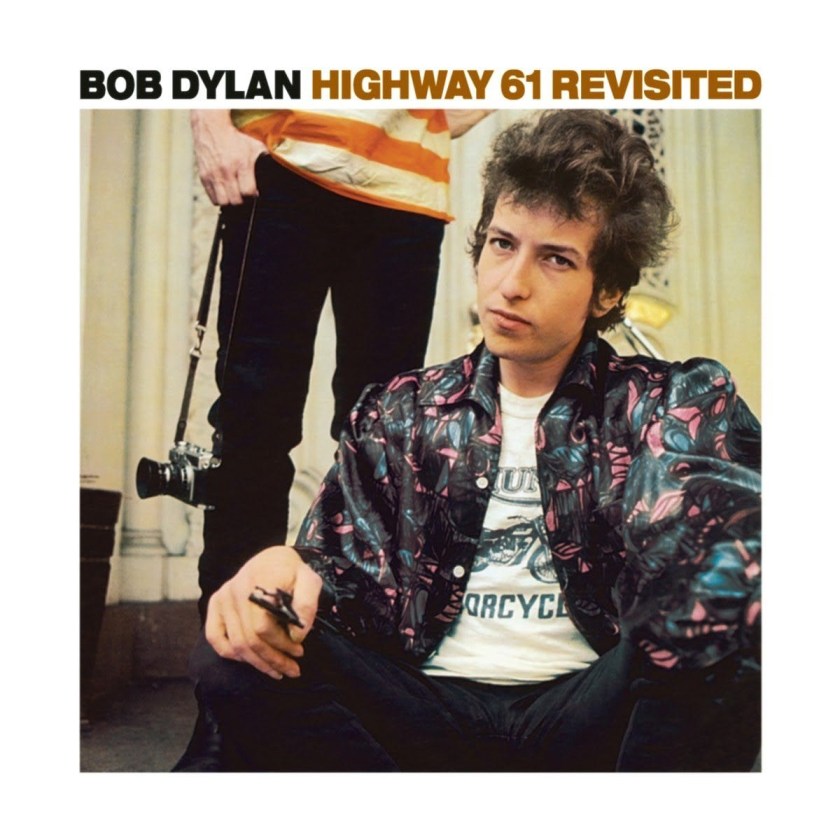
Two days after the Forest Hills concert, Dylan released Highway 61 Revisited, his first full rock album. Its title was a play on U.S. Highway 61, known as the “Blues Highway.” It contained his hit single, Like a Rolling Stone, and was a mixture of songs that tied folk-blues to rock, some of which he introduced at Forest Hills. The album was a success and is considered among the greatest albums of all time.
Dylan went on a worldwide concert tour for the next year with his own band playing a similar format of half folk – half rock format, and fan anger continued. There would be no turning back.
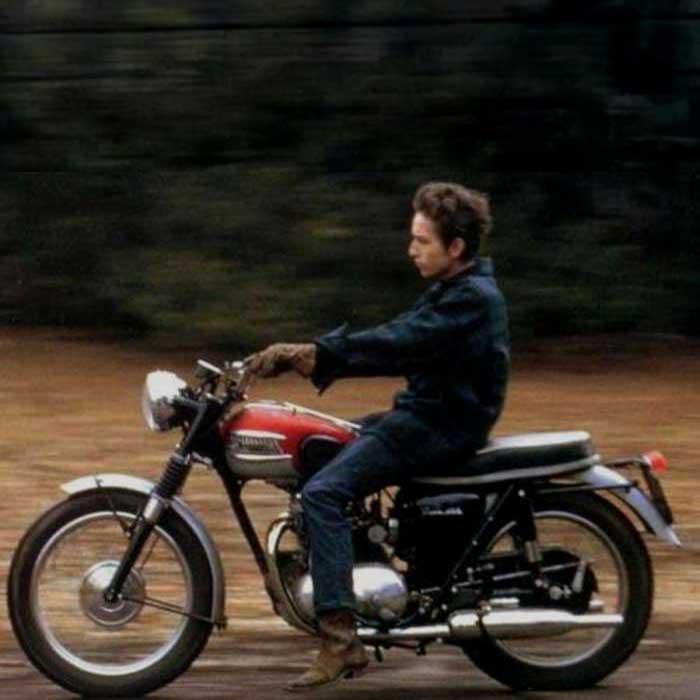
On July 29, 1966 he was seriously hurt in a motorcycle accident near his home in Woodstock, N.Y. Rumors surrounded him. Despite reports that he had serious neck vertebrate injuries, no hospital records were ever discovered. Some speculated that he had enough of the tour and wanted to retreat from the fame. He cancelled all tour dates and retreated out of public attention for the next year.
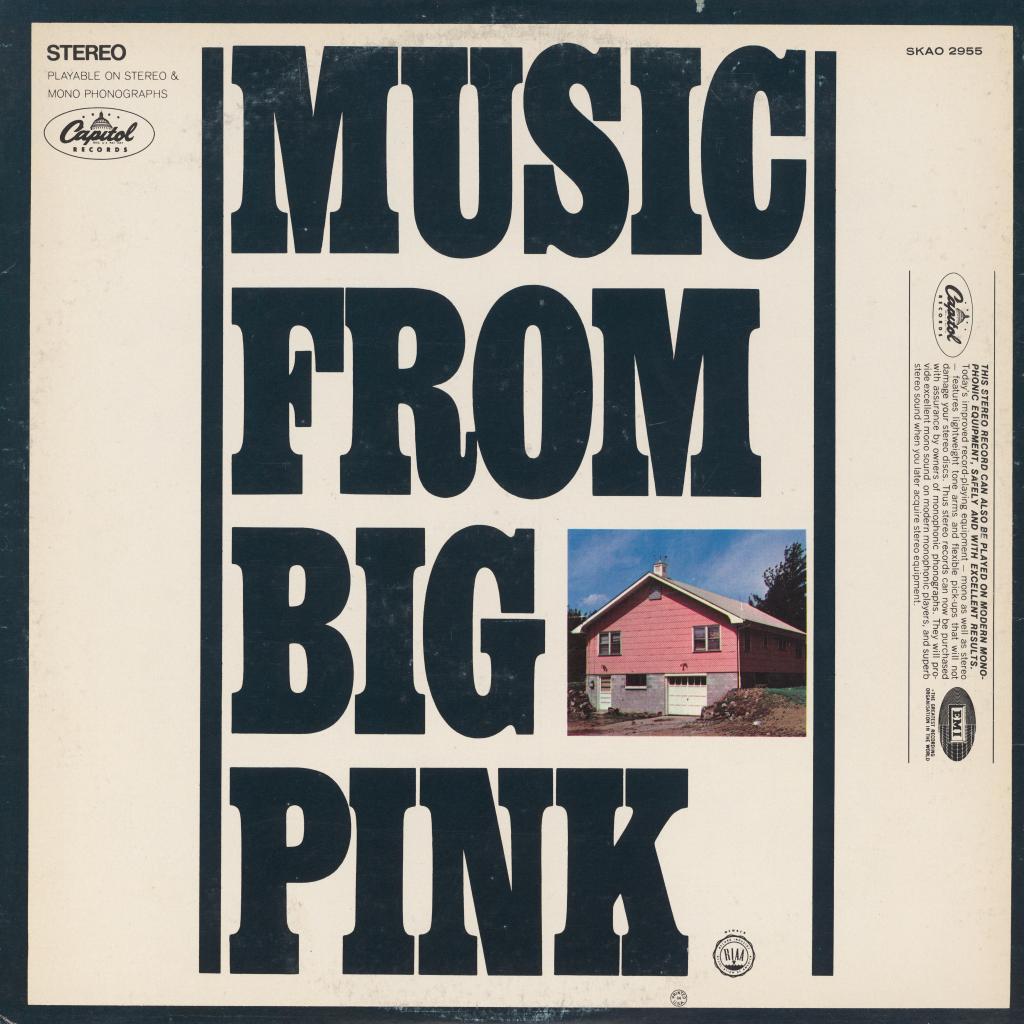
During that year off, he began to collaborate with his bandmates, formerly know as “The Hawks.” Meanwhile, they would release their own famous Music From Big Pinkalbum created at nearby Saugerties. That album would be hailed as a masterpiece and launch their successful career as “The Band.”
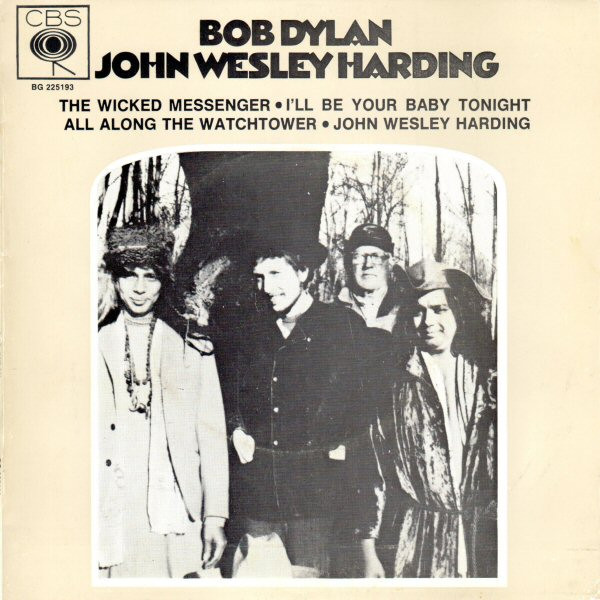
During his recuperation Dylan would work on music that would evolve into his eighth album, John Wesley Harding (December 27, 1967)- which had a distinct country and blues sound and included a new big hit I’ll be Your Baby Tonight. Once again, proving his musical style was always changing.
His style and audience had changed. In fact, throughout his long career to this day, he would constantly change his music, the way it is played, and his interests. Change has always been his one reliable constant.
Afterword
That night in Forest Hills was my first Dylan concert. I’ve seen him a few times since, always curious what he’ll sound like next. My search for reviews and recollections led me into a tangle of lore — Murray the K, Al Kooper, Harvey Brooks, Albert Grossman, Daniel Kramer, Tony Mart, and “The Band.”
No video exists of that concert; only a rough bootleg recording survives. But after revisiting it through memory and research, I realize how lucky I was — to have been there when music, and culture itself, shifted gears.
I may be too old now to recall every detail, but not too old to appreciate it anew.
Long live Dylan — and the memories he still manufactures.
Bonus Tracks
Harvey Brooks Remembers
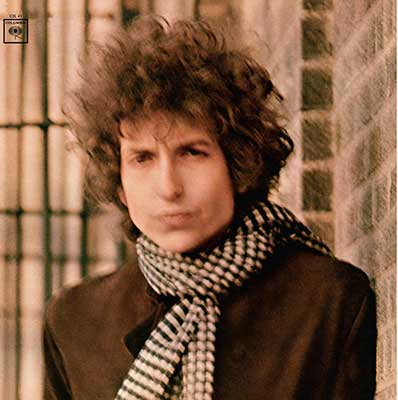
Harvey Brooks played bass during that electric second set at the Forest Hills. He vividly remembers how strange the night was. Brooks was a renown studio bass player and played on the Highway 61 Revisited and Blonde and Blonde albums. He was asked by Dylan’s manager, Albert Grossman to play on tour for two concerts one at Forest Hills and the other the Hollywood Bowl. He would be replaced by Rick Danko of The Hawks (which would become The Band) for the rest of Dylan’s worldwide tour.
Harvey Brooks (bassist) discusses his memory of playing Dylan’s Forest Hills Concert August. 28, 1965
Al Kooper On His Most Famous Organ Riff
Studio musician Al Kooper played organ at Forest Hills behind Dylan. But the story behind how he got involved is an interesting combination of luck and one brilliant organ riff when recording Like a Rolling Stone . Kooper went on to a successful career as songwriter, record producer, and musician. He played behind many famous musical recordings and founded the group Blood, Sweat and Tears. Kooper was replaced in Dylan’s band after two concerts by Garth Hudson of The Hawks (which would become The Band).
Al Kooper discusses his accidentally famous organ playing on Like a Rolling Stone
Daniel Kramer on Photographing Bob Dylan
On August 27, 1964, the young aspiring photographer Daniel Kramer made a pilgrimage to Woodstock, NY to propose to act as personal photographer for Bob Dylan. Dylan agreed and Kramer went on to produce some of the most iconic and beautiful images of Dylan in his heyday – for exactly one year and a day. Those included album covers, time with friends and concerts such as Forest Hills. Here he shares some of his thoughts on that one-year assignment that brought him fame and added to Dylan’s legend.
Kramer’s opus “Bob Dylan: A Year and a Day” is a great story and source of beautiful images of Dylan in his heyday 1964-1965. This should be on the book shelf of every true Dylan fan. More on Kramer’s work.
Sources
Books
Elijah Wald, Dylan Goes Electric: Newport, Seeger, Dylan and the Night That Split the Sixties. Harper Collins, NY, 2015
Robbie Robertson, Testimony, Penguin Random House, NY, 2016
Levon Helm, This Wheel’s On Fire, William Morrow and Company, NY, 1993
Bob Dylan Press Conference, KQED Studios, San Francisco, CA, December 3rd, 1965 Transcript of a long interview with Dylan during the folk-electric tour with some insight on his music and showing how he always befuddles interviewers. https://dylanstubs.com/extras/1965.pdf
Nora Ephron & Susan Edmiston, Don’t Look Back — Bob Dylan Speaks, New York Herald Tribune Sunday Magazine, New York, June 6, 1965 Transcript of a long interview in the transition period to electric. Famous for Dylan responding to a question if he was a poet, “Oh, I think of myself more as a song and dance man.” https://www.interferenza.net/bcs/interw/65-aug.htm
Thomas Meehan, Public Writer No, 1?, New York Times, December 12, 1965 Meehand discusses the question of Dylan being a true poet for the generation.
Robert Shelton, Dylan Conquers Unruly Audience, New York Times, August 30, 1965 Shelton offers a positive review of the Forest Hills concert in spite of the negative reactions.
Dave Moberg, The Folk and the Rock, Newsweek Magazine, September 20, 1963 Discussion of the new folk-rock movement created by Dylan
Bob Dylan – The Forest Hills Concert (Swingin’ Pig Remaster) [Aug 28, 1965] This is the only audio copy of the original concert. It’s a rough unprofessional recording but covers most of the concert. Click here to listen
Documentaries
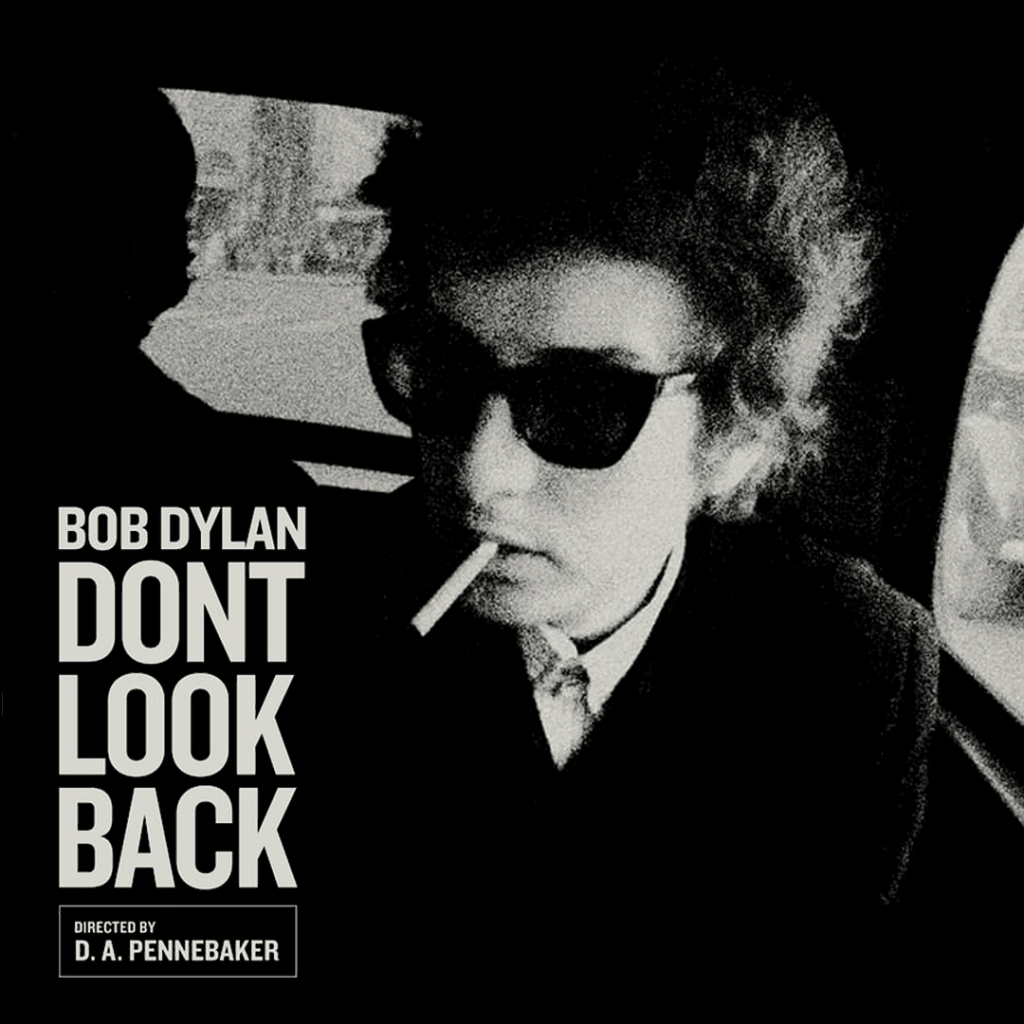
Dont Look Back, 1967 Director: D. A. Pennebaker The definitive Dylan documentary — raw, handheld, and intimate. Dylan’s 1965 U.K tour. Captures him just as he’s leaving folk behind for rock. Led to the behind-the-scenes documentary format in film. Watch options.
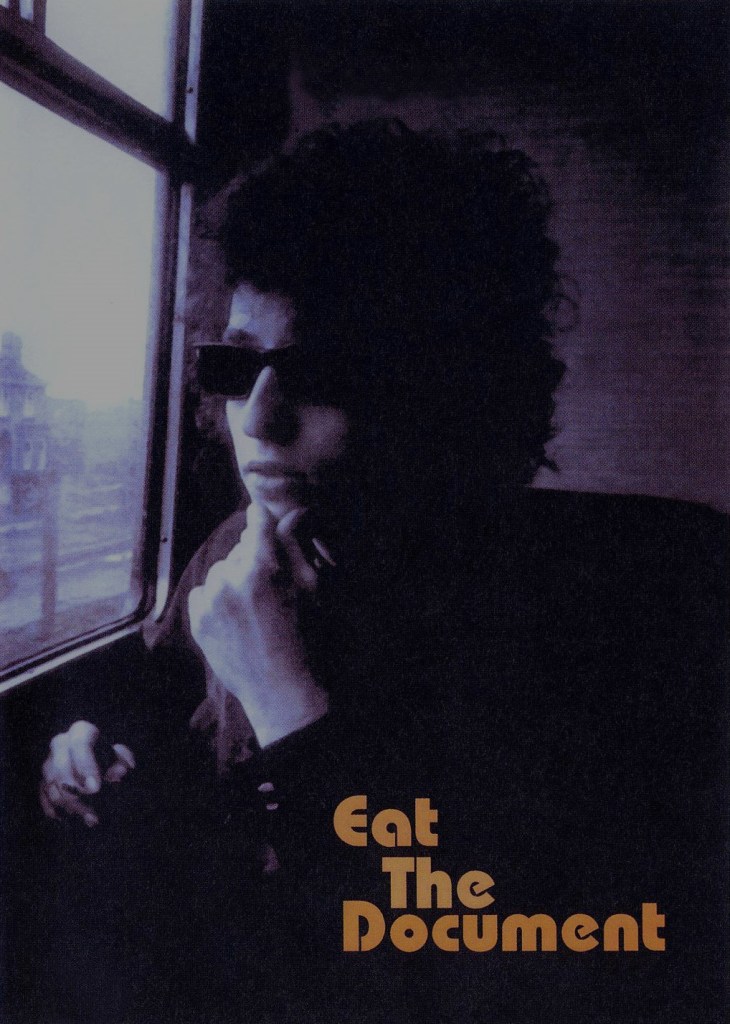
Eat the Document, 1972 Directed by: Bob Dylan & D. A. Pennebaker Dylan’s 1966 European tour with The Hawks (later The Band) This film shows Dylan’s onstage electricity and offstage exhaustion during his chaotic “electric” phase. Watch options.
The Last Waltz, 1978 Director: Martin Scorsese The Band’s final concert and one of rock’s greatest films. Dylan appears near the end — his tribute to having been backed up by these performers on his 1966 tour. Other famous musicians including Neil Young, Joni Mitchell, and Eric Clapton join in. Watch options.
No Direction Home, 2005 Director: Martin Scorsese Film produced with Dylan’s cooperation focusing on Dylan’s early years, 1961–1966. Includes archival footage from Newport Folk Festival and 1966 World Tour showing his evolution from folk hero to rock revolutionary. Watch options.
My recent visit to Students 2 Science’s Apollo Technology Center offers hands-on STEM experiences, aiming to inspire underserved New Jersey students. By fostering curiosity and ambition, S2S cultivates future innovators, relying on corporate and individual support for its mission.
I recently had the opportunity to visit a new kind of technology center designed not just to educate, but to inspire students in STEM (Science, Technology, Engineering, and Math) through hands-on experiences. Students 2 Science’s Apollo Technology Center is an ambitious new facility devoted to giving every New Jersey student, especially those from underserved communities, access to real-world science.
Students 2 Science Welcome
As a self-identified techie (at least I used to be), I’ve always been drawn to science, even if math was never my strongest subject. What has always fascinated me is how science and technology can amaze us and improve our lives. That’s probably why my career centered on using technology to solve problems and make things work better.
Today, science faces growing skepticism and misinformation. Healthy questioning is one thing, but the outright rejection of evidence and expertise has become troubling and discouraging for young people who might otherwise pursue careers in the sciences.
My son-in-law, John Dempsey, a trustee of Students 2 Science (S2S), had long spoken highly of the organization and invited me to the opening of their brand-new Apollo Technology Center. I knew little about how science is taught today or what truly motivates students but I was eager to find out.
What I discovered was an impressive nonprofit that has spent years building a professional team of educators, corporate partners, and volunteers dedicated to one mission: making STEM education accessible to all. S2S has already reached nearly 250,000 students across Newark and 25 other New Jersey school districts. The Apollo Center in Whippany, a newly renovated, 20,000-square-foot facility in a once-vacant office building, represents the culmination of those efforts. I wanted to see firsthand how science itself could be re-imagined to inspire the next generation.
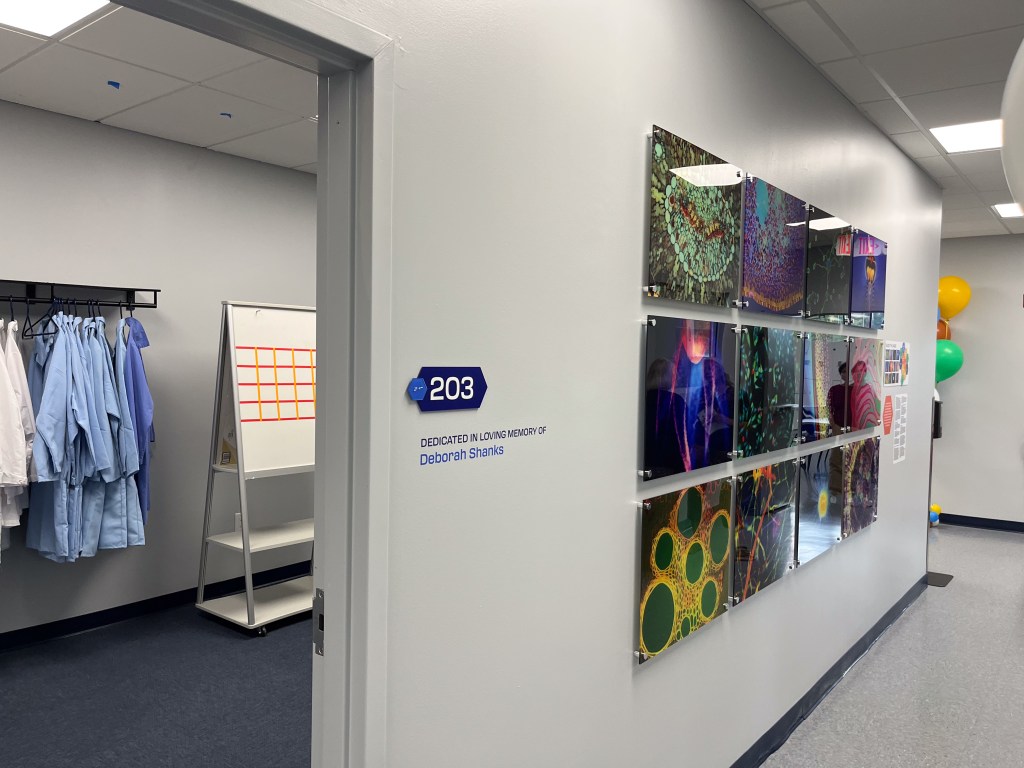
During the Open House, visitors could tour the labs and classrooms of this unique facility. I watched demonstrations in ecology, electronics, communications, biology, and medical science. The equipment was modern and professional-grade; the instructors and staff were enthusiastic and eager to share their work.
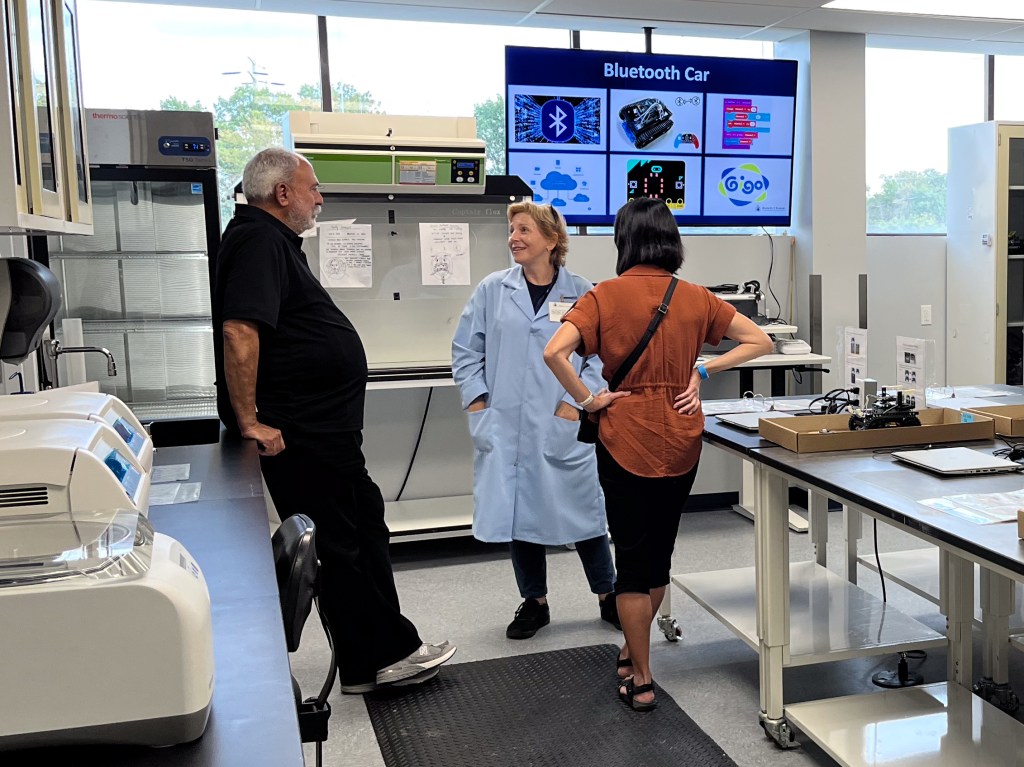
Two labs especially stood out. The Virtual Lab featured a microscope linked to a digital display, allowing instructors to project real-time images, like a magnified view of bees, to large monitors and even broadcast them live to classrooms across the state via Zoom. Few school districts could replicate this kind of technology and expertise on their own, but through S2S, they can all share in it.
Virtual Lab
The Medical Diagnostics Lab was equally impressive. Designed for high school students, it simulates real-world medical problem-solving. Teams of students are presented with a (hypothetical) patient in crisis and use vital signs and blood test results from actual diagnostic equipment to identify the condition and propose treatment. It’s the kind of immersive, problem-based learning that makes science come alive.
Medical Diagnostic Lab
Experiencing the energy of these labs and meeting the scientists, educators, and volunteers behind them convinced me that Students 2 Science offers something truly special. Programs like this not only teach skills, they spark curiosity, confidence, and ambition. With the growing demand for professionals in science and technology, we need more initiatives like this to cultivate future innovators.
Students 2 Scienceis a nonprofit organization that relies on the generosity of its corporate partners, volunteers, and donors. Companies can contribute equipment, expertise, and mentorship, while individuals can volunteer their time or make donations to support the mission.
If this new “branch” of STEM education is any indication, the future of science in New Jersey and beyond is looking bright and growing.
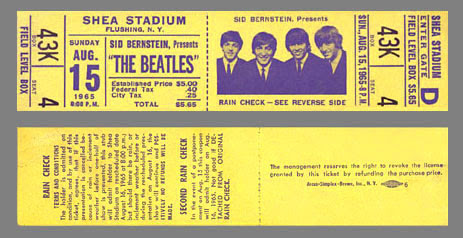
What was it like to be at the new Shea Stadium on August 15, 1965 to see the Beatles? Proof that serendipity happens every so often.
I’m reposting this 2021 article today (8/15/25) on my experience with the Beatles – being young, naive and lucky; as I would learn as an adult. Today, is the 60th anniversary of that August 15, 1965 concert which would become famous and cherished as marker for this moment in history.
A Washington Post writer, Billy Heller, called me last week to discuss what it was like to be there. I helped fill in some blanks and directed him to my sister Barbara who was there with me, as the best example of what a crazy teenage girl experienced that night. She not only appeared in the lead of the story was interviewed by CBS New York for a small segment recalling that special day for Beatle fans and for Shea stadium.
Unfortunately, the writer neglected the story behind the story, where my friend Mike and I had accidentally found ourselves in the stadium and experienced an other-worldly event that we would only truly appreciate later in life.
Read on if you are curious about our adventure. And do read the full Washington Post article: When the Beatles hit a grand slam in rock-and-roll to get the full idea of what Beatlemania was all about.
Paul Kiczek
This is a TV video screen capture of the August 15, 2025 CBS News segment. Note there is a slight window glare top middle part of screen.
There are not many moments in life where you find yourself witnessing and participating in a significant historical event. You know it even then because there has never been anything like it before. You are gobsmacked with what you see, hear and feel. And, to top it off, all this happens accidentally by a fortunate set of circumstances.
It was on August 15, 1965 that the Beatles were scheduled to play Shea Stadium in Flushing Meadows, New York. My sisters Chris and Barbara and their friend Gail were rabid Beatle fans and they made sure they had their tickets as well as their white go-go boots ready. These were the days when large concerts were rare. This one would be their second tour of the U.S. but the first-ever “stadium concert” and the largest concert crowd (55,600) at any concert at that time.
Strangers in a Strange Land
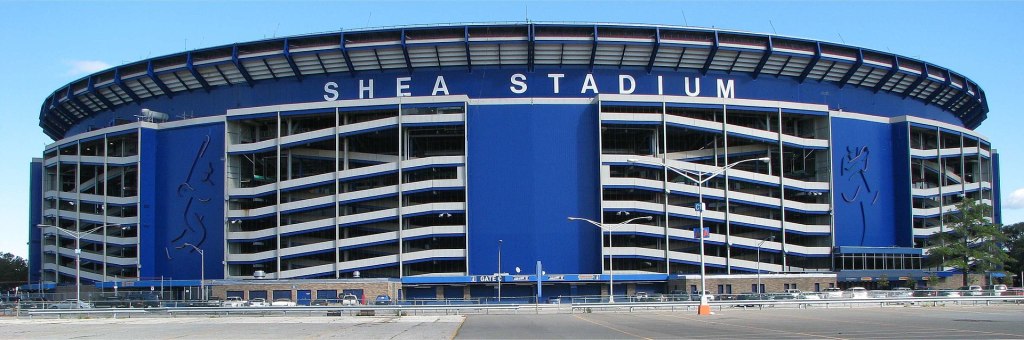
Shea was completed only a year before and as the latest project promoted by Robert Moses, the famed New York City planner, to develop the Queens area. It was located in Flushing Meadows next to the grounds of the World’s Fair of 1964-65 in Corona Park.
Most of us had visited the World’s Fair the year before and marveled at exhibitions. It was a fascinating look at the future and and offered a taste of other countries. I still remember the Lowenbräu beer pavilion where we could drink beer freely, just like being in Bavaria, even though we were underaged and about as naive as we could be about the rest of the world. It seemed like we were moving into the future and becoming part of a bigger world.
1964-65 New York City World’s Fair
Accepting the Mission
In the original plan, my dad was supposed to drive my sisters to and from Shea since they were young teens not old enough to drive. Well, it turned out my buddy Mike Hayser and I were hanging around my house that hazy 80-degree Sunday with nothing particular to do so we volunteered to take them instead. Why my father allowed us to drive I’ll never know but probably the long ride and the need to wait for them were factors. And, it was, after all, the 1960’s and there was a certain freedom and permission that’s hard to reconcile with today’s helicopter parenting.
We didn’t even think about how crazy this could be with thousands of screaming fans. But we sensed that there would be lots of girls and a great adventure awaiting. Little did we know we would be driving directly into history.
At 17 years old I considered my six months of experience enough to tackle the big-game driving in New York City’s traffic and its strange mysterious boroughs. Shea was then a big new and bold stadium. It was built to last for the New York Mets franchise, which started only a few years before. Both the stadium and the team represented new hope for us bitter and abandoned ex-Brooklyn Dodger fans.
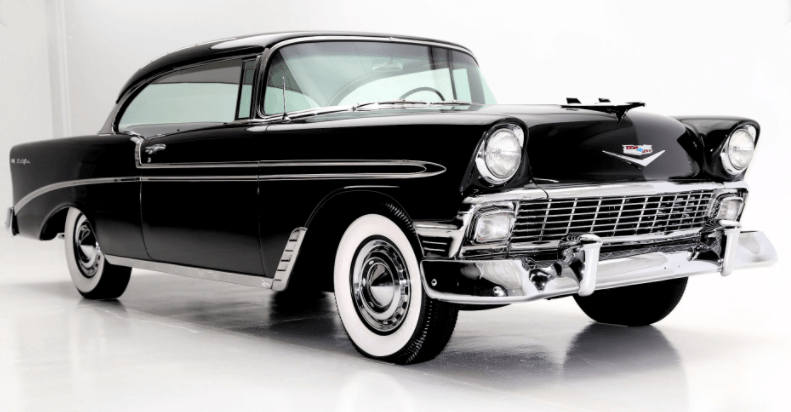
1956 Chevrolet Bel Air
The Way to Shea
This was my longest and most challenging drive with my hand-painted blue 56’ Chevy. Living in Roselle, the best way to get to Shea was to take the Goethals Bridge from Elizabeth to Staten Island and drive across the new and mammoth Verrazano-Narrows Bridge (which was another Robert Moses project.). The bridge had just opened in January 1964 and was an instant success allowing traffic to Brooklyn, Queens and Long Island via the Belt and Grand Central Parkways. To us on the Jersey side, these were legendary roads where we were warned daily of horrendous traffic conditions on the radio and assumed only brave and crazy drivers dare go. So, why not try?
Verrazano-Narrows Bridge led to a new world
The only way to get somewhere far away in those days was to rely on old-fashioned, artfully folded paper maps. Every car had dozens of maps in the glove compartment which were free to grab at any gas station. We relied on maps, intuition and signs (if they were still there) to find where we were going. So, we grabbed a map of New York and headed out like modern explorers to find Shea Stadium and experience the wild urban frontier.
Going with the Flow
As we approached Shea the traffic became heavy and led to a stop. A tremendous crowd was moving toward the stadium so we decided to find a parking spot along the road and walk to the stadium, even though our mission was to deliver my sisters and kill some time exploring the area – later to pick them up somehow. My sisters found the gates where ticket holders entered moving rapidly. Mike and I realized at this point that the action was inside the stadium and our best move would be to try and get in.
A $5.65 Box Seat Ticket to Ride
We studied the situation and realized that this was a sellout and there no tickets (Box seats cost $5.65 apiece!) to be bought and the security staff seemed only half-interested in checking tickets. So, we approached a guard to tell the story of our good deed of taking my sisters to the concert; only to be left outside waiting. Let’s just say on that day everyone was in a good mood. They turned away as we freely walked into the most important concert of our lives, without a ticket.
The Beatles had only broken into the U.S. market a couple years ago but by now they were known worldwide having created over a half-dozen albums and two films. This was the beginning of their North America tour having just released their album and film “Help!” less than two weeks ago and had appeared on the Ed Sullivan show the night before.
Experiencing Pandemonium
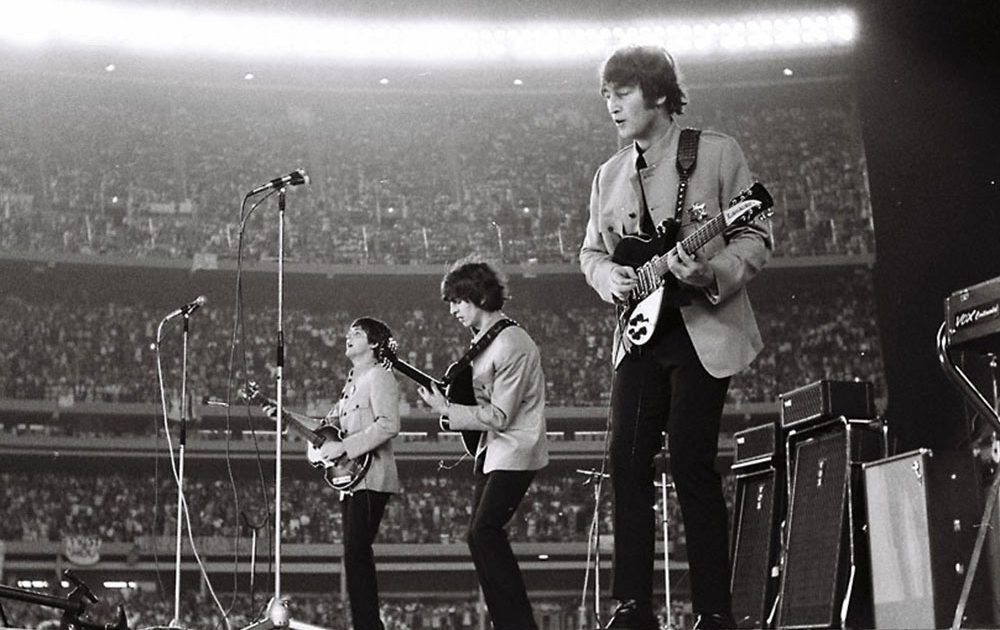
From dugout to stage
Pop concerts were not that common and were not believed to be big revenue generators. All that changed at Shea. The concert at Shea Stadium set a world record for attendance and gross revenue. The Beatles got $160,000 of the $304,000 box office sales and proved that there was money and other benefits in staging large concerts.
Lead off acts included Brenda Holloway, King Curtis, Sounds Incorporated, Killer Joe Piro and The Discothèque Dancers, The Young Rascals and Cannibal & the Headhunters. Hosts included Murray the K and Cousin Brucie Morrow. Television host Ed Sullivan introduced the band when they took the stage: “Now, ladies and gentlemen, honored by their country, decorated by their Queen, and loved here in America, here are The Beatles!”
The concert was ahead of the audio technology at the time and could not properly project the music in the massive stadium. Powerful stage amplifiers couldn’t play louder than the screaming crowd. Even the stadium’s P.A. system, normally used by baseball announcers, was also employed to help project the band’s sound. But, the roar of the crowd could be heard throughout their appearance.
Thousands of fans like these
Once the Beatles started playing, it didn’t matter where your tickets were or if you had one. Everyone spilled into the lower levels and stood for the entire concert in awe of the band and the crowd of frenzied fans. They continued to play 12 songs lasting about an hour. We had traveled two hours, witnessed the largest crowd we had ever seen, managed to crash the gate and listen to some great music. But, nothing compared to the electric reaction of this huge crowd. Girls were out of control and screaming everywhere. I remember getting goosebumps by just witnessing the joy and excitement that was beyond our imagination. It was obvious that Beatles were having as great a time as their audience.
Playing to the ecstatic noisy crowd
After the concert fans stormed the field and we made our way out. I’m still not sure how we found my sisters in that crowd of over 55,000. I don’t remember a thing about the ride home but I’m sure we basked in the good vibes of the event knowing that we were there for a very special event with memories that will last a lifetime.
The Concert at Shea in the Beatles’ Words…
“I think we just went a bit hysterical that night; we couldn’t believe where we were and what was going on, we couldn’t hear a bloody thing and we thought ‘This isn’t very good, but it’s going down great.’ The hysteria started to kick in. That was a great one.”
Paul McCartney, Back To The World tour book
“Once you know you’ve filled a place that size, it’s magic; just walls of people. Half the fun was being involved in this gigantic event ourselves.”
Paul McCartney, The Beatles Bible
“What I remember most about the concert was that we were so far away from the audience. . . And screaming had become the thing to do. . . Everybody screamed. If you look at the footage, you can see how we reacted to the place. It was very big and very strange.”
Ringo Starr, The Beatles Anthology
“At Shea Stadium, I saw the top of the mountain.”
John Lennon, recalling the show in 1970 in a TV interview
Epilogue
It’s interesting to note that at the time of the concert the Watts Los Angeles riots were taking place with the black community angry about the police brutality and civil rights. Meanwhile, President Johnson signed the Voting Act of 1965 that very afternoon establishing new laws that were meant to provide free and fair elections forever.
The mighty Shea was demolished forty seven years later replaced by Citi Field, but the same roads and bridges remain. The Beatles were only in their 20s and at the height of their careers in 1965 but played their last concert together in 1970, just five years later. That last concert and the Beatles legend is still being explored with the release of the new Peter Jackson/Disney+ retrospective on the Beatles last project together, the making of “Get Back.”
History, it seems, is never written in stone and just takes time to understand and appreciate.
The Beatles at Shea Stadium Video
The following video was purchased years ago online and represents a rough cut of the original special recording which appeared on British and American TV as a special. It is approximately 52 minutes long.
After decades of staying quiet, I stepped into the streets. What I discovered surprised me: protesting isn’t just a political act—it’s a personal practice that builds resilience, awareness, and a sense of belonging.
Like running, protesting requires practice, discipline, and belief that your effort matters—even when you feel alone.
After joining six protests over the past two months, the experience finally started to feel familiar. I began to understand what it was all about. There’s a reason, a rhythm, and even a reward to protesting that I hadn’t grasped before. Still, something instinctual pushed me into it—more impulse than logic.
Protesting doesn’t come naturally. In everyday life, when things are relatively calm, most of us try not to rock the boat. We avoid confrontation, sidestep discomfort. We’re taught to “suck it up” and “don’t be a complainer.” After all, there’s always someone worse off, right? And then there’s the risk—stirring the pot can bring consequences, especially from those who’d rather you simply “behave.” At my age—77—I could easily ask, who needs the trouble?
But what do you do when logic, reason, and normality seem to vanish? Do you just complain? Do you tune out? Seek comfort from friends? That’s where protesting comes in—not just as a solution, but as a kind of therapy.
Fifty years ago, before fitness was even trendy, I took up running as a personal challenge. Back then, adult recreational running was unusual. But as marathons and Olympic athletes captured public attention, the idea caught on. We began to believe that even the average person could strive for something great—even if the race was personal.
Running took a leap of faith. It demanded hard physical work, but promised positive results—mental clarity, health, confidence. It was lonely at first, with little guidance and few role models. But it became a habit. And eventually, the world caught up. Running went from fringe to mainstream.
Now, since January 20th, I’ve taken up a new “sport”: protesting. Frustrated with the state of the nation and the new administration, I turned to activism not just as civic duty—but for my own mental fitness. And like running, protesting requires practice, resilience, and a belief that effort matters.
First, it takes mental toughness to shake off apathy. You need to believe that one person can make a difference—especially when standing with others. And yes, there’s a kind of performance involved. Maybe you’re just holding a sign in silence. Maybe you’re shouting chants or singing satirical songs about a congressman or the president. It can feel awkward or corny at times. But it can also feel exactly right—like you’re doing what needs to be done. Like you’re part of something larger, and your voice is finally being heard.
There’s power in simply showing up. A sign in hand can be the first step toward change.
So, I’ve come to believe we must train ourselves—just like athletes—to overcome political passivity. With every new day of shock and awe, we grow stronger, more aware, more ready to push back. Protesting may not fix everything, but it sends a clear message: we will not sit quietly and watch democracy fade.
A chainsaw cuts through the trunk but roots remain. Protests are like a thousand surgical cuts, exacting a slow painful death for Tesla.
It was my second protest.
Our target was a newly born corporate giant – Tesla, Inc.
It had the potential to grow into mighty beneficial force only to turn lately into a funding source for a fascist.
Tesla is a corporation led by a charismatic leader who promised a new world of consumer choice with environmental benefits, a cool modern design and a refreshingly new use of energy; only to use his influence and money he earned from his venture to tear down our democracy.
Fortunately, then unfortunately, Tesla grew up to become the step-child of Elon Musk who is a larger-than-life leader responsible for building a good intentioned company; only to become a pawn in his egotistical fantasy and global politics.
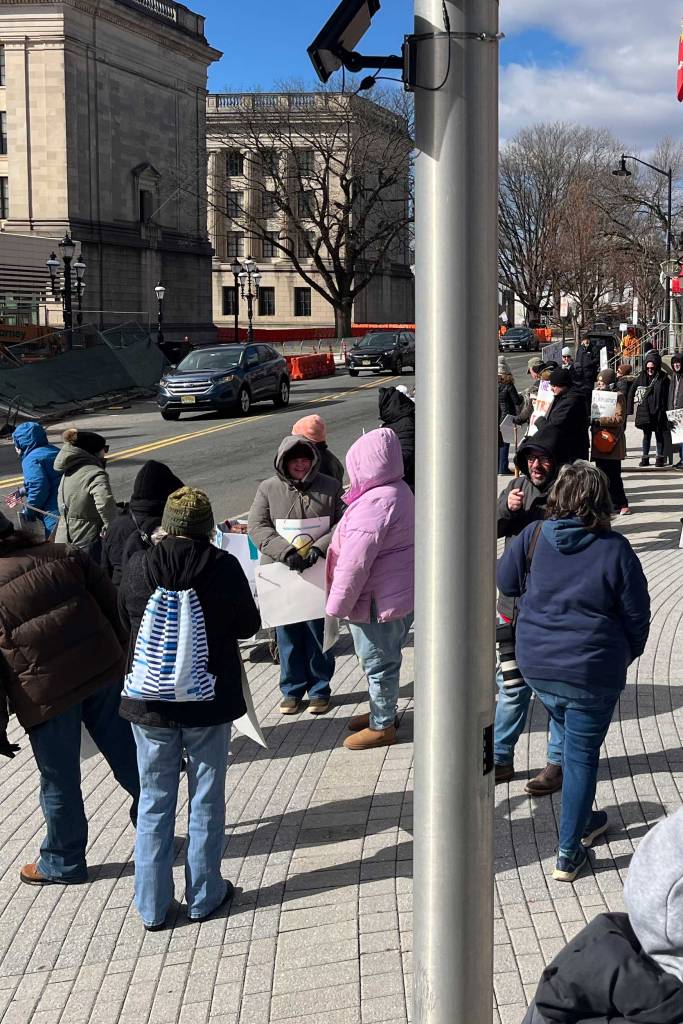
About a week ago, I protested in Trenton at the state capitol building as a general protest of the policies and executive orders of Trump and Musk. I considered that protest a warm-up and learning experience for a rookie. Being a quiet President’s Day in the city, it became apparent that we (about 500) were mostly preaching to the choir. You can’t help but ask yourself at the scene, “Who knows we we are here with our message?” With little traffic and little press coverage, I left there thinking it was worth the effort but it could have been much more. Confessions of a Reluctant Protester.
Paul’s sign for Tesla protest
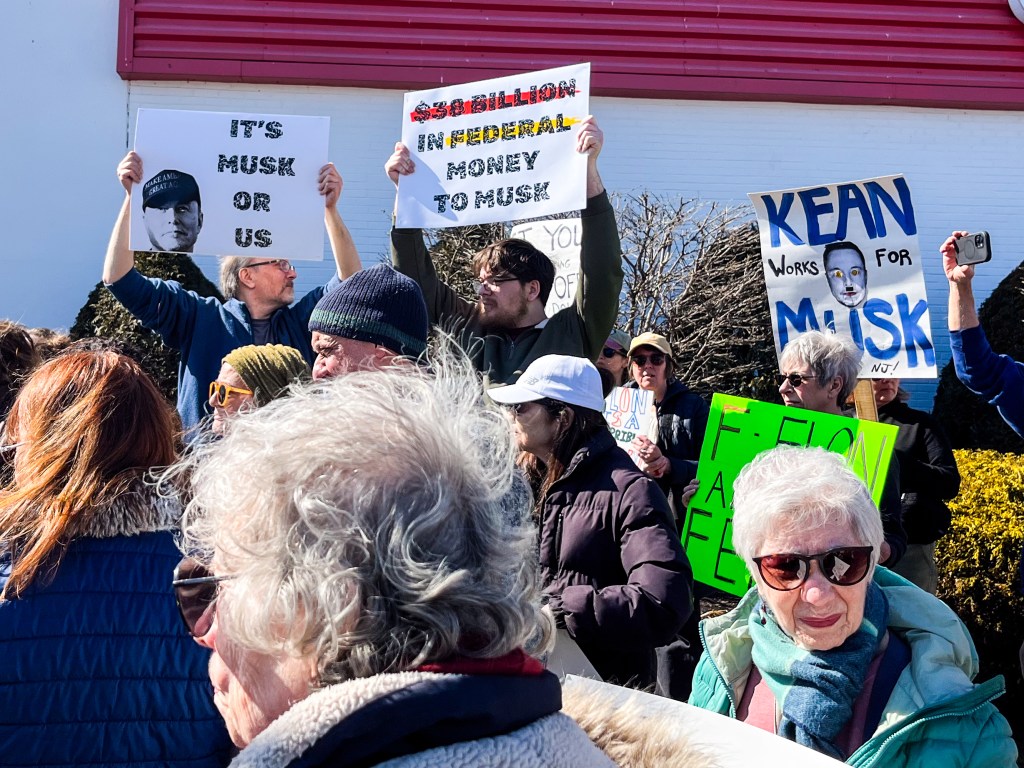
But today, Saturday, March 1, 2025, promised to be a more targeted effort. A Tesla Takedown. We were after Elon Musk’s primary source of wealth and income by loudly demonstrating in front of a Tesla showroom on Route 22, Springfield NJ – a notoriously busy commercial highway. It happens that Tesla vehicles can only be bought online. But, they are typically picked up and serviced at the few regional showrooms. Since, there are no dealerships, any effect that can be made at a showroom is directly on the company and not any independent dealer.
I heard of the hastily planned protest by SOMA Action thru posts on Facebook Group Lean On Us and registered for the event. Our group (estimated at 220) met across the street near a Staples, ready with signs and some general guidelines – Don’t block the showroom, don’t interact if there are counter-protesters and always safety-first. Luckily, there was plenty of parking nearby and a grassy shoulder right in front of the Tesla showroom facing Route 22.
The weather was cold and windy but the traffic was constant and moving slowly as they saw an impressive protesting crowd yelling loudly and waving signs they could not miss. Our enthusiastic group of all ages yelled to chants such as “Hey, hey, ho, ho, Elon Musk has got to go!” As cars were going by at 20 mph, horns were blaring in support. Even more strangely, many passengers (and even some drivers) were video-recording the protest on their smartphones as they passed by. It seemed mostly positive support, in spite of the fact that we were causing a major slowdown!
A steady stream of traffic, including local police and Tesla owners drove by from noon to 1:30. I felt tired yet relieved. We all came away with the feeling that this was an effective protest having been seen and heard by several hundred, if not thousands, in a very short time.
I know if I owned a Tesla, whether or not I believed in what Musk-Trump was doing, I might think hard about conveying a negative feeling. Does the car now represent a political point of view? Has the brand and value of my Tesla been trashed? Being able to generate those feelings is a victory, however small, for democracy by my account.
If Musk-Trump can “chainsaw” government services at the elevated organization level by cutting thousands of jobs at once, maybe enough motivated individuals can surgically cut into organizations like Tesla with a “scalpel” using various forms of protests that destroy the brand and negatively affect sales over time.
Tesla’s role as a pioneer in electric vehicles is over. Today, there are plenty of companies that can offer a better product without the dirty laundry. We can put capitalism to work if we all get out our scalpels and carve Tesla into a pariah. A slow death for Tesla, by a thousand cuts, would be sweet justice and a fitting contrast to a chainsaw massacre.
More Thomas Paine words of wisdom in troubled times….
What can the average person do to fight back? It’s never too early or too late to get involved. Take back our country before it’s too late.
It didn’t have to be this way. I’m a reluctant protester and I’m pissed off.
I have been enjoying an active, yet complacent retirement for the last eight years. At least that was the case until Trump clawed his way back to running our nation. Four days from today I’ll turn 77 years old. I’m at a time in my life where one usually mellows and winds down activities and ambitions. But, if Trump, at 78, can find the energy to ruin a country, then maybe I should at least try to help build it back. But how?
I’m still trying to understand what happened in just a few short weeks. What will happen tomorrow? And, how can anything be the same once the dust settles? I bemoan those who have lost their government jobs and noble ideals that they upheld. Collateral business, friendships and relationships may be permanently frayed. It will take a lot of effort to someday reconstruct a government and a community that are in basic harmony again.
I have to ask myself, “Is it me?” Why do those I care about not seem as troubled about the repercussions of what is happening? The news is filled with so many new catastrophes each day. It’s all shocking and numbing, yet still feels distant right now. Most of us have yet to see the effect these changes will have to employment, health, safety and peace – to name a few likely bad outcomes. And, for what?
Protest – “Not My President”
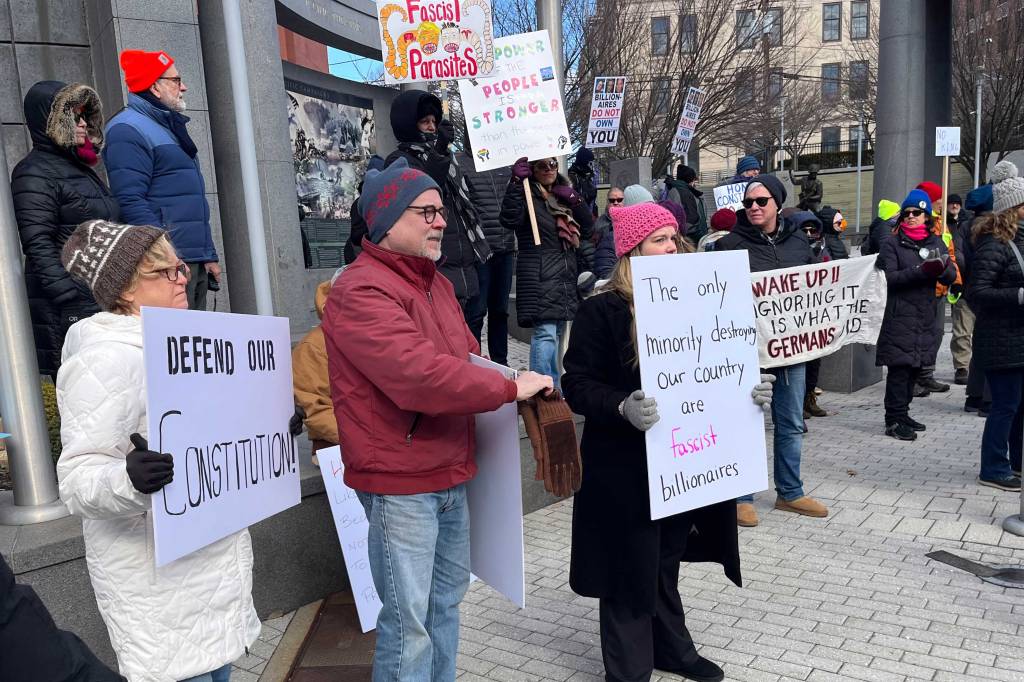
Last Monday I gathered for a protest at the New Jersey state capitol building in Trenton for a few hours, venting my frustrations and meeting others who had similar feelings. I had gotten a tip from my friend Bob who had posted some of his frustrations with the current state of affairs. He created a private Facebook group Lean On Us which linked to a national public site 50501 which listed a “Not My President Day” event. It seemed like the perfect celebration for this President’s Day. Understand, at this point most of us are just becoming active and have no idea how this works and what to expect.
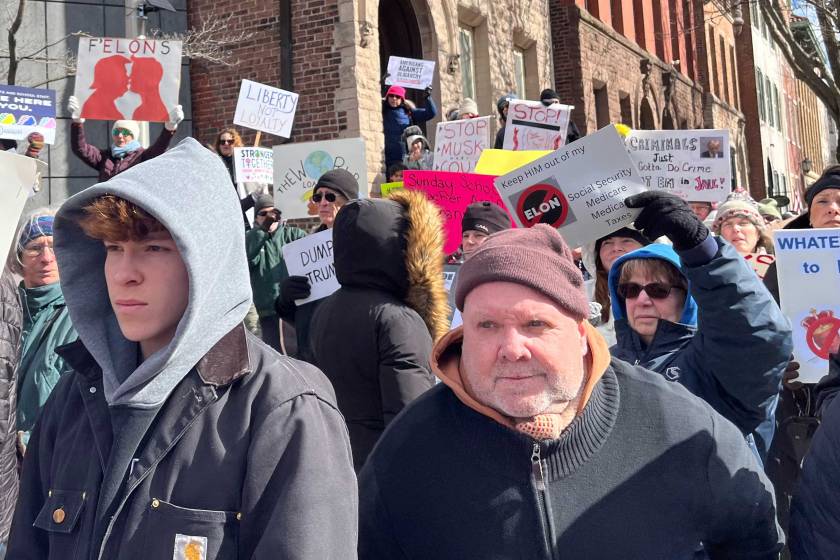
I got there early and then watched as a handful of us became a large crowd of about 500 or more. Apparently, our small group was just one of many small organic groups of citizens that had become frustrated enough to get out in 20 degree weather with 20 mph winds to protest what Trump-Musk is doing to destroy our government. There were no speakers but plenty of motivated, energetic and loud people with great rebellious signs wanting to take back what we already lost and to stop the bleeding.
Protest Builds
The size of the crowd, chants and the waiving and beeping of cars was the only indication that we are on the right track. There was little press coverage, although similar protests were happening across the country at many state capital buildings.
I would not call protesting fun but it is rewarding. A least it feels like I’m actively doing something. Ultimately, you want your effort to pay off and have some effect, even it’s just to let others know that they are not alone. My dream is that everyone finds a way to express their anger and their will; enough to change what seems to be an inevitable train wreck.
If you feel frustrated too, find a way to get active. It's a new rebellion. Protesting, phone calls, writing letters, talking to others will help you cope as it did for me.

Remember what Thomas Paine wrote in the American Crisis..."These are the times that try men's souls."
The dreams and nightmares of a 14 yr old Auschwitz prisoner is part of what has been haunting me. Ghosts are all around and are trying to warn us.
Visiting Auschwitz was a profoundly emotional, yet strangely analytical experience. Your senses and mind struggle to comprehend the unimaginable atrocities that unfolded there.
Being physically present in such a place heightens your awareness in ways no history lesson ever could. But sometimes, a single image can evoke emotions almost as powerfully.
Since that visit, I’ve often felt haunted by echoes of what I witnessed. Evidence of this haunting continues to surface.
Shortly after our trip to Poland, I watched A Real Pain, a film about two Jewish cousins, David (Jesse Eisenberg) and Benji (Kieran Culkin), on a Polish heritage tour. While the film is mostly a comedy, their visit to the Majdanek concentration camp bore an unsettling resemblance to my own experience.
Not long after, The Zone of Interest was released. The film focuses on Auschwitz commandant Rudolf Höss and his wife Hedwig, who live a comfortable family life just beyond the fence of the concentration camp. In their home, domestic routines play out against the distant backdrop of prison sounds and the ever-present specter of death.
More recently, I read a review of Lily Tuck’s book in the New York Times. The book, inspired by a single photograph of a 14-year-old girl, imagines the life of an inmate before and during the Holocaust. That led to my expanded interest in the holocaust.
Then came Holocaust Remembrance Day, marking the 80th anniversary of Auschwitz’s liberation. Media coverage was filled with stories from the few remaining survivors, all children during that horrific time. Their voices served as reminders that the past still lingers.
Ghosts don’t need to appear physically to haunt us; they are far more subtle. The echoes of the dead surround us if we care to look and listen.
My Goodreads Book Review: The Rest is Memory
It was less than a year ago, on a heritage tour of Poland, that I had an opportunity to visit the Auschwitz-Birkenau Museum. That visit was still fresh in my mind. So, when I learned of Lily Tuck’s new book “The Rest is Memory,” a portrayal of a young prisoner, I immediately dove into the book to see if it could provide a perspective of what it was like as a teenager to experience this manufactured hell.
Visiting Auschwitz is an otherworldly experience. The tour is an extremely efficient, almost military process, led by knowledgeable docents who lead you through various buildings and exhibits. The guide touches on who was imprisoned there, how they were treated and the unfathomable amount of death and destruction that occurred. The fact that over a million prisoners died in this one camp, the great majority between just 1942 and 1944, is hard to comprehend.
There is a special quiet and solemn feeling shared by all throughout the tour. Occasionally, you would hear someone in the tour breakdown in tears. But, most of us were absorbed in trying to comprehend what happened and how we could reconcile that with our understanding of humanity. Our tour guide explained in simple, cold terms the operation of the camp and how a prisoner might live and die here. The grounds and exhibits were obvious evidence of the holocaust.
Seeing prisoner ID portrait photos on a wall was my most vivid memory. They personalized life in a concentration camp. No photo could even begin to tell the story of what a person went through, although they looked like they knew what was ahead. However, there were some survivors, including the camp photographer, Willhelm Brasse, who managed to save 40,000 photos along with his memories.
The Rest is Memory is a story of the star-crossed life of Czeslawa Kowka, a 14-year old female prisoner, who’s camp portrait became an obsession for Tuck as she imagined what it must have been like for her. It is told in a style that recalls my Auschwitz tour guide’s careful, factual and unemotional telling. The language is sparse and almost banal. There’s no need here for elaboration or exaggeration when imagination based on facts is a more powerful agent.
Czeslawa’s personal story is necessarily made up by Tuck. Czeslawa was tattooed as prisoner number 26947 and immediately lost her identity when she arrived in Auschwitz in 1942. There is little trace of her real life, except for a few basic facts like birth date (August 15, 1928), internment date (December 13, 1942) and death (March 12, 1943). Tuck appears to have looked back at her hometown area and constructed a possible tale of a normal life before the Nazi invasion. Its a life of a pre-war ordinary teenager with a romantic interest in Anton, an older guy with a motorcycle. She’s close with her mother Katarzyna, friends, community and church (she is Polish Catholic). Although she has an abusive, distant father, she has an enjoyable life and a promising future, maybe even as a teacher. All this will be violently taken from her within a couple of years.
Tuck seems just as committed to telling the horrific story of how the Polish people were completely controlled and abused. The Nazis declared war on Poland in September 1939 and in twenty-six days gained full control of the entire country. Hitler declared “The destruction of Poland is our primary task.” Germany needed “Lebensraum” (living space) for its survival and expansion. Most of the populations of Central and Eastern Europe would have to be removed permanently through mass deportation, extermination, or enslavement. The country of Poland was to be resettled with Germans.
Czeslawa lived in the small town of Wólka Złojecka outside of the historic eastern city of Zamosc. This area would be among the first to be repopulated in 1941. Over 110,000 would eventually move. She and her mother were forced off their farm with other women and eventually sent to Auschwitz to do forced labor. We learn her father (Pawel), uncle and other farmers in her village are shot and buried in a mass grave. Her would-be boyfriend Anton escapes on his motorcycle only to be beaten, imprisoned and die in Russia. Even though Russia fought Germany, it also had its designs on Polish territory and inflicted its own cruelty on the Poles. There appeared to be no escape for the Poles.
The book alternates timelines: from a broad historical view, to the innocent mind of a young girl before all this happens and then to the mundane sadness of a prisoner of which there is no hope. Although we don’t dwell on the suffering it seems to be everywhere. If you juxtapose that with the privileged life of the SS guards and their Commandant Rudolph Höss, it becomes hard to imagine a crueler place.
Pleasant and unpleasant memories are all that are left for Czeslawa. Occasionally, there are flashes of what might have been. Dreams of food, friends, wizards, dragons and even dogs are all warped by the environment where scarcity is everywhere and hope is nowhere to be found.
The book weighing in at 112 pages is a blessedly short read. My normal reading self would have craved for more details. But, I think in this case, Tuck sets the limit on what we need to know. For me, reading The Rest is Memory was like re-visiting Auschwitz. It is not a pleasant experience but a re-awakening of my senses and imagination. Unfortunately, we see many of the same cruel signs of those times around us today. Its always worth considering what are the limits of humanity and acknowledge that if it happened once, it can happen again.
The above review was published on Goodreads which can be accessed here.
A brief look at three days in the cultural capital of our motherland. It was our reward for a week’s worth of exploring family history in Poland.
Three days were not enough! But we gave it our best shot. There’s plenty to see and do in this old classic European City. It’s probably the best place to truly understand Poland and its rich history.
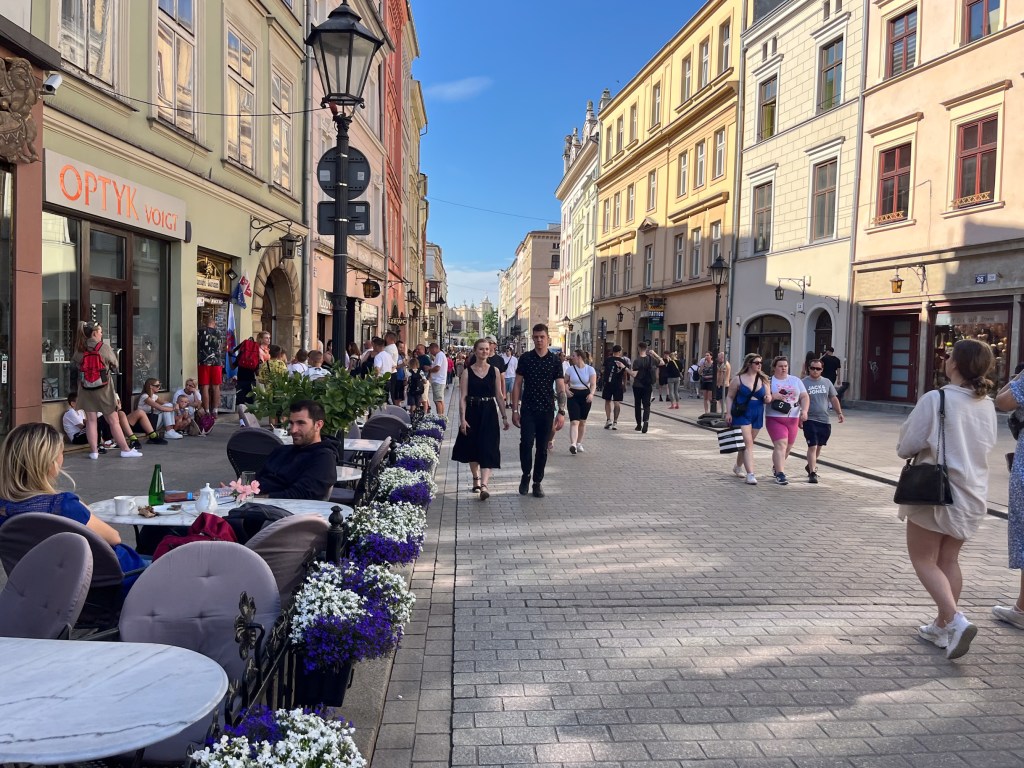
As we approached Kraków, the highway gave way to a grand boulevard. Stylish pedestrians strolled past modern storefronts housed in historic buildings. After five days as an odd trio of Americans navigating a land both unfamiliar yet strikingly reminiscent of suburban America, we found ourselves in a quintessential European city. Kraków exuded all the charm, energy, and grandeur of the world’s great cities.
Thanks to our guide and translator, Lucjan Cichochi, we had managed to overcome the language barrier during our PolishOrigins tour. As we prepared to part ways with him and venture out on our own, we reflected on how a few key phrases and a friendly attitude could go a long way in bridging communication gaps. Now, it was time for a little indulgence: the ease of English accessibility, the freedom of being a tourist, and the vibrancy of Kraków awaited us.
Ethan (my son), Ethan Luke (my grandson), and I had traveled over 200 miles across southeastern Poland by van, tracing our family roots. Over the past week, we experienced moments of wonder and joy as we discovered familial connections, met new relatives, and explored beautiful locales. Even when our leads seemed to run dry, the journey offered insights into Polish life and history, connecting us with our ancestors’ world.
After an enriching week in Poland’s rural heartlands, we turned our attention to Kraków—our final destination. Over the next three days, we planned to immerse ourselves in the city’s rich history and culture, which serve as a proud testament to Poland’s enduring spirit.
Kraków, one of Poland’s oldest and most significant cities, became the country’s capital in 1038. Situated along the Vistula River, it has long been a hub for trade, linking the Baltic and Black Seas. During the Middle Ages, Poland grew into one of Europe’s most influential nations, with shifting borders reflecting its complex history of alliances, invasions, and leadership changes. Though the political capital moved to Warsaw in 1596, Kraków remained the intellectual, cultural, and historical heart of the nation.
Kazimierz: A Neighborhood with a Soul
Friday, June 14, 2024
We arrived in the afternoon at the Queen Boutique Hotel, a four-star gem nestled in the heart of Kraków’s Kazimierz district. With spacious rooms priced at a reasonable $130 per night, the hotel’s central location made it an ideal base for exploring nearby landmarks, including Wawel Castle, Old Town, and Podgórze.
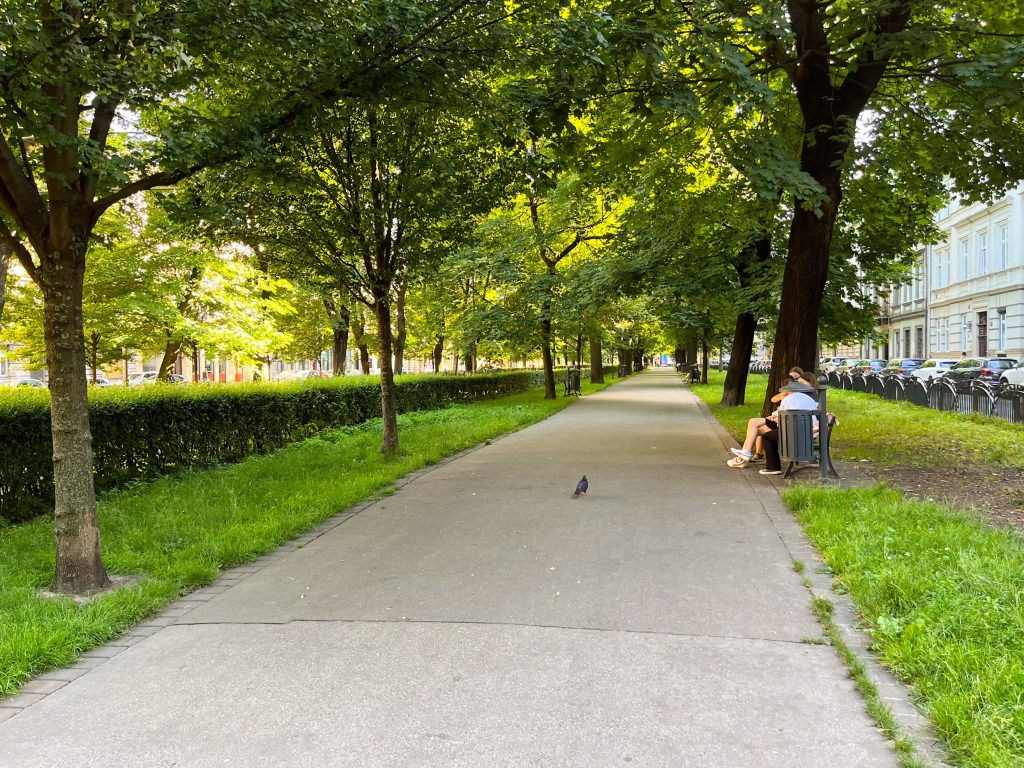
Outside our Hotel in KrakiwStrolling the Dietla
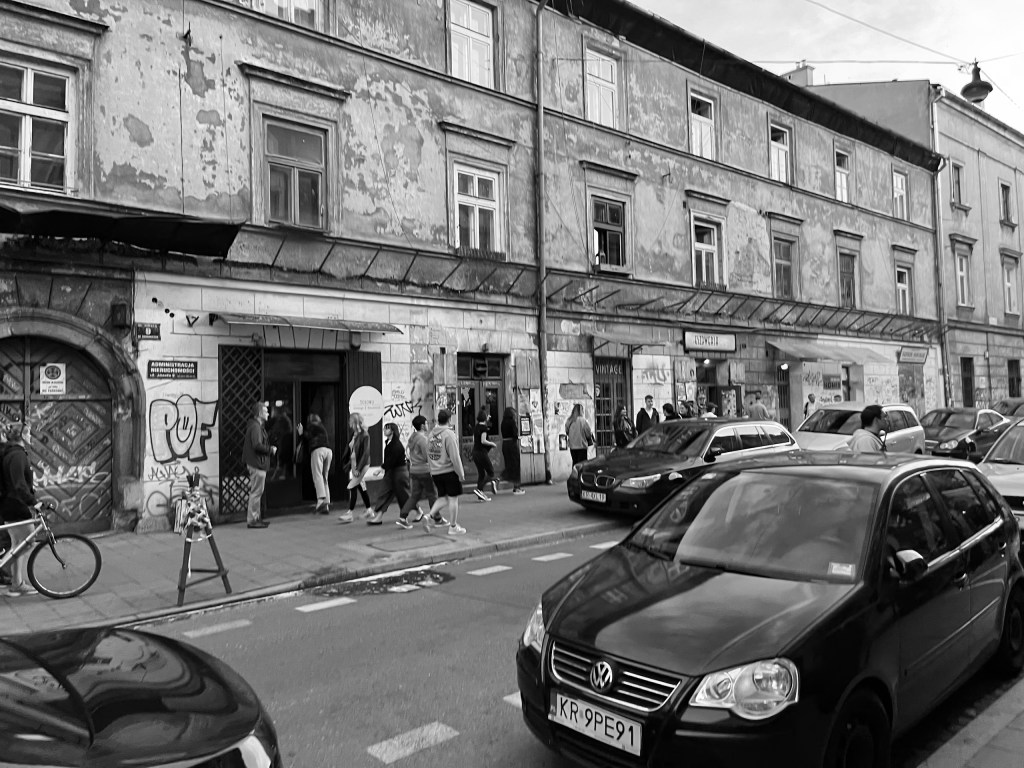
That evening, we ventured out, guided by local restaurant recommendations. Just beyond our hotel, we crossed the leafy Dietla boulevard and entered Kazimierz. The area’s weathered facades, adorned with graffiti and steeped in history, told a story of resilience and rebirth.
A Challenging History
Once an independent town, Kazimierz became a haven for Jewish refugees fleeing persecution. By World War II, it had evolved into Kraków’s Jewish quarter, only to be devastated by the Nazis. During the communist era, Kazimierz remained neglected until the 1990s, when the movie Shindler’s List sparked a cultural revival.
Savoring Flavors and Music
Drawn by lively music, we stumbled upon a cozy plaza surrounded by restaurants. The weather at 7:30 p.m. in mid-June was still bright (darkness around 10:00 p.m.) and comfortable, perfect for eating outside and watching the crowd of visitors. We dined outside at AWIW, a Jewish-Polish café, as we broadened our culinary tastes with a mix of Polish, Jewish, and Middle Eastern dishes, all accompanied by traditional klezmer music.
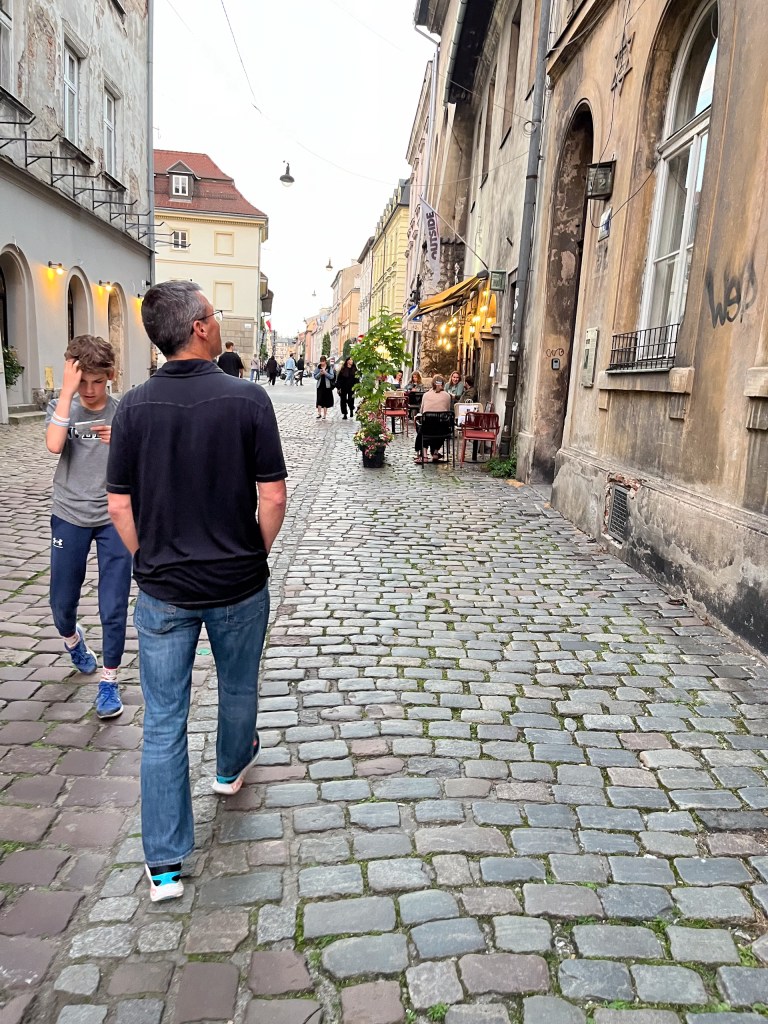
After dinner we decided to explore more of Kasimierz. While looking rundown and dirty, this was the liveliest and most creative section in town, filled with historical buildings, galleries, and restaurants.
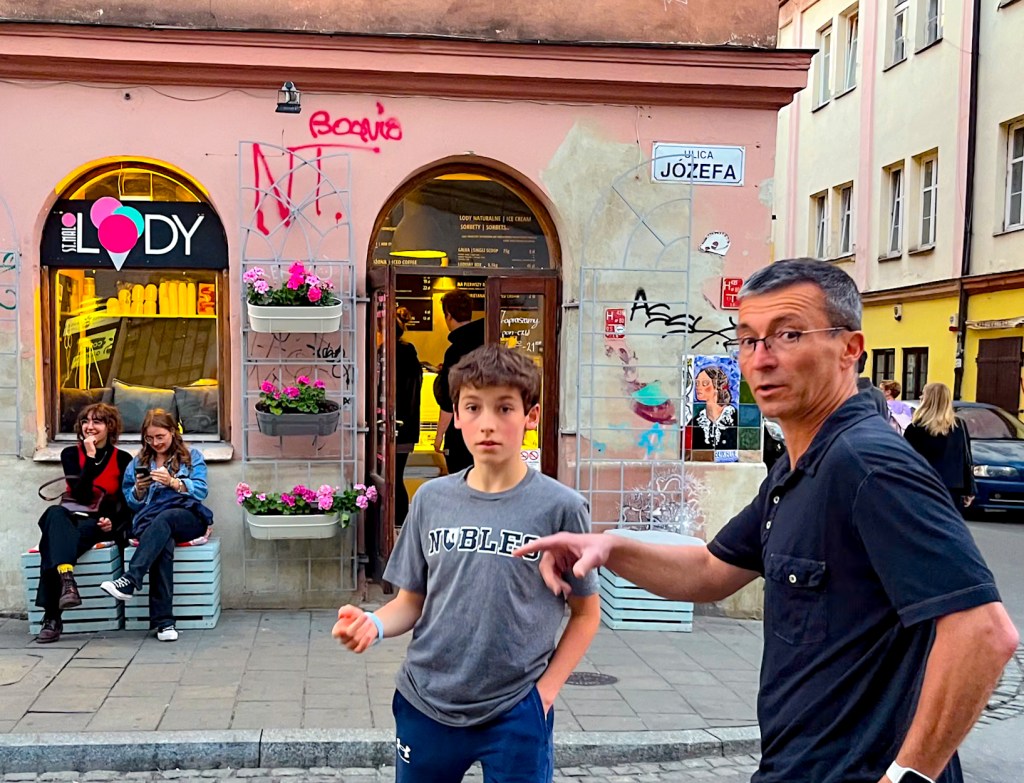
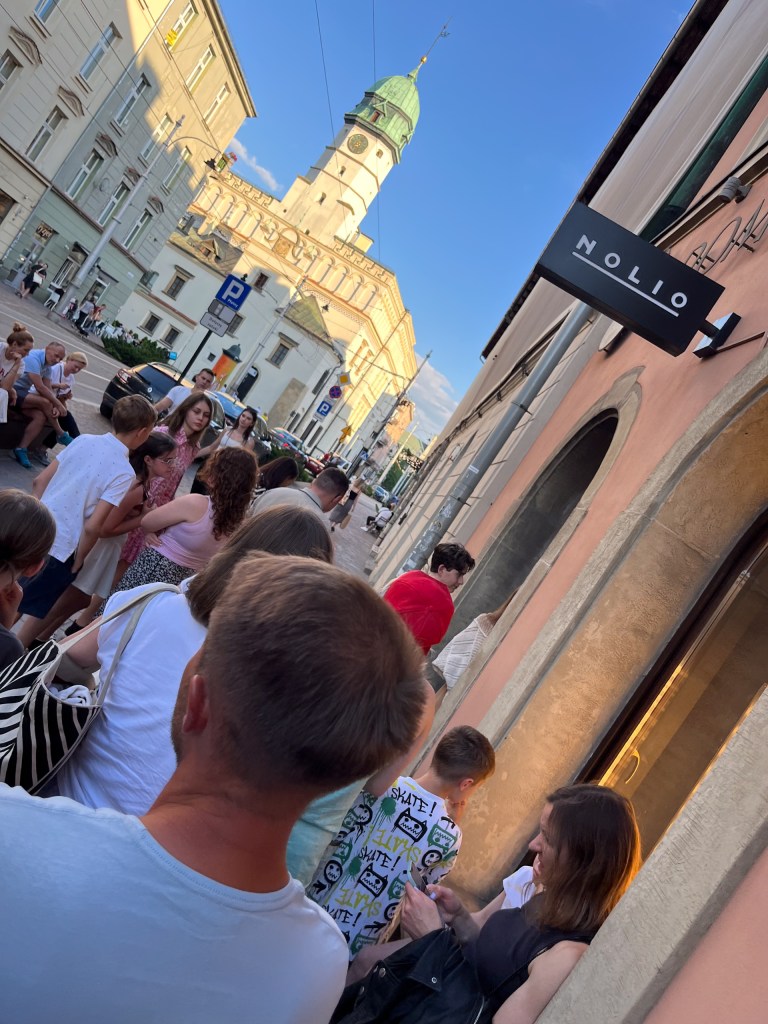
Tonight we set aside our hunt for the past and searched for the best homemade ice cream for dessert. It was not easy. There were too many places to choose from and it seemed we were not the only ones on that mission.
A Day in Polish History
Saturday, June 15, 2024
Wawel Hill
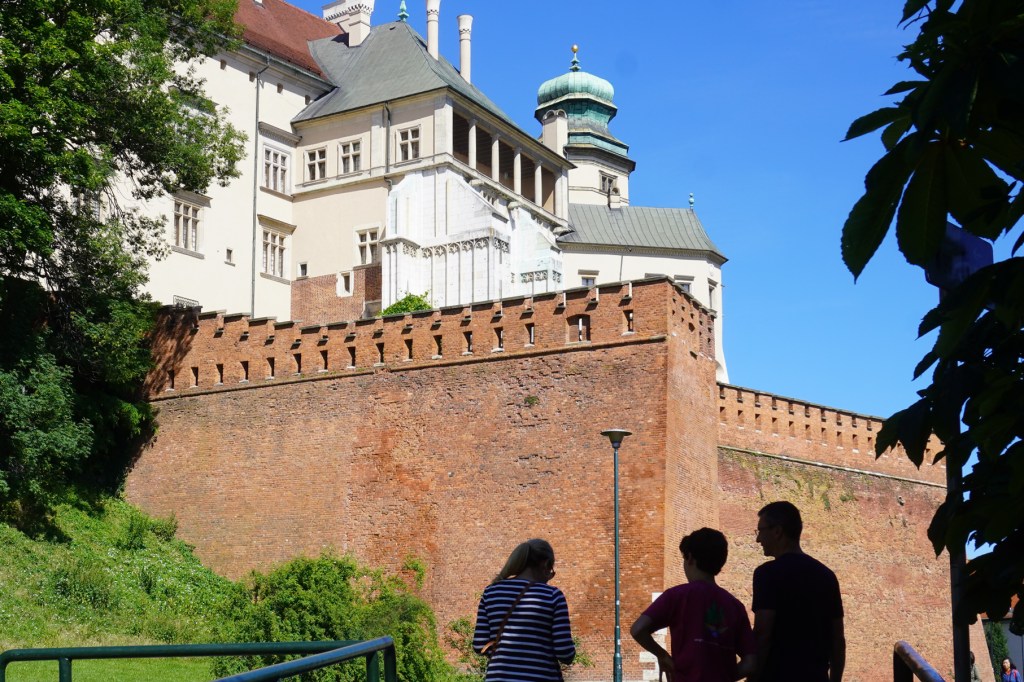
The next morning, we met our guide Johanna and walked to Wawel Hill, home to Kraków’s iconic Wawel Castle. Perched above the Vistula River, the castle complex dates back to the 14th century, though the site has been inhabited since the 4th century.
The Legend of the Wawel Dragon
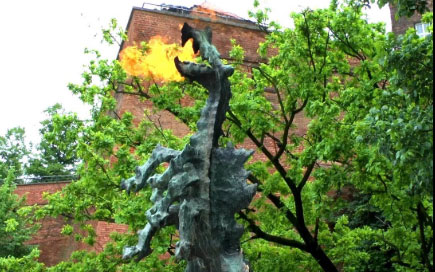
One version of the legend (there are many) of Smok Wawelski, the dragon,claims that this troublesome monster lived in the limestone cave at the base of Wawel Hill and liked to eat maidens. Knights came from all over to slay the dragon but instead were eaten alive. It took a shoemaker to devise a plan to kill the dragon by offering it a sheep with sulfur sewn inside which the dragon ate and then died. For his reward he married the princess. Today, there is a statue of the dragon that occasionally spews fire at the base of Wawel Hill reminding us of the city’s very own famous dragon.
Fire-breathing Krakow Dragon Monument
Wawel Castle
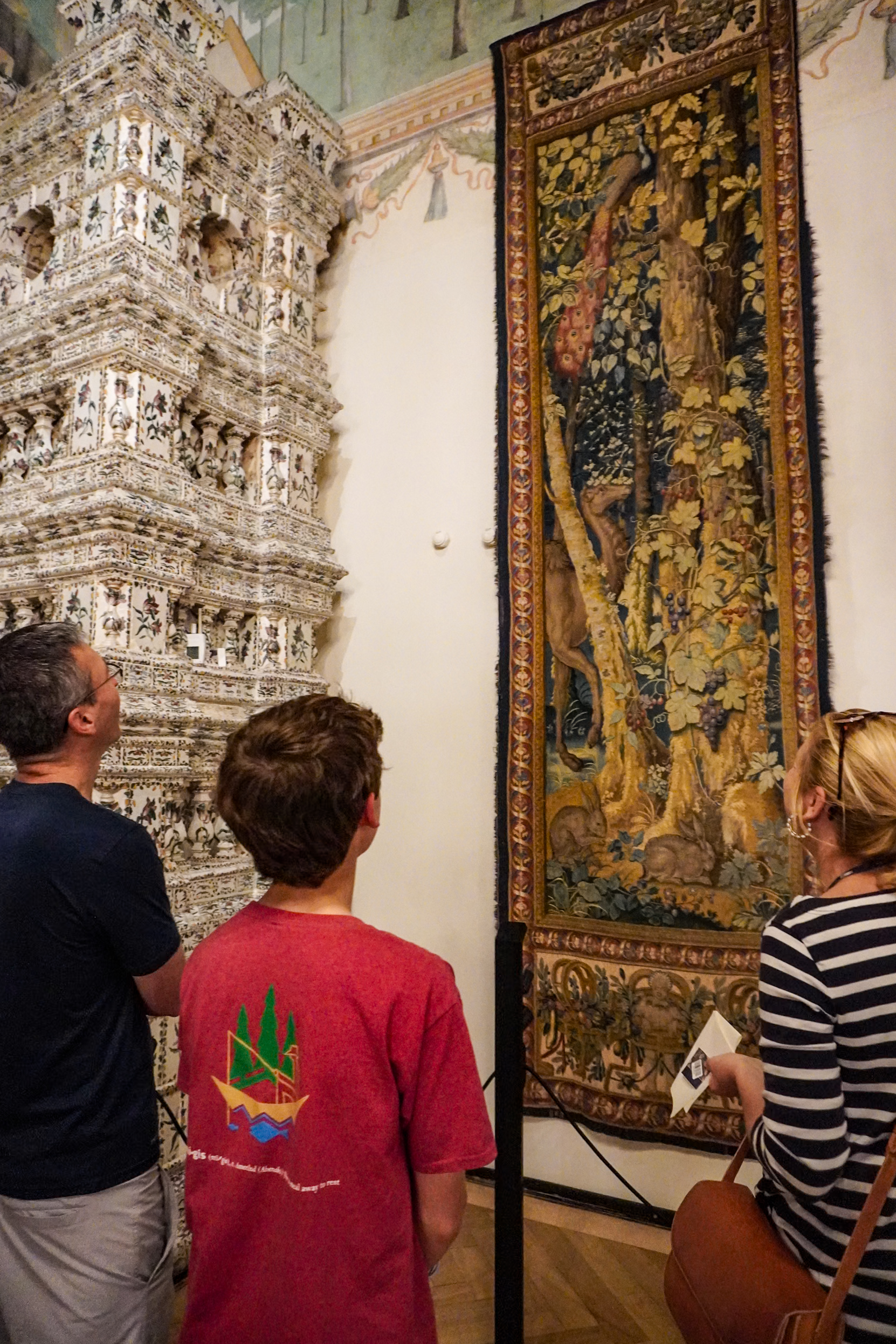
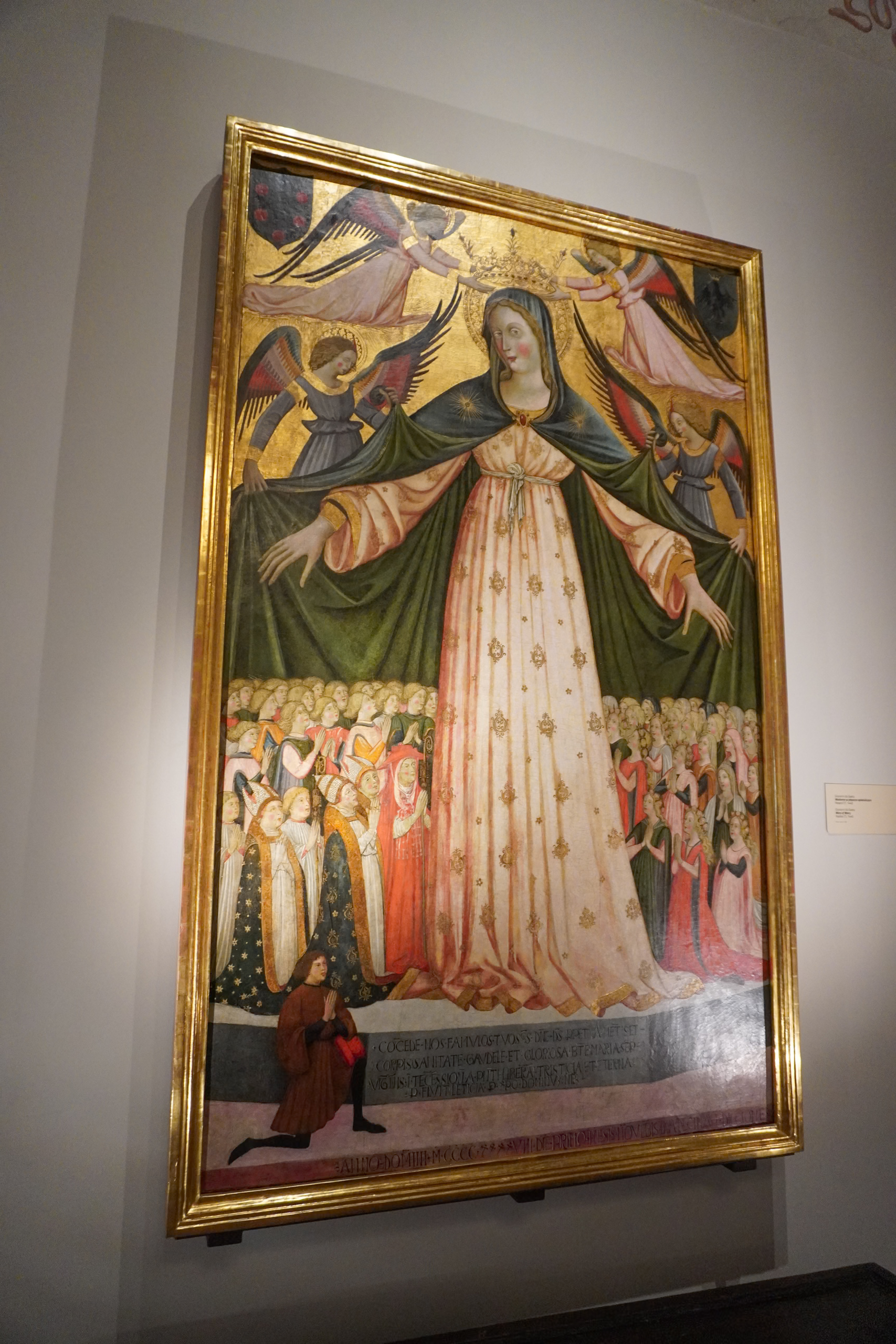
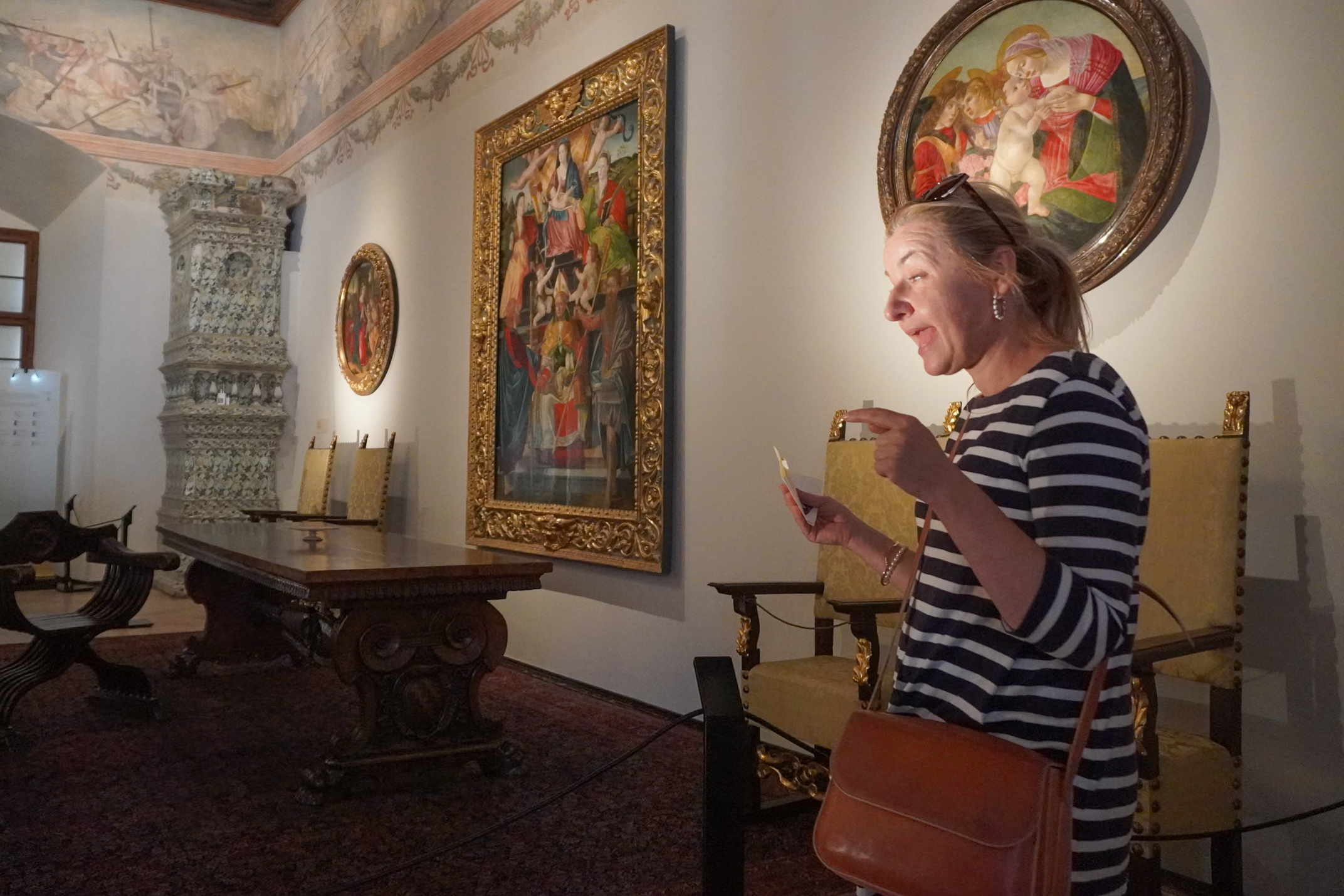
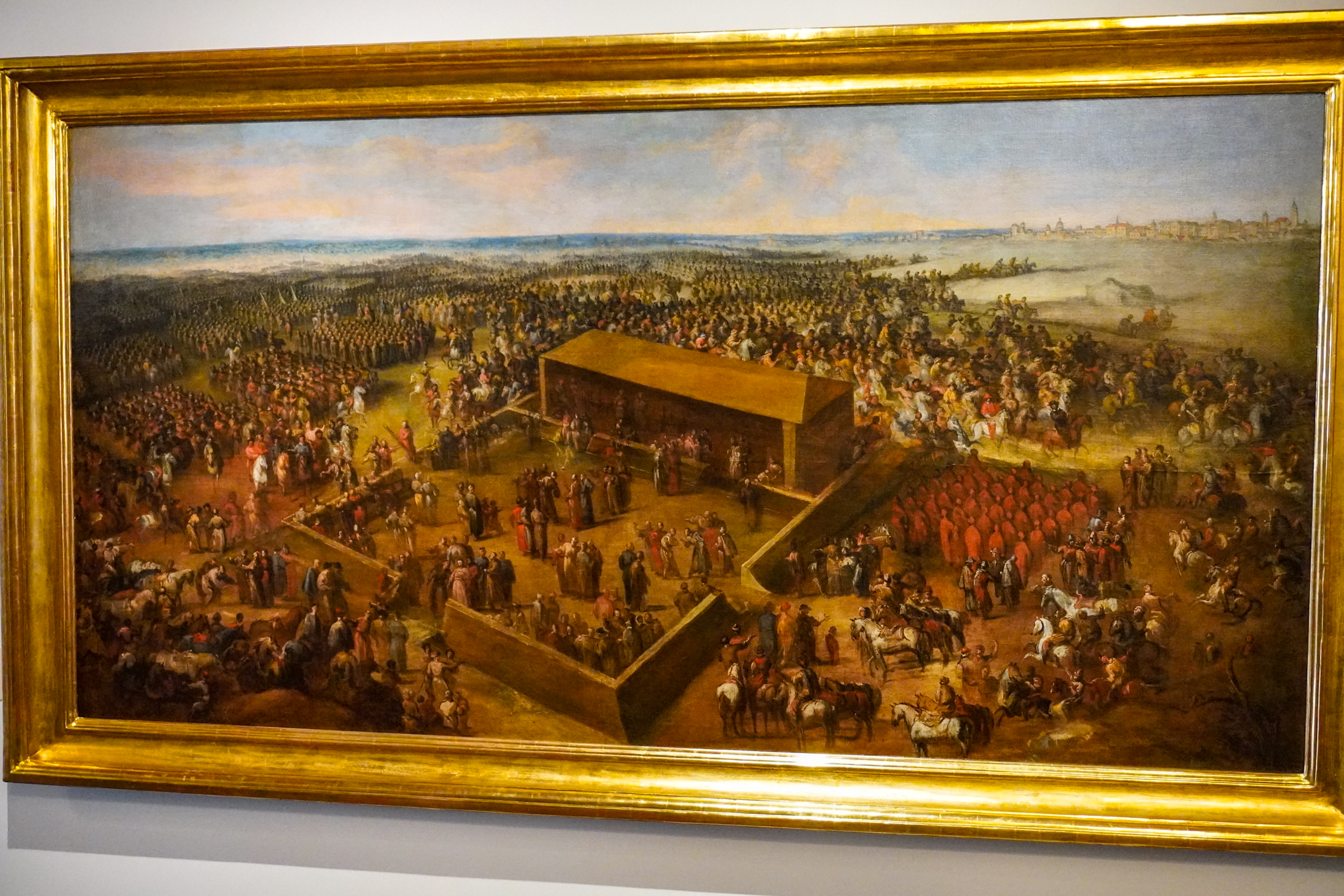
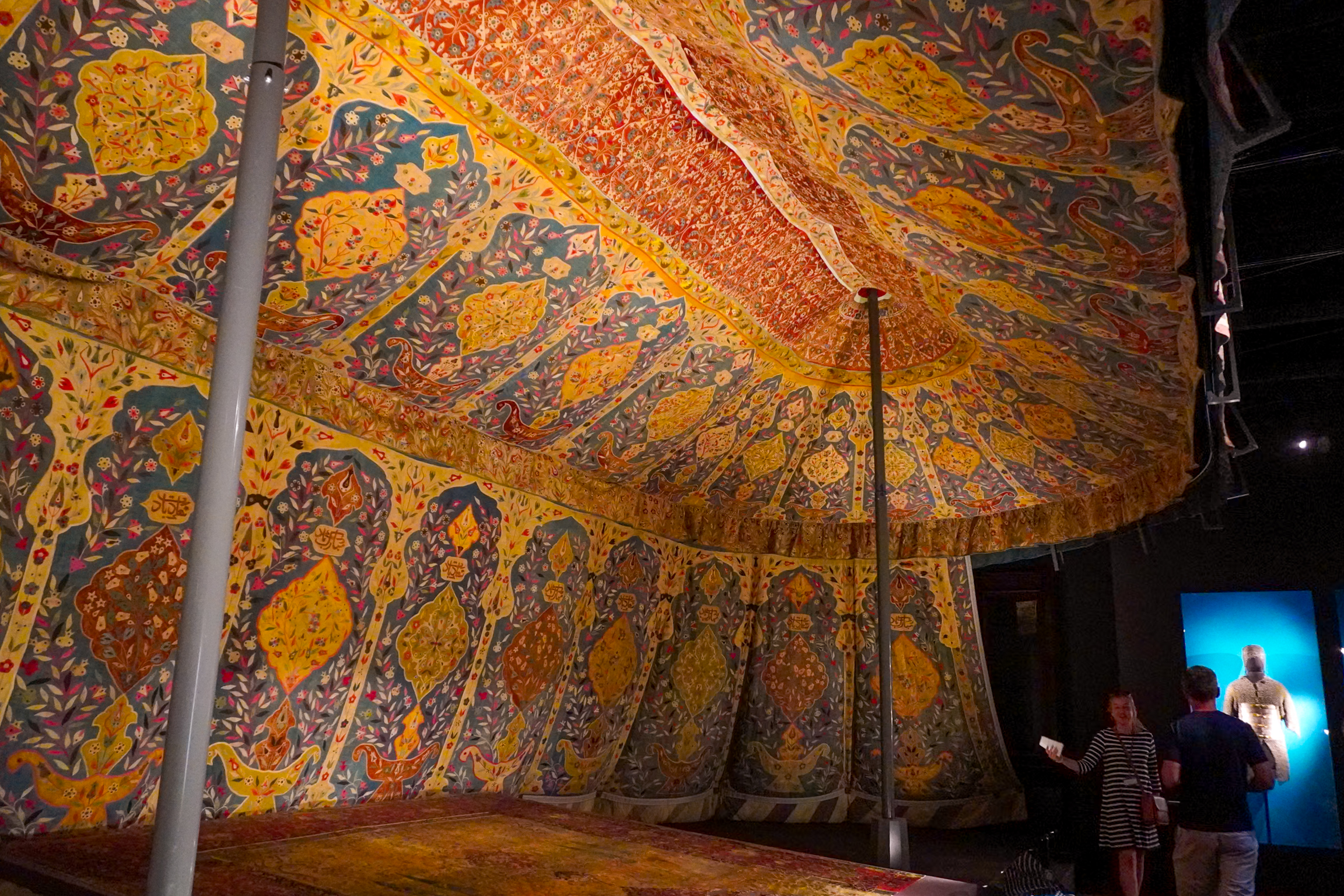
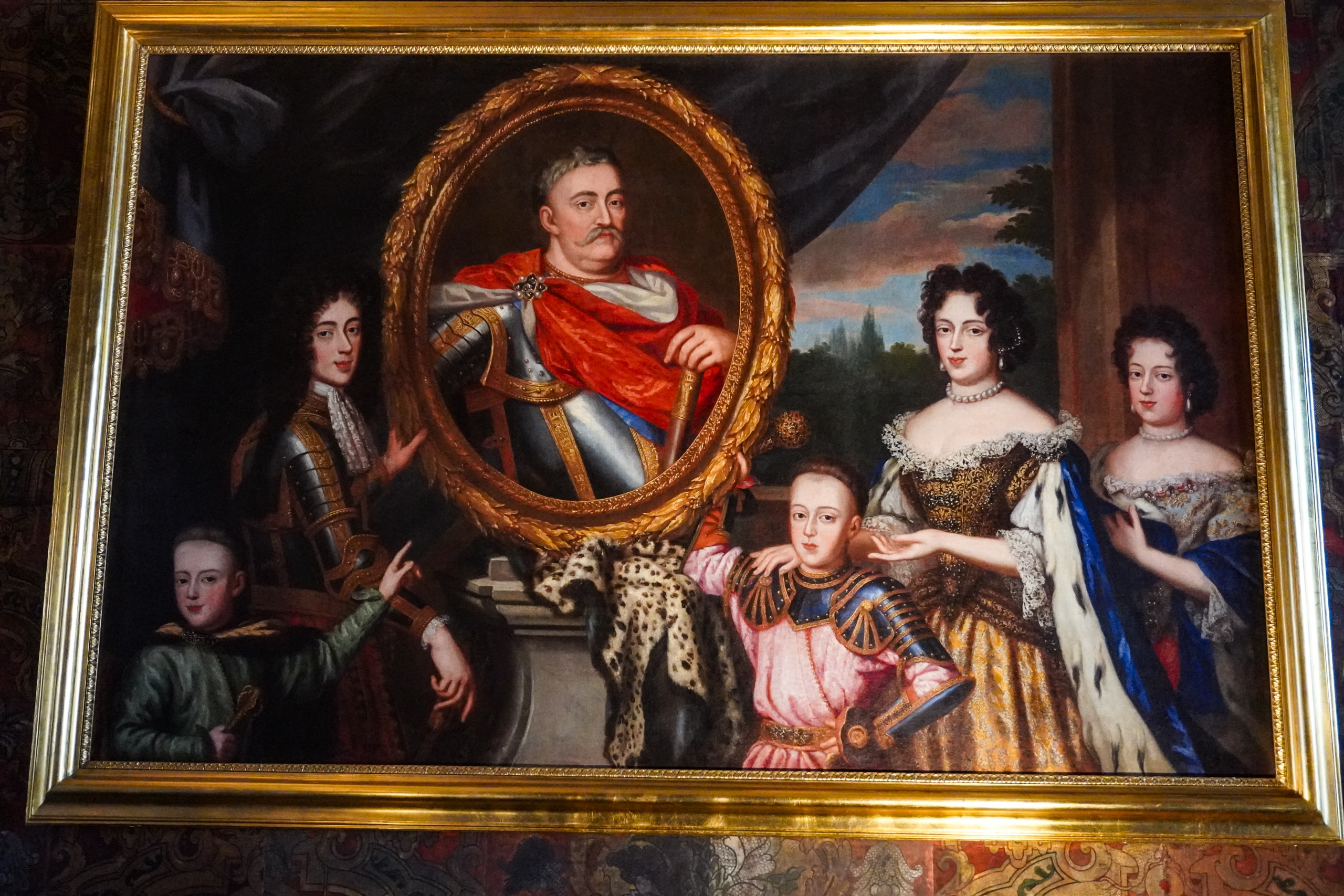
Our tour began with the castle’s Royal Apartments, brimming with centuries-old treasures: ornate armor, tapestries, and murals depicting Poland’s storied past. We also explored an Oriental Art exhibition, featuring intricate artifacts from 17th-century Turkey.
The National Shrine
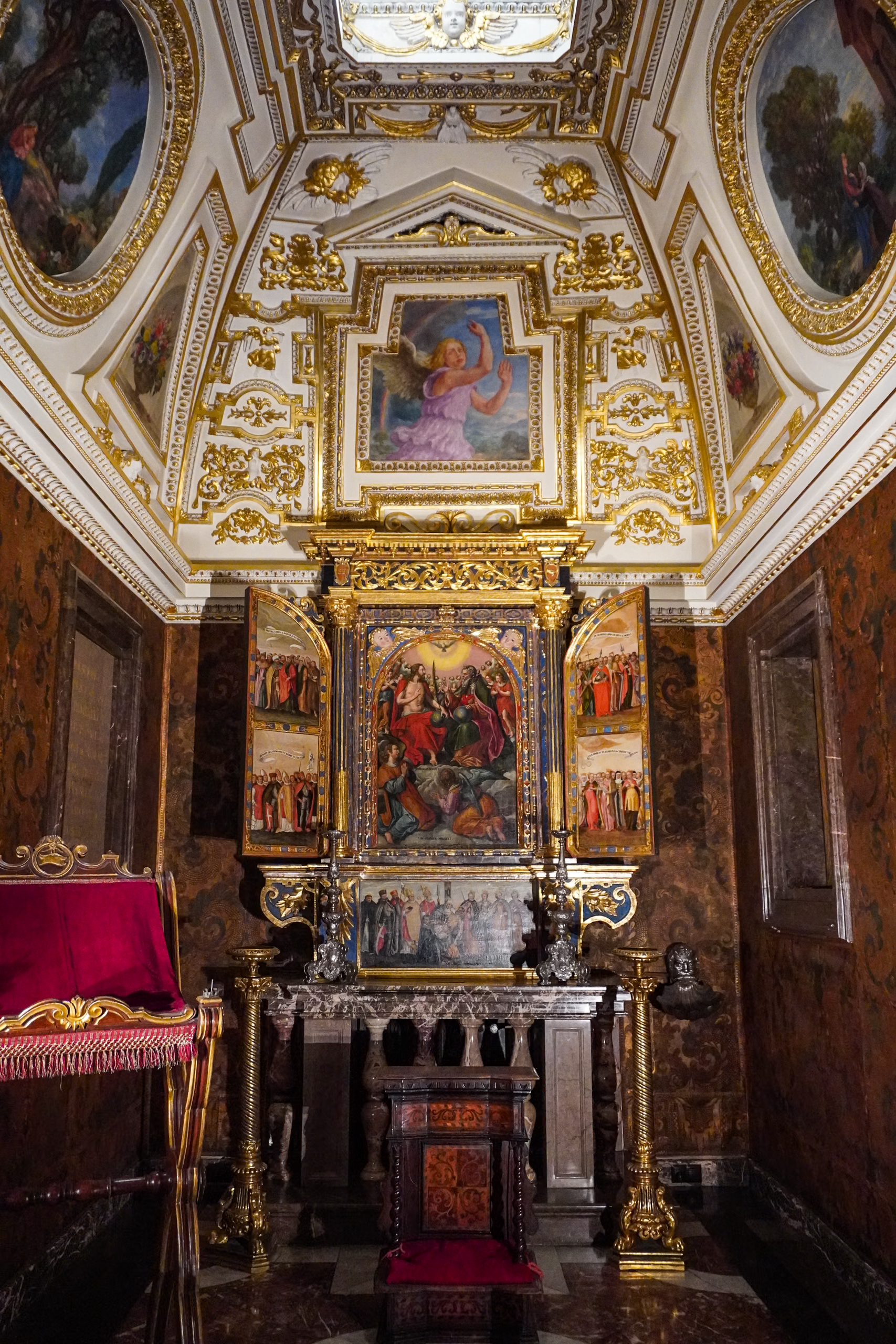
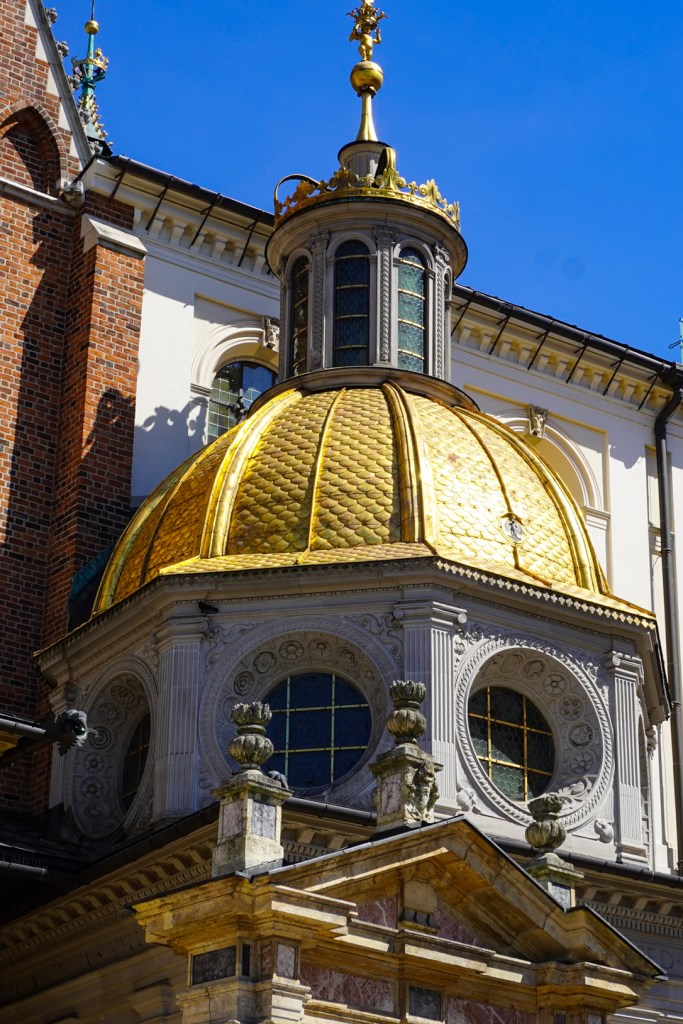
Next up was a visit to Wawel Cathedral is the sacred center of Krakow and possibly the entire country. Sigismund Chapel is notable for its 24kt gold domb. Since the 1300’s kings and other notable Poles have been coronated and buried here. You can see the actual sarcophagi tombs carved with images of the dead. Even the national hero, Tadeusz Kosciusko, who led American troops during the Revolutionary War, is buried here.
For Whom the Bells Toll
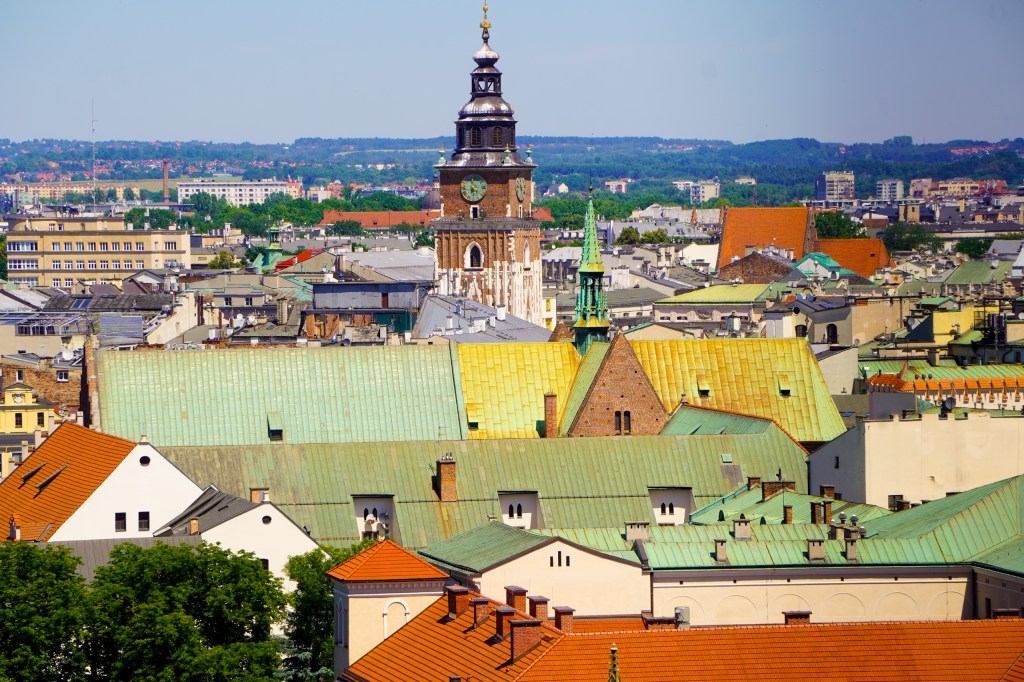
Of special interest, is climbing the 70 tight wooden steps up to the Cathedral bell tower. Here there is a great view of the castle and old town areas. But, our destination was the huge bells above us as we climbed.
View from the Wawel Cathedral Bell Tower
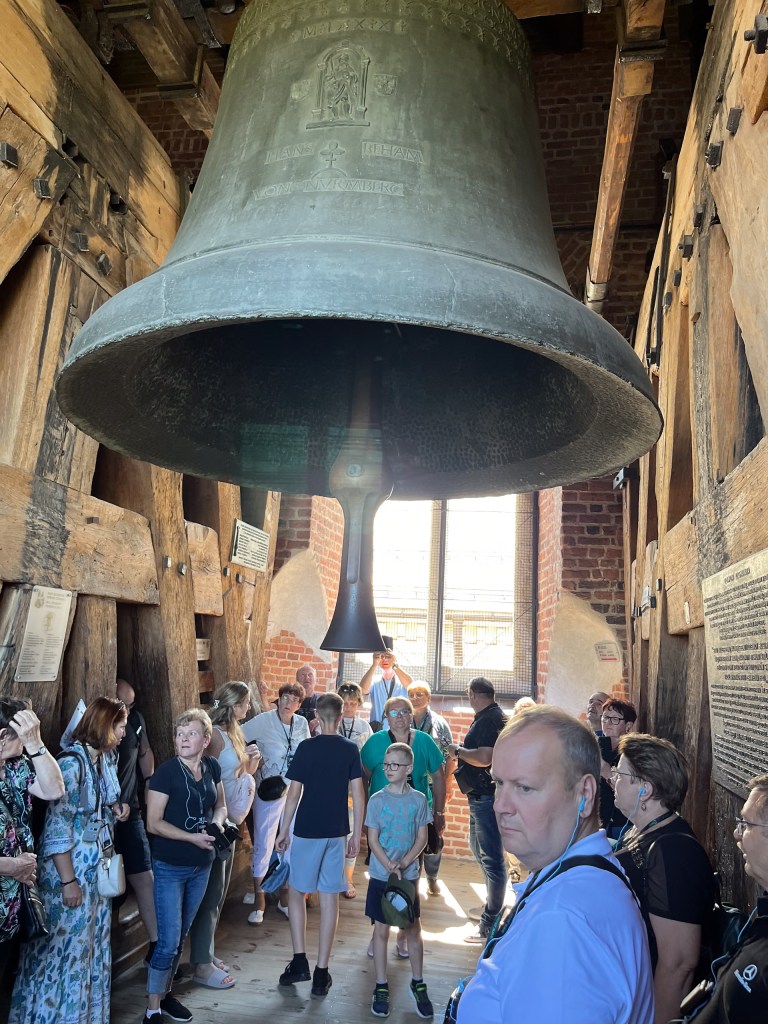
The huge, 12-ton Sigismond Bell (cast in 1520), is said to have a magical sound and is only rung on momentous occasions for Poland, such as national celebrations, major religious holidays, or times of great sorrow.
Sigismond Bell
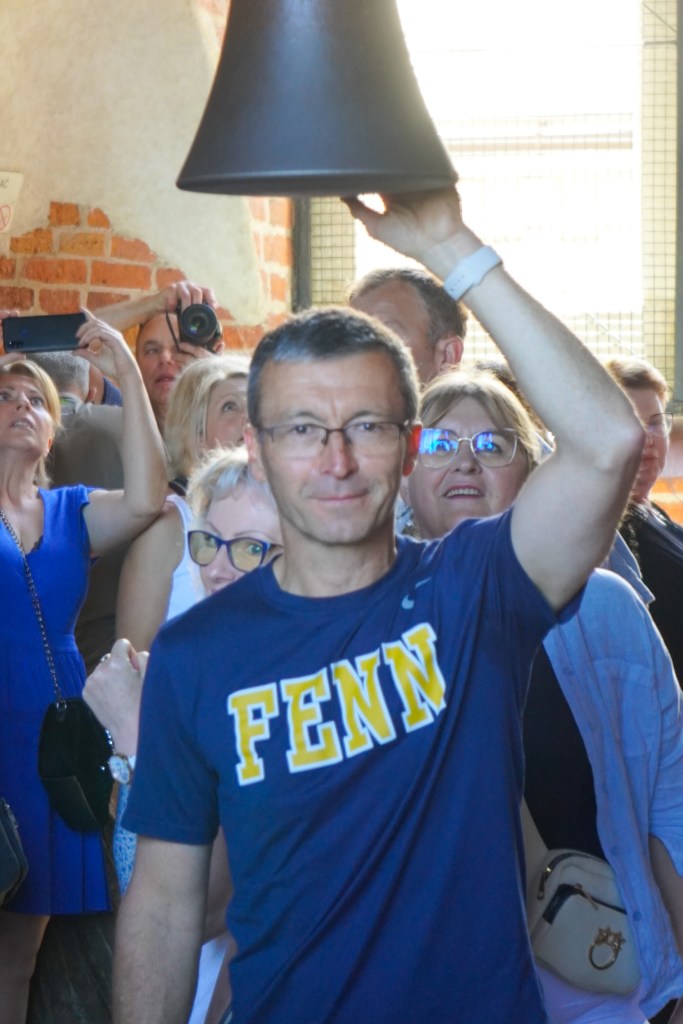
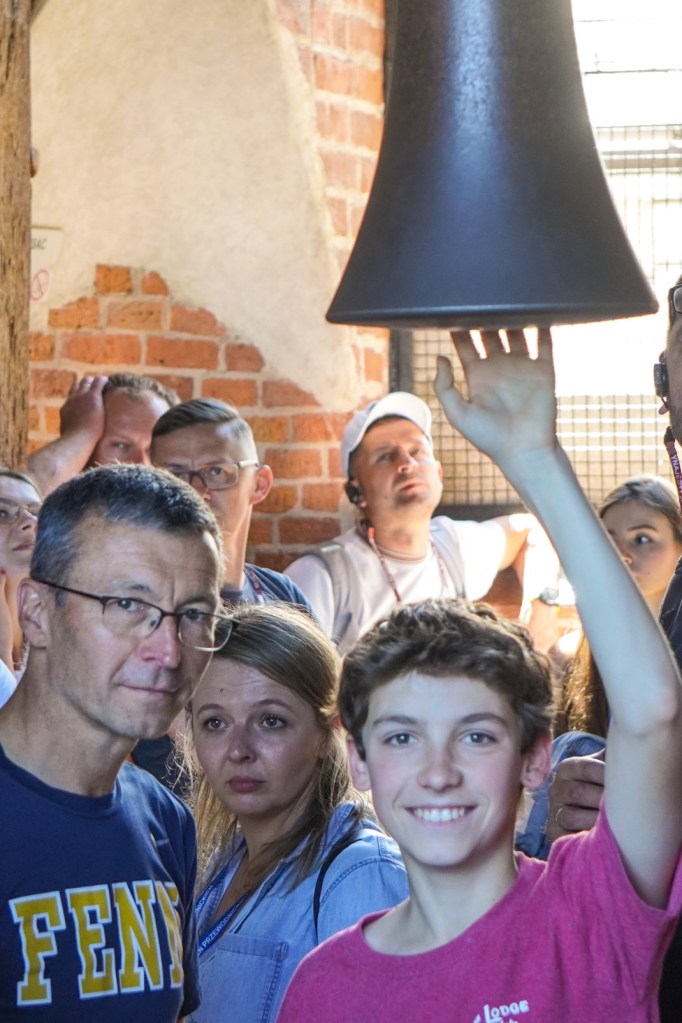
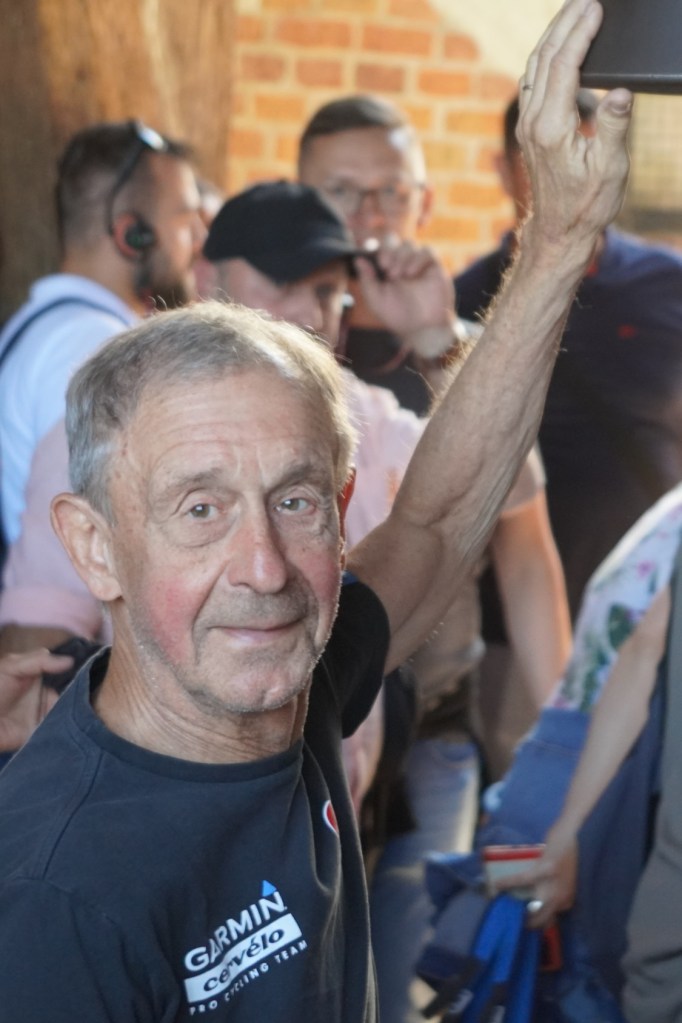
Of lesser importance, in the bell tower, but even more popular, is the Bell of St. John. The bell should be touched with the left hand while making a wish. especially in matters of the heart, such as love and marriage. Each of us touched the bell with our own private wish.
Old Buildings in the Old Town
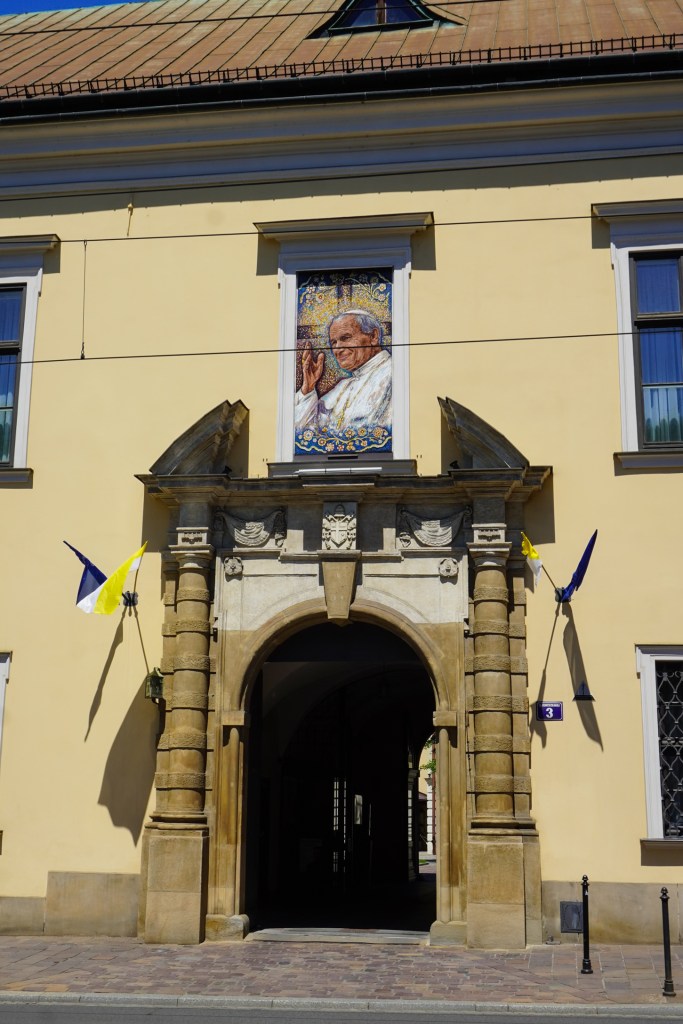
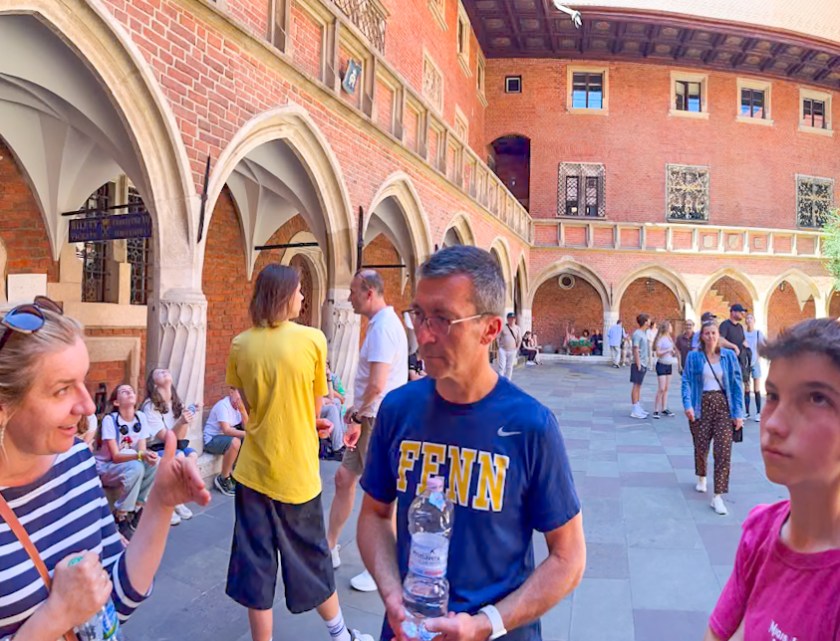
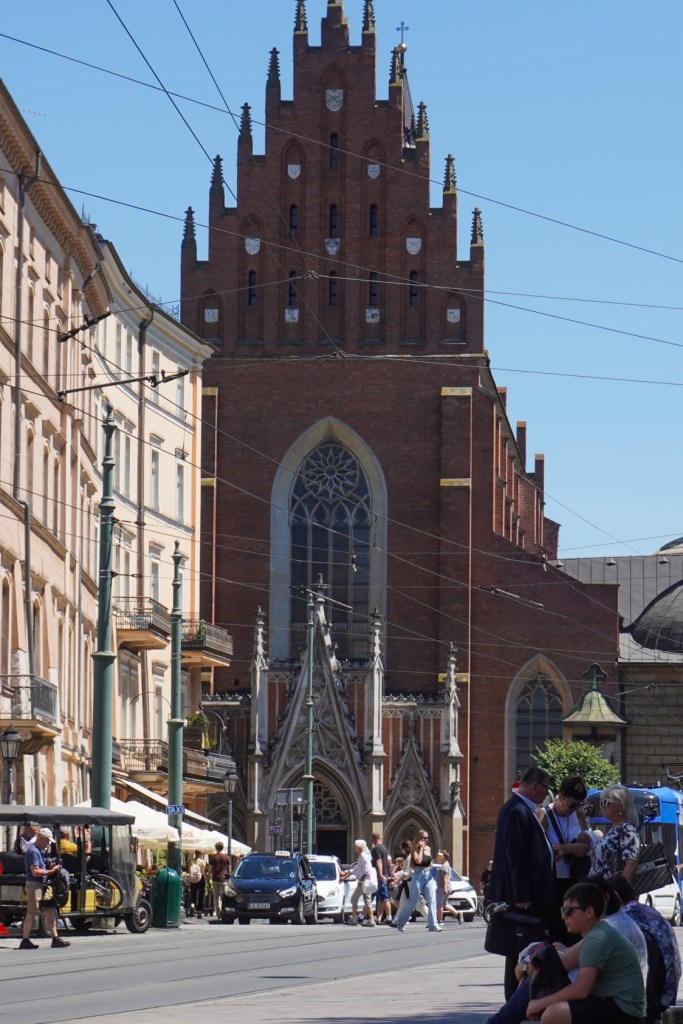
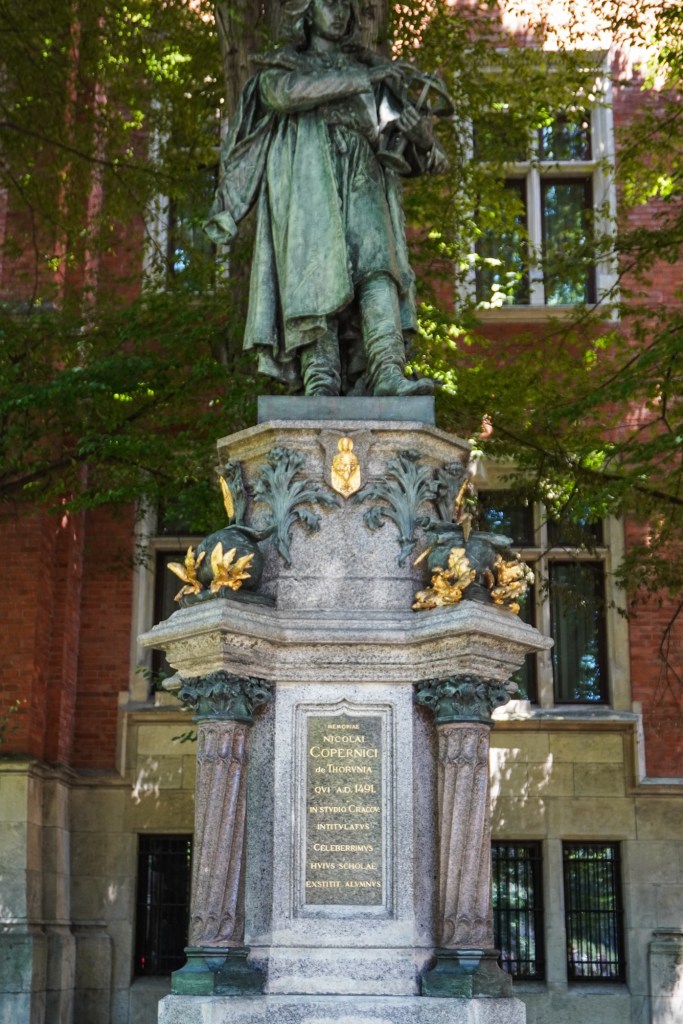
We left the castle area to briefly view a few other historical buildings. The Papel Window in the bishop’s palace where favorite-son Karol Wojtyla (who later became Pope John Paul II) would address his followers, the Church of Saints Peter and Paul and the Jagiellonian University, one of the oldest universities in Europe (1364).
A Gothic Masterpiece
Chief among other nearby historical buildings St. Mary’s Basilica know for its magnificent stained-glass windows and famous altarpiece, a pentaptych by Veit Stoss, is said to be the greatest Gothic work of art in Poland.
Roaming Around
Our three hour tour ended with us heading toward Rynek Glowny (aka Rynek Main Marketplace) for lunch and then a nap back at our hotel, only a few blocks away.
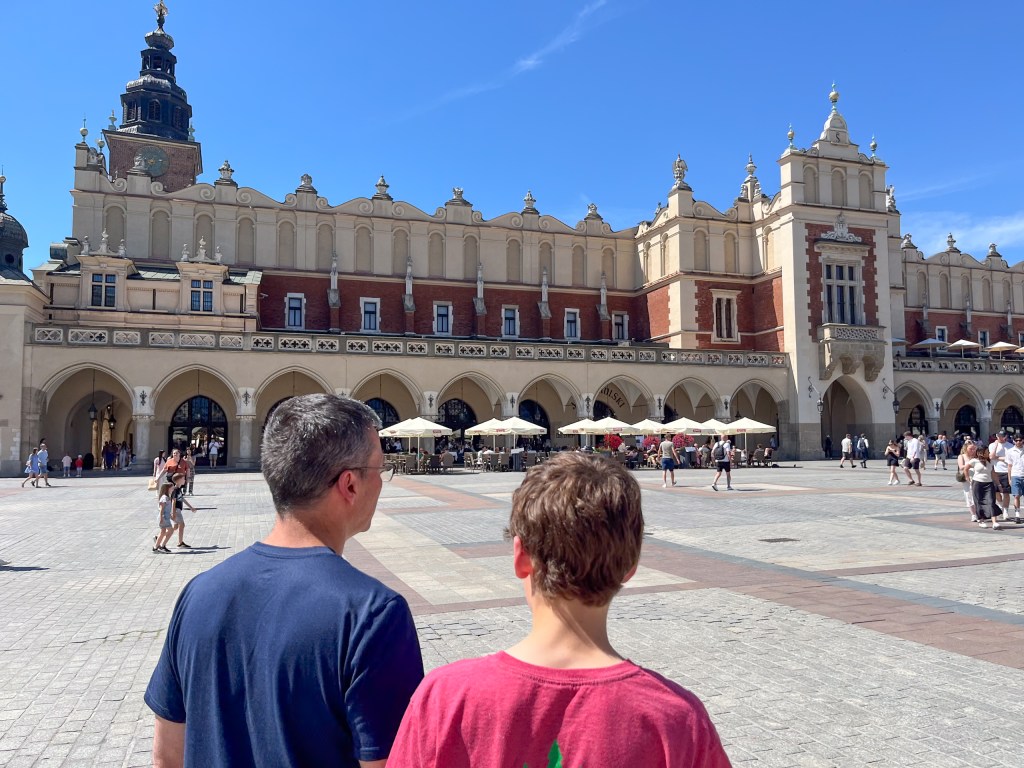
We were surprised by the size of this plaza, said to be the biggest in Europe. In the middle of the plaza, was a large building called Cloth Hall, a very old medieval marketplace where vendors would sell goods, especially clothing. Tip:Here was a great place to buy amber jewelry and Boleslawiec pottery, specialties of this area. We found just what we needed to bring home at a reasonable price solving our souvenir anxiety quickly.
Streets of Old TownCloth Hall
That evening we explored more of the Kazimierz and Old Town sections. We followed the crowds and found maybe the best Italian/pizza restaurant in town, Nolio’s. It was a very lively night with people of all ages, appreciating the good vibes and weather.
A Day of Reflection
Sunday, June 16, 2024
Auschwitz-Birkenau
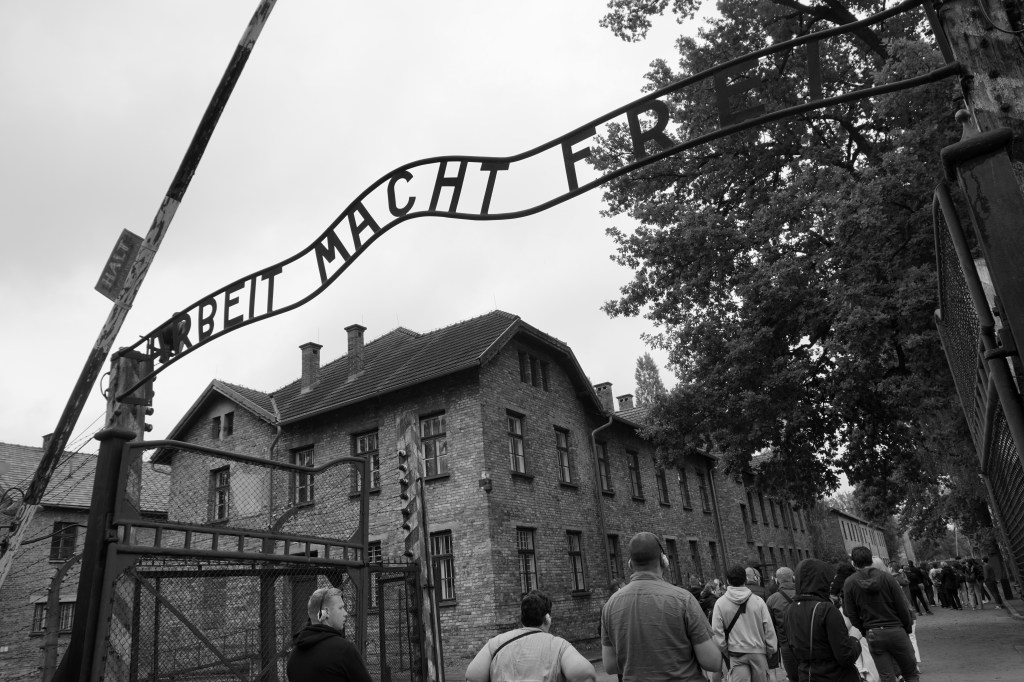
Our final day in Kraków took a somber turn with a visit to Auschwitz-Birkenau. Located a short drive from the city, the concentration camp stands as a harrowing reminder of humanity’s capacity for cruelty. Touring the grounds was a powerful, emotional experience, leaving us with a renewed commitment to remembering and learning from history.
Auschwitz Entry Gate – (translation) “Work Will Set You Free”
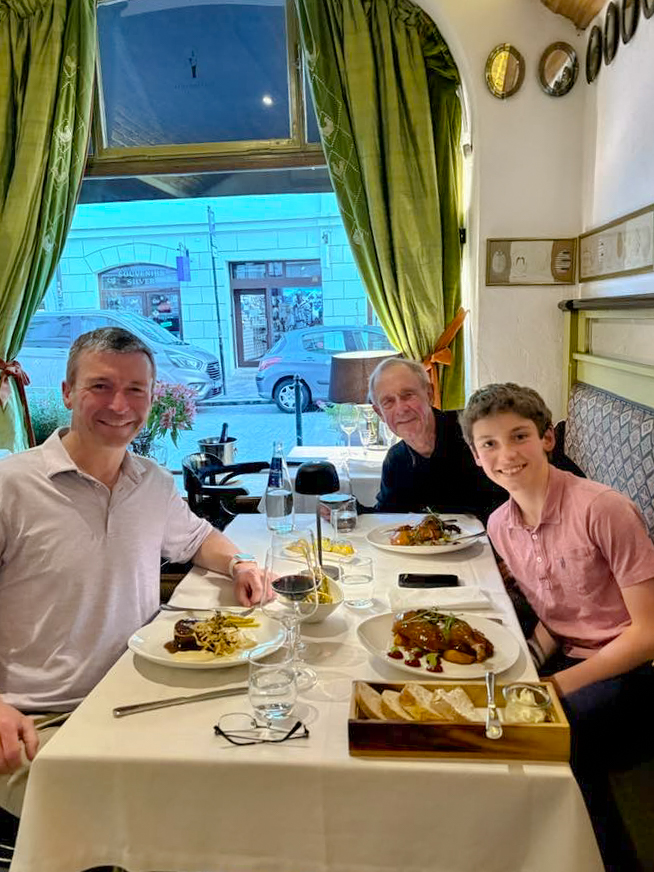
Returning to Kraków that evening, we marked Father’s Day with a celebratory dinner at Kogel Mogul, a Michelin-star restaurant specializing in gourmet Polish cuisine. The meal, a gift from Ethan’s wife Amanda, was the perfect way to cap off our journey.
A Michelin-star restaurant in Old Town called Kogel Mogul had been recommended to me by a friend. They specialized in gourmet Polish food. Both the food and service was outstanding and prices were reasonable for that level of quality. We would recommend it to anyone looking for a special dinner in Krakow.
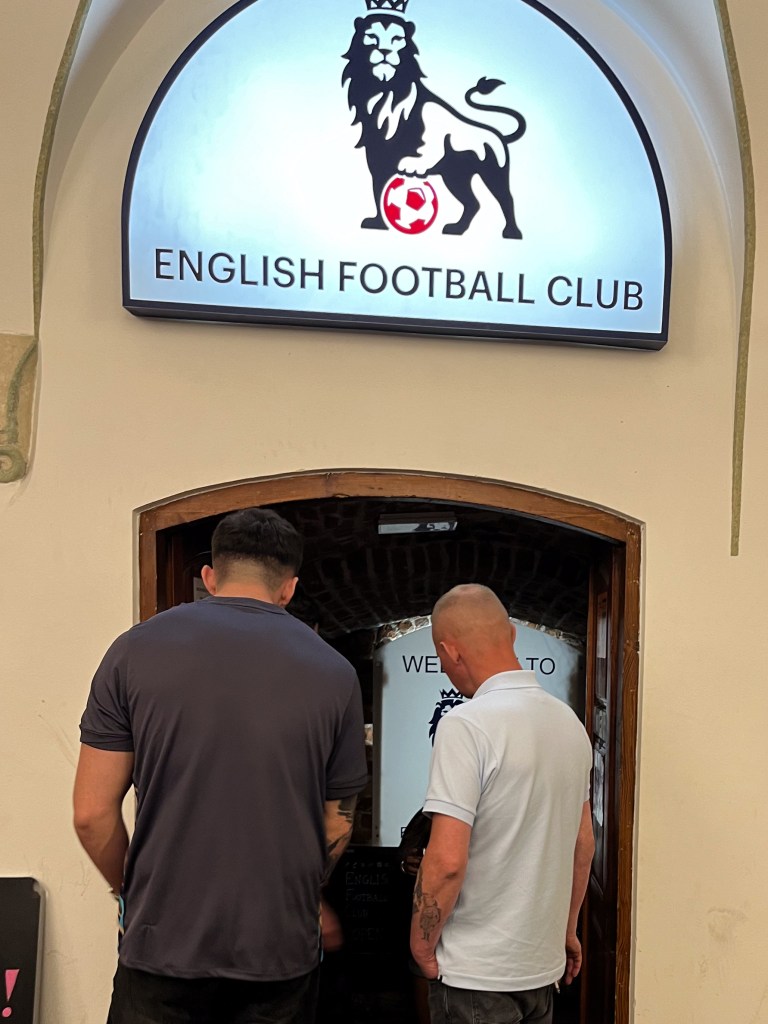
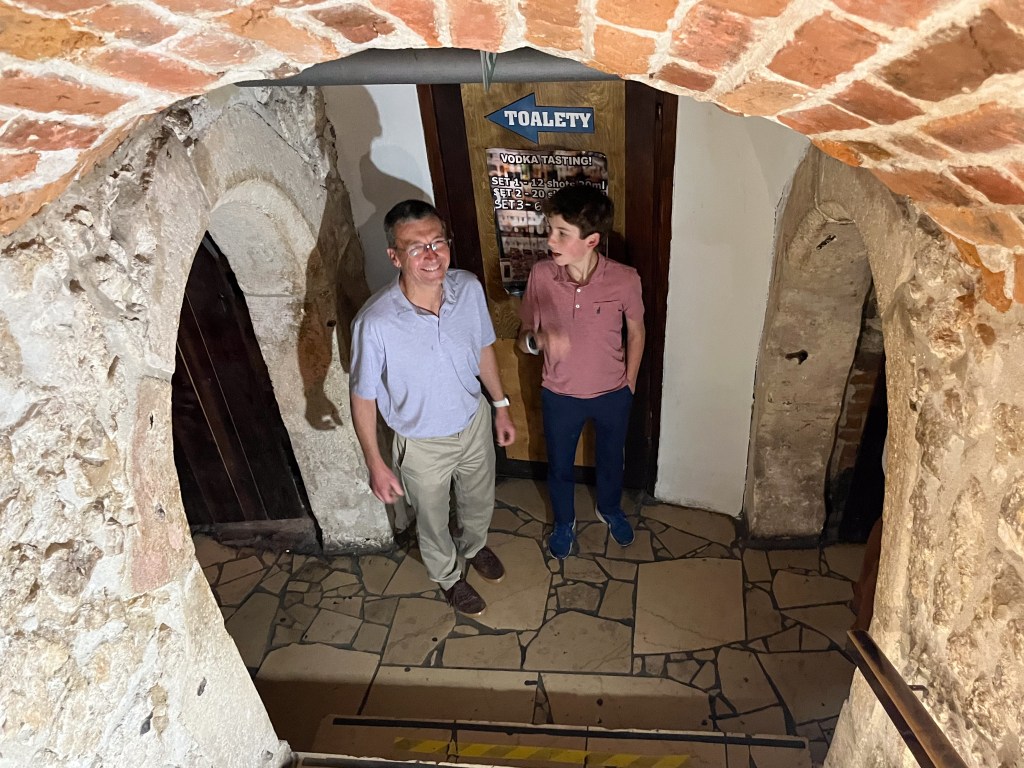
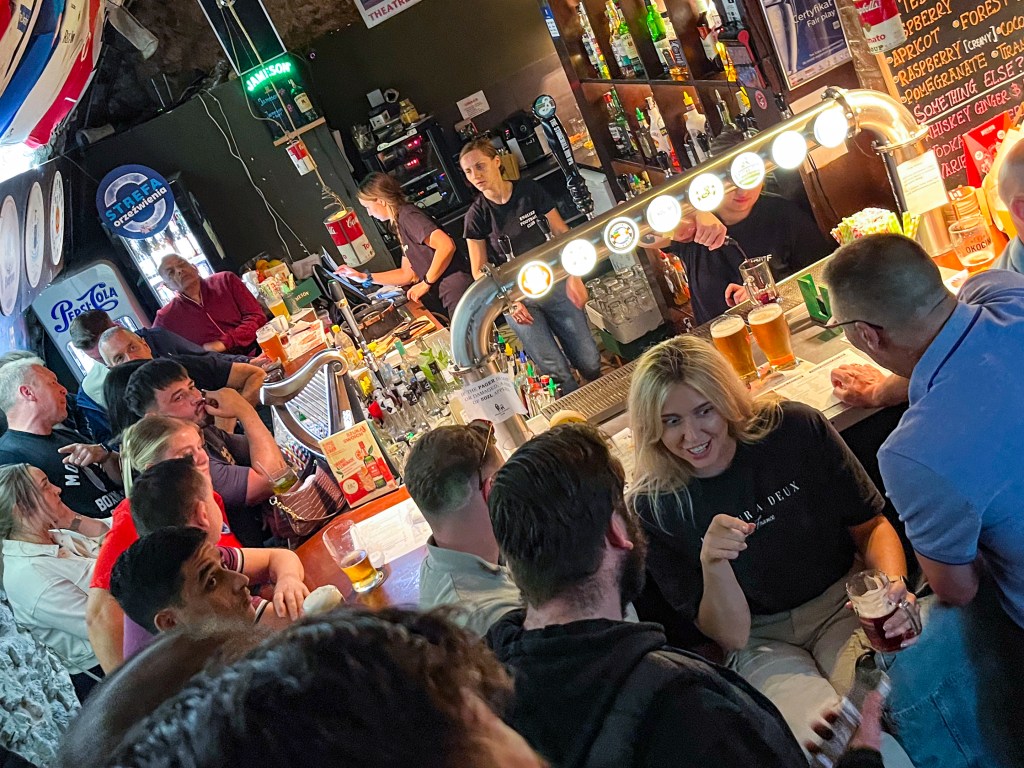
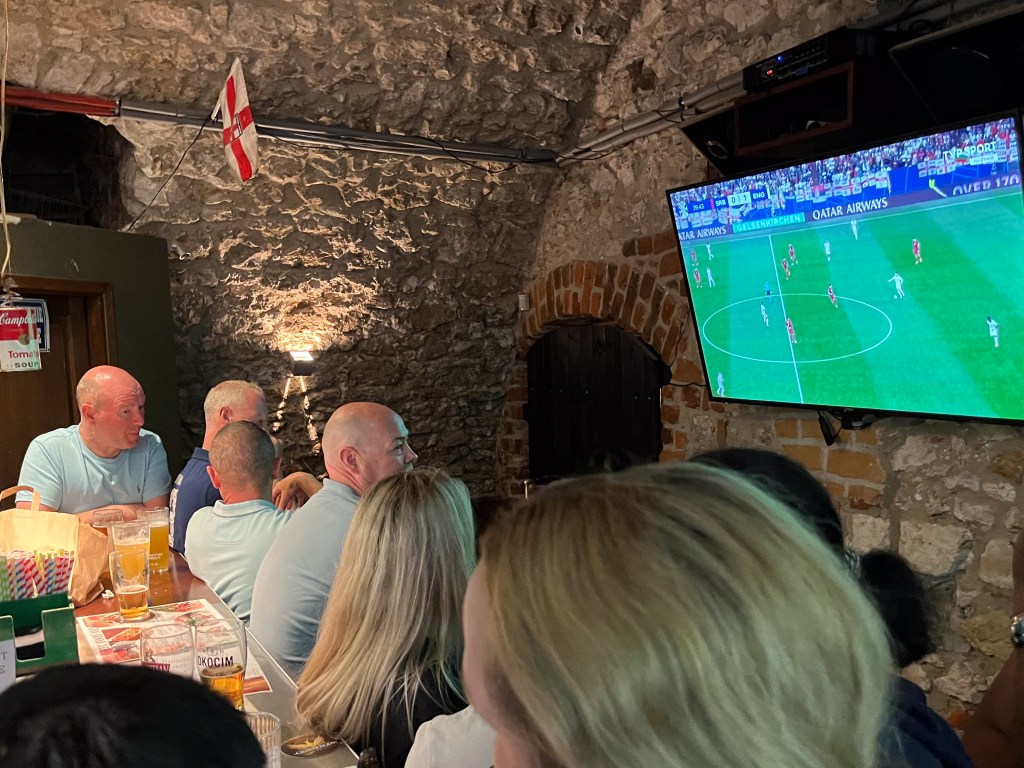
Leaving the restaurant after a leisurely meal we walked around the old town which was still lively but less crowded. We followed a stream of people heading to what looked like a cellar bar with called the “English Football Club”. Seemed a bit out of place here in Poland but especially relevant because the Euro 2024 Tournament was underway, as my young grandson Ethan Luke (15 years old and a BIG “soccer” fan) reminded us.
We ended up in a jam-packed bar of what we presume were mostly British ex-pats cheering on the England against Serbia. Wow! For a few moments we were transported to a different part of Europe with all the spirit and camaraderie we seek in our travels. The crowd was so tight that we could not even buy a drink, which would have been nice but not necessary to enjoy the fun.
We continued exploring the Old Town section for a while that last night while father and son duked it out on where to go next. Next, would be back to the hotel for some sleep after a long day.
Final Thoughts
Kraków captivated us with its unique blend of history, culture, and modernity. Its welcoming atmosphere, vibrant neighborhoods, and proud heritage left an indelible impression. While we regretted not having time to explore every corner, we left with a deep appreciation for the city and its people—and a resolve to return.
As a Polish American, this journey was more than a vacation; it was a homecoming.
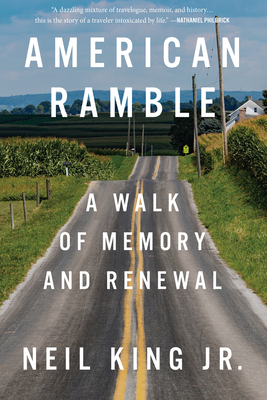
A great book on a 2021 solo walk from Washington DC to NYC. King unearth’s the past with the present in his personal journey.
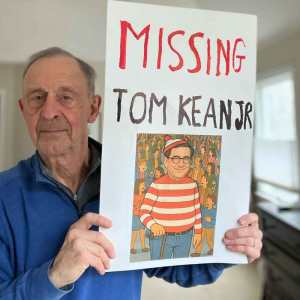
The following is a review of a 2023 book by Neil King, Jr, about his very personal solo walk from Washington DC to New York City in 2021. My son Justin gifted it to me after hearing Neil discussing it at a local talk. Thanks Justin!
It was a book that I related to very personally. I’ve done many long walks in past years and lately have changed most of my serious personal journeys to long bike rides.
But I have to admit the feel of pushing one’s self, even as I get older, is still alluring to me. And, the absolutely free feeling of being solo on a journey is an experience I will never forget. I love being back home with my family but I also love the wanderlust of being on the road.
-Paul
Neil King Jr. confronts aging, a personal battle with cancer, and the broader struggles of COVID-19 and political upheaval. In the midst of these challenges, he embarks on a long walk as an antidote to depression. This walk becomes a deeply focused endeavor, channeling his energy into researching, planning, and executing a journey through history to better understand the present state of the country.
King’s unique journey is more about the creation and leveraging of a personal challenge than the physical feat of walking 330 miles in 26 days. Though the route may appear to be a ramble (a walk for pleasure, typically without a definite goal), it is anything but aimless. King meticulously plans his route and accommodations, choosing interesting and often off-beat places with unique ties to America’s past. Equipped with a simple backpack, he immerses himself in the journey.
His walk from Washington, D.C., to New York City becomes a tapestry of American history, reminding us of Native Americans, revolutionary patriots, immigrants, slavery, and more recent events like 9/11 and the January 6th insurrection. The country has changed significantly, yet remnants of the past remain, often hidden in plain sight. King’s research brings these historical elements to life, allowing for a deeper understanding of our present.
However, King’s book is more than a historical sketch; it captures moments of interaction with the environment and people, making it special. It’s about contemplating how others live, recognizing our similarities and differences, and discovering more about oneself.
Back in 2010, I had a similar experience as I turned 60. While I did not face a health issue, I sought a deeper reflection on my life’s journey. Inspired by JFK’s fitness challenge (50-Mile Hike), I decided to walk 50 miles in one day, following the East Coast Greenway from Metropark in Edison, NJ, to New York City. This path, then a new concept in “pedestrianism,” connected communities for walkers, runners, and cyclists.
The newspapers picked up the story, and to my surprise, over 50 fellow walkers joined me. This overwhelming experience led to the founding of FreeWalkers, a group dedicated to long-distance walking. Today, http://Freewalkers.org has inspired thousands to experience places differently—city to country, historical to new, monuments to industrial waste, in all types of weather. Meeting fellow walkers and people along the way is as natural as walking itself and is a major reason walking has gained popularity. Some prefer the solitary walk King fondly describes, while others enjoy the group experience.
King encapsulates the essence of his journey: “My walk was, in reality, its own explanation. You embark on a long solitary stroll in part so as not to explain it. You go to cast aside distractions. You go for the fun of it, the promise of pure serendipity, and simply because you can….Possum ergo facio – I can, therefore I will.”
I applaud King for writing a book that describes the fascinating patchwork of people and places awaiting anyone who takes up the challenge of walking more than they think they can. His journey helps us appreciate the world around us, both past and present.
The above review was also published on Goodreads.com here.



























 After an enriching week in Poland’s rural heartlands, we turned our attention to Kraków—our final destination. Over the next three days, we planned to immerse ourselves in the city’s rich history and culture, which serve as a proud testament to Poland’s enduring spirit.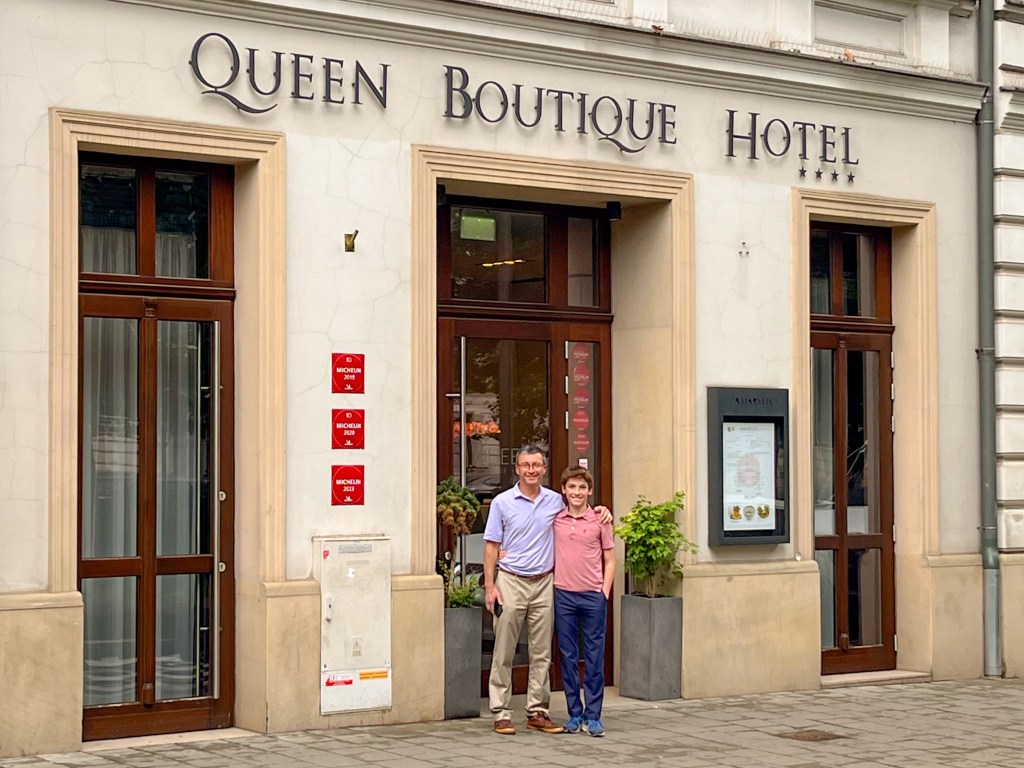






 My Plan C