My Revolutionary March to Princeton

Watching Ken Burns’ ‘The American Revolution’ brought back memories of my 15-mile historical reenactment walk eight years ago. There’s nothing like being there to appreciate the sacrifices our forefathers made for our country.

The plan was to walk with a Revolutionary War re-enactment group from Trenton to Princeton to reenact the famous Battle of Princeton. What that actually meant to a crazy group of long distance walkers remained to be seen.

Battle Briefing
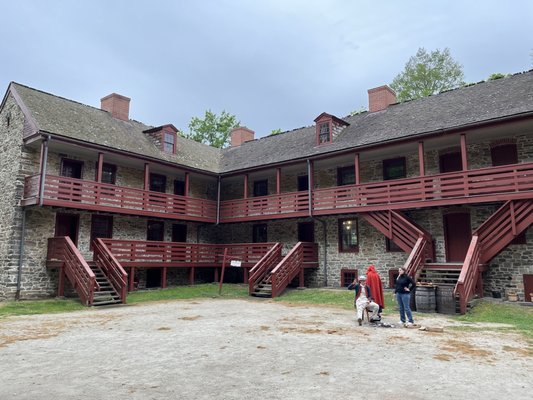
As we approached the Old Barracks of Trenton there was an eerie silence. The old wooden two story building was wrapped in a fort-like fence barely lit by faint street lights in the middle of a post-industrial city. There was no trace of life, let alone preparations for a battle.

Our rag-tag group of six FreeWalkers were here as volunteers to experience what it might have been like to be part of a crucial Revolutionary War battle by following reenactors in an event labeled “To Princeton with Peale!.” To be accurate these were Charles Wilson Peale’s Company of Philadelphia Associators who would march through the night to surprise the British at the Battle of Princeton.

We were experienced long distance walkers but not battle tested, as they were. We were used to marching long distances and even cold temperatures. Our march on Princeton event provided new challenges for both pedestrian civilians and enacting soldiers.

The Battle of Princeton was a crucial event in turning the tide against the British and surprising Cornwallis’s troops. Only days before, Washington had held off the British at Trenton and captured a Hessian garrison after crossing the Delaware.

Now, bolstered by their current successes and desperate for victory, Washington planned a surprise, nightime offensive attack on the British. They needed to somehow quietly march the troops 15 miles around the British flank with a surprise attack on Princeton. Reenactors and observers like us would re-create what it was like to be there and be part of it.

Getting Ready for Battle

loredana-march-princeton-8
The general informs us the troops are still sleeping

Our first problem appeared at the stroke of midnight when we were set to start. We learned the troops were actually still sleeping in the barracks and would start this year at 1:00 a.m.! Where would the Continentals go if they had to wait an hour? “To a pub!” someone replied. As we started walking away, a faint bar light of the Smoke House (aka 1911BBQ) on Front Street appeared. Naturally, we took shelter in preparation of the upcoming battle walk.

Developing a Battle Plan at the Smoke House Bar.
At the Smoke House … waiting.

After about an hour at the Smoke House, we were primed for some kind of battle as we spilled out of toward our Continental troops mustering outside the barracks. Orders were given. We were headed to Princeton. Soon we headed down the old streets of Trenton following the troops. There was a positive energy in the air, in spite of the hour, five inches of snow and bitterly cold temperatures.

It’s Time to March

Getting Serious
Peale’s Philadelphia Associators at attention and ready to move out

This was our first experience interacting with reenactors. Reenactors take their roles seriously. We managed to chat briefly with couple soldiers but most kept quiet on the march or talked quietly – just as it was ordered by Washington. We learned that historical reenactments are more than just dressing up and marching to this event. There is a sincere attempt to mirror history as best they can.

Beautiful Trenton Street
Quietly marching through the streets of Trenton at 1:30 a.m.

In 1777, history recorded that the temperatures were probably in the 20s and snow had fallen a week before. It had thawed and refroze leaving a crusty snow to walk on. That was an important fact in deciding to attack, as too much mud or deep snow would have made a successful attack impossible. This day we had to face the cold temperature and five fresh inches, enhancing the experience. Our conditions, at least for weather, were worse this year of 2017 than 1777.

We continued past the old colonial homes and townhouses of Trenton into the Chambersburg section. Then continued on a broad Hamilton Avenue into Mercerville, Hamilton and eventually turned on Quaker Bridge Road toward Princeton. This was a roundabout route around Cornwallis’s troops. Now, these are well-travelled commercial roads.

As we walked in the middle of the quiet night in these suburbs the only sign of life was a single Wawa convenience store where we could take shelter for a 15-minute break. The troops were not so lucky. They kept going, presumably because convenience stores are a post-revolution concept.

Our objective was finally reached about 6 a.m. when we approached the Thomas Clarke House on the Princeton Battlefield. This was where the soldiers would come together for the battle reenactment. The only problem with this was that we still had a couple hours before the reenactment began. There was one campfire and one house for all to share and the temperature was said to be in the single digits.

midnightmarchprinceton-46

Our history lesson organized by the Princeton Battlefield Society started at 6:45 a.m. It was fascinating and helped put the actual event in perspective. The British Army historian William P. Tatum III, Ph.D. told the story of the battle.

Our History Lesson

We all recognize Washington’s crossing of the Delaware which occurred on December 26, 1776 where he attacked the Hessian troops in the Battle of Trenton. With that success he moved into Trenton and held back the British who attacked him at the Battle of Assunpink Creek on January 2, 1777. Then, in a surprise move, Washington’s troops led by General Mercer continued marching that night toward Princeton to capture the British garrison before heading to Morristown for winter quarters.

deathofmercer
Trumbull’s Death of General Mercer

Mercer was mortally wounded. Reinforcements under General Cadwalader turned back after seeing Mercer under fire (Peale’s unit was under Cadwalder). But, eventually Washington sent troops who overcame the British and took over Nassau Hall, a strategic British garrison. The victory helped drive the British out of New Jersey and helped turn the tide of the war. It gave new confidence to the Colonials and helped enlist more soldiers.

loredana-march-princeton-73


On the battlefield where we watched, soldiers fire cannon at costumed British troops on the snow covered fields, amazed at the difficulties of war. Moving heavy cannon in the snow, wadding bullets and gunpowder, meanwhile being shot at in the open. If nothing else this had to be a nerve-wracking experience for both sides. Then, if you consider that most of these men had just been through several major battles in recent days, were lacking sleep and were at the end of their supplies, the effort and outcome seems all the more amazing.

British Fire Back

Taking Solace in Victory

The combination of bitter cold, warmth of a fire, shelter in historical homes and the presence of colonial soldiers had created a new, yet old, reality show. After this long 10-hour bitter cold night, learning first-hand about war in the 18th century, and building close bonds with fellow troops – we had enough.

Just as Washington headed to his headquarters in Morristown after the battle, I too headed for my Morristown home.

War is hell, and a tough slog, especially in the winter.

For one sleepless night, we became immersed in history and energized by the spirit of 1776. Huzzah!

Reference Note:

Much of the above article was first published for FreeWalkers in 2017 under FreeWalkers March to Princeton under a separate blog Distant Thoughts,
Witnessing Auschwitz

Our family of three generations of Polish-Americans tour Auschwitz-Birkenau in search of its history and cautionary message. Can anything so brutal ever happen again?

We decided to add a visit to the Memorial and Museum Auschwitz-Birkenau as a final point of interest on our genealogical trip to Poland. It was about an hour and a half cab ride north of Krakow. As you can imagine, touring a concentration camp is not a pleasant task, but it was an important one for a trip themed around life and death.

All of our sources suggested purchasing tour tickets well in advance, as it is an “important” tourist destination. Much of the concentration camp area is free and open to the public. However, the museum offers reasonably priced small group tours in various languages, including English. The professional guide leads about 30 ticket holders throughout Auschwitz and the neighboring Birkenau camp, providing the necessary historical background in a roughly 90-minute tour.

There were busloads of visitors this Sunday (June 16) starting at the new visitors’ center, which seemed well-equipped and organized to handle large daily crowds in the thousands. The visitors’ center, a year-old, mostly concrete structure, is sparsely designed but well-thought-out as a waiting area to keep visitors moving. There seemed to be a bit of irony as we followed our somber guide, almost blindly, in military order to Auschwitz and then by bus to Birkenau. The place naturally has that kind of aura.

We visited a handful of the many buildings in a progression that seemed to heighten the senses to the scale of this horrific place. We started with an understanding of the scale of this project, which began in 1939 when the Nazis annexed the town of Oswiecim to create an industrial base with a work camp at Auschwitz, a former WWI Polish barracks. The success in exploiting and then murdering prisoners led to a huge expansion at nearby Birkenau and other smaller camps in the area. The camps held over 1.5 million prisoners, 1.1 million of whom were murdered. In just a few years, the Nazis had learned how to efficiently kill and plunder Jews (largest number by far), Poles, Russians, Gypsies, and others from all over Europe.

The tour, buildings, and grounds are preserved much as they would have been back then. Auschwitz does not look particularly threatening from the outside of the buildings until you learn what happened on the inside. The museum tour continues quickly through several buildings, each with a specific focus such as medical experimentation, extermination, proof of crime, interrogation, punishment, and cremation.

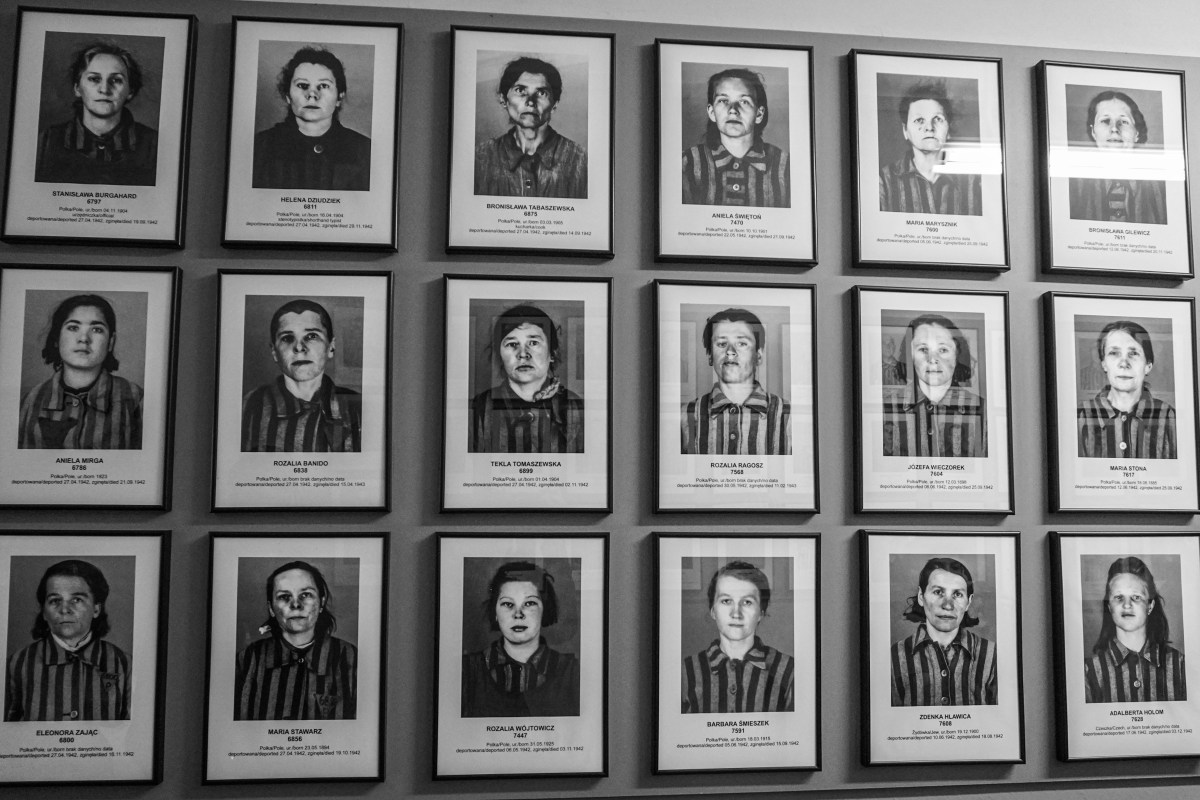
All this is explained and examined through the many glass-enclosed statements and artifacts. Surprisingly, the photos on display do not show the ravaged bodies of the starved and tortured, but rather pensive and scared individuals waiting for the worst to come. This is not a multimedia experience. We see and hear only the story, but by being in the actual place, we can more easily imagine what happened. Imagination here can be more powerful than simulation.

The final third of the tour was a short bus trip to Birkenau after touring Auschwitz. I was surprised by the larger scale of the Birkenau camp. Its 365 acres are wide open except for a dozen or so buildings and the ever-present electrified barbed wire fence. There is a dominant headquarters building and guardhouse with train tracks running right through it. The tracks and train end about a half-mile into the camp, where thousands of prisoners would end their final journey.

Auschwitz remains important as a reminder to all of us of man’s ability to do wrong, especially to each other. One can only imagine how anyone could be so cruel, although there is plenty of reason today to think that it could happen again. On the other hand, we know that people can change too. Germany and Japan today are positive examples. It’s worth a visit to Auschwitz at least once in your life to give that some serious consideration.

For this particular visit I chose to create one slide show video with pics we took while on the tour with the theme from Shindler’s List playing in the backgroud. While we were all lost for words, the pictures are memorable and speak much louder than words.

Slideshow Video of Photos taken at Tour of Auschwitz-Birkenau

A Butterfly on a Bike

On August 18, 2021 all rides and adventures stopped for Iohan Gueorguiev. But his legend and spirit lives on in his videos and our fond memory of him.

Listen to this story on Spotify including Iohan discussing his thoughts and goals.

While browsing the New York Times’ website in August of 2021 I came across a link to an article that immediately caught my attention. The link read, “Iohan Gueorguiev, ‘Bike Wanderer’ of the Wilderness, Dies at 33.” It was probably the combination of his odd name, his given title and the fact that he lived a short life that drove me to find out more.

In his short life, and in particular his last seven years, he rode over 60,000 miles, rode in 19 countries, climbed mountains, paddled rivers and experienced all sorts of discomfort, pain and pleasure along the way. Fortunately for us, he documented much of his accomplishments in a collection of over 70 YouTube videos which have had over 7 million views. His “See the World” YouTube channel was basically the travelogue of his adventures. Iohan was chasing a dream of biking from Canada’s Arctic Circle to the tip of Argentina. He almost made it.

Iohan’s YouTube Channel “See the World”

Iohan was not unique in the adventure sport of bikepacking. But through his videos you would find that there was no one quite like him. He consistently held a positive and humble attitude as he would bravely move forward through snow, ice, wind, rain, heat, rough terrain and the highest mountains. His videos are evidence that he saw himself not as a super hero, but as a witness to a world we never see. Through him, we could vicariously conquer the harshest conditions, see the beauty on those backroads and meet the real local people (and animals) along the way.

During his last two years, Covid restrictions and logistics got in the way. But, at the end, it was the physical condition of obstructive sleep apnea which led to insomnia and then depression causing him to give up his dream and his life. His abrupt final end seemed like the ultimate paradox to a life that always found a way to overcome all obstacles.

Riding Into the Rabbit Hole

With my own experience cycling and touring on a bike, I was especially intrigued about his crazy adventures and the effect he had on others. I began pouring over one video to the next for months until I had followed his seven- year journey . From the beginning, he chose not to be the ultra-prepared, technical sportsman but to rely on on basic knowledge, a positive attitude, his intuition, friendly spirit and his ability to improvise in a McGiver-ish way. He became the “everyman adventurer” I so admired. 

With no detailed plan he set out to experience the world, not to conquer it. Each trip over the years he would gain knowledge of bikes, tires, roads, weather, sponsors, photography, travel, native languages and native people. Starting with a basic GoPro camera and simple mountain bike in the Yukon he films the icy frontier and finishes his travelogue on a fat bike taking stunning drone videos of the high mountain desert of Patagonia and some of the highest peaks in the world. 

The videos are not about him but about what he sees. Iohan shot and edited all the video while laying down a beautiful sound-track for each of them. They are a pleasure to watch, listen to and dream about.

The popularity of his videos and comments about his death seemed outsized for what he accomplished. Many, including me, felt like we had met him, or at least understood him. His many experiences with people and animals, especially dogs, are in those videos as evidence of a kind and caring person you could not help but admire. 

The Butterfly Effect

There is a popular notion in chaos theory that some very small action can cause something great to happen called the “butterfly effect.” A story often told is that the flapping of a butterfly’s wings may eventually cause a change in the weather. I would like to think that Iohan is that butterfly for thousands of us.

His many followers vicariously lived an adventure by meeting him or experiencing his videos. I know that the hours of video I watched changed my impression of bike touring, the natural world beyond and the people we never get to meet, but wish we could – from the top of North America to bottom of South America.

I have no doubt that some of Iohan’s fans will embark on similar journeys, share friendships with others and take joy in the natural world around us because of Iohan and the work and experiences he left behind. The fluttering I hear is the sound of a bike pedal.

More sources

Heart of Gold Revisited

A great concert for the ages. Neil Young at the Ryman Auditorium.

We’re taking a slight “detour” here from my Reunion Tour bike trip blogging to comment on and recommend a movie that brought home some of my personal feelings as of late. It’s one of the best concert movies I have ever seen.

Striking Gold

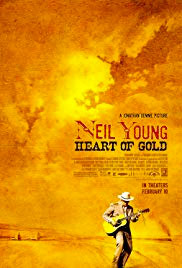
undefinedOccasionally, out of the blue, something appears as a selection on one of my 60+ streaming TV channels that really, really is worth watching. That happened last night when I selected from Kanopy the 2006 Neil Young: Heart of Gold documentary directed by Jonathan Demme. Its themes, music and point in Neil’s life tie right into my 13-day, 500+mile bike tour I completed last week. The message sent to me was clear – others pass this way too.

This is the thoughtful and everyman Neil Young performing songs for the first time from his Prairie Wind album which was critically acclaimed and nominated for 2 Grammys. It was a different turn toward an Americana sound somewhat like country, bluegrass and folk ballads. It reminded me of the music I heard in Vermont that just tell simple stories well. I loved the album at the time but had totally forgotten about it. This is the same Neil Young who once sang, “It’s better to burn out than fade away.”

You’re Never too Young

Young wrote most of the songs after his father’s death a few months before. At the time, he was diagnosed with a treatable brain aneurysm. Yet, he opened a tour of the album at the famed 2,600-seat Ryman Auditorium in Nashville, the shrine and home of the original Grand Ole Opry. At the time he was all too aware of the fragility of life.

The songs are about growing up in Alberta, his father, his daughter, his god, and even his guitar. It’s a beautiful positive ode to the basic important things in life. While I’m not a country music fan, the emotional connection that a good country song brings is in this music, in spades.

Young is reverent to all the places, old times and everyone he has known. The heartfelt lyrics and sound are true and played to perfection with great musicians, including Emmy Lou Harris and with artistic and minimalist filming. Neil never looked more like the musical genius he is than in this work.

If you’ve read other posts on my blog myplanc.blog, you know its about getting older and in appreciating and discovering joy in everyday things. This documentary did just that for me and helped me bask a bit longer in the good vibes I got from visiting some old friends – and having the unforgettable opportunity to reminisce about good old times.

One of These Days – one of my favorite songs on Prairie Wind in harmony with my Reunion Tour.