A Protester in Training: How Activism Became My New Form of Fitness

After decades of staying quiet, I stepped into the streets. What I discovered surprised me: protesting isn’t just a political act—it’s a personal practice that builds resilience, awareness, and a sense of belonging.

After joining six protests over the past two months, the experience finally started to feel familiar. I began to understand what it was all about. There’s a reason, a rhythm, and even a reward to protesting that I hadn’t grasped before. Still, something instinctual pushed me into it—more impulse than logic.

Protesting doesn’t come naturally. In everyday life, when things are relatively calm, most of us try not to rock the boat. We avoid confrontation, sidestep discomfort. We’re taught to “suck it up” and “don’t be a complainer.” After all, there’s always someone worse off, right? And then there’s the risk—stirring the pot can bring consequences, especially from those who’d rather you simply “behave.” At my age—77—I could easily ask, who needs the trouble?

But what do you do when logic, reason, and normality seem to vanish? Do you just complain? Do you tune out? Seek comfort from friends? That’s where protesting comes in—not just as a solution, but as a kind of therapy.

Fifty years ago, before fitness was even trendy, I took up running as a personal challenge. Back then, adult recreational running was unusual. But as marathons and Olympic athletes captured public attention, the idea caught on. We began to believe that even the average person could strive for something great—even if the race was personal.

Running took a leap of faith. It demanded hard physical work, but promised positive results—mental clarity, health, confidence. It was lonely at first, with little guidance and few role models. But it became a habit. And eventually, the world caught up. Running went from fringe to mainstream.

Now, since January 20th, I’ve taken up a new “sport”: protesting. Frustrated with the state of the nation and the new administration, I turned to activism not just as civic duty—but for my own mental fitness. And like running, protesting requires practice, resilience, and a belief that effort matters.

First, it takes mental toughness to shake off apathy. You need to believe that one person can make a difference—especially when standing with others. And yes, there’s a kind of performance involved. Maybe you’re just holding a sign in silence. Maybe you’re shouting chants or singing satirical songs about a congressman or the president. It can feel awkward or corny at times. But it can also feel exactly right—like you’re doing what needs to be done. Like you’re part of something larger, and your voice is finally being heard.

So, I’ve come to believe we must train ourselves—just like athletes—to overcome political passivity. With every new day of shock and awe, we grow stronger, more aware, more ready to push back. Protesting may not fix everything, but it sends a clear message: we will not sit quietly and watch democracy fade.

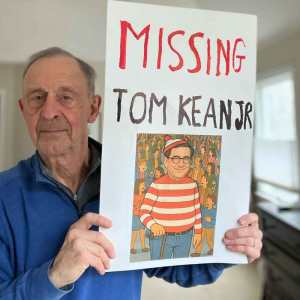
Poster for a Missing Tom Kean, Jr, who is notorious for not mneeting with his constiutents.

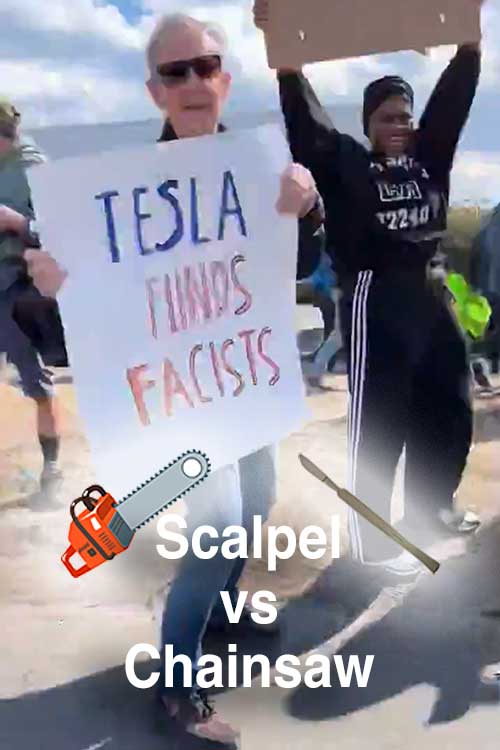
Scalpel vs Chainsaw

A chainsaw cuts through the trunk but roots remain. Protests are like a thousand surgical cuts, exacting a slow painful death for Tesla.

It was my second protest.

Our target was a newly born corporate giant – Tesla, Inc.

It had the potential to grow into mighty beneficial force only to turn lately into a funding source for a fascist. 

Tesla is a corporation led by a charismatic leader who promised a new world of consumer choice with environmental benefits, a cool modern design and a refreshingly new use of energy; only to use his influence and money he earned from his venture to tear down our democracy.

Fortunately, then unfortunately, Tesla grew up to become the step-child of Elon Musk who is a larger-than-life leader responsible for building a good intentioned company; only to become a pawn in his egotistical fantasy and global politics.

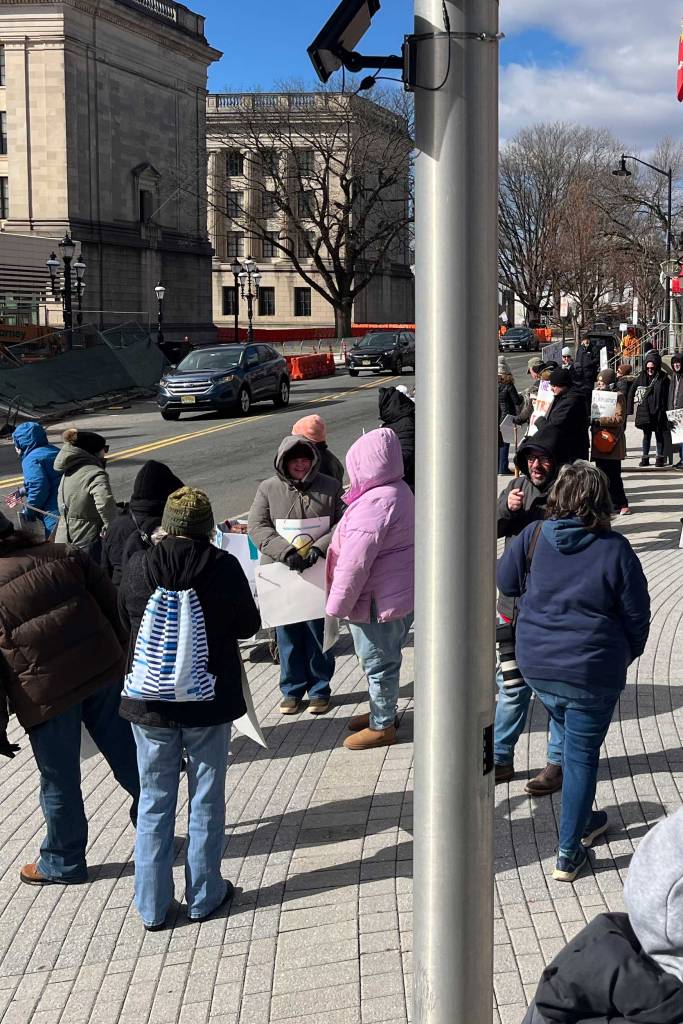
About a week ago, I protested in Trenton at the state capitol building as a general protest of the policies and executive orders of Trump and Musk. I considered that protest a warm-up and learning experience for a rookie. Being a quiet President’s Day in the city, it became apparent that we (about 500) were mostly preaching to the choir. You can’t help but ask yourself at the scene, “Who knows we we are here with our message?” With little traffic and little press coverage, I left there thinking it was worth the effort but it could have been much more. Confessions of a Reluctant Protester.

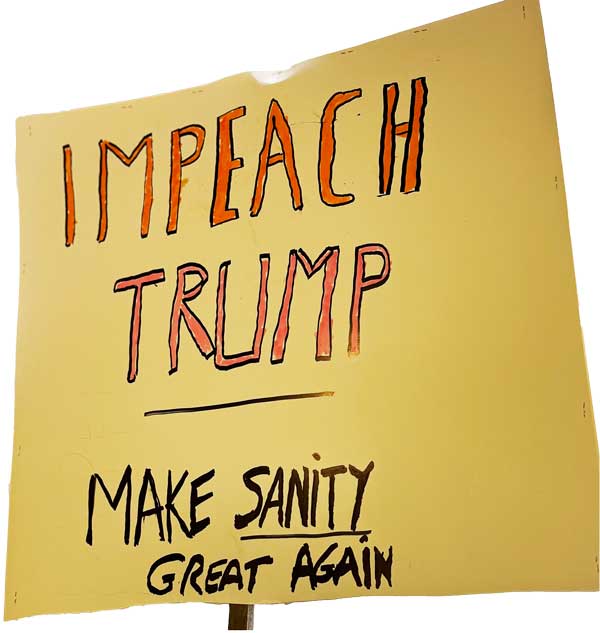
Paul with protest sign
Paul’s sign for Tesla protest

But today, Saturday, March 1, 2025, promised to be a more targeted effort. A Tesla Takedown. We were after Elon Musk’s primary source of wealth and income by loudly demonstrating in front of a Tesla showroom on Route 22, Springfield NJ – a notoriously busy commercial highway. It happens that Tesla vehicles can only be bought online. But, they are typically picked up and serviced at the few regional showrooms. Since, there are no dealerships, any effect that can be made at a showroom is directly on the company and not any independent dealer.

Outside Staples in Springfield ready to protest across the street

I heard of the hastily planned protest by SOMA Action thru posts on Facebook Group Lean On Us and registered for the event. Our group (estimated at 220) met across the street near a Staples, ready with signs and some general guidelines – Don’t block the showroom, don’t interact if there are counter-protesters and always safety-first. Luckily, there was plenty of parking nearby and a grassy shoulder right in front of the Tesla showroom facing Route 22.

The weather was cold and windy but the traffic was constant and moving slowly as they saw an impressive protesting crowd yelling loudly and waving signs they could not miss. Our enthusiastic group of all ages yelled to chants such as “Hey, hey, ho, ho, Elon Musk has got to go!” As cars were going by at 20 mph, horns were blaring in support. Even more strangely, many passengers (and even some drivers) were video-recording the protest on their smartphones as they passed by. It seemed mostly positive support, in spite of the fact that we were causing a major slowdown! 

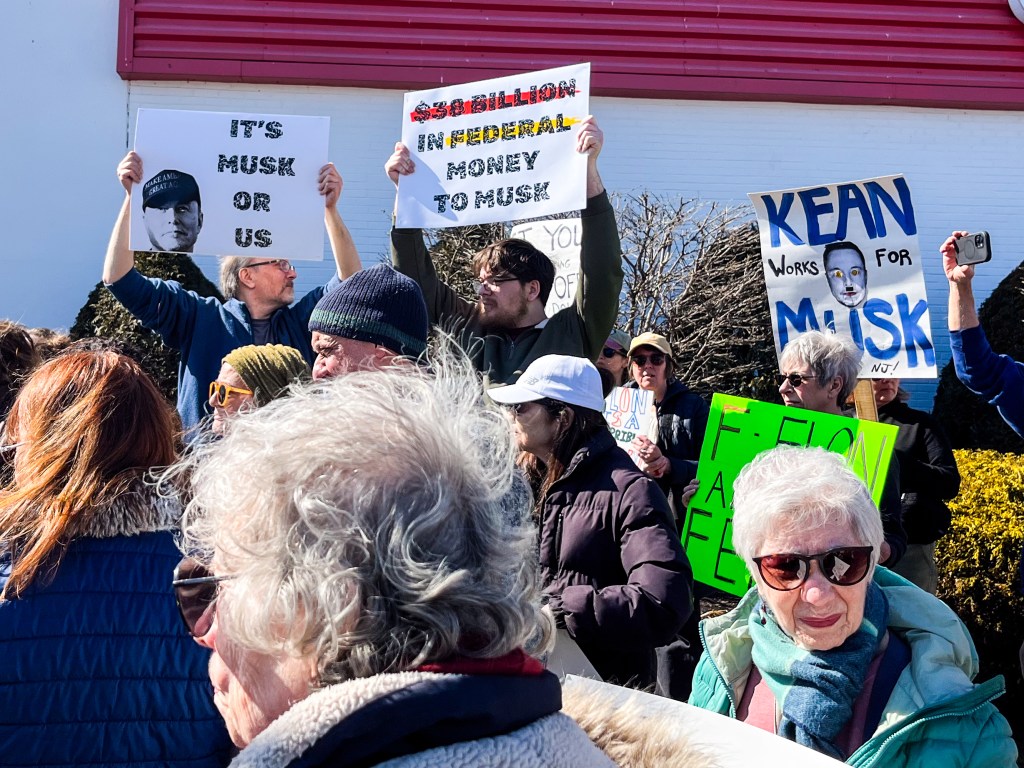
Protesting in front of Tesla showroom in Springfield NJ

A steady stream of traffic, including local police and Tesla owners drove by from noon to 1:30. I felt tired yet relieved. We all came away with the feeling that this was an effective protest having been seen and heard by several hundred, if not thousands, in a very short time. 

I know if I owned a Tesla, whether or not I believed in what Musk-Trump was doing, I might think hard about conveying a negative feeling. Does the car now represent a political point of view? Has the brand and value of my Tesla been trashed? Being able to generate those feelings is a victory, however small, for democracy by my account. 

If Musk-Trump can “chainsaw” government services at the elevated organization level by cutting thousands of jobs at once, maybe enough motivated individuals can surgically cut into organizations like Tesla with a “scalpel” using various forms of protests that destroy the brand and negatively affect sales over time.

Tesla’s role as a pioneer in electric vehicles is over. Today, there are plenty of companies that can offer a better product without the dirty laundry. We can put capitalism to work if we all get out our scalpels and carve Tesla into a pariah. A slow death for Tesla, by a thousand cuts, would be sweet justice and a fitting contrast to a chainsaw massacre. 

More Thomas Paine words of wisdom in troubled times….

Confessions of a Reluctant Protester

What can the average person do to fight back? It’s never too early or too late to get involved. Take back our country before it’s too late.

It didn’t have to be this way.
I’m a reluctant protester and I’m pissed off.

I have been enjoying an active, yet complacent retirement for the last eight years. At least that was the case until Trump clawed his way back to running our nation. Four days from today I’ll turn 77 years old. I’m at a time in my life where one usually mellows and winds down activities and ambitions. But, if Trump, at 78, can find the energy to ruin a country, then maybe I should at least try to help build it back. But how?

I’m still trying to understand what happened in just a few short weeks. What will happen tomorrow? And, how can anything be the same once the dust settles? I bemoan those who have lost their government jobs and noble ideals that they upheld. Collateral business, friendships and relationships may be permanently frayed. It will take a lot of effort to someday reconstruct a government and a community that are in basic harmony again.

I have to ask myself, “Is it me?” Why do those I care about not seem as troubled about the repercussions of what is happening? The news is filled with so many new catastrophes each day. It’s all shocking and numbing, yet still feels distant right now. Most of us have yet to see the effect these changes will have to employment, health, safety and peace – to name a few likely bad outcomes. And, for what?

Protest – “Not My President”

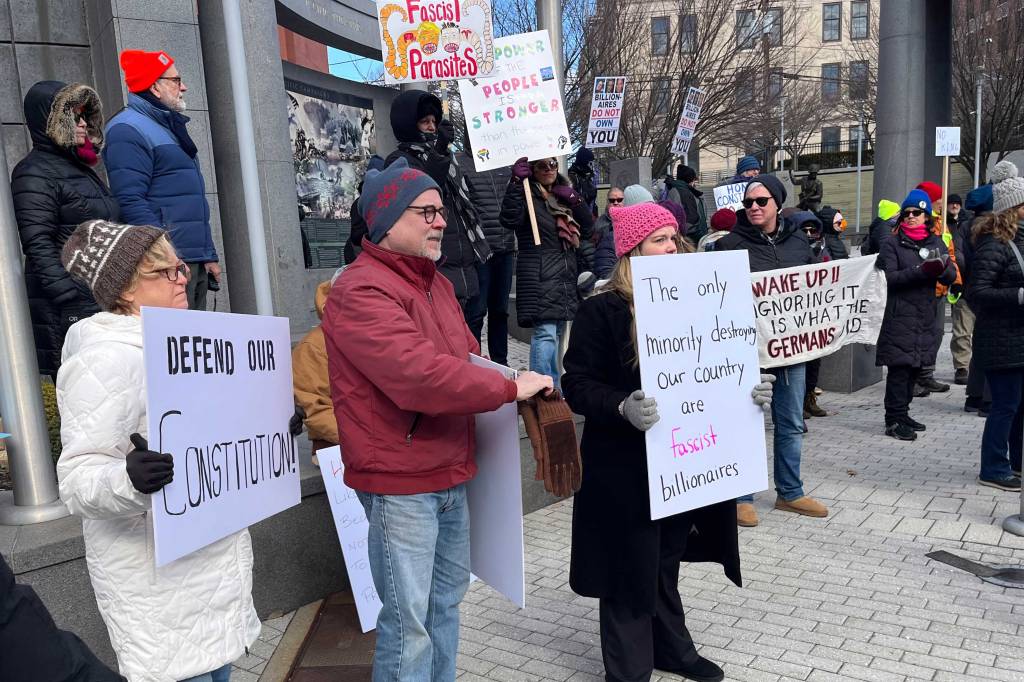
Last Monday I gathered for a protest at the New Jersey state capitol building in Trenton for a few hours, venting my frustrations and meeting others who had similar feelings. I had gotten a tip from my friend Bob who had posted some of his frustrations with the current state of affairs. He created a private Facebook group Lean On Us which linked to a national public site 50501 which listed a “Not My President Day” event. It seemed like the perfect celebration for this President’s Day. Understand, at this point most of us are just becoming active and have no idea how this works and what to expect.

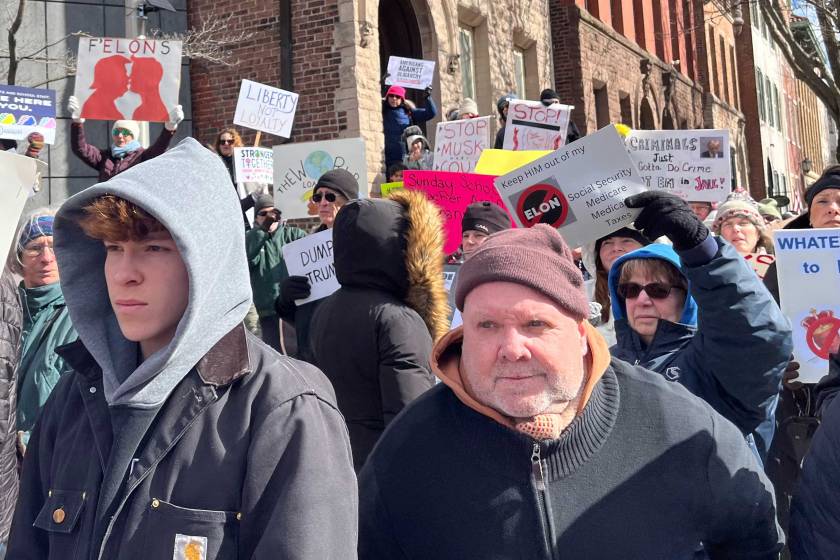
I got there early and then watched as a handful of us became a large crowd of about 500 or more. Apparently, our small group was just one of many small organic groups of citizens that had become frustrated enough to get out in 20 degree weather with 20 mph winds to protest what Trump-Musk is doing to destroy our government. There were no speakers but plenty of motivated, energetic and loud people with great rebellious signs wanting to take back what we already lost and to stop the bleeding.

The size of the crowd, chants and the waiving and beeping of cars was the only indication that we are on the right track. There was little press coverage, although similar protests were happening across the country at many state capital buildings.

I would not call protesting fun but it is rewarding. A least it feels like I’m actively doing something. Ultimately, you want your effort to pay off and have some effect, even it’s just to let others know that they are not alone. My dream is that everyone finds a way to express their anger and their will; enough to change what seems to be an inevitable train wreck.

If you feel frustrated too, find a way to get active. It's a new rebellion. Protesting, phone calls, writing letters, talking to others will help you cope as it did for me. 

Remember what Thomas Paine wrote in the American Crisis..."These are the times that try men's souls."

Haunted by Images: Review of “The Rest is Memory” by Lily Tuck

The dreams and nightmares of a 14 yr old Auschwitz prisoner is part of what has been haunting me. Ghosts are all around and are trying to warn us.

Visiting Auschwitz was a profoundly emotional, yet strangely analytical experience. Your senses and mind struggle to comprehend the unimaginable atrocities that unfolded there.

Since that visit, I’ve often felt haunted by echoes of what I witnessed. Evidence of this haunting continues to surface.

Shortly after our trip to Poland, I watched A Real Pain, a film about two Jewish cousins, David (Jesse Eisenberg) and Benji (Kieran Culkin), on a Polish heritage tour. While the film is mostly a comedy, their visit to the Majdanek concentration camp bore an unsettling resemblance to my own experience.

Not long after, The Zone of Interest was released. The film focuses on Auschwitz commandant Rudolf Höss and his wife Hedwig, who live a comfortable family life just beyond the fence of the concentration camp. In their home, domestic routines play out against the distant backdrop of prison sounds and the ever-present specter of death.

More recently, I read a review of Lily Tuck’s book in the New York Times. The book, inspired by a single photograph of a 14-year-old girl, imagines the life of an inmate before and during the Holocaust. That led to my expanded interest in the holocaust.

Then came Holocaust Remembrance Day, marking the 80th anniversary of Auschwitz’s liberation. Media coverage was filled with stories from the few remaining survivors, all children during that horrific time. Their voices served as reminders that the past still lingers.


My Goodreads Book Review: The Rest is Memory

It was less than a year ago, on a heritage tour of Poland, that I had an opportunity to visit the Auschwitz-Birkenau Museum. That visit was still fresh in my mind. So, when I learned of Lily Tuck’s new book The Rest is Memory,” a portrayal of a young prisoner, I immediately dove into the book to see if it could provide a perspective of what it was like as a teenager to experience this manufactured hell.

Visiting Auschwitz is an otherworldly experience. The tour is an extremely efficient, almost military process, led by knowledgeable docents who lead you through various buildings and exhibits. The guide touches on who was imprisoned there, how they were treated and the unfathomable amount of death and destruction that occurred. The fact that over a million prisoners died in this one camp, the great majority between just 1942 and 1944, is hard to comprehend.

To see my personal remembrance of the tour click here.

There is a special quiet and solemn feeling shared by all throughout the tour. Occasionally, you would hear someone in the tour breakdown in tears. But, most of us were absorbed in trying to comprehend what happened and how we could reconcile that with our understanding of humanity. Our tour guide explained in simple, cold terms the operation of the camp and how a prisoner might live and die here. The grounds and exhibits were obvious evidence of the holocaust.

Seeing prisoner ID portrait photos on a wall was my most vivid memory. They personalized life in a concentration camp. No photo could even begin to tell the story of what a person went through, although they looked like they knew what was ahead. However, there were some survivors, including the camp photographer, Willhelm Brasse, who managed to save 40,000 photos along with his memories.

The Rest is Memory is a story of the star-crossed life of Czeslawa Kowka, a 14-year old female prisoner, who’s camp portrait became an obsession for Tuck as she imagined what it must have been like for her. It is told in a style that recalls my Auschwitz tour guide’s careful, factual and unemotional telling. The language is sparse and almost banal. There’s no need here for elaboration or exaggeration when imagination based on facts is a more powerful agent.

Czeslawa’s personal story is necessarily made up by Tuck. Czeslawa was tattooed as prisoner number 26947 and immediately lost her identity when she arrived in Auschwitz in 1942. There is little trace of her real life, except for a few basic facts like birth date (August 15, 1928), internment date (December 13, 1942) and death (March 12, 1943). Tuck appears to have looked back at her hometown area and constructed a possible tale of a normal life before the Nazi invasion. Its a life of a pre-war ordinary teenager with a romantic interest in Anton, an older guy with a motorcycle. She’s close with her mother Katarzyna, friends, community and church (she is Polish Catholic). Although she has an abusive, distant father, she has an enjoyable life and a promising future, maybe even as a teacher. All this will be violently taken from her within a couple of years.

Tuck seems just as committed to telling the horrific story of how the Polish people were completely controlled and abused. The Nazis declared war on Poland in September 1939 and in twenty-six days gained full control of the entire country. Hitler declared “The destruction of Poland is our primary task.” Germany needed “Lebensraum” (living space) for its survival and expansion. Most of the populations of Central and Eastern Europe would have to be removed permanently through mass deportation, extermination, or enslavement. The country of Poland was to be resettled with Germans.

Czeslawa lived in the small town of Wólka Złojecka outside of the historic eastern city of Zamosc. This area would be among the first to be repopulated in 1941. Over 110,000 would eventually move. She and her mother were forced off their farm with other women and eventually sent to Auschwitz to do forced labor. We learn her father (Pawel), uncle and other farmers in her village are shot and buried in a mass grave. Her would-be boyfriend Anton escapes on his motorcycle only to be beaten, imprisoned and die in Russia. Even though Russia fought Germany, it also had its designs on Polish territory and inflicted its own cruelty on the Poles. There appeared to be no escape for the Poles.

The book alternates timelines: from a broad historical view, to the innocent mind of a young girl before all this happens and then to the mundane sadness of a prisoner of which there is no hope. Although we don’t dwell on the suffering it seems to be everywhere. If you juxtapose that with the privileged life of the SS guards and their Commandant Rudolph Höss, it becomes hard to imagine a crueler place.

Pleasant and unpleasant memories are all that are left for Czeslawa. Occasionally, there are flashes of what might have been. Dreams of food, friends, wizards, dragons and even dogs are all warped by the environment where scarcity is everywhere and hope is nowhere to be found.

The book weighing in at 112 pages is a blessedly short read. My normal reading self would have craved for more details. But, I think in this case, Tuck sets the limit on what we need to know. For me, reading The Rest is Memory was like re-visiting Auschwitz. It is not a pleasant experience but a re-awakening of my senses and imagination. Unfortunately, we see many of the same cruel signs of those times around us today. Its always worth considering what are the limits of humanity and acknowledge that if it happened once, it can happen again.

A Review – When Harry Met Pablo

An interesting and obscure story of how cultural change in art and politics clashed and came together – at least briefly and symbolically – when Truman meets Picasso.

The following is my Goodreads review of an interesting historical period of change in the art world and in politics during the Cold War period. Truman, who was responsible for using the Atom bomb to end the war and in the act destroyed thousands of lives, meets Picasso who was a staunch pacifist and communist supporter. Truman sees “modern art” as “ham and eggs art” but recognizes Picasso’s talent and fame. Both are at the twilight of their careers.

Through a brief history of how modern art began to flourish and how politics was woven into art, Algeo provides and entertaining look at how the times changed art, politics and maybe even personal attitudes.

PK

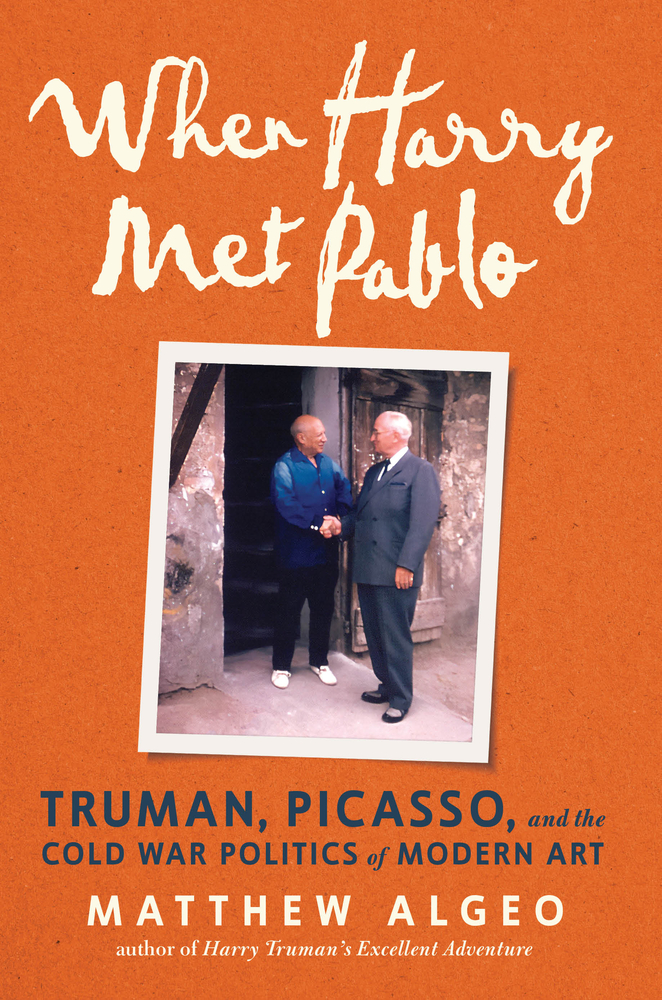
When Harry Met Pablo: Truman, Picasso, and the Cold War Politics of Modern Art by Matthew Algeo

 My rating: 4 of 5 stars

In the great tug of war of existential beliefs, there’s always a point and counterpoint. But, it’s a universal law that everything changes with the passing of time. Maybe we soften or maybe we learn to live with opposing points of view. This is a story of how contradictory lives and beliefs co-exist and come together, at least briefly, in odd and unexpected ways.

A photo of Picasso shaking hands with Truman seemed to have been the perfect set piece for Algeo’s travel back in time to explore a hopeful period where stark contractions co-existed. It was clear. There was a good, bad and ugly. But, in the post World War II era everything was re-aligning in art, music and politics.

Their 1958 meeting occurred during the cold war after one of the most violent and consequential periods known to man. Truman, a popular democratic everyman, used his might to win a war by unrepentantly authorizing the killing of millions to justify the end. Picasso, on the other hand, was a famous recluse artist who promoted peace and was an unrepentant communist. They were polar opposites in almost every way. If a photo is worth a thousand words this one was worth a thousand questions,

When Harry Meets Pablo provides an intriguing history of how the definition of art was changing in the mid 1900’s. The first half of the book paints a picture of how America was reacting to the awakening of a new form of “modern art” exemplified by Picasso and other European artists. The book discusses how the new art form was received and nurtured by creating such institutions as MoMA. Special gallery events and even a traveling show were promoted to allow the public to experience the new form of art. Even the government promoted a cultural awakening to art through the Advancing American Art program.

At the time of the “red scare”, a relatively unknown, but deeply conservative, Republican Michigan congressman named George A. Dondero played an outsized role in stopping government art programs, much as was played out in the McCarthy hearings at the time. He declared modern art an infiltration of communism and blacklisted many artists as communist sympathizers – even though communist dictators like Stalin would have nothing to do with it.

Slowly, in America, the existing convention of realistic art gave way to an acceptance of the modern style by the middle of the century. But not everyone agreed that this was “art”. Truman, for one, often called it “ham and eggs” art disparaging the skill and impact it had. He was not alone. But at least Harry appreciated the difference of opinion and fought for an artist’s freedom of expression.

The second half of the book offers a unique look at a world attempting to regain its post-war balance. After his presidency, Truman planned to slip away to his Missouri home from Washington on a public train and once again lead a normal civilian life. Harry soon learned that the public was still interested in his life and thoughts. He was chased down by fans and the press everywhere he went.

Sam Rosenman, an ex-judge and close advisor to Franklin Roosevelt helped create the New Deal strategy. He was to continue to become a “consiglieri” to Harry while he was president. He and his wife Dorothy became close personal friends with Harry and Bess. Sam’s law partner Ralph Colin, a well-known collector of modern art and trustee at MoMA, educated Sam on the new modern style. Soon, Rosenman and Truman were two friends with at least one contrary point of view – “What is art”?

Truman asked Rosenman and his wife Dorothy to join him and Bess on a European vacation in mid-1958. The cross-Atlantic voyage by ship would take them to ports in Italy and eventually Cannes in France. Coincidentally, Picasso’s home was in Vallauris, in the hills above Cannes

A plot for a meeting was apparently hatched clandestinely by Alfred Barr, founder and chief executive of MoMA who had helped Picasso gain recognition in America and wanted to promote modern art. Truman a family man of modest means was to meet Picasso, a rich and famous womanizer at Picasso’s home. No doubt Sam Rosenman also had a hand in arranging the meeting. But how was that to be done when the two men, in the twilight of their careers, seemed to have nothing in common except their age?

Here’s where the story becomes hazy as Picasso, famously a recluse, graciously agrees to meet with Truman at his Villa La Californie for the day. The Truman’s and Rosenman’s spend most of the day together with Picasso graciously showing them around his studio and nearby town famous for his pottery. There is no real reporting of what transpired between them but photos seem to reveal a cordial if not enjoyable visit. We see photos and speculate what that day might have been. The rest is up to our imagination.

The meeting made a small story buried in the news, as other world events stole the limelight. We don’t know if the meeting made an impact on anyone. Perhaps it just was a courteous and friendly call or maybe a sign that time had soften the difference between different points of view. Not knowing the details, leaves the reader with unanswered questions of what might have happened when opposites come together.

View all my reviews

Click below for Matt Algeo’s entertaining November 2022 book presentation at the Harry S. Truman library via CSPAN.

A Review – The Flag, the Cross and the Station Wagon

A thought provoking argument on how a 50-year timeline of trends and events have taken us to where we are today and what senior activism can do to change it.

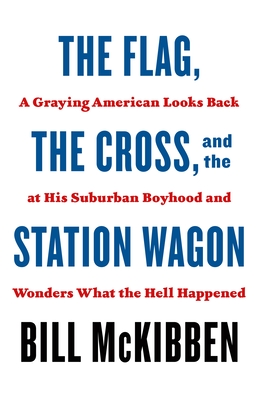
The Flag, the Cross, and the Station Wagon: A Graying American Looks Back at His Suburban Boyhood and Wonders What the Hell Happened
by Bill McKibben

Paul Kiczek‘s Goodreads review
Feb 08, 2023  
5 stars

Bill McKibben, the renown environmental activist, has written a very easy to read and thought provoking book that attempts to explain how a 50-year timeline of trends and events have taken us to where we are today. It seems our lives are an unwitting product of many avenues of “progress” from politics to religion to technology. The changes we have experienced have been shaped by a “hyper” drive toward individualism, capitalism and new forms of communicating.

At age 75, I have even lived through a decade more change than Bill. I have learned to accept most of it. Employed at one time in the tech sector I once cheered on innovation, automation and efficiency. But, I’ll be damned if I can figure out why things have turned so negative, unreasonable and intractable. Tribalism permeates more and more of our lives every day. Surely, the amount and frequency of change has been a major factor. This book calls on us to stop and try to understand the injustice that exists from these changes.

The fact that McKibben is from the Lexington, MA area helps draw a clear comparison and contrast to today’s politics. Revolutionary America was largely an aspirational community of individuals that depended on each other and shared core beliefs. Today, we are not even sure what to aspire to other than wealth. And, foundational religious beliefs have withered in the face of individualism or have been diluted by the proliferation of religious sects. Frankly, a community based on shared higher ideals seems difficult to imagine these days.

The problem with technology has been an inability to see or predict the negative effect of its progress. Whether an unanticipated end product is pollution, inequality or a social breakdown, we don’t seem to know how to fix it without destroying the comfortable lives we built upon it. We are programmed to be transactional. There may be talk of reparations but what we really want is our money’s worth. We hesitate to take responsibility for previous generation’s mistakes while we minimize our cost and distress.

Can we change our way of thinking? Will we be better able to evaluate the long term and negative side of the latest technology or untethered capitalism. It seems like there’s no better time to give pause to what we are doing than right now, especially with the oncoming age of AI.

McKibben recently started an organization for people over 60, like me, called Third Act which is directed toward activism about big issues such as the environment. It seems many of us are out there wondering what went wrong too and how we might help. It’s a great idea since we have more free time and are probably healthier and wealthier than past seniors.

I recently joined Third Act and hope that I can play a role in helping solve problems that had seemed beyond the “old” me. Issues that seemed impossible to change might seem Quixotic but may be just what we are looking for. I still want the world to be a better place for my wife, three children and eight grandchildren and I want them to know I’m not too old to do something about that.