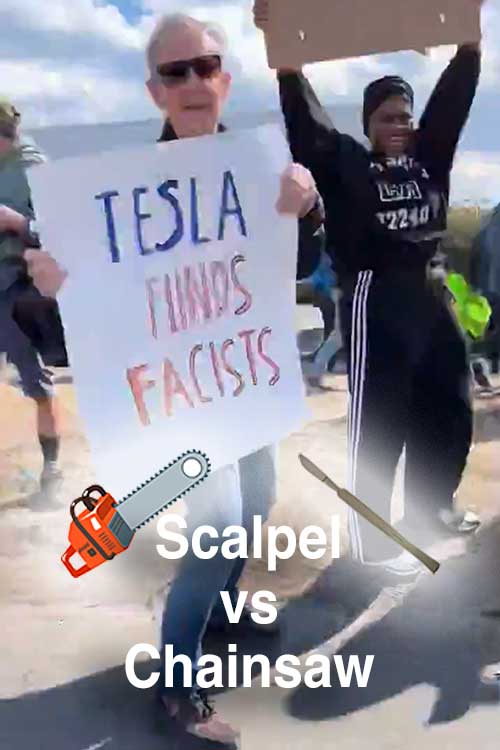
Scalpel vs Chainsaw

A chainsaw cuts through the trunk but roots remain. Protests are like a thousand surgical cuts, exacting a slow painful death for Tesla.

It was my second protest.

Our target was a newly born corporate giant – Tesla, Inc.

It had the potential to grow into mighty beneficial force only to turn lately into a funding source for a fascist. 

Tesla is a corporation led by a charismatic leader who promised a new world of consumer choice with environmental benefits, a cool modern design and a refreshingly new use of energy; only to use his influence and money he earned from his venture to tear down our democracy.

Fortunately, then unfortunately, Tesla grew up to become the step-child of Elon Musk who is a larger-than-life leader responsible for building a good intentioned company; only to become a pawn in his egotistical fantasy and global politics.

About a week ago, I protested in Trenton at the state capitol building as a general protest of the policies and executive orders of Trump and Musk. I considered that protest a warm-up and learning experience for a rookie. Being a quiet President’s Day in the city, it became apparent that we (about 500) were mostly preaching to the choir. You can’t help but ask yourself at the scene, “Who knows we we are here with our message?” With little traffic and little press coverage, I left there thinking it was worth the effort but it could have been much more. Confessions of a Reluctant Protester.

Paul with protest sign
Paul’s sign for Tesla protest

But today, Saturday, March 1, 2025, promised to be a more targeted effort. A Tesla Takedown. We were after Elon Musk’s primary source of wealth and income by loudly demonstrating in front of a Tesla showroom on Route 22, Springfield NJ – a notoriously busy commercial highway. It happens that Tesla vehicles can only be bought online. But, they are typically picked up and serviced at the few regional showrooms. Since, there are no dealerships, any effect that can be made at a showroom is directly on the company and not any independent dealer.

Outside Staples in Springfield ready to protest across the street

I heard of the hastily planned protest by SOMA Action thru posts on Facebook Group Lean On Us and registered for the event. Our group (estimated at 220) met across the street near a Staples, ready with signs and some general guidelines – Don’t block the showroom, don’t interact if there are counter-protesters and always safety-first. Luckily, there was plenty of parking nearby and a grassy shoulder right in front of the Tesla showroom facing Route 22.
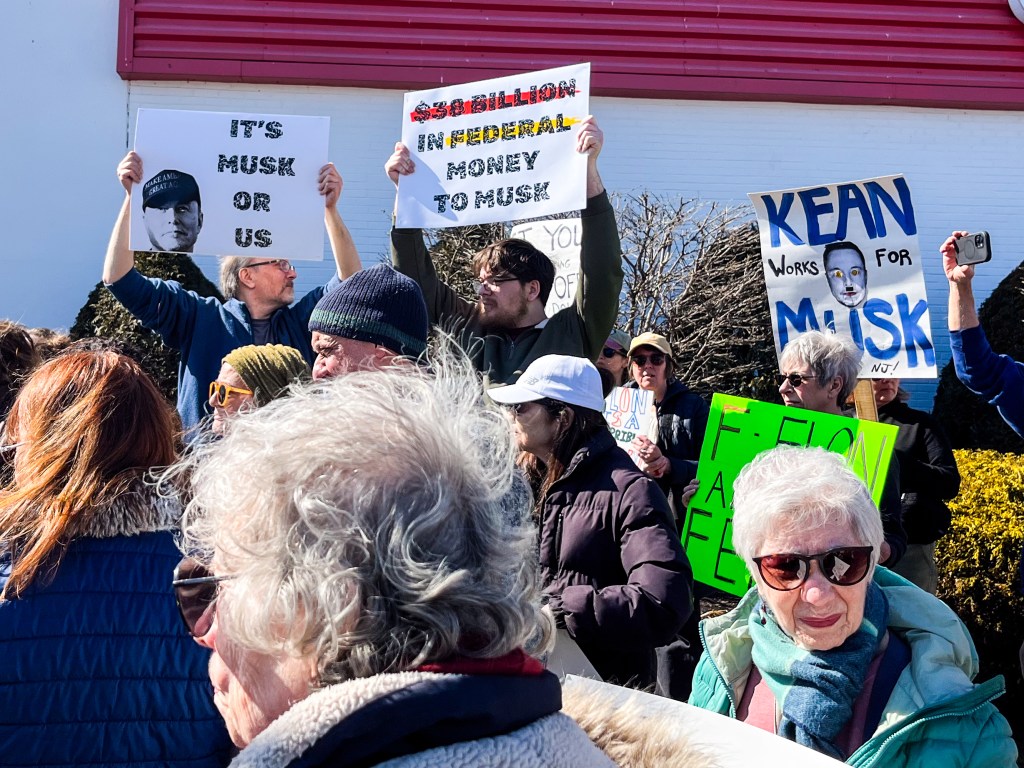
The weather was cold and windy but the traffic was constant and moving slowly as they saw an impressive protesting crowd yelling loudly and waving signs they could not miss. Our enthusiastic group of all ages yelled to chants such as “Hey, hey, ho, ho, Elon Musk has got to go!” As cars were going by at 20 mph, horns were blaring in support. Even more strangely, many passengers (and even some drivers) were video-recording the protest on their smartphones as they passed by. It seemed mostly positive support, in spite of the fact that we were causing a major slowdown! 

Protesting in front of Tesla showroom in Springfield NJ

A steady stream of traffic, including local police and Tesla owners drove by from noon to 1:30. I felt tired yet relieved. We all came away with the feeling that this was an effective protest having been seen and heard by several hundred, if not thousands, in a very short time. 

I know if I owned a Tesla, whether or not I believed in what Musk-Trump was doing, I might think hard about conveying a negative feeling. Does the car now represent a political point of view? Has the brand and value of my Tesla been trashed? Being able to generate those feelings is a victory, however small, for democracy by my account. 

If Musk-Trump can “chainsaw” government services at the elevated organization level by cutting thousands of jobs at once, maybe enough motivated individuals can surgically cut into organizations like Tesla with a “scalpel” using various forms of protests that destroy the brand and negatively affect sales over time.

Tesla’s role as a pioneer in electric vehicles is over. Today, there are plenty of companies that can offer a better product without the dirty laundry. We can put capitalism to work if we all get out our scalpels and carve Tesla into a pariah. A slow death for Tesla, by a thousand cuts, would be sweet justice and a fitting contrast to a chainsaw massacre. 

More Thomas Paine words of wisdom in troubled times….
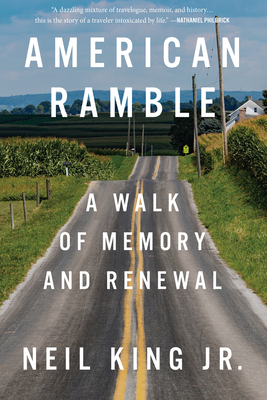
Review of American Ramble: by Neil King, Jr.

A great book on a 2021 solo walk from Washington DC to NYC. King unearth’s the past with the present in his personal journey.

The following is a review of a 2023 book by Neil King, Jr, about his very personal solo walk from Washington DC to New York City in 2021. My son Justin gifted it to me after hearing Neil discussing it at a local talk. Thanks Justin!

It was a book that I related to very personally. I’ve done many long walks in past years and lately have changed most of my serious personal journeys to long bike rides.

But I have to admit the feel of pushing one’s self, even as I get older, is still alluring to me. And, the absolutely free feeling of being solo on a journey is an experience I will never forget. I love being back home with my family but I also love the wanderlust of being on the road.

-Paul

Neil King Jr. confronts aging, a personal battle with cancer, and the broader struggles of COVID-19 and political upheaval. In the midst of these challenges, he embarks on a long walk as an antidote to depression. This walk becomes a deeply focused endeavor, channeling his energy into researching, planning, and executing a journey through history to better understand the present state of the country.

King’s unique journey is more about the creation and leveraging of a personal challenge than the physical feat of walking 330 miles in 26 days. Though the route may appear to be a ramble (a walk for pleasure, typically without a definite goal), it is anything but aimless. King meticulously plans his route and accommodations, choosing interesting and often off-beat places with unique ties to America’s past. Equipped with a simple backpack, he immerses himself in the journey.

His walk from Washington, D.C., to New York City becomes a tapestry of American history, reminding us of Native Americans, revolutionary patriots, immigrants, slavery, and more recent events like 9/11 and the January 6th insurrection. The country has changed significantly, yet remnants of the past remain, often hidden in plain sight. King’s research brings these historical elements to life, allowing for a deeper understanding of our present.

However, King’s book is more than a historical sketch; it captures moments of interaction with the environment and people, making it special. It’s about contemplating how others live, recognizing our similarities and differences, and discovering more about oneself.

Back in 2010, I had a similar experience as I turned 60. While I did not face a health issue, I sought a deeper reflection on my life’s journey. Inspired by JFK’s fitness challenge (50-Mile Hike), I decided to walk 50 miles in one day, following the East Coast Greenway from Metropark in Edison, NJ, to New York City. This path, then a new concept in “pedestrianism,” connected communities for walkers, runners, and cyclists.

The newspapers picked up the story, and to my surprise, over 50 fellow walkers joined me. This overwhelming experience led to the founding of FreeWalkers, a group dedicated to long-distance walking. Today, http://Freewalkers.org has inspired thousands to experience places differently—city to country, historical to new, monuments to industrial waste, in all types of weather. Meeting fellow walkers and people along the way is as natural as walking itself and is a major reason walking has gained popularity. Some prefer the solitary walk King fondly describes, while others enjoy the group experience.

King encapsulates the essence of his journey: “My walk was, in reality, its own explanation. You embark on a long solitary stroll in part so as not to explain it. You go to cast aside distractions. You go for the fun of it, the promise of pure serendipity, and simply because you can….Possum ergo facio – I can, therefore I will.”


I applaud King for writing a book that describes the fascinating patchwork of people and places awaiting anyone who takes up the challenge of walking more than they think they can. His journey helps us appreciate the world around us, both past and present.

The above review was also published on Goodreads.com here.

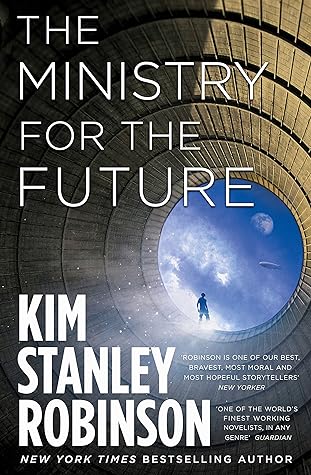
A Review – The Ministry for the Future

A review of a 2021 sci-fi book of how we confront a huge world-wide crisis, globally join forces to avert environmental disaster and create a new future for the planet. Is it wishful thinking?

The following is my Goodreads review of a 2021 sci-fi book that may be fiction but optimistically expands on current technology, some new scientific ideas and a global willingness to confront our environmental disaster. Where most science fiction stories paint a grim picture of the future, this one is a story of how we beat the odds and created a wiser and more humane world.

While much of Robinson’s works have described the far away future, this book contemplates a horrific disaster only years away that is the catalyst for finally changing the way we treat our environment on a global scale. Totally impossible to believe on its timescale and scope of change, it nevertheless provides some hopeful consolation that a bright future may still be possible for our planet.

PK

The Ministry for the Future
 by Kim Stanley Robinson

 My rating: 3 of 5 stars


I’m generally not a sci-fi reader unless a book is strongly recommended or I hear it contains some interesting new ideas. The author KSR is obviously well known for his thinking and writing about the future by extrapolating present ideas or emerging technologies. I learned about this book while following Molly Wood’s “Everybody In the Pool” newsletter and podcast on environmental tech. There really is a growth of invention and investment in that sector – affirming a reality that there is capital and interest in solving our doomsday environment conundrum.

While this book has a weak storyline, it grabs the reader at the beginning with Frank living through the horrors of “The Great Indian Heat Wave” an event that kills millions within a single week. It shocks the entire world into finally becoming aware that the environmental problems need to be addressed. What seems to be implausible is that India becomes the model for solving these issues and the rest of the world seems willing to actually act together in solving it on a global scale. The Ministry of the Future become the catalyst for laying out big plans and our protagonist, Mary, is the cool director of the Ministry that can save the planet.

KSR asks us to believe that countries just a few years into the future will be willing to see past the politics and change their nationalistic attitudes for the good of the planet. Even China is seen as an enlightened, wise collaborator. This collaborative approach causes the planet to see benefits quickly with innovative solutions and within one lifetime.

Like most who read this book, I really enjoyed the innovative solutions that KSR presents like a carbon capture coin investment strategy (similar to bitcoin), pumping up trapped water from the polar icecaps, swarm drones, wide use of airships and the birth of a new beneficial social network. There’s even a mind-bending thought of using sanctioned positive terrorism on the bad environmental actors. His material is best with creative new ideas that have some basis in fact today. If only they were that simple to evolve.

After the initial few exciting chapters, the book shifts back and forth between different points of view and how the evolution of the Ministry creates the bureaucratic plan. The environment improves quickly. The storyline seems lost but observations on possible new solutions are worth the read. The Ministry has helped create a world that works together living peacefully on the same planet.


View all my reviews

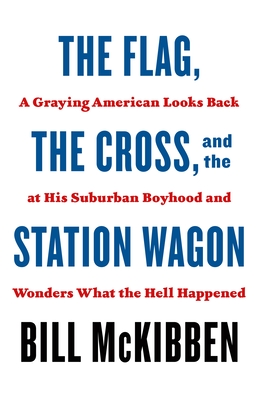
A Review – The Flag, the Cross and the Station Wagon

A thought provoking argument on how a 50-year timeline of trends and events have taken us to where we are today and what senior activism can do to change it.

The Flag, the Cross, and the Station Wagon: A Graying American Looks Back at His Suburban Boyhood and Wonders What the Hell Happened
by Bill McKibben

Paul Kiczek‘s Goodreads review
Feb 08, 2023  
5 stars

Bill McKibben, the renown environmental activist, has written a very easy to read and thought provoking book that attempts to explain how a 50-year timeline of trends and events have taken us to where we are today. It seems our lives are an unwitting product of many avenues of “progress” from politics to religion to technology. The changes we have experienced have been shaped by a “hyper” drive toward individualism, capitalism and new forms of communicating.

At age 75, I have even lived through a decade more change than Bill. I have learned to accept most of it. Employed at one time in the tech sector I once cheered on innovation, automation and efficiency. But, I’ll be damned if I can figure out why things have turned so negative, unreasonable and intractable. Tribalism permeates more and more of our lives every day. Surely, the amount and frequency of change has been a major factor. This book calls on us to stop and try to understand the injustice that exists from these changes.

The fact that McKibben is from the Lexington, MA area helps draw a clear comparison and contrast to today’s politics. Revolutionary America was largely an aspirational community of individuals that depended on each other and shared core beliefs. Today, we are not even sure what to aspire to other than wealth. And, foundational religious beliefs have withered in the face of individualism or have been diluted by the proliferation of religious sects. Frankly, a community based on shared higher ideals seems difficult to imagine these days.

The problem with technology has been an inability to see or predict the negative effect of its progress. Whether an unanticipated end product is pollution, inequality or a social breakdown, we don’t seem to know how to fix it without destroying the comfortable lives we built upon it. We are programmed to be transactional. There may be talk of reparations but what we really want is our money’s worth. We hesitate to take responsibility for previous generation’s mistakes while we minimize our cost and distress.

Can we change our way of thinking? Will we be better able to evaluate the long term and negative side of the latest technology or untethered capitalism. It seems like there’s no better time to give pause to what we are doing than right now, especially with the oncoming age of AI.

McKibben recently started an organization for people over 60, like me, called Third Act which is directed toward activism about big issues such as the environment. It seems many of us are out there wondering what went wrong too and how we might help. It’s a great idea since we have more free time and are probably healthier and wealthier than past seniors.

I recently joined Third Act and hope that I can play a role in helping solve problems that had seemed beyond the “old” me. Issues that seemed impossible to change might seem Quixotic but may be just what we are looking for. I still want the world to be a better place for my wife, three children and eight grandchildren and I want them to know I’m not too old to do something about that.