Searching for the Kennedy Spirit

Ten years ago (April 2014) we were privileged to walk 50 miles in The Netherlands at the oldest continuous one-day Kennedy 50-Mile walk in the world. Imagine 7,000 people all walking and enjoying a communal effort inspired by JFK. We were wowed by the experience and the hospitality of the Dutch.

The following essay first appeared on the Freewalkers.org website about ten years ago (April 2014). It is a slightly edited version describing my unique opportunity to walk in the Netherlands with 7,000 others in this well-established annual event – The Kennedy-Mars Sittard – on the 50th anniversary of the famous “50-Mile Hike.”

The Freewalkers.org walking organization was built upon the spirit of that challenge in 1963 presented by President John F. Kennedy. He challenged Americans to walk 50-miles for their physical fitness and to demonstrate the strength of our nation. Little did he realize that others around the world would also take up that unlikely challenge – and continue the legend – even to today. The Kennedy-Mars Sittard recently celebrated the 60th anniversary of this popular community event!

Paul Kiczek

The Journey (April 2014)

Traveling nearly 4,000 miles for a walk may seem like a long way to go for something that can be done anywhere. But the walks we have been doing as FreeWalkers are more than the walk itself. Mostly, they are about personal challenge and the power of community – things that John F. Kennedy stood for. Far away in Sittard, Netherlands we found a community that continues to honor his lasting legacy each year with a challenging event.
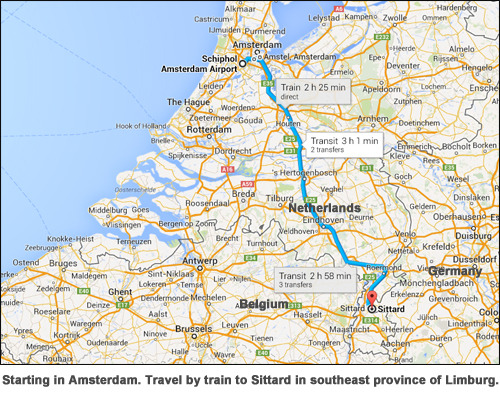
We took advantage of a unique opportunity to visit Holland and a participate in a great community challenge called the Kennedy-Mars Sittard, a 50-mile (80K) walk (aka, “march”) that took place on Saturday, April 19, 2014. Thanks to FreeWalker Ray Smith and event director Ad van der Loo we not only got to participate, but would be guests of several generous Dutch families.

If you are familiar with our FreeWalker events, you know our events tend to be similar long distance walks. In the five years we have been offering events, rarely do we draw over 100 participants. In this age of charity walks and marathons, that’s a fairly small number, but even those events started small when they began.

What we knew of the “Kennedymars Sittard” was that it was the oldest and largest 50-mile walk of its kind that originated with the JFK 50-Mile Hike phenomenon and continues to this day. The idea for a 50-mile hike originated with our President, John F. Kennedy, in 1963 as a challenge to his military to demonstrate their fitness. Part of the reason for issuing the challenge was to support his program on physical fitness and also to show that our troops were ready for action during the “Cold War” – two topics that are still seem particularly relevant today. 

Almost immediately, the public took up his military challenge, led by his brother, Attorney General, Robert F. Kennedy who demonstrated it could be done within days of the order. Soon, personal attempts were made throughout the country, and even globally, in such places as the Netherlands, England, and Ireland – even in some of the farther reaches of the old colonial empires. 

There was no plan or preparation behind this, just the spontaneous energy of a challenge, almost a dare, coming from a leader that the world respected. Some were motivated to test their limits and share that experience with others. But, why has this tradition continued for over 50 years after his tragic death? We were on a mission to find out.

The Kennedy-Mars Tradition is Born

In the spring of that year, four teenagers in Sittard decided to launch their own walk based on Kennedy’s words. Without diving deep into the history and motivation of the Dutch for walking, there seems to be tradition to walk, and certainly to bike. Remarkably, that’s still in stark evidence today.

Everywhere you go places and streets are designed for the pedestrian on two feet and the cyclist on two wheels. It is second nature to the entire nation. At least in this one place, cars and pedestrians seem to have found a way to co-exist comfortably together. It is said that the Dutch have an ability to differ in opinion yet settle and arrive at solutions that they can all can live with. It’s a mutual respect for each other.
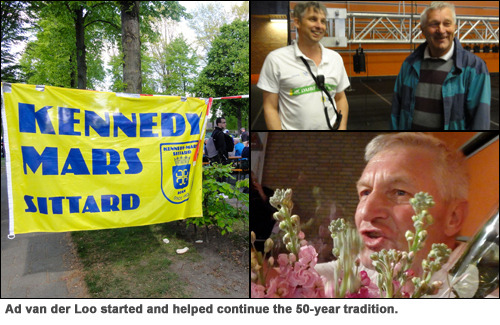
Ad van der Loo, was one of the four teens that started the walk in 1963 and soon took responsibility for organizing the annual event that takes place each year on the Saturday before Easter. Ad had walked the event several times but put his energy into managing the expanding event for the past 43 years, instead of walking it. This year, he was turning control over to a new generation – but not before walking one more time.

Ad had honored us last year by allowing FreeWalker Ray Smith to say a few inspirational words at their 50th Anniversary.. Ray had been stationed in Germany for many years and had participated in the event before.) Ray took back an invitation for other FreeWalkers to come to Sittard and experience their unique event. This event seemed to set the gold standard for what FreeWalker events could become. 
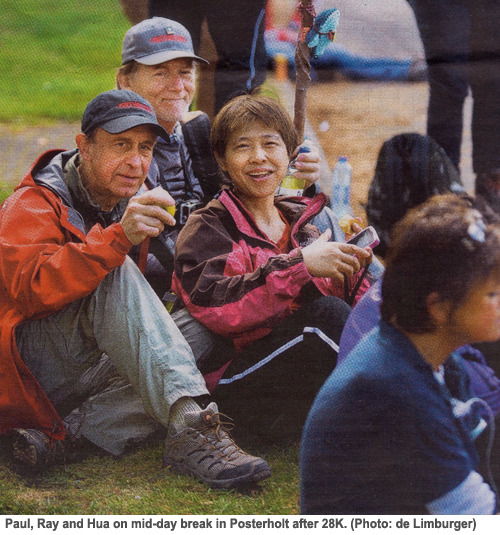
So, with barely a plan we American FreeWalkers – Ray Smith, Hua Davis and I – decided on our own to head to the Netherlands. One thing that should be said about the country is that although their language is Dutch, nearly everyone speaks English. So, even a short stay there was easy. As far as we knew, we were the only Americans participating in the event this year. It is probably 95% a local/regional event. It was a unique opportunity for us and I think an honor for Ad Van der Loo and the Kennedy-Mars Sittard organization to know that we had ventured this far to participate.

Getting Settled in Sittard

On Thursday, Ray and I arrived together by train in Sittard, having met in Amsterdam that morning. We were met by our hosts, the Hermans (my host family) and de Beurs (Ray’s hosts). We pre-registered for the event and went off to our homes for dinner and a good night’s sleep. Hua’s plan was to fly in on Friday, stay just one night with her host family and take off on a train immediately after completing the 50 mile walk. That was an aggressive plan that most would not try. But if you knew Hua, you would not be surprised nor doubtful that she could do it.
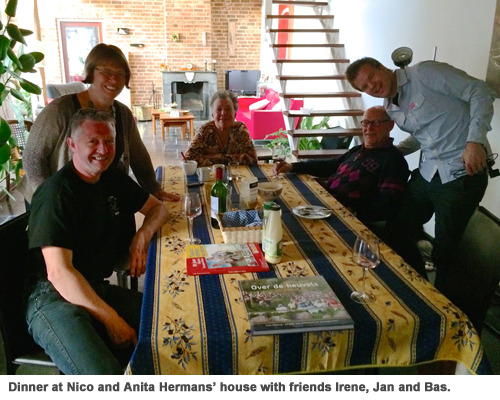
My stay with the Hermans family is worth detailing. I will write more about that great experience in another post. It made the trip at least twice as entertaining and rewarding for me. I know that Ray and Hua felt similarly about their experience and we thank those families for their generosity and time which we all cherished.

Pre-Event Day

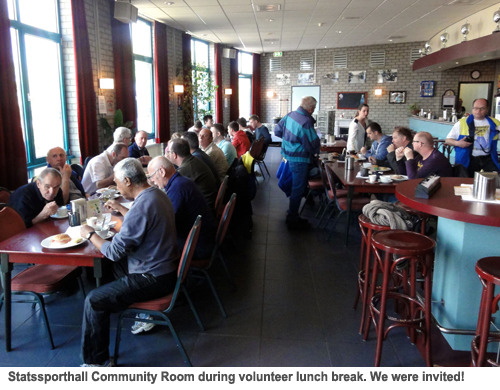
We met Hua Friday afternoon at the train station and headed to see the Statssportshall (large indoor sports hall/gym), where preparations were being made for the event with Ad Van der Loo. Having been the director of the event for so many years, Ad invited us to join him and his volunteers in a light lunch. Ad’s dedication to the event earned him the devotion of every worker there.
At the de Beurs place, we were interviewed by a reporter for the regional newspaper, de Limburger. It was a lengthy interview that signaled to me that they were sincerely interested in the motivation of three Americans coming this far for their regional event. Inevitably, the conversation came to the differences between Americans and the Dutch.

I think they see Americans as creative and impatient and often chasing the wrong goals but they admire us for our positive thinking and ability to take action. The Dutch give more weight to creating a fair society and certainly one that encourages physical activity in a natural way. I think the question that remained is could we tell our story about the Kennedy Sittard and change American attitudes? What if we could get President Obama to march 50 miles? Could that rejuvenate an interest in long distance walking in America? Could we build a bridge to the Netherlands? 

Ray, Hua and I borrowed bikes and went out on our own to see the area around Sittard. It was an interesting first-hand experience to see how the roads and traffic signals accommodated bikes and pedestrians. Bike paths and dedicated signals were everywhere. We were back before dinner and each of us went off to our respective host’s home to get an early night’s sleep, as we were due to meet at the start of the event at 4:30 a.m. at the Sportshall.

It’s Time to March

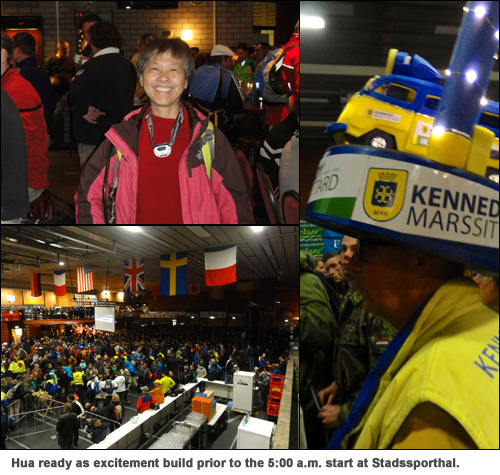
After an early breakfast at my host’s home, Nico drove me to the Sportshall. Before long the hall was packed, bands began to play and announcements were made in Dutch. All we needed to do was follow the crowd. Ray, Hua and I decided to walk together for a while but had no particular strategy. At 5:00 a sea of thousands of people began moving out of the hall and stringing out in the dark along the streets of Sittard. Within an hour we were heading outside of the town into the countryside.
The route for the walk is a loop with 90% in the Netherlands and 10% in Belgium. This year the walk avoided Germany due to security concerns. It is essentially a counterclockwise route heading toward the countryside near Germany and ending through Belgium before returning to Sittard.

As in our FreeWalker events, some groups charge ahead in hopes of finishing at a fast time. This event does have an option for a competitive timed class. Many others, like us, plod along at our normal average of about 3 mph speed. All must walk and running is not allowed.

We were walking somewhere in the middle of the starting 80K group of 2,818 participants. Another 1,758 registered for 40K were scheduled to leave later and 2,871 for a 10K even later in the day. The total was estimated to be about 6,947 participants! 80% crossed the finish line!

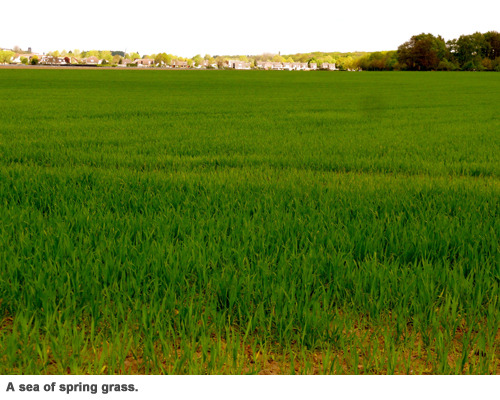
We walked in the dark until sunrise as we left Sittard and headed to open farmland areas. At this time of the year, the ground had been freshly tilled or small vegetables were sprouting up. What is striking is the size and view of the fertile areas. Since the Netherlands was largely built on land reclaimed from the sea, nearly the entire area we walked was flat consisting of dark sandy soil. This makes farmlands appear as vast as an ocean, broken only by a canal, a road or a line of trees here and there. This unique landscape generates an abundance of food for the country and much of Europe.

The skies were constantly changing over the day. At this time of the year, the weather can be unpredicatable. It is just as likely to rain as not. For most of the day, the puffy clouds passed over us with patches of sun shining through and temperatures from the 40s(F) to low 60s. Perfect weather for walking anywhere.
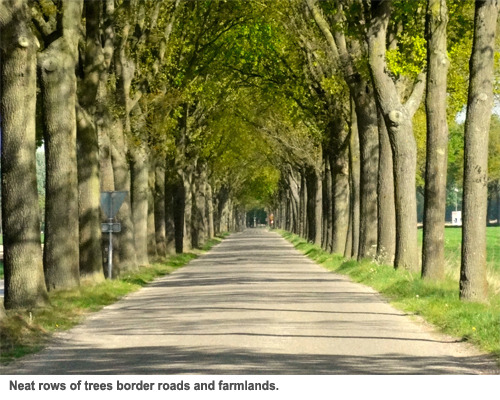
And, what a day for a walk it would be. The vast farmlands seemed never-ending. Much as in the U.S., many farmers have sold their smaller farms to larger companies and moved into the towns. It’s a new generation favoring a different lifestyle.
Towns we pass through seem to be small and quiet residential communities. Houses are clean, orderly and of modest simple design. Care is taken to keep plants trim and neat with a tendency to prune older plants like topiary in a way I have never seen before.

While the Dutch are said to be somewhat private, I found that they were very friendly and open. A woman I met was walking with her husband and another couple for their 23rd Kennedymars. She said, “We started by thinking ‘Why not?’. Now, it’s like a disease. We just can’t stop.”

Then, there was the incredible walking waiter. He was dressed in a tuxedo and held a serving ray with a full glass of beer and an Easter egg. Why is he doing this? He started with a dare and a bet. That was 18 years ago. Today, he still enjoys the challenge each year and the obvious attention and conversations he draws.

A van with big speakers followed us and played pop music to liven the walk, which made me feel at home. We also we walked by many traditional um-pah bands. That, gave us the feeling that we were somewhere special.

Breaks on a long walk are spaced here between 7 to 15 miles. Bathrooms along the way were not easy to find. But, everyone seemed to work it out and no one was complaining. Food support consisted mostly of some fruit along with soft raisin rolls and raisin cookies and hard-boiled colored Easter eggs.

There were no power bars, no sports drinks and no bottled water – things we take for granted in the U.S. Arriving at a support stop usually meant finding a faucet and filling your bottles. Each of the major stops were places where you could also buy food and drink if you wanted. Perhaps that’s a good way to get support from the local businesses and friendly neighbors as we passed.

About half-way on our march the landscape changed. Larger rivers of water appear that probably lead out to the sea. We crossed a large bridge which provided a high view of the land and the waterway.

We were well passed the half-way point, getting tired and anxious to keep going when we came upon a lively party. They were cheering us on when a woman grabbed me and we started to twirl around. Wow! Suddenly, I had a burst of energy as we danced to a cheering crowd. Fantastic. And, just what I needed to find that spirit again we were seaching for.
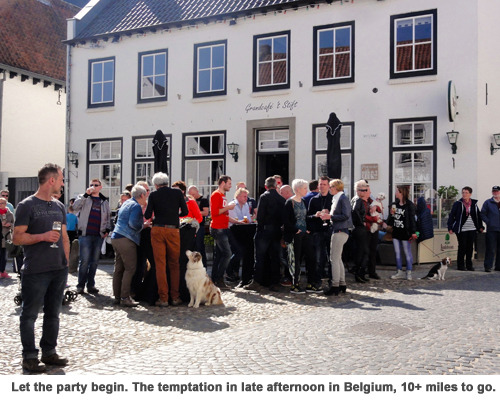
We were in Belgium, although it was not easy to know. We went through some older historic towns and the area became more populated. Cafes suddenly started to appear. I sensed that the mood of the march had changed to a celebration even though we had more than 10 miles to go. Then unexpected treats appeared from the local residents – free Belgium waffles! The best Hua and I had ever had – or at least we thought so at that moment.

At the last rest stop, we met Ad van der Loo again. He was in a great mood after his final massage and ready to make it to the finish. Hua and I stayed together throughout the walk and we decided that it would be great and fortunate to finish with Ad, on this special occasion.  For over 40 years he had to manage the event and could not actually walk it. This would be a triumphant occasion for him and us. Nothing could stop us now.

As we saw the city sign for Sittard we picked up the pace and soon we were at the Sportshall with lines of people cheering us on in a European fashion. Granted, I was tired but I had this flash like I had just finished a stage of the Tour de France!
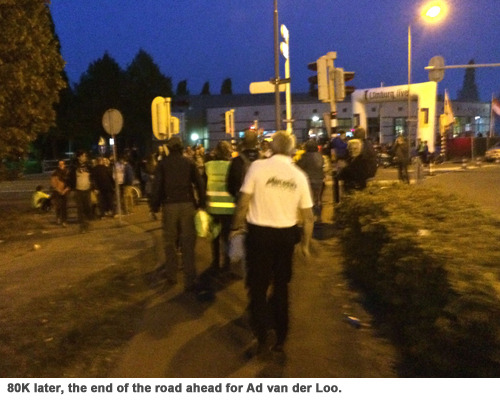
We followed the crowd into the hall and stayed with Ad as he received special awards and recognition not only for finishing but for all his work in building and maintaining the event for over 50 years.

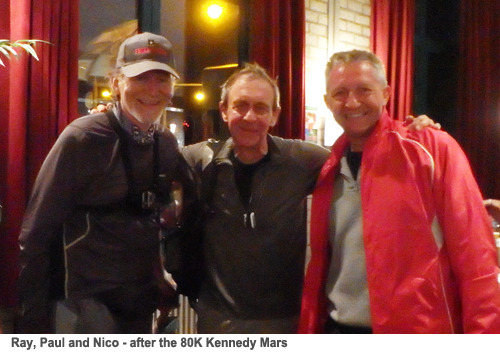
Hua and I had finished the 80K, 50-mile walk at around 9:20 p.m. Saturday evening. My feet were achy and tender. I thought I developed a blister but just avoided one. Ray had finished about an hour ahead of us and was waiting with my new friend and host, Nico Hermans. We sat for a while talking about the day over that beer I had been dreaming about in Belgium 15 miles and 5 hours ago.
What We Found

The Kennedy Legend lives on in the Netherlands! If you look back on films, recordings, writings, and witnesses to the time its easy to see that one man did make a difference. Although he didn’t invent the idea of a long walk or maybe even anticipate that it would spawn global community events, his words had meaning and continue to change our lives. It’s better to give, better to participate, better to try and better to reach out to others than to accept less than we are capable of. And, Ad van der Loo is still a living example of those principles of JFK.

We had learned that memories of Kennedy and what he stood for are still alive in Sittard. And, so it must be in other places that host similar events. It gives us incentive to continue our FreeWalkers journey to build similar events that offer others the challenge and enjoyment of a community experience that challenges our physical and mental endurance. Our hope is that our new friends in the Netherlands will join us at one of our events in the future. We “Walked the Walk” and we were glad we did.

Learn More >>

  1. FreeWalkers Photos of the Event and near Sittard
  2. FreeWalkers.org website
  3. Kennedy-Mars Sittard website (Home-Dutch)
  4. Kennedy-Mars Sittard Photo Album
  5. 50-Mile Hike Phenomenon Essay
A Butterfly on a Bike

On August 18, 2021 all rides and adventures stopped for Iohan Gueorguiev. But his legend and spirit lives on in his videos and our fond memory of him.

Listen to this story on Spotify including Iohan discussing his thoughts and goals.

While browsing the New York Times’ website in August of 2021 I came across a link to an article that immediately caught my attention. The link read, “Iohan Gueorguiev, ‘Bike Wanderer’ of the Wilderness, Dies at 33.” It was probably the combination of his odd name, his given title and the fact that he lived a short life that drove me to find out more.

In his short life, and in particular his last seven years, he rode over 60,000 miles, rode in 19 countries, climbed mountains, paddled rivers and experienced all sorts of discomfort, pain and pleasure along the way. Fortunately for us, he documented much of his accomplishments in a collection of over 70 YouTube videos which have had over 7 million views. His “See the World” YouTube channel was basically the travelogue of his adventures. Iohan was chasing a dream of biking from Canada’s Arctic Circle to the tip of Argentina. He almost made it.

Iohan’s YouTube Channel “See the World”

Iohan was not unique in the adventure sport of bikepacking. But through his videos you would find that there was no one quite like him. He consistently held a positive and humble attitude as he would bravely move forward through snow, ice, wind, rain, heat, rough terrain and the highest mountains. His videos are evidence that he saw himself not as a super hero, but as a witness to a world we never see. Through him, we could vicariously conquer the harshest conditions, see the beauty on those backroads and meet the real local people (and animals) along the way.

During his last two years, Covid restrictions and logistics got in the way. But, at the end, it was the physical condition of obstructive sleep apnea which led to insomnia and then depression causing him to give up his dream and his life. His abrupt final end seemed like the ultimate paradox to a life that always found a way to overcome all obstacles.

Riding Into the Rabbit Hole

With my own experience cycling and touring on a bike, I was especially intrigued about his crazy adventures and the effect he had on others. I began pouring over one video to the next for months until I had followed his seven- year journey . From the beginning, he chose not to be the ultra-prepared, technical sportsman but to rely on on basic knowledge, a positive attitude, his intuition, friendly spirit and his ability to improvise in a McGiver-ish way. He became the “everyman adventurer” I so admired. 

With no detailed plan he set out to experience the world, not to conquer it. Each trip over the years he would gain knowledge of bikes, tires, roads, weather, sponsors, photography, travel, native languages and native people. Starting with a basic GoPro camera and simple mountain bike in the Yukon he films the icy frontier and finishes his travelogue on a fat bike taking stunning drone videos of the high mountain desert of Patagonia and some of the highest peaks in the world. 

The videos are not about him but about what he sees. Iohan shot and edited all the video while laying down a beautiful sound-track for each of them. They are a pleasure to watch, listen to and dream about.

The popularity of his videos and comments about his death seemed outsized for what he accomplished. Many, including me, felt like we had met him, or at least understood him. His many experiences with people and animals, especially dogs, are in those videos as evidence of a kind and caring person you could not help but admire. 

The Butterfly Effect

There is a popular notion in chaos theory that some very small action can cause something great to happen called the “butterfly effect.” A story often told is that the flapping of a butterfly’s wings may eventually cause a change in the weather. I would like to think that Iohan is that butterfly for thousands of us.

His many followers vicariously lived an adventure by meeting him or experiencing his videos. I know that the hours of video I watched changed my impression of bike touring, the natural world beyond and the people we never get to meet, but wish we could – from the top of North America to bottom of South America.

I have no doubt that some of Iohan’s fans will embark on similar journeys, share friendships with others and take joy in the natural world around us because of Iohan and the work and experiences he left behind. The fluttering I hear is the sound of a bike pedal.

More sources

My Career in the News Business

My career in the news business was on a roll until I outgrew it. But there were valuable life lessons and skills learned. Where have all the paperboys gone?

This post is a story I wrote for my Storyworth project. It represents an installment of a personal compilation of stories I hope to complete this year. While the Covid pandemic has delayed long bike trips, I guess I have no excuse to stop writing.

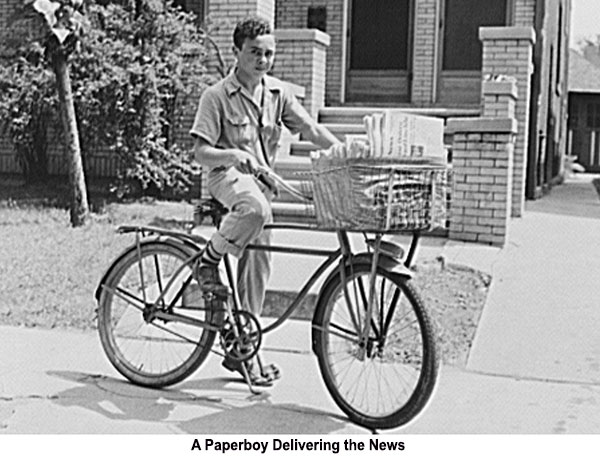
Sometime around 1960 I began my career in business. I was gladly working as a 12-year old paperboy (carrier) for the Newark Star-Ledger. This was my first job and real-life classroom on how to make money and work for a boss. My boss, the local circulation manager, was Mr. Danz, who was like a coach for a team of child laborers. Along with baby-sitting, acting and family farming, having a paper route has been one of a very few regular jobs that the Federal Government exempts from the child labor laws. 

This was the heyday of print journalism. All families relied on the newspaper as the single most informative and trustworthy source of information. Television and radio, of course, were also important. But, newspapers delivered a long, dependable and regular flow of detailed national, regional and local news that you could choose to read when you wanted. Newspaper outlets were like nodes on the information network of the day. It seemed like delivering the news on my bike was a pretty important job as well as profitable and fun. 

Getting Hired

Back then, most families would either buy the paper at a local corner store or subscribe to “home delivery”. In the 1950’s and 1960’s it seemed pre-teen and early teenage boys would deliver most newspapers including morning and afternoon papers. Newspapers advertised for “carriers” as a way to earn some money and be independent. Parents agreed and encouraged their kids to take on a paper route.

A paper route taught a young kid lessons in responsibility, accounting, customer service, sales and marketing. Best of all, most of time you were independent and on your own as long as you lived up to the responsibilities .

Learning Customer Service

Every day a bundle of 50 Star-Ledger  newspapers were dropped at the curb in front of my house in the middle of the night or very early morning, with a thud. With newspapers to deliver in the morning before school, I would get up early at 6:00 a.m., break open the bundle and start folding or rubber banding each newspaper. There was an art to a simple fold when the weather was good and the paper was of a reasonable size. There was a feel and smell to the damp news that was evident by the newsprint left on your hands.

If the weather was bad, we wrapped the paper in wax paper (the use of plastics bags came years later). For Sunday, early sections had to be assembled with the latest news that arrived early Sunday morning. Sunday papers were usually an inch or more thick so they required special attention and more delivery time. 

Developing Job Skills

The key to a successful paperboy route was preparation and developing a good toss. Because newspapers were so popular your route would usually be in your neighborhood or close by with maybe 33%-50% of the houses as your customers. It was my responsibility to get up early enough to deliver the newspaper before everyone was out the door. Come rain or come shine. No one wanted a late newspaper, one that landed too far away from the front door, or one that was wet. Failure to deliver under these standards could affect tips or worse yet – a complaint to the my boss, the circulation manager. 

The “toss” was a zen-like skill that could be honed to perfection. It required executing the principles of balance, aerodynamics, centrifugal force, wind adjustments and deadly aim. While riding and steering the bike with one hand, you would grab a single newspaper and perform a toss across your body, thus causing a backhand spin so that the paper would float to the stairs near the front door. If done properly it was a thing of beauty and a gratifying experience. 

Driving the Delivery Vehicle

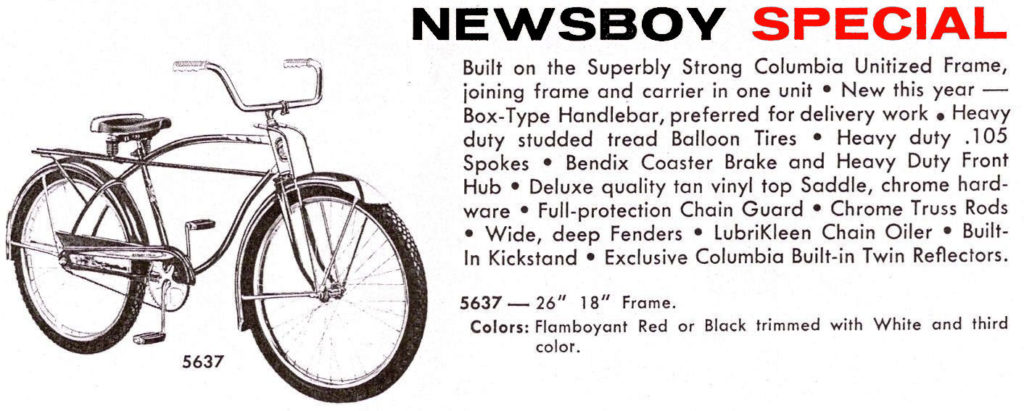
Most of the time my black Columbia cruiser bike with fenders and a big basket was all I needed. As soon as all papers were bound or folded I’d load up the bike and head out to work.

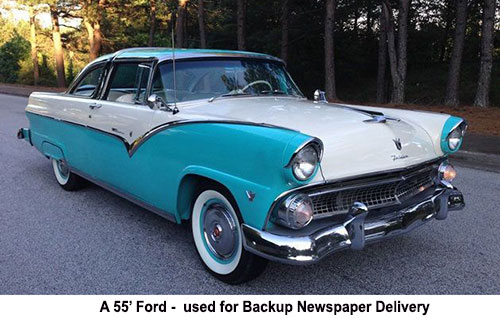
Bad or cold weather could be an obstacle and often would require my father to drive me around in the two-tone 55’ Ford before he went to work.

You had to get to know your customers and often their particular service requests, like where to deliver the paper and which customer got the paper on certain days, like weekdays or Sundays.

Collecting for the Boss

Near the end of the week was collection day. I’m pretty sure I  collected every every couple weeks or maybe monthly. But it was by personal visit to each customer. I would carry around a large ring binder with one card for each customer. I would punch a hole for the weeks paid by that customer as I collected the cash. 

On Saturday afternoon, Mr Danz would come by to pick up the payments I collected along with discussing  problem customers, any complaints that might have come to him and any new contests I could win for getting new subscribers to sign up. 

I was paid only on the number of customers I had and collected. Hey, looking back at this now, it seems like a whole lot like a junior bookie operation – working for the Star-Ledger gang. I remember Mr. Danz as being a nice guy but there was a certain amount of intimidation as a kid  answering to an adult of authority.

Getting Paid

In the newspaper delivery business, it was customary to give tips but papers were not expensive. As I remember it, we earned about $20 to $30 per week between a fee per paper delivered and tips. You would lay out your customer cards and count you money less your tips in front of Mr. Danz and officially get paid. It was enough to be proud and make a small profit after considering expenses. You also learned that no one delivering newspapers was going to make a fortune. But you did learn some business skills, a few life lessons and a way to buy a few things on your own or learn how to save money.

Witnessing the Extinction

There has been cultural changes over the years. What used to be an admirable job for young kid began to be seen as potentially dangerous. Children’s freedom became even more restricted. Perhaps, more was given to them rather than requiring them to earn it. In any case, it would be rare to see a child delivering newspapers these days. Selling cookies or popcorn is the extent of our early real-life work experiences that we permit today.

But, beyond the cultural change the Internet has been the major disrupter of paper-based news. Today most news publishing companies rely on subscription service websites and online advertising. The change in the public’s choice of media has caused print ad spending to move to online advertising and news resources given to online stories.  Meanwhile, the world of home delivery has changed too. We are consuming less print media and have less of a need for an actual newspaper to be delivered.

The Star Ledger in 1960 cost just $.10 per daily and $.25 per Sunday edition at the newsstand – and that did not change until 1980! In 1960 the typical delivery customer was paying something like $1 to $2 per week. Today, the newsstand cost is $3.00 per daily and $5.00 per Sunday with much less content. The paper is now owned by Advance Local Media LLC which promotes NJ.com as its digital partner preferring to promote a paper and virtual “home delivery” subscription of around $500 per year.

That’s a lot of money for the news to be delivered to you. If you chose to receive a physical newspaper, chances are it would be delivered by a man, or woman, throwing a paper out a car window randomly in the wee hours and whom you would never expect to meet. While there are plenty of reasons, including environmental ones, that make the old model unworkable today, there are also plenty of reasons that we should have thought more about what we lost in automating our news. 

Today’s mishmash of online neighborhoods and social networks fracture the delivery of local and regional news. We now have to find where the news is and choose only the news we want. And, our sources are no longer unbiased or represent a higher ideal of truth. Are we getting more information delivered to us or are we less informed than we were 60 years ago?

And so it goes…

My career in the news business lasted a few years but helped me build an interest in business and an entrepreneurial spirit which lasts until today. Today, it seems the only news job a young adult can participate in is creating content for YouTube. That may seem strange but it’s where the eyeballs, fun and excitement are these days. As we move beyond the printing press, let us remember those heady days when newspapers were the boss!

“Were it left to me to decide if we should have a government without newspapers, or newspapers without a government, I should not hesitate a moment to prefer the latter.”

Thomas Jefferson
Listen to this story on My Plan C Podcast.

A Review of The Road to San Donato

I recommend this book to my cycling friends and every father and son that I know. It’s a story of fathers and sons, a cycling adventure and the importance of family and community. Besides that, it’s a fun and fast read!


The Road to San Donato: Fathers, Sons, and Cycling Across ItalyThe Road to San Donato: Fathers, Sons, and Cycling Across Italy by Robert Cocuzzo
My rating: 5 of 5 stars

If life is a journey, then the best moments happen when we have the courage to take a different route. This is a story of a coming of age for three men. The author, Rob, convinces his dad, Stephen, to join him on a discovery bike trip through Italy with the goal of visiting their ancestral village, San Donato. Rob’s grandfather (“Papa”) is seriously ill and is near the end of his life. While Papa was part of a first born generation in the U.S., many of the people that settled in their Brighton neighborhood had come from the same village. Rob concocts the idea of a bike trip to understand Papa’s family background and vicariously provide a trip for Papa before it is too late.

While Rob seems to have a good relationship with dad, it’s obvious that Stephen is not your average father. He’s extremely independent, has obsessive habits and tends to love wild challenges, even at the age of 64. He also manages to commute to work on a “fixie”, which is a sure mark that he is already a badass cyclist. The image we get is of an aged-out hippie that is true to his core of beliefs who is a great father, but is not fully understood by Rob. With Papa slipping away and dad becoming a senior citizen, Rob sees the serendipity of the moment to enlist his father as his companion on a 500 mile trip from Florence to San Donato. As Rob says to Stephen, “We’ll go for Papa.”

While the experiences in the towns along the way are brief and somewhat interesting the real benefit is in overcoming the physical and mental challenges along the way. Once at San Donato, the revealing of the family history and the gracious hospitality there is an unexpected reward. Within a few days in the village, they have a change of perspective and a different appreciation for the importance of history and our ancestry. The village has a surprise story of courage and community during the days of Fascism that brings wonder and pride to both father and son.

I’ve taken a couple long distance bike rides over the past few years. Riding with others can be difficult because of the push and pull of each rider’s skills and conditioning. But, the reward is to discover more about that person, share your own personal story and to motivate each other. There can be no better pairing than father and son to benefit from this opportunity. Any son or father naturally looks back at the mystery of each other and desires at some point to know and understand more – even though that always has its limits. Each fact we discover inevitably reveals something about ourselves too.

The author has a casual style of writing which exposes a mixture of personal feelings and humor which makes for an easy and enjoyable read. The pace of the book and its subject matter is fast and complete as it goes from the start of the idea of the trip to its final conclusion and slightly beyond leaving a very satisfying ending.

View all my reviews

How the sausage is made…part 3

For all those who sweat over the details… Here’s how this bike tour was done. Each time I learn a little more.

This post will answer some questions on how I ride these bike tours. It is a fresh update to my previous posts for my Epic Bike Tour. That tour I rode my bike from Key West to Morristown (home). Here, I’ll discuss the differences in this recent New England tour I called the Reunion Tour from Burlington VT to Morristown NJ, 18 months later.

In last year’s posts of “How the Sausage is made”… #1, #2 – I discussed the following relating to my east coast bike tour:

  • my bike setup
  • how I navigate
  • where I spend money
  • how I eat. 

I applied what learned in April 2018 to this trip and avoided some of the pitfalls. Here’s some of the differences and what I discovered along the way.

The Bike

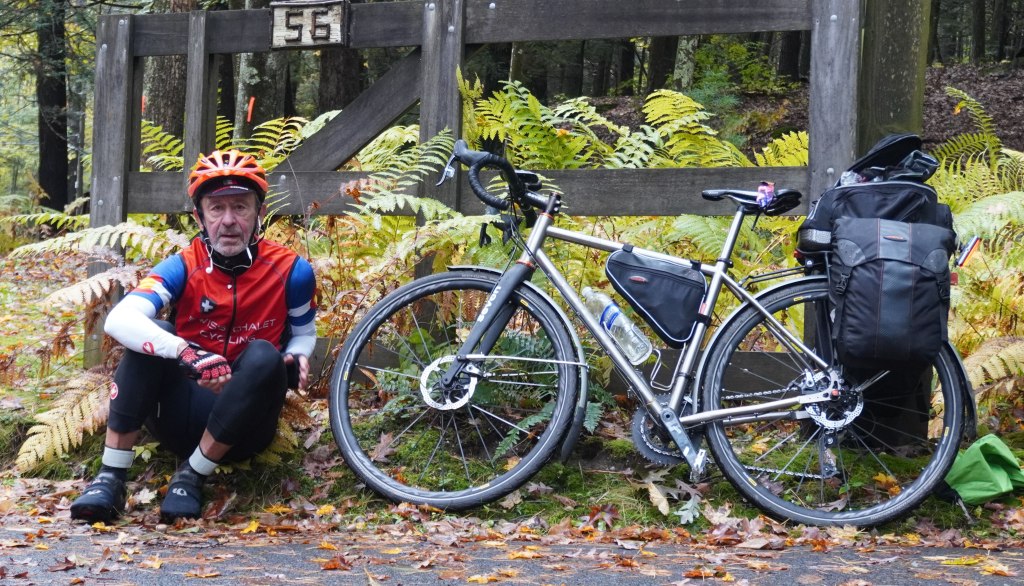
My bike (named “Silver”) is a custom-built model called an Expat S, titanium gravel/touring bike by Seven Cycles. It is an 11-speed using Sram Force 22 components with gearing of 50/34 front and a 28/14 rear. For more tech details click here. It weighed in at 22 lbs with Portland Design Works aluminum fenders, and Iberia rear rack system and bags. I used 2 panniers, commuter bag and top tube bag. All total about 40 extra pounds to carry in bags. I decided early-on that I would not camp this trip so I did not take as much gear as I did on the Epic Tour. 

All other components were the same from last year except I replaced the cassette and chain and switched to a tubeless tire setup. The Seven had come with the lastest Mavic UST tubeless rims. After testing tubeless road tires and reading reviews, I decided to take a risk and go the with Schawalbe Marathon Supreme 700 X 35c tubeless tires for a smoother, safer and more reliable ride. They worked perfectly this time inflated to about 60 psi.

I realized on this trip the importance of disk brakes for this kind of riding. With the extra weight going down monster hills, the bike was easy to control, even in wet weather.

Comparing Tours (East Coast vs. New England)

The goal of this trip was to ride about 525 miles through the mountains of New England within a two-week timeframe while visiting a few friends along the way. That’s much less mileage than the 1,600 flat miles for the U.S. east coast tour in 2018.

As I did in the Epic Tour, I wanted to do this by transporting my bike to the farthest point of the route and then find an interesting way back home by bike. Amtrak provided a convenient way to port the bike to Burlington without breaking it down.

I still averaged the same amount of mileage each day (roughly 65 miles each day) but each day presented a climbing challenge (averaging over 3,000 feet of climbing per day).  The trip was tougher on a day-to-day basis but at least as enjoyable, due to beautiful fall scenery and visits with friends.

I’ve learned quickly that whether you are a person who likes routines or not, it is essential to bike touring. Doing otherwise causes wasted time, confusion and lost items behind. Here’s some of my standard routines:

My Daily Start Up Routine

  • Wake up – between 5:00 and 6:00 a.m. depending on what day’s challenge is ahead. Normal bathroom routine. Includes applying lotions (sunscreen (at times), chamois creme, glide, etc.), take routine vitamin supplements.
  • Suit up – with usually base layer top, jersey, shorts, leg warmers, socks, gloves, arm warmers, helmet and wind vest. For this NE trip, at times I needed to wear a light winter jacket, shoe covers and long finger gloves for the cold days in early October. One morning started at 29 degrees! I also wore a chest heart rate monitor to monitor physical effort for the day. I purposely wear colors that stand out to be seen for safety for this type of riding.
  • Routine bike check – tires, screws tightened, rear light on and bike computer. I’ll use a front flashing light and extra rear lights if visibility is poor.
  • Check top bar bag – make sure I have flat kit, air inflators, anti-theft lock and chain.
  • Pack 3 Bags
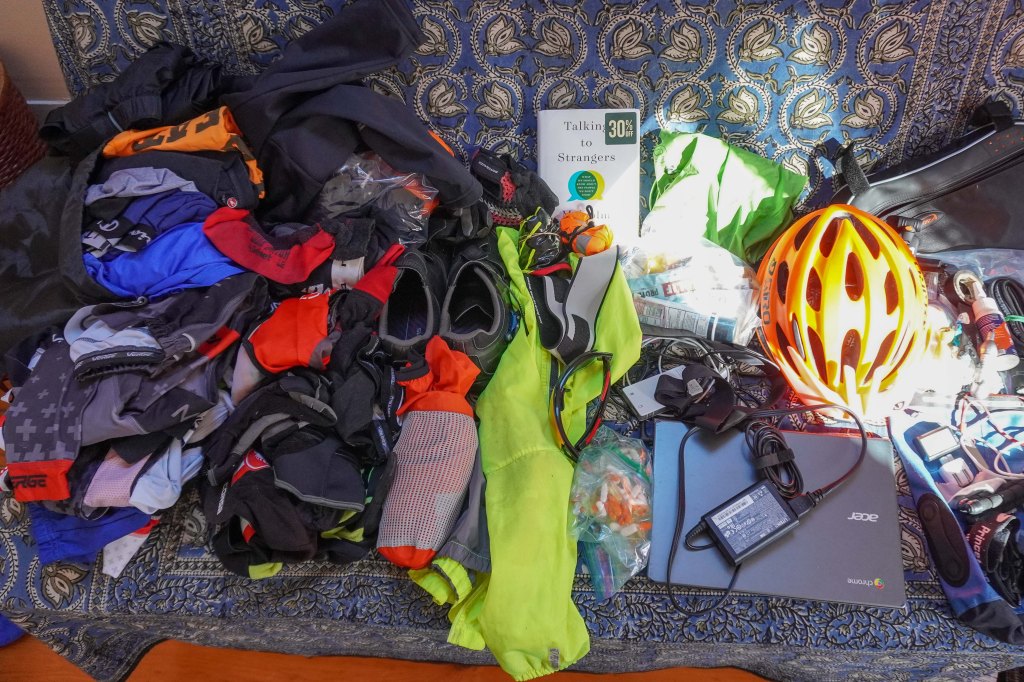
    Pannier #1 – Casual clothes – 2 t-shirts, underwear, button-down shirt, running shorts, jeans, socks, sandals, light fleece. Toiletries. Portable computer. (total less than 15 lbs.)
    Pannier #2 – Cycling clothes – 2 jerseys, 2 shorts, 2 socks, extra gloves, arm warmers, leg warmers, cap, warm riding jacket (doubles as casual jacket), shoe covers. Rain gear – pants, water-resistant jacket, helmet cover, water repellent shoe covers. (less than 15 lbs.)
    Commuter Bag – hard shell bottom with compartments that locks on top of the rear bike rack. Great for everything else and to take into town to carry food back to where I’m staying.
    Includes everything I might need along the way. Energy food, camera and equipment, misc. electronics (chargers, cables, etc.), papers, bungie cords, wallet/money/ID.
  • Install bags on bike – panniers on the sides and commuter bag on top.

My Eating Routine

Huge breakfast was a treat in Woodstock VT.
  • Pre-Ride – eat something light like cereal, bagel, donut and coffee. Coffee is my most important item at this point. If nothing available at start I would search out a place to get something.
  • Breakfast – optional depending on what I’ve eaten earlier or the length of the ride. I have dabbled in bigger breakfasts and then skip lunch.
  • Lunch – optional. If it looks like a long hard day, I’ll go for a lunch. A Foot-long Subway Veggie Delight is my preference.
  • Late Afternoon Snack – I like to stop for Gatorade and some chips or pretzels or nuts. Something salty.
  • Dinner -For this trip, I either ate with friends or went out to a local inexpensive place that looked interesting based on suggestions from my hosts, people I met or something suggested on Google. Because of the area’s reputation for fine craft beers, I made a point of sampling some fine beers along the way.

General Schedule

  • Wake up 5:30 a.m.
  • Breakfast 9:00 a.m.
  • Lunch 11:30 a.m.
  • Snack stop 1:00 p.m.
  • Arrive at lodging 2:00 p.m.
  • Shower / change 3:00 p.m.
  • Ride or walk the area 4:00 p.m.
  • Dinner 6:00 p.m.
  • Blog / email / phone calls 8:00 p.m.
  • Lights out 10:00 p.m.

Lodging

I’ve learned to make the most of Airbnb.com locations for great places to stay at reasonable prices. You can also usually book within a short time frame if you are traveling off-season. For this trip, I used a combination of staying 5 nights with friends and 7 nights at airbnb’s.

One of my main concerns was the weather forecast. While I was prepared to ride in the rain, I was able to plan to avoid a full day of rain near the end of the trip. Sitting out a day of rain means that your schedule would need to be reset for an extra day and can throw off all your plans and reservations. That’s why except for the first week, I delayed reserving the mid-part of the trip until a few days before that day so I could be relatively sure I would be riding that day. I have also found that with a day of riding and being alone, I enjoyed the company of others and the opportunity to learn more about the area from the airbnb hosts.

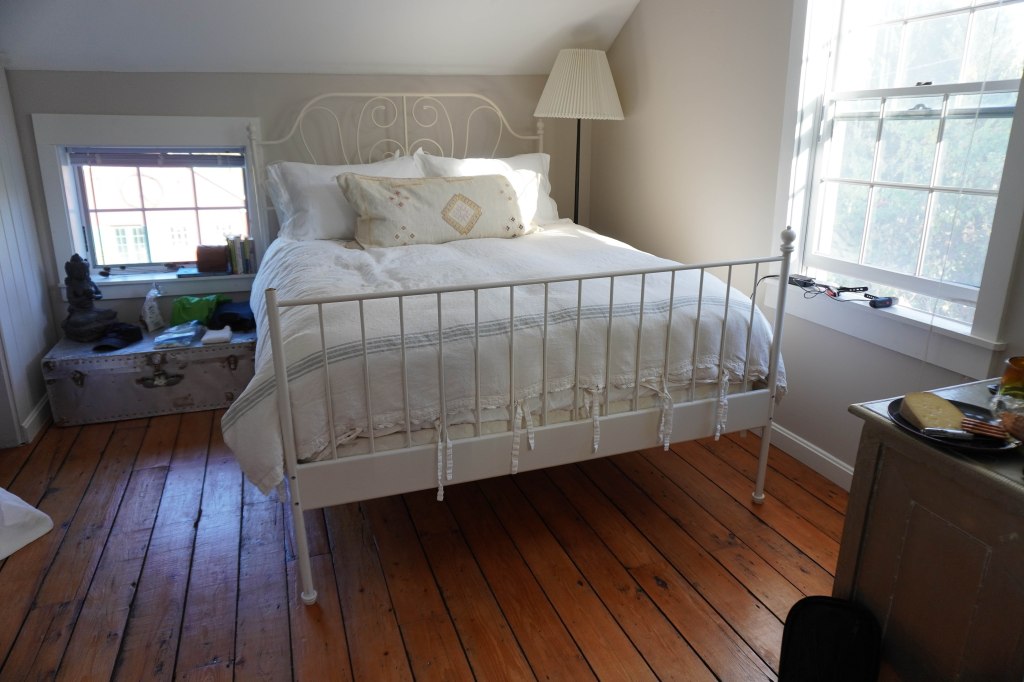
One of the nicest airbnb’s was in Bennington VT in the main house on a tree farm.

Here’s the rundown on my stays. The locations are first based on finding an area near my route and about 50 to 70 miles from my previous stay, The most important factors are 1) how close is the place to my route 2) How expensive – with all other fees included 3) What ratings the host had from previous guests. Here’s where I stayed and the total cost of the stay (1-person):

  • Sep 28 – Burlington, VT = $81.77
  • Sep 29 – Burlington, VT = $81.77
  • Sep 30 – Mike Kennedy’s – Barnet, VT
  • Oct 1 – Mike Kennedy’s – Barnet, VT
  • Oct 2 – Mike Kennedy’s – Barnet, VT
  • Oct 3 – Hanover, NH = $73.84
  • Oct 4 – West Rutland, VT = $60.95
  • Oct 5 – Bennington, VT – $67.48
  • Oct 6 – Lee, MA = $60.53
  • Oct 7 – Lee, MA = $45.00
  • Oct 8 – Mike Hayser – Sherman, CT
  • Oct 9 – Tom Siccardi – Chester, NY
  • TOTAL = 12 nights, 7 @ airbnb lodging = $471.34

Riding the Roads

Riding on the Ashuwillticook Rail Trail in Adams MA

Probably the most asked about question is what roads I took. As I have mentioned, I tend to use Google Maps / Bicycle routes from one place to another. But Google provides no information on what the roads will be like. Here in Vermont and other places along the way, I was often taken off state roads and guided toward well-meaning country roads. I can only guess that there is some algorithm that decides what might be best for an average cyclist to see and experience. My priorities were 1) to get to the next location as efficiently and safe as possible 2) to see some of the local areas I was traveling through. Google and I were not always on the same wavelength.

My first day on the bike from Burlington, the western part of the state to the eastern part in Barnet, was the hardest day (see more here on that here). With a variety of roads from nicely paved highways with adequate shoulders to busy highways with rumble strips and speeding cars and trucks. This type of trip is not for anyone that panics in traffic. Or, sometimes dirt and gravel roads led to trails more for suited mountain bike. Luckily, the bike and tires were strong enough to take a beating and still roll well on paved roads.

There were rail trails and pure dirt double-track trails in the woods where I would see no one for hours. Many times I was not sure where the road was taking me. I guess that’s part of the excitement of the journey. Eventually, you have to come out somewhere where you can re-calibrate.

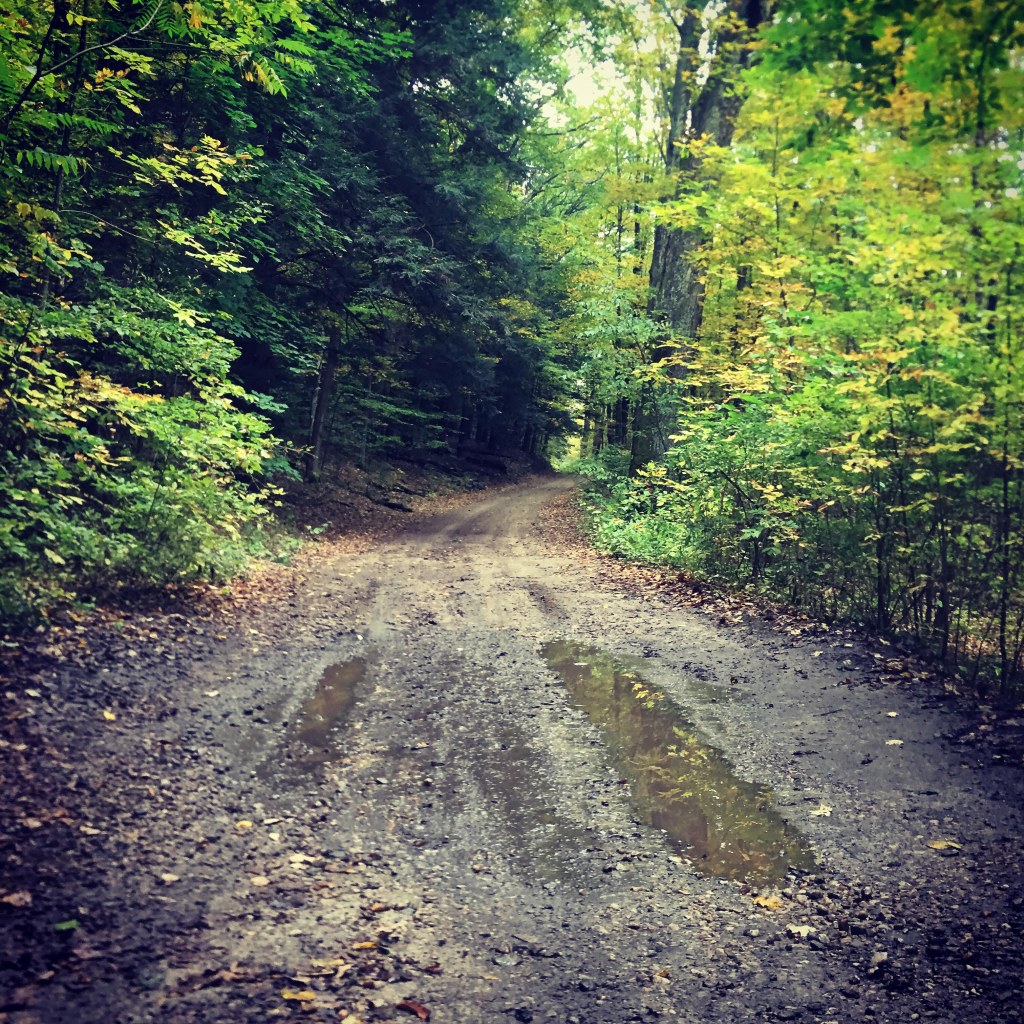
One of the rougher roads to roll through. Nice change of scenery but slowed me down. Thanks Google!

For this journey, I relied on Google maps with earphones to tell me when to turn. I normally never ride with earphones. My son Ethan’s friend did provide a route that I did use to get from Burlington to Barnet which did help for that segment. I did not search out other posted cycling maps since I could not know what maps might be best for my objectives. Researching this, especially if I had to change plans along the way would be inefficient.

Electrical power to keep my cell phone and bike computer going was critical. I relied on two back-up sources and every day had to go to back up power shortly after lunchtime. One backup source was a solar cell on the rear of my bike. On that first long day of riding I ran completely out of all power, in the dark, but I was right in front of my friend’s house. Whew! That was close.

There were only three places where I had to actually walk my bike up the hill either because of the steep elevation and/or conditions of the road or the fatigue I was experiencing. While I was avoiding the steepest areas, I think my body adjusted to carrying the extra weight and pacing myself with the hills. It was a personally satisfying achievement and proved that I was capable of doing more than I thought.