My recent visit to Students 2 Science’s Apollo Technology Center offers hands-on STEM experiences, aiming to inspire underserved New Jersey students. By fostering curiosity and ambition, S2S cultivates future innovators, relying on corporate and individual support for its mission.
I recently had the opportunity to visit a new kind of technology center designed not just to educate, but to inspire students in STEM (Science, Technology, Engineering, and Math) through hands-on experiences. Students 2 Science’s Apollo Technology Center is an ambitious new facility devoted to giving every New Jersey student, especially those from underserved communities, access to real-world science.
Students 2 Science Welcome
As a self-identified techie (at least I used to be), I’ve always been drawn to science, even if math was never my strongest subject. What has always fascinated me is how science and technology can amaze us and improve our lives. That’s probably why my career centered on using technology to solve problems and make things work better.
Today, science faces growing skepticism and misinformation. Healthy questioning is one thing, but the outright rejection of evidence and expertise has become troubling and discouraging for young people who might otherwise pursue careers in the sciences.
My son-in-law, John Dempsey, a trustee of Students 2 Science (S2S), had long spoken highly of the organization and invited me to the opening of their brand-new Apollo Technology Center. I knew little about how science is taught today or what truly motivates students but I was eager to find out.
What I discovered was an impressive nonprofit that has spent years building a professional team of educators, corporate partners, and volunteers dedicated to one mission: making STEM education accessible to all. S2S has already reached nearly 250,000 students across Newark and 25 other New Jersey school districts. The Apollo Center in Whippany, a newly renovated, 20,000-square-foot facility in a once-vacant office building, represents the culmination of those efforts. I wanted to see firsthand how science itself could be re-imagined to inspire the next generation.
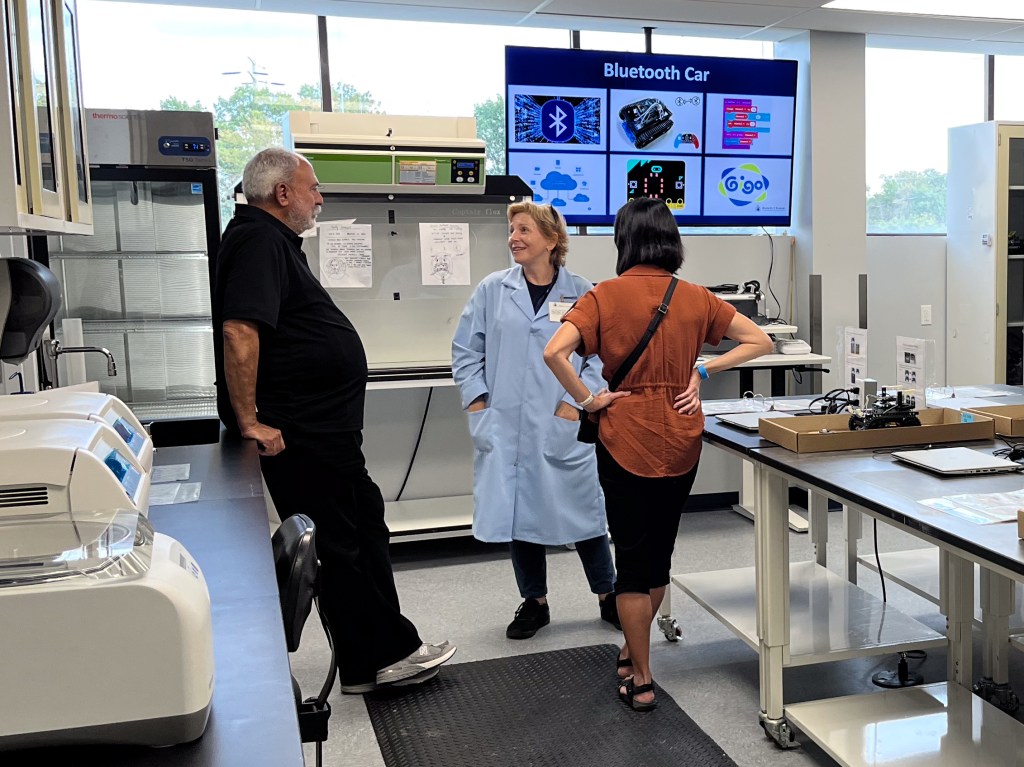
During the Open House, visitors could tour the labs and classrooms of this unique facility. I watched demonstrations in ecology, electronics, communications, biology, and medical science. The equipment was modern and professional-grade; the instructors and staff were enthusiastic and eager to share their work.
Two labs especially stood out. The Virtual Lab featured a microscope linked to a digital display, allowing instructors to project real-time images, like a magnified view of bees, to large monitors and even broadcast them live to classrooms across the state via Zoom. Few school districts could replicate this kind of technology and expertise on their own, but through S2S, they can all share in it.
Virtual Lab
The Medical Diagnostics Lab was equally impressive. Designed for high school students, it simulates real-world medical problem-solving. Teams of students are presented with a (hypothetical) patient in crisis and use vital signs and blood test results from actual diagnostic equipment to identify the condition and propose treatment. It’s the kind of immersive, problem-based learning that makes science come alive.
Medical Diagnostic Lab
Experiencing the energy of these labs and meeting the scientists, educators, and volunteers behind them convinced me that Students 2 Science offers something truly special. Programs like this not only teach skills, they spark curiosity, confidence, and ambition. With the growing demand for professionals in science and technology, we need more initiatives like this to cultivate future innovators.
Students 2 Scienceis a nonprofit organization that relies on the generosity of its corporate partners, volunteers, and donors. Companies can contribute equipment, expertise, and mentorship, while individuals can volunteer their time or make donations to support the mission.
If this new “branch” of STEM education is any indication, the future of science in New Jersey and beyond is looking bright and growing.
My career in the news business was on a roll until I outgrew it. But there were valuable life lessons and skills learned. Where have all the paperboys gone?
This post is a story I wrote for my Storyworth project. It represents an installment of a personal compilation of stories I hope to complete this year. While the Covid pandemic has delayed long bike trips, I guess I have no excuse to stop writing.
Sometime around 1960 I began my career in business. I was gladly working as a 12-year old paperboy (carrier) for the Newark Star-Ledger. This was my first job and real-life classroom on how to make money and work for a boss. My boss, the local circulation manager, was Mr. Danz, who was like a coach for a team of child laborers. Along with baby-sitting, acting and family farming, having a paper route has been one of a very few regular jobs that the Federal Government exempts from the child labor laws.
This was the heyday of print journalism. All families relied on the newspaper as the single most informative and trustworthy source of information. Television and radio, of course, were also important. But, newspapers delivered a long, dependable and regular flow of detailed national, regional and local news that you could choose to read when you wanted. Newspaper outlets were like nodes on the information network of the day. It seemed like delivering the news on my bike was a pretty important job as well as profitable and fun.
Getting Hired
Back then, most families would either buy the paper at a local corner store or subscribe to “home delivery”. In the 1950’s and 1960’s it seemed pre-teen and early teenage boys would deliver most newspapers including morning and afternoon papers. Newspapers advertised for “carriers” as a way to earn some money and be independent. Parents agreed and encouraged their kids to take on a paper route.
A paper route taught a young kid lessons in responsibility, accounting, customer service, sales and marketing. Best of all, most of time you were independent and on your own as long as you lived up to the responsibilities .
Learning Customer Service
Every day a bundle of 50 Star-Ledger newspapers were dropped at the curb in front of my house in the middle of the night or very early morning, with a thud. With newspapers to deliver in the morning before school, I would get up early at 6:00 a.m., break open the bundle and start folding or rubber banding each newspaper. There was an art to a simple fold when the weather was good and the paper was of a reasonable size. There was a feel and smell to the damp news that was evident by the newsprint left on your hands.
If the weather was bad, we wrapped the paper in wax paper (the use of plastics bags came years later). For Sunday, early sections had to be assembled with the latest news that arrived early Sunday morning. Sunday papers were usually an inch or more thick so they required special attention and more delivery time.
Developing Job Skills
The key to a successful paperboy route was preparation and developing a good toss. Because newspapers were so popular your route would usually be in your neighborhood or close by with maybe 33%-50% of the houses as your customers. It was my responsibility to get up early enough to deliver the newspaper before everyone was out the door. Come rain or come shine. No one wanted a late newspaper, one that landed too far away from the front door, or one that was wet. Failure to deliver under these standards could affect tips or worse yet – a complaint to the my boss, the circulation manager.
The “toss” was a zen-like skill that could be honed to perfection. It required executing the principles of balance, aerodynamics, centrifugal force, wind adjustments and deadly aim. While riding and steering the bike with one hand, you would grab a single newspaper and perform a toss across your body, thus causing a backhand spin so that the paper would float to the stairs near the front door. If done properly it was a thing of beauty and a gratifying experience.
Driving the Delivery Vehicle
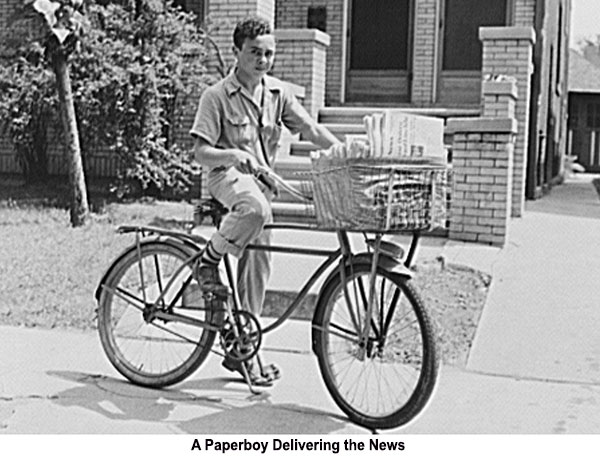
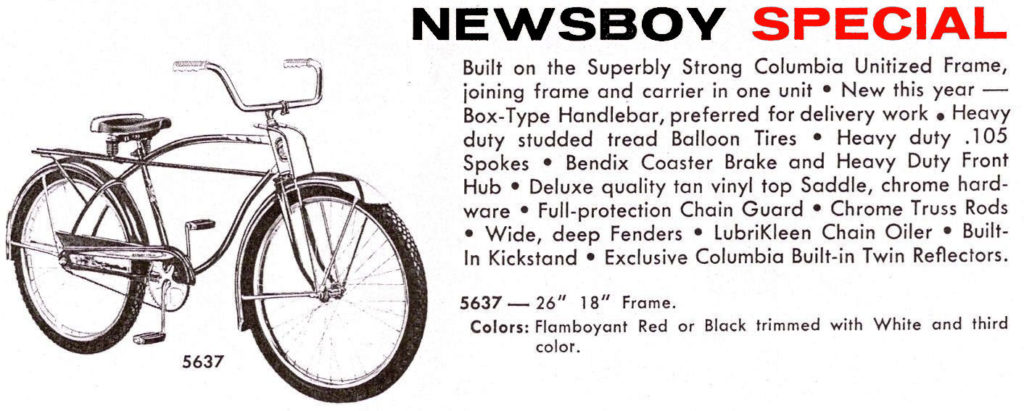
Most of the time my black Columbia cruiser bike with fenders and a big basket was all I needed. As soon as all papers were bound or folded I’d load up the bike and head out to work.
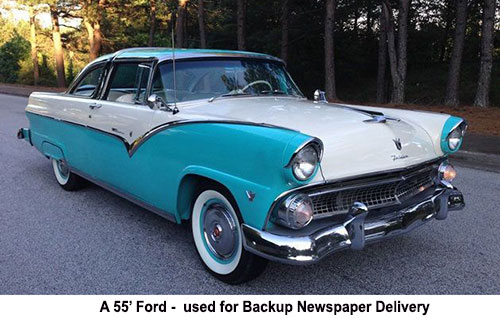
Bad or cold weather could be an obstacle and often would require my father to drive me around in the two-tone 55’ Ford before he went to work.
You had to get to know your customers and often their particular service requests, like where to deliver the paper and which customer got the paper on certain days, like weekdays or Sundays.
Collecting for the Boss
Near the end of the week was collection day. I’m pretty sure I collected every every couple weeks or maybe monthly. But it was by personal visit to each customer. I would carry around a large ring binder with one card for each customer. I would punch a hole for the weeks paid by that customer as I collected the cash.
On Saturday afternoon, Mr Danz would come by to pick up the payments I collected along with discussing problem customers, any complaints that might have come to him and any new contests I could win for getting new subscribers to sign up.
I was paid only on the number of customers I had and collected. Hey, looking back at this now, it seems like a whole lot like a junior bookie operation – working for the Star-Ledger gang. I remember Mr. Danz as being a nice guy but there was a certain amount of intimidation as a kid answering to an adult of authority.
Getting Paid
In the newspaper delivery business, it was customary to give tips but papers were not expensive. As I remember it, we earned about $20 to $30 per week between a fee per paper delivered and tips. You would lay out your customer cards and count you money less your tips in front of Mr. Danz and officially get paid. It was enough to be proud and make a small profit after considering expenses. You also learned that no one delivering newspapers was going to make a fortune. But you did learn some business skills, a few life lessons and a way to buy a few things on your own or learn how to save money.
Witnessing the Extinction
There has been cultural changes over the years. What used to be an admirable job for young kid began to be seen as potentially dangerous. Children’s freedom became even more restricted. Perhaps, more was given to them rather than requiring them to earn it. In any case, it would be rare to see a child delivering newspapers these days. Selling cookies or popcorn is the extent of our early real-life work experiences that we permit today.
But, beyond the cultural change the Internet has been the major disrupter of paper-based news. Today most news publishing companies rely on subscription service websites and online advertising. The change in the public’s choice of media has caused print ad spending to move to online advertising and news resources given to online stories. Meanwhile, the world of home delivery has changed too. We are consuming less print media and have less of a need for an actual newspaper to be delivered.
The Star Ledger in 1960 cost just $.10 per daily and $.25 per Sunday edition at the newsstand – and that did not change until 1980! In 1960 the typical delivery customer was paying something like $1 to $2 per week. Today, the newsstand cost is $3.00 per daily and $5.00 per Sunday with much less content. The paper is now owned by Advance Local Media LLC which promotes NJ.com as its digital partner preferring to promote a paper and virtual “home delivery” subscription of around $500 per year.
That’s a lot of money for the news to be delivered to you. If you chose to receive a physical newspaper, chances are it would be delivered by a man, or woman, throwing a paper out a car window randomly in the wee hours and whom you would never expect to meet. While there are plenty of reasons, including environmental ones, that make the old model unworkable today, there are also plenty of reasons that we should have thought more about what we lost in automating our news.
Today’s mishmash of online neighborhoods and social networks fracture the delivery of local and regional news. We now have to find where the news is and choose only the news we want. And, our sources are no longer unbiased or represent a higher ideal of truth. Are we getting more information delivered to us or are we less informed than we were 60 years ago?
And so it goes…
My career in the news business lasted a few years but helped me build an interest in business and an entrepreneurial spirit which lasts until today. Today, it seems the only news job a young adult can participate in is creating content for YouTube. That may seem strange but it’s where the eyeballs, fun and excitement are these days. As we move beyond the printing press, let us remember those heady days when newspapers were the boss!
“Were it left to me to decide if we should have a government without newspapers, or newspapers without a government, I should not hesitate a moment to prefer the latter.”






 My Plan C